
[B’ Spokes: The first step in solving a problem is recognizing there is a problem and I have seen far too many unconcerned parents about their children’s weight.]
*****************************************************************************
ATLANTA, Sept. 5, 2012 /PRNewswire/ — A behavioral insights research study commissioned by Children’s Healthcare of Atlanta suggests that while the majority of Georgia parents recognized the severity of the childhood obesity epidemic in the state, parents of overweight and obese children still don’t believe the issue affects their family. With Georgia having the second highest childhood obesity rate in the country, Children’s has kicked off the latest initiative of its Strong4Life movement called "The Talk" to jump-start a personalization of the issue for these parents.
With childhood obesity reaching epidemic rates in the country, it’s not surprising that parents now fear The Talk about weight and body issues with their kids more than the talks about sex and drugs.
…
The behavioral insights research study completed in February 2012 included surveys with 1,043 families with children 0 – 11 years old, representing a true cross-section of Georgia, including children classified as normal weight, overweight and obese (according to the CDC’s BMI classifications). From those families, 42 percent of families were identified with overweight or obese kids. Of those 42 percent of families’ surveyed with overweight or obese children, 76 percent misclassified their children as either underweight or normal weight.
…
https://www.prnewswire.com/news-releases/parents-remain-in-denial-about-childhood-obesity-epidemic-168525386.html
via CenterLines, the e-newsletter of the National Center for Bicycling & Walking.
Three-quarters of driving instructors think cycle awareness should be part of driving test
[B’ Spokes: It is my assertion that cycling proficiency should be part of drivers’ ed as it is the parents not schools that teach kids how to cycle and it’s too easy for parents to undo what schools teach (if schools here teach anything of significance about cycling… e.g. walk bike in crosswalks… like that’s going to be a life long lesson with significant impact on safety over time.)]
******************************************************************************
by Sarah Barth, road.cc
More than 75 per cent of driving instructors believe that a cycle awareness module should be part of the driving test in Britain.
…
On the flipside, even more instructors – 88 per cent – thought that cyclists should have some sort of training.
"The Government should reintroduce cycling proficiency in schools or at least facilitate partnerships between schools and The National Standards for Cycle Training, which was established as a unified cycle training program to promote road safety," said Ian McIntosh, CEO of RED.
…
https://road.cc/content/news/66588-three-quarters-driving-instructors-think-cycle-awareness-should-be-part-driving
WEAR & TEAR
[B’ Spokes: If you do decide to toss your bike please consider giving it to Velocipede Bike Project ]
I bike pretty much everyday. And biking is great. Until it’s not. Then I have to come to terms with reality.
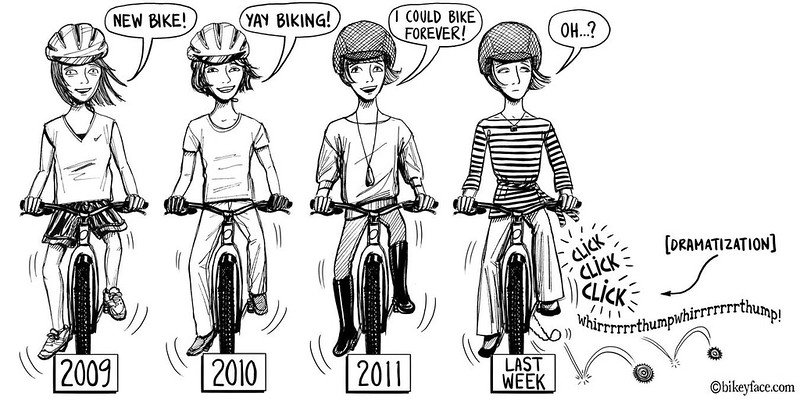
Yes, I biked so much I basically wore out my bike.
While I’m flattered to be stronger than metal (apparently,) repairs are always easy to put off. Biking is free, right? Nope. Because if it’s free, you’re doing it wrong.
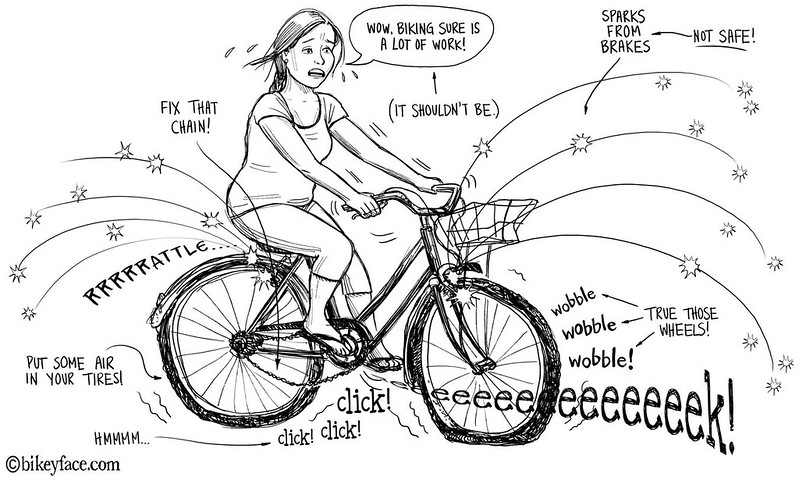
And risking your safety! So plan to put some money into your bike if you rely on it. For under $100 you could get the basics covered: lube, chain,wheels, lights, brakes. Still cheaper than a car or subway.
But if that’s too much cash you could always fix things this way:
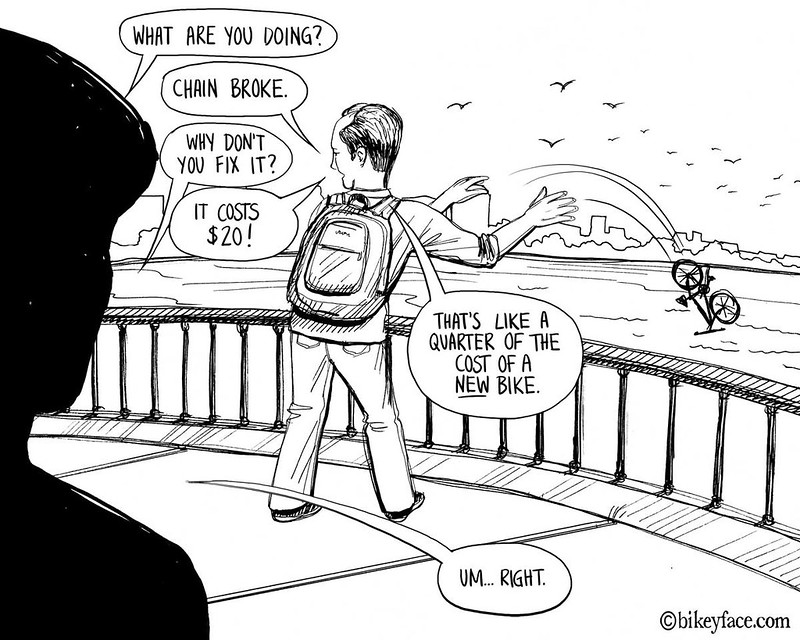
No, seriously, go to your local bike shop and get things squared away! It’s worth it.
Chicago unveils 1st pedestrian safety plan
[B’ Spokes: It would be interesting if our new bike/ped master plan (due 2014) included items like this:]
*********************************************************************
By Bridget Doyle, Chicago Tribune reporter
…
The hundreds of recommendations include better-marked crosswalks, the establishment of pedestrian islands in the middle of multilane streets, better signals and beacons, and pedestrian countdown timers at crossings. Other long-term improvements discussed in the plan include staggered midblock bump-outs on residential streets to slow traffic.
Continental-style crosswalks were among the first changes, CDOT Commissioner Gabe Klein said, largely because the department began to weave in the new pedestrian plan in time for already-scheduled construction projects.
The crosswalks have big rungs across the walkway for higher visibility and are made of a reflective material, Klein said. More than 100 such crosswalks were installed in 2012, Klein said.
Pavement markings — on crosswalks and stop lines for vehicles — are faded across Chicago, and Klein said millions would be spent this year repainting such markings so they are visible to drivers, pedestrians and bicyclists.
"Our goal is to bake these new standards into everything that’s being done in public right of way," he said.
The plan also establishes what the agency’s announced "Zero in Ten" goal: reducing pedestrian fatalities in Chicago to zero in the next 10 years.<br>
…
Continue reading “Chicago unveils 1st pedestrian safety plan”
Heads up Baltimore cyclists, red light tickets
A cyclist just got a ticket for running a red light in Baltimore. Thought you should know.
Simple understanding

Two Chances to Reform Contributory Negligence Doctrine in Maryland
by Jim Titus, The Washcycle
…
Observers have been expecting the Court to revisit this question for the last few years, because the Court requested a special report to evaluate the two doctrines. That report, completed last year, did not make specific recommendations; but it provided alot of context that will help the Court regardless of its decision. During the 20th century, 46 states adopted comparative fault, 34 by statute and 12 by court decision, with Alabama, North Carolina, Virginia, DC, and Maryland being the only holdouts.
As we have discussed on this blog many times, the doctrine of contributory negligence has alot of good points, but it is totally unfair to cyclists.
…
Torrey C. Brown (NCR) Trail Overnight Parking Policy
Recently, DNR was contacted by a bicyclist who was riding the Torrey C.
Brown Trail (North Central
Trail) from its beginning in
Maryland to its terminus in
York , PA, where he and his
friends were staying overnight. He inquired where he could leave his
vehicle overnight when state park
policy prohibited overnight parking at the
DNR trailhead lots. Ranger Sarah Witcher, DNR’s trail
manager out of
Gunpowder State
Park , quickly notified the cyclist about the process
for trail users wanting to leave a vehicle overnight.
Brown Trail (North Central
Trail) from its beginning in
Maryland to its terminus in
York , PA, where he and his
friends were staying overnight. He inquired where he could leave his
vehicle overnight when state park
policy prohibited overnight parking at the
DNR trailhead lots. Ranger Sarah Witcher, DNR’s trail
manager out of
Gunpowder State
Park , quickly notified the cyclist about the process
for trail users wanting to leave a vehicle overnight.
1. Contact Ranger Sarah Witcher
Area
Manager
Manager
Gunpowder
Falls State
Park
PO Box
480
Kingsville ,
MD
21087
2. Provide Ranger Witcher with the following
information:
information:
A. Dates and times you plan to be parked in
the DNR trailhead parking
lot
the DNR trailhead parking
lot
B. The
specific parking lot you intend to
use
C. The number of participants
and the general plan for your trip
and the general plan for your trip
D. Your vehicle tag numbers
and/or descriptions for those who plan to park overnight
and/or descriptions for those who plan to park overnight
3. Once you have provided Ranger Witcher
with your vehicle description and general itinerary, she will issue a
document called a “use agreement” which will require your
signature.
with your vehicle description and general itinerary, she will issue a
document called a “use agreement” which will require your
signature.
4. Display the use agreement or some other easy
identifier in your windshield on the night you leave your vehicle.
identifier in your windshield on the night you leave your vehicle.
5. Ranger Witcher will let her staff and the
Natural Resources Police know, so they will not issue citations and can be aware
of your presence, for your safety and that of the other park
patrons.
Natural Resources Police know, so they will not issue citations and can be aware
of your presence, for your safety and that of the other park
patrons.
6. Ranger Witcher would generally like at least two
weeks notice.
weeks notice.
Cheers!
STEVE
CARR
CARR
Land Trails Planner
Land Acquisition & Planning
Maryland Department of Natural Resources
580 Taylor Avenue, E-4
Annapolis ,
MD
21401
MD
21401
Robert T. Brown, Veterans Administration executive R.I.P.
By Jacques Kelly, The Baltimore Sun
Robert T. Brown, a retired Veterans Administration executive, died Aug. 25 at the Edenwald Retirement Community in Towson after suffering a fall earlier in the summer. He was 96.
…
Mr. Brown and his wife were members of the Baltimore Bicycling Club and the Monocacy Canoe Club and other nature and wildlife organizations. They belonged to the National Organization for Women and the League of Women Voters. The couple enjoyed riding their tandem bicycle on the Northern Central Trail in northern Baltimore County.
…
Funding for Trails in Maryland
[B’ Spokes: I ran across this while researching the previous article and it’s cool enough to share.]
The Recreational Trails Program (RTP)
The Recreational Trails Program (RTP) provides funds to the States to develop
and maintain recreational trails and trail-related facilities for both
non-motorized and motorized recreational trail uses. The RTP is an assistance
program of the Department of Transportation’s Federal Highway Administration (FHWA).
Federal transportation funds benefit recreation including hiking, bicycling,
in-line skating, equestrian use, cross-country skiing, snowmobiling, off-road
motorcycling, all-terrain vehicle riding, four-wheel driving, or using other
off-road motorized vehicles.
Maryland received $1,158,618 in RTP funds in 2010, and $5,622,664 over the
course of the last five years.
In the fall of 2010, Governor Martin O’Malley announced the results
of the first-ever comprehensive Maryland State Parks Economic Impact and
Visitors Study at a meeting with stakeholders at New Germany State Park.
According to the study, Maryland State Parks have an estimated annual economic
benefit to local economies and the State of more than $650 million annually.[Emphasis mine]
- Each year, a network of 66 Maryland State Parks welcomes nearly 10
million day visitors and 1 million visitors who stay overnight in
campgrounds and cabins. - Maryland State Park visitors directly spend more than $567 million
during their trips to State Parks, producing a total economic impact of more
than $650 million annually. - State park visitor spending supported more than 10,000 full-time jobs
and generated more than $39 million in state and local retail, gasoline,
hotel, and income taxes. - 70 percent of spending and employment impacts are concentrated within 20
minutes of State Parks in local, “gateway communities,” often in rural
settings. - 49 percent of overnight visitors and 29 percent of day visitors are from
out-of-state. - 95 percent of day visitors and 94 percent of overnight visitors had
expectations met or exceeded during their trip to a Maryland State Park. - 48 percent of day visitors and 63 percent of overnight visitors come to
the State Parks with children. One in 10 groups came with five or more kids. - Visitors ranked hiking/walking as the most popular activity in State
Parks during the time of the survey followed by: general relaxation,
swimming, sightseeing, and picnicking/cooking out. - More than 90 percent of survey respondents agree or strongly agree that
Maryland State Parks offer a safe and affordable way to escape from stress,
connect with nature, and offer a positive experience for their children.
“This report demonstrates that Maryland’s network of 66 State Parks is a
tremendous asset to our State, providing both exciting recreational
opportunities to residents and visitors and significant economic benefits.” said
Governor O’Malley. “The impact of visitor spending in our communities proves
that our investments in visitor experiences provide valuable returns — including
job creation —that help keep Maryland smart, green and growing.”