
Via Bike Arlington
As many of you know, Jill DiMauro will be leaving Maryland later this summer. Jill is moving to upstate New York so that she can be near her partner, who is moving to Canada for a year — she must leave the U.S. for 365 days before reapplying for residency status. Because U.S. immigration law does not recognize same-sex marriage, Jill cannot sponsor her partner’s status.
Proteus has a long and interesting history. The shop moved to its current location — a former auto repair shop (we think) — on Route 1 at Erie Street in College Park in the 1970s. In the early days, the shop built custom bikes and bicycle frames, including special orders for racers. Jill purchased the shop in 2003, bringing an enormous passion for everyday bicycling and long-distance riders. Jill specializes in bike fitting, the art and science of helping riders achieve the most comfortable and efficient riding position. A former community planner, she has also made Proteus a second home and friendly hangout for many bike enthusiasts from all over the region.
The new owners are Laurie Lemieux and Ben Bassett. They purchased the shop in May, under a transition plan that will stretch through the end of July. Jill will continue managing the shop and doing pro-fits through July 31.
Laurie is a women’s health nurse practitioner and was most recently employed as a professor of nursing at Catholic University. She earned her masters degree from the University of Maryland and her doctor of nursing practice degree from Johns Hopkins University. She will be transitioning to full-time at the shop throughout this summer as she winds down her teaching duties. She occasionally contributes to this forum under the username “mllwhnp”. (Disclosure: we have been married for 29 years!)
Laurie is a regular on Proteus shop rides and Thursday potlucks. She rides an Orbea road bike on weekends and uses her Bianchi cyclocross bike for commuting. She is currently working as Jill’s apprentice, doing pro-fits and working on bike and accessory orders. She shares Jill’s passion for excellent bike selection and proper fitting — one of her goals for the shop is that a certified bike fitter would be at the shop on every shift, as well as by appointment. She is especially interested in helping newer riders of all ages and abilities improve their fitness, avoid injury, and get riding every day!
Many DC area cyclists have ridden with Ben at one time or another. He regularly rides in local century (or longer) road rides and mountain bike events. He has been known to take 50+ mile rides on his unicycle, cargo bike, or vintage Wizard of Oz bike (and not get dropped)! If you haven’t met him on a ride or at the shop, he is one of the friendliest and most unassuming cyclists you will even meet. His knowledge of bikes and parts is encyclopedic.
Shop repair manager Anthony Reiss and mechanic John Huntzinger will continue to work full time at the shop. Anthony is a former BMX rider and touring enthusiast who has taken self-supported cross-country rides. He has done every imaginable type of repair and bike build, as well as some that were previously unimagined. Johnny joined the shop’s staff about three years ago — he builds bikes, does repairs, and helps Anthony and Ben with customer service.
Of course, Proteus would not be able to thrive without its loyal volunteers. The extended Proteus family have made this transition possible, and will continue to be the backbone of the shop. Everyone is trying to make the best of a crazy legal situation, but we are very excited that Proteus will be in good hands for the future. Jill is leaving the shop in secure financial shape, and has recently signed a long-term lease for the shop’s physical space. Laurie and Ben have made arrangements to continue the shop’s relationships with Bianchi, Kona, Jamis, and Felt (and maybe Orbea) bike makers, as well as with accessory suppliers Endura and Louis Garneau and others. The shop will operate with nearly no debt, and will continue to make a priority of supporting the local bike community.
We are planning to have going away party for Jill in late July. We don’t have a final date and time yet, but it will probably be on a weekend evening after the shop closes at 6pm. All are welcome to drop by and give Jill our thanks and best wishes.
-Jeff
PS. The shop’s website hasn’t been updated yet, but in the meantime, the best way to keep up with what’s going on at Proteus is to visit the Facebook page: www.facebook.com/proteusbicycles .
Continue reading “Changes at Proteus Bike Shop”
Quit Griping About Gas Prices — It’s All in Your Head!
Sean Williams makes a lot of excellent points here: https://www.dailyfinance.com/2012/06/26/quit-griping-about-gas-prices—-its-all-in-your-/
So I will assert that the issue really boils down to people just driving too much, come on folks lets bike or walk and quit using the car for every little thing.
US House of Representatives rejects funding Vehicle Mileage Tax studies
by Scott Wilson (Rational Transport) on Road Pricing
The blocking of further funding for this was proposed by Rep. Chip Cravaack (R-Minn.). He argued that it would “would hurt rural drivers, cost a lot to implement, since it would require devices in each car to track how many miles have been driven, and could impinge on privacy rights.”Now I’m not one to argue whether or not the Federal Government ought to be responsible for funding such studies, as it really depends on whether it wants to supplement or replace its own Federal gas tax. However, I can question the view of Rep. Cravaack, which contains a range of misconceptions.
I’ll go through them point by point:
“Hurts rural drivers”: This is a question of equity, and whilst the issue of equity raises claims of winners and losers, the only sure way to ensure equity is to charge according to a fair allocation of costs. Charging by distance on the face of it, means you use the road network more so you pay more. However, does that mean rural users are likely to be overcharged? There is a paucity of accessible research on the revenue generated by different roads by location. However, what I have seen over the years indicates that rural roads get heavily cross subsidised simply because the fixed costs of those roads can’t be recovered easily from the very low volumes of traffic on them. So the question comes as to who should subsidise them or if there is a better way to take this into account. One way is to ask whether the access value of a road to a property might better be recovered from charging the property itself as well as the motorist. That could mean not charging rural trips as much, because property owners value others being able to get to their properties. My counter-argument to this one, is that vehicles visiting rural areas should also pay. Besides, fuel taxes hurt people who can’t afford new fuel efficient vehicles. There is a concern that is worthy of debate, but rural roads will equally benefit if heavy trucks pay for the long mileage they undertake on them. My point is that what is charged (and how it is charged) should reflect cost.
For more good points continue reading here: https://roadpricing.blogspot.com/2012/06/us-house-of-representatives-rejects.html
B’ Spokes: Something I want to bring up as well as I have heard that rural drivers resent subsidizing mass transit since they don’t benefit from it. Well then why should city drivers subsidize rural roads?
rural roads get heavily cross subsidised simply because the fixed costs of those roads can’t be recovered easily from the very low volumes of traffic on them.
Anyway the current system isn’t working too well and it seems such a shame not to look at other ways to get the job done.
Beach Blanket Bike Party!
Friday, July 27, 2012 – 7:00 PM
Washington Monument
That’s right, it’s been friggin’ HOT out there! So what better way to theme our next ride than a BEACH party! Rock your best board shorts or bikini tops (or whatever you want to wear) and bring along a beach ball and water guns as we party our way through Baltimore!
The route, as usual, will be posted later in the month, but we know we are going to pass the Orioles game (like in May) AND make our notorious impromptu dance party at the convention center during Otakon! Our finish this year is confirmed at the sandy boardwalk of Bay Cafe in Canton with happy hour drink prices for all of us! ($3.50 drinks, across the board, minus top shelf) so be sure to plan on joining us after the ride for drinks and food!
Like always, meet us at the monument at 7pm for a 7:30 sharp roll out time! for more information visit our website www.baltimorebikeparty.com, especially if you haven’t been out with us before!
Carroll County Man Day Away from Ending Continental Bike Ride to Support Wounded Vets
BY: KELLI STEELE – WGMD NEWS
A Carroll County, Maryland soldier nearing the end of his military career is just days away from successfully ending a solo bicycle trip across the United States in which he is raising awareness and funds to support military veterans wounded in the service of our country.
59-year-old Sergeant First Class Bill Cherneski will end his ride in Ocean City on Saturday; Tuesday, he rolled into his hometown of Hampstead, Maryland for the first time since April 28 when he began his cross-country trek at the Pacific Ocean in La Push, Washington.
Cherneski will be riding today towards Ocean City to finish his mission of making it to the Atlantic Ocean by noon on Saturday.
https://www.wgmd.com/?p=62318
Kickstarter: Druid Hill Park Passport: Discover; Enjoy; Learn; Be active!
About this project
Druid Hill Park Passport
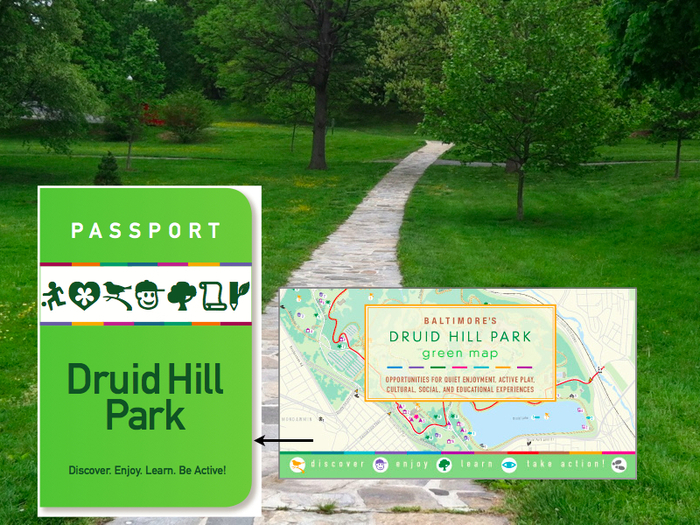
When Baltimore Green Map created the tantalizing, informative Druid Hill Park Green Map, we set aside 5000 maps for this Passport project. Why? Because it’s one thing to learn about a place by reading a map, but our goal is to have more people experience more aspects of the park, to visit it frequently, and ultimately become advocates for maintaining and improving it. “Discover. Enjoy. Learn. Be active!” covers the sequence we hope to inspire. This Kickstarter will fund activity refinement, graphic design, and printing of 5000 passports.
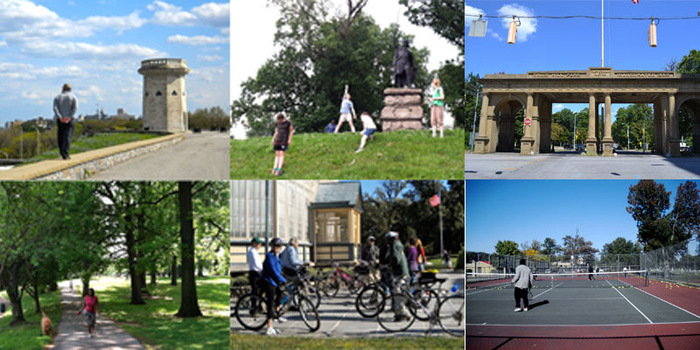
The Passport, accompanied by the DH map, will be a guide to this wonderful 745-acre park in the center of Baltimore, Maryland. It will contain 16 pages of activities to help you get to know the park through experiences around the themes: Nature, Exercise, History and Culture. With each activity you will record the results, then bring the passport to the Conservatory to get it stamped. Actually observing, listening, walking, running, playing, relaxing at places throughout the park, then recording, composing, drawing, imitating, exerting, imagining….how can you resist becoming a Druid Hill Park fan? Passport + map will be available for free at places and events in the park and by request.
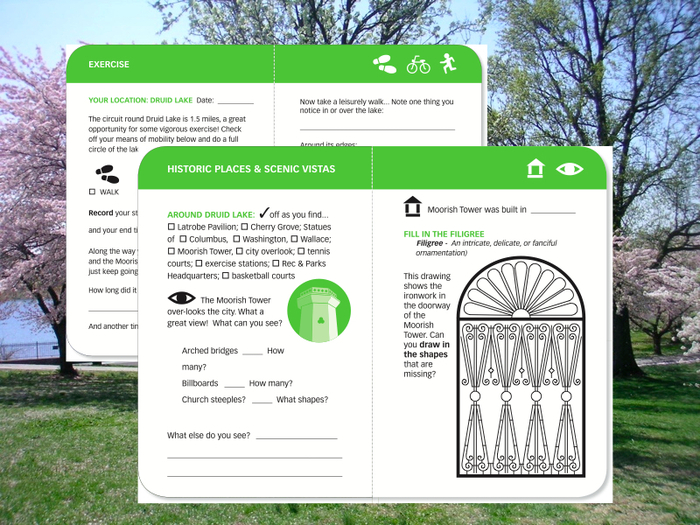
Key to this project is our use of the international Green Map® icons to signify the resources in the park and to be the actual stamps. I started Baltimore Green Map as the local mapmaking affiliate of this international network. I wanted to “map the positives” here in Baltimore, the places that contribute to making this such an interesting and livable city. We look forward to sharing this project as a model for other Green Mappers, now active in 63 countries worldwide, mapping what makes communities livable and sustainable.
We are testing ideas now with Friends of Druid Hill Park members, park-enthusiast families, and willing neighbors to be sure the instructions are clear and the activities engaging. Our graphic designer, Elizabeth Gething, has created some fine sample pages!
Our Incentives
The Passport is very much a collaborative project. Advocates and stewards of the park are pitching in to offer a wide variety of incentives. You can choose rewards that highlight any of our themes – nature, exercise, history & culture – or just feel good that you are helping. We will invite you to a celebration at the very wonderful Rawlings Conservatory when the Passport is completed, but will send it out if you cannot attend.
Even if you don’t live in Baltimore, you will love the map, created in collaboration with graphic designer Joanne Cooper Wingard. It was featured in the most recent Cooper Hewitt National Design Triennial exhibit.
I’m grateful to my Passport partners – the Friends of Druid Hill Park, the Rawlings Conservatory staff, Disc Golfers, and Baltimore City Recreation & Parks Department. Huge thanks to Chris Hartlove who helped me create our video, to Harlan Brothers for use of his music, “Secret Song,” and to you Kickstarters who help us complete this project!
Has the U.S. Reached "Peak Car"?
B’ Spokes: This article in Scientific American has a lot of interesting points but I would like to comment a bit about their subtitle "Traffic is easing as more Americans are deciding to drive less, sell their cars or not buy one at all"
My comment is to contrast "a 1.2 percent decline in vehicle miles traveled (VMT) last year" with "traffic congestion in the United States fell by 27 percent last year". While exactly what is cause and effect is still under consideration I still want to point out for consideration that just a small reduction in VMT results in larger relief of congestion. This is due in part because once a roadway is at the saturation point of maximum traffic the addition of just a small amount traffic cause a cascading delay effect (think of one person hitting the brakes on a crowded highway and then all those behind are now also hitting the brakes), a catastrophic failure (think grid lock but something similar happens once people have to wait more then one cycle for a light causing more and more people to wait in the queue at each cycle) or just a "simple" traffic accident (happens on average every 5 minutes in Maryland and "accidents" are the MAJOR cause of traffic delays.)
The short of it is our road designs cannot gracefully handle additional traffic above a certain threshold, they fail and they fail severely. I will assert that’s why just a small reduction in VMT will result in a larger reductions of congestion.
My point in bringing this all up is because we cannot afford to build enough roads to have congestion free driving. But we can afford to provide alternate transportation to keep travel times for all at tolerable levels. And that’s the question we should be asking, are travel times at a tolerable level and forget about congested roads (they are inevitable.) And on this point I will assert average commute travel time of around a half hour is tolerable and the "worst" of 5 more minutes* is not that big of a deal. Of course we should try and improve this but the main thrust should be on alternate transportation (not more road projects at the expense of alternate transportation) as that will yield the most bang for the buck.
The Scientific American article: https://www.scientificamerican.com/article.cfm?id=has-us-reached-peak-car-americans-driving-less
Continue reading “Has the U.S. Reached "Peak Car"?”
Halfway
On the transportation bill, Republicans agreed to drop two issues that have nothing to do with transporation (the Keystone pipeline – an issue of their own creation – and the EPA coal ash regulations) and in return Democrats “gave up on $1.4 billion for conservation and agreed to allow states more leeway in how they use money that was once mandated for landscaping, bike improvements and pedestrian walkways” much of which is directly related to transportation. This from a bill that was already a compromise with Senate Republicans. So Democrats gave into Republican demands not once, but twice, and somehow Barbara Boxer can say with a straight face ““I am so glad that House Republicans met Democrats halfway.” I’m sorry to tell you, but that is not halfway. If she thinks it is, then I would love to sell her a used car.
Via The Wash Cycle
What is Baltimore Bike Party? [video]
Come ride with all your friends the last Friday of every month.
Join the Baltimore Bike Party group here…
https://www.facebook.com/groups/275878782500783/
And join us for the June 80's ride here…
https://www.facebook.com/events/318284521587946/
Thanks to Nate Evans for the additional shots!
All shot with a GoPro Hero HD
Music – Spitfire, Unison (Knife Party Remix)
– Airwolf Theme
-Matthew Wilder, Break My Stride
Lack of connections, visibility hurt ICC Trail
Less than a year old, the Intercounty Connector Trail offers a new way to get across Montgomery County by bike. However, a circuitous route, a lack of connections to surrounding areas, and sections with poor visibility all hurt its potential.
…
Not surprisingly, area bicyclists were unhappy with the decision. “Why do designers think cyclists should have to go the long way, but cars need a direct route?” asked WashCycle.
https://greatergreaterwashington.org/post/15381/lack-of-connections-visibility-hurt-icc-trail/
[B’ Spokes: It may be of interest on how we got to this point.
The ICC Was A Fast Tracked Project
The problem the government looks at the length of the planning process as an unnecessary expense (this is evident in the new Transportation Bill and the “streamlining” of the timing of the environmental review process. When it should be looking at the quality of the results. It should be intuitive but there are studies that show that the more you involve the public the better the outcome of the project. Does this take longer? Sure but it gets better results which is a lot better then one under used road putting a strain on our road budget for years to come.
Defend, defend and defend
While no planning agency says this is their policy it has become very apparent (in Maryland at least) that this is the state’s policy. I say that because by the time a project comes up for public comment it is too late to go back and make changes as that will take more design time and there is no budget for that. So the public’s only option is to accept or reject the plan as given. It is my opinion one of the mistakes the cycling advocates made was to request minor tweaks to the original design of the ICC rather then just saying “This design is unacceptable so it has to be scraped in it’s entirety.” Which may sound a bit extreme but certainly less extreme then the state’s assertion “a highway is not an environmental problem, but a bike path is an environmental problem.” So my advice for future advocacy efforts, no more mister nice guy, if the project design is unacceptable, it is unacceptable, end of story even if it can be easily fixed. Our policy should be to demand that they fix the plan first or we come out against the plan. (Just to note some local planners are easier to work with then the state, so use your discretion when working with local projects. I will also point out the irony of it’s harder to work with the state with their bigger budgets and with more year end left over funds then with locals with tighter budgets because I will assert there is a greater need to be responsive to the public at the local level then at the state level. )
Stick your fingers in your ears and hum real loud syndrome and the impact on MBPAC
While this is directed at the previous administration [Ehrlich (Governor) and Flanagan (Secretary of Transportation)] I remain concerned vestiges of this attitude remain within MDOT. There is nothing about the current observations of the ICC and its trail that were not known before the project ever got approved. So why did they go ahead with it anyway? I can’t answer that but I can point to an issue that hindered getting a full and complete trail as envisioned by master plans.
While the concept of having members from different state agencies on Maryland Bicycle and Pedestrian Advisory Committee (MBPAC) sounds like a good one, the gotcha comes in can a state employee vote against the policy of the Governor? With that in mind MBPAC intended to send a message to MDOT that this convoluted mix of on and off trail route + indirect circuitous routing of a bike “trail” was not a full and complete trail as envisioned by master plans. But that got nixed very effectively by the state by threatening to fire any state employee who voted in support of trying to fix this so called “trail” that we got. So instead of MDOT getting just one vote it got 9 votes by this tactic. (I will also note that when the vote took place few general public members of MBPAC were present.)
With any planning just on paper one group can say one thing and another group can say the opposite but here we are with things mostly in place and guess what, Ehrlich and Flanagan got it wrong and used excessive force in trying to ignore public/advisory committee’s input. Perhaps if MBPAC amended its bylaws so members could vote the way they feel best and still be secure in their jobs to avoid this from happening again would be a good place to start.
]