
A nice heart worming story that started in Baltimore: https://nwahomepage.com/fulltext?nxd_id=346962
Photo of the NCR trail in the Sun
Teen Bicyclist Sent to Hopkins After Collision with Car
By Marc Shapiro, Owings Mills Patch
A 13-year-old boy was sent to The Johns Hopkins Hospital Friday after he collided with a car while riding his bike at 7:14 p.m., police said.
“The bicyclist was heading west on Academy Avenue,” said Lt. Stephen Doarnberger, assistant commander of the Baltimore County Police’s Franklin Precinct. “The car was traveling north on Highfalcon [Road] and the bicyclist did not stop at the stop sign.” [B’ Spokes: How do we know this? Driver testimony only?]
The teen was thrown from his bicycle after colliding with the 2005 Acura TL, which was driven by a 60-year-old Reisterstown man. The severity of his injuries is unknown, but he was conscious at the scene and able to speak with police officers, Doarnberger said.
No charges will be filed in the incident.
https://owingsmills.patch.com/articles/teen-bicyclist-sent-to-hopkins-after-collision-with-car
[B’ Spokes: I am under the opinion that at fault discussion should exist on both sides of car/bike collisions, so I am concerned that there is no mention (consideration) that the driver may be at fault in this case. Granted this is a kind of intersection that cyclists might be prone to not fully stop for but I will assert we rarely ride in front of a car that we can see coming.
My next assertion is that motorist in Maryland rarely obey the speed limit, with 10 to 15mph above the speed limit being rather typical, and that is rarely seen as illegal behavior by the police, this concerns me a great deal especially on roads where cyclists and pedestrians are present. Speed can make the critical difference between life and death and between a crash and no crash.
It is known in traffic engineering circles that intersections need “daylighting” (be free of obstructions) so cross traffic can get an adequate look down the road so they can cross safely. How much clear space is needed depends on the speed of the road. But what if the cross traffic speed is exceeding the designed speed of the clear zone? The cross traffic would be invisible until it was too late to react.
And that’s what I speculate might have happen here (or more correctly, I would feel a lot better if the speed of the motorist was carefully looked into.) From my Google Earth snapshot below I drew a 4 second line (2 second reaction time + 2 second stopping time) for a car that is traveling 35mph. It looks to me as the cyclist approached from the east (top of photo) a 35mph motorist was hidden behind the tree but would have been visible if the motorist was traveling 25mph.

§ 21-101.(t) Right-of-way. — “Right-of-way” means the right of one vehicle or pedestrian to proceed in a lawful manner on a highway in preference to another vehicle or pedestrian.
I’ll note that I have yet to see this portion of legal code applied to crashes with cyclists and pedestrians, to summarize, a motorist loses their legal right-of-way when breaking the law (such as speeding.) My point in this is a cyclist/ped should not be at fault if a motorist zips around a corner and hits them. We need time to react to traffic and we should not have the legal obligation of having to yield to traffic traveling too fast for conditions.
Conclusion: Cyclists, please keep in mind that not all low traffic intersections are created the same, some hide speeding traffic too well and give you very little time to react, use your hearing to hear approaching traffic. Motorists, please 35-40mph in residential is not acceptable. Police, please enforce the traffic laws. Thanks to all who help make this world a little safer.]
Somewhat related:
Cokinos, who was 23 at the time, was speeding at 56 miles an hour in a 30-mile-an-hour zone when he struck Luis — who was crossing Springtown Road in front of his home.Seven months later in November, a Montgomery County District Court judge found Cokinos not guilty of negligent driving or contributing to an accident.
SIMPLE SOLUTION
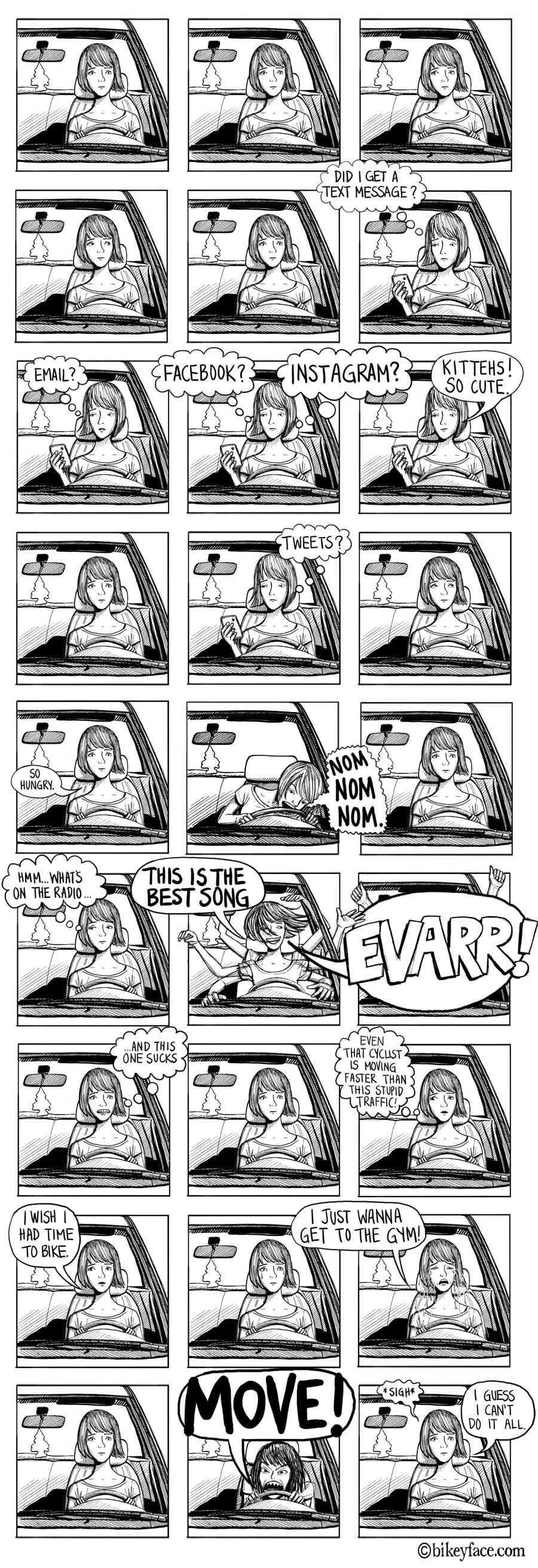
B’ Spokes: I just discovered this blog called Bickeyface, it’s really cute, here is a sample (click the pic for the original page):
Study shows biking customers spend more
Posted by Jonathan Mau, Bike Portland
"Survey results suggest that patrons who arrive by automobile do not necessarily convey greater monetary benefits to businesses than bicyclists, transit users, or pedestrians. This finding is contrary to what business owners often believe."
https://bikeportland.org/2012/07/06/study-shows-biking-customers-spend-more-74357
BEING ON FOOT DOESN’T MAKE YOU SPECIAL
B’ Spokes: Here are some excerpts from this great satire piece by By Matt Meltzer on Miami Beach 411 (pertains to Maryland as well I think):
Turning right on a red? As long as there’s no cars go for it. Doesn’t matter if a family of five is trying to cross. If they live in Miami, they know to stop. Crosswalk without a stop sign? That’s what we in Miami call a colossal waste of street paint. Nobody’s slowing down, and cars are a lot bigger and faster than you. Chance it if you like, because you think you have some sort of “right of way.” But the consequences if you’re wrong aren’t worth trying us.
LAWLESSNESS = EFFICIENCY
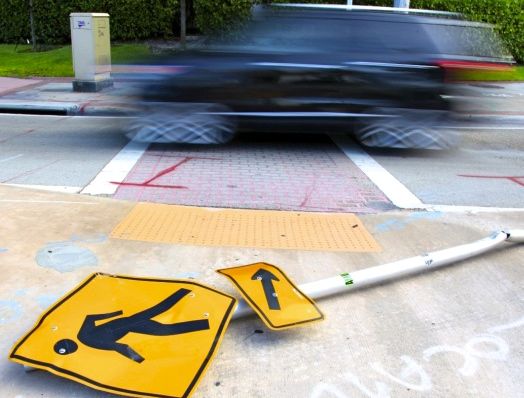
Now some would complain and say this makes Miami a dangerous city. I say it actually helps us be more efficient. Traffic here – especially street traffic – is bad enough as it is. And what with the new red light cameras curtailing our trademark “Four to a Red’ move, it’s getting even slower. Could you imagine if our drivers had to wait for slow-moving tourists to cross the street too? We’d never get anywhere.
Read the full article: https://www.miamibeach411.com/news/miami-pedestrians
What a Difference 60 Years Makes: Dragnet’s Hunt for a Hit-and-Run Killer
by Angie Schmitt, Streets Blog
We have to thank Network blog Copenhagenize for pointing us to this video, from a 1954 episode of the classic detective series Dragnet. In this installment, Los Angeles Police Detective Joe Friday and his team investigate a hit-and-run collision that killed a young boy and his grandmother as they were crossing the street.
Apparently the attitude toward traffic deaths among law enforcement officials has changed quite a bit since 1954, notes Copenhagenize’s Mikael Colville-Andersen:
As Sergeant Joe Friday puts it [6 minutes, 18 seconds in]: “How much difference, for example, as far as moral guilt is concerned, is there between the following: #1 the man who plans a killing, takes up a gun, finds his victim and shoots him to death. And #2 the man who thinks he has to look out for no one’s welfare but his own, gets behind the wheel of a car, disregards the ordinary rules of safety and proceeds to commit homicide with a motor vehicle. Often times the crime masquerades under the guise of an accident. Morally, no matter how you spell it, it adds up to murder just as surely as if the person had taken a gun and shot his victim down.”
Imagine. Look at how much air time was given to a hit & run. Things have certainly changed. Maybe lucrative car commercials ended up weeding out bad branding like this storyline.
Contrast that with modern-day New York City, where the family members of hit-and-run victims have to sue the police department for failing to investigate a very similar crime. Where’s Joe Friday when you need him?
…
Continue reading “What a Difference 60 Years Makes: Dragnet’s Hunt for a Hit-and-Run Killer”
Sunday Train: The Steel Interstate and the Great Highway Lie
by BruceMcF, Daily Kos
…
What The Big Highway Lie Is Not, Part I
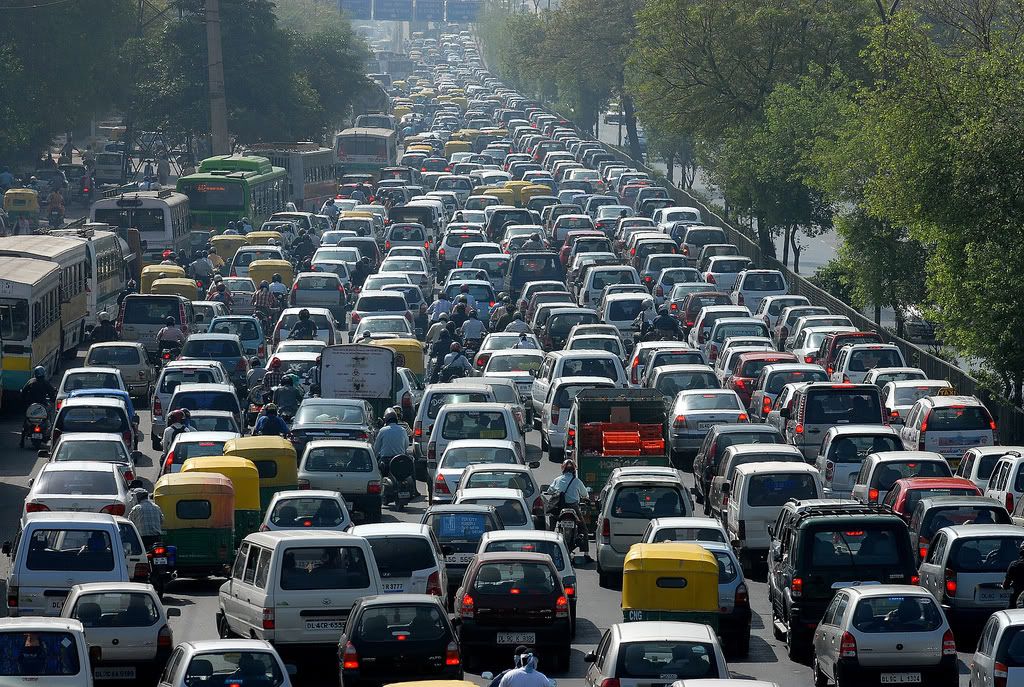 There are some people who labor under the misconception that gas taxes fund highway maintenance cost.
The notion is quite absurd on the face of it. The share of the federal highway fund that goes to roadworks is greater than the share of driving that takes place on funded highways, so obviously driving on unfunded streets … mostly urban and inner-suburban city streets … yields gas taxes that cross-subsidize driving on funded highways.
For example, here is the 2008 FHA Highway Statistics on highway revenues as a percentage of total disbursements:
- 46.61% Motor Fuel and Vehicle Taxes
- 5.11% Tolls
- 4.57% Property Taxes and Assessments
- 22.19% General Fund Appropriations
- 9.60% Investment Income and other Receipts
- 10.95% Bond Issue Proceeds
Of course, the gas tax and vehicle tax revenues are collected for all road uses, and only directed to qualifying highways. While qualification of urban streets for state gas tax funding varies by state, urban streets that do not qualify for national or state highway designation are excluded from federal highway gas taxes.
Of course, over half a century of subsidy has channeled traffic onto these federally funded highways (that is, Interstate, National, State, County and Township highways), but still, according to the introduction to the 2011 CBO report on alternative approaches to highway funding:
About 25 percent of the nation’s highways, which carry about 85 percent of all road traffic, are paid for in part by the federal government.
… so the direct gas tax and vehicle tax proceeds from driving on federally funded highways is at most 85% of 46.61%, or about 40%.
And, of course, this is also a substantial overstatement, since that is about 15% from Federal gas taxes and about 25% from state gas taxes. And in most states, gasoline is exempt from state and local sales taxes, so that only a portion of state gas taxes are an actual additional user fee, with much of the state gas tax simply being a diversion from the general fund. It would be as if alcohol sales in a state charged a “drinks tax” which went into providing infrastructure in support of drinking parties ~ and were exempted from state sales tax.
I don’t have any recent figures on how much of total state gas tax revenues is an increment over what would be the sales tax proceeds on sales tax exempt gasoline sales, and how much is a diversion, but if the additional user tax component is between 40% and 60% of total state gas taxes, then total “farebox cost recovery” of the highway system is between 30% and 35%.
While “nobody serious seriously believes that gas taxes fully fund our nation’s highways”, anybody who has read the Tea Party Parade that fills many online newspaper comments sections when a rail project is covered knows that lots of people are happy to make the absurd claim.
Now, that absurd claim is simply wishful thinking. It collapses immediately when presented with the publicly available Federal Highway Administration figures. The fact that it is confidently stated by so many serves to establish how many people are happy to state facts that are blatantly false, often passed on from someone else equally misinformed because it sounded like something that ought to be true.
…
B’ Spokes: It’s worth noting that the bulk of the “farebox cost recovery” of the highway system goes to interstate highways. And I will assert that in terms of simple dollars analogy all the money that cars pay in “user fees” go toward the interstate highway system… roads that cyclists are prohibited from using. So when it comes to roads that all modes use, we all help pay for. If cars get a specific “user” tax then why can’t we treat our sales tax as a user tax that helps fund the roads? Keep in mind that outdoor recreation spending is near twice that of motor vehicles (and a portion of motor vehicle spending is exempt from sales tax.)
the farebox recovery ratio above is not a ratio of physical cost imposed upon the highway system by driving, but a ratio of revenues to our inadequate highway spending. From the ASCE report cited above (p. 99), 5yr road spending of $380.5b can be set against total investment needs of $930b, for a 59% shortfall.
Outdoor Industry report says recreational cycling pumps $81 billion into U.S. economy each year
by Jonathan Maus, Bike Portland
…
According to the report, Americans spend more on bicycling gear and trips ($81 billion) than they do on airplane tickets ($51 billion). That $81 billion is spread between $10 billion on bikes, gear, and accessories and over $70 billion on bicycle "trip related sales." The direct economic impact of that spending supports 772,146 jobs. The report claims that the "ripple effect spending" of all this bicycling activity is over $198 billion and supports 1,478,475 jobs.
…
The OIA says outdoor recreation is an "overlooked economic giant." With annual spending at $646 billion, it’s third in total annual consumer spending behind only financial services/insurance and health care spending. By way of comparison, total annual spending on motor vehicles and parts is just $340 billion.
…
https://bikeportland.org/2012/06/20/outdoor-recreation-report-says-bicycling-pumps-81-billion-into-u-s-economy-each-year-73608
In Metro Portland, Car Collisions More Costly Than Congestion
If that is true in the Portland metro area how much more so for Baltimore County?
Population
Portland Metro 2,226,009
Baltimore County 805,029
Fatal crashes from 2007-2009
Portland Metro 151
Baltimore County 270
So with 61% of the population of Portland Metro we have 179% more fatal crashes. Yet we spend more time and money in trying to "solve" congestion then improving safety. Priorities need to change!
Portland metro crash info: https://streetsblog.net/2012/06/21/in-metro-portland-car-collisions-more-costly-than-congestion/
And https://bikeportland.org/2012/06/20/metro-state-of-safety-report-collisions-cost-region-958-million-per-year-73564
Continue reading “In Metro Portland, Car Collisions More Costly Than Congestion”