Sometimes the Simplest Ideas Make the Best Pop-Ups

B’ Spokes: I still think one option we have in Baltimore to fight the resistance to bike infrastructure is to call for temporary (or a study, experimental) treatments of a street. I think it would be really cool to get something extra (for approx a month) during the spring or fall when cycling ridership is the highest. And let’s bring in other sustainable options in with it as well, need inspiration?

POP UP ROCKWELL is a one-week experiment to test “complete & green street” improvements on downtown Cleveland’s Rockwell Avenue (between W. Roadway and E. 6th Street), which took place during April 21 – 27, 2012. The temporary street transformation explores fresh ideas for making the street more pedestrian and bicyclist friendly. Going beyond two-dimensional drawings used in typical public meetings, Pop Up Rockwell allows people to physically experience a future vision of the city in three dimensions, in a real environment, and provide feedback before large financial and political investments are made.

The project builds on the Cleveland Urban Design Collaborative's (CUDC) expertise in temporary urbanism developed through Pop Up City, an initiative started by the CUDC in 2007. The project is led by graduate students at Kent State University's Cleveland Urban Design Collaborative, but involves partnership with several stakeholder groups representing advocacy organizations, non-profits, municipal government, federal agencies and local businesses. The temporary installations include Cleveland’s first cycle track, stormwater bio-filtration benches, enhanced transit waiting areas and wind animated public art. Lessons learned from the short-term project may influence permanent changes, which support the City of Cleveland’s Complete & Green Streets Ordinance and Group Plan Commission recommendations.

More info available at: www.popuprockwell.com

Further reading: https://www.theatlanticcities.com/neighborhoods/2012/07/sometimes-simplest-ideas-make-best-pop-ups/2492/
Tracking State Transportation Dollars (How Does MD Compare?)

MD’s score from 1 (low) to 5 (high) spending of federal funds in the following categories:
3 – Bridge Maintenance/Replacement
5 – Transit
5 – Road Maintenance/Minor Widening
1 – Bicycle/Pedestrian
1 – Road/Bridge Project with Bicycle/Pedestrian Components
1 – Safety
5 – New Road Capacity
1 – Bridge Capacity Expansion
2 – Other
Anyone else see a pattern here?
Continue reading “Tracking State Transportation Dollars (How Does MD Compare?)”

Howard County Bicycle Master Plan

Howard County is developing its first Bicycle Transportation Master Plan. The Department of Planning and Zoning (DPZ) is the lead agency administering the planning process. To ensure a comprehensive look at bicycling, DPZ has secured the involvement of a number of other county agencies including the Office of the County Executive, the County Council and Department of Public Works. Visit the Technical Advisory Group page for a list of agencies and representatives involved.

The master plan will address bicycling for both transportation and recreation; and will look at on-road and off-road bicycling facilities. A variety of methods will be used to gather public input, including a series of public workshops in the Fall of 2012 and availability of an interactive on-line map. The master planning process is expected to last a year from June 2012 – June 2013.

Bicycle Master Plan Goals & Objectives
  • Identify and develop countywide system of bicycle facilities to foster connectivity within and between the following: villages, communities and neighborhoods throughout the County, as well as neighboring cities and counties, parks and recreation centers, schools and educational institutions, commercial and employment centers, and regional and local transit facilities.
  • Facilitate recreational and transportation trips by bicycle in the County and improve safety for all types of bicyclists.
  • Recommend County policies that will support bicycling, including bikeway facility design.
  • Build public support for implementation of the Plan.

https://bikehoward.com/

Go West – A vision for Garrett County Trails

By Steve Carr
In 1999, the Garrett County Commissioners saw that Pennsylvania’s Great Allegheny Passage (GAP) — a paved rail-trail running from Cumberland to Pittsburgh — was taking shape just to the north. This activity led officials to appoint a Recreational Trails Task Force to explore trail possibilities in Western Maryland.
Task force members developed a Master Trail Plan for the county and created Garrett Trails, a non-profit, volunteer group to implement the plan. In June 2008, the task force voted to formally reorganize Garrett Trails as the permanent organization tasked with carrying out the master plan and more generally, trail development and promotion.
Making connections
Since 2002, Garrett Trails has been focused on the ambitious goal of creating the Eastern Continental Divide Loop Trail, which is envisioned as a 200-mile hard-packed, multi-user pathway through the heart of Garrett County that creates connections between existing trails and also links with larger trail networks outside the county. (See map.)
The trail will eventually pass the Deep Creek Hydroelectric Power Plant and connect to the Fork Run Trail System. From there, the Chamber of Commerce/Visitor Center will be accessible along with Deep Creek Lake State Park via Route 219 bike lanes and then connect the Meadow Mountain Trail (MMT) north back to Grantsville. This impressive undertaking could take years to complete.

Read more: https://www.dnr.maryland.gov/naturalresource/summer2012/garret.pdf

In Search of Good PSAs about Bike Lanes and Sharrows

B’ Spokes: In this article https://www.commutebybike.com/2012/06/14/in-search-of-good-psas-about-bike-lanes-and-sharrows/ Ted Johnson explores some of the material out there that explains bike lanes and sharrows.
In an ideal world all engineering would be intuitive and instruction manuals would be a thing of the past but we are far from having an ideal world. And I am still amazed that we are putting this stuff down on the pavement with little to poor educational material out there so people know how to use this stuff properly.
I am still amazed at the effort we had to do after the Nathan Krasnopoler crash (https://www.baltimorespokes.org/article.php?story=2011030413431398 ) and I am appreciative that the Baltimore Sun picked up on some of these points to help get the word out but still I don’t like the idea we need a serious crash to get attention on the lack of education.

Pedestrian accommodation?

image

B’ Spokes: In this Non Sequitur comic by Wiley Miller he seems to get at the nuance of the walk signal that still allows motorist right and left turns… with or without the walk signal it is still cross at out own risk.

Bike Tour of Community Gardens 7/28

On Saturday, July 28, join other cyclists and environmental advocates for a tour of some of Baltimore’s best and most hidden community gardens.

The Charm City Farm and Garden Tour starts and ends at Cylburn Arboreteum, includes bike and bus tour options, and finishes with a party complete with live music, games, a garden-themed photo booth, and a gardeners potluck! Registration starts at 1, the tours starts at 2, and the party starts at 5. All are welcome to join for all or part of the event. See https://sites.google.com/site/charmcitygardentour/ for more information, and email charmcitygardentour@gmail.com to register! Hope to see you there!

As pedestrian accidents mount, Ocean City looks for answers, whoops I mean blame the victim and get the laws wrong

B’ Spokes: Years back I attended a statewide bike/ped safety meeting and the Ocean City Police really impressed me as having a handle on all the aspects of pedestrian safety but after reading this article in the Sun https://articles.baltimoresun.com/2012-07-08/business/bs-md-oc-pedestrian-safety-20120702_1_pedestrians-ocean-city-crosswalk-signs I wounder what happened?

Surprising Aspects of Maryland Pedestrian Laws OK, actually that is about Florida pedestrian laws but as far as I can tell they are identical to Maryland (when I have the time I will repost with Maryland law citations. See Surprising Aspects of Pedestrian Laws for Maryland laws.) So what do we learn from this?

1) There Is No “Jaywalking” Law
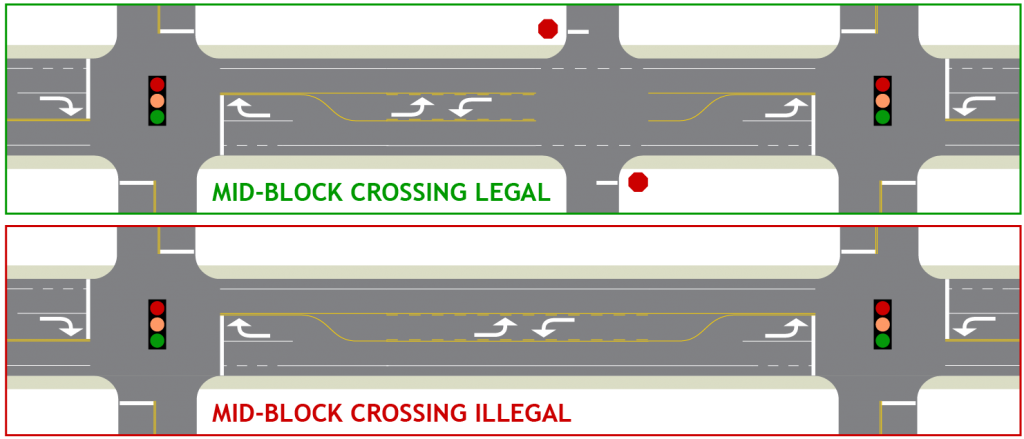
2) Yes you can cross mid-block on Coastal Highway as it resembles the top half of this illustration
image
3) § 21-504.(a) In general. — Notwithstanding any other provision of this title, the driver of a vehicle shall exercise due care to avoid colliding with any pedestrian.
4) There are lots of unmarked crosswalks along Coastal Highway where the driver is legally obligated to stop for pedestrians, this is NOT Jaywalking!

  • § 21-101.(i) Crosswalk. — “Crosswalk” means that part of a roadway that is:
  • (1) Within the prolongation or connection of the lateral lines of sidewalks at any place where 2 or more roadways of any type meet or join, measured from the curbs or, in the absence of curbs, from the edges of the roadway;
  • (2) Within the prolongation or connection of the lateral lines of a bicycle way where a bicycle way and a roadway of any type meet or join, measured from the curbs or, in the absence of curbs, from the edges of the roadway; or
  • (3) Distinctly indicated for pedestrian crossing by lines or other markings.


5) A key outcome of this analysis is the importance of pedestrian desire lines to the location of new or improved pedestrian facilities (Accommodate pedestrians where they want to cross!)
6) “a nine-mile ribbon of blacktop eight lanes wide.” – I think I see the problem, over accommodating motorist and under accommodating pedestrians.