City’s Lake Avenue Traffic Response Annoys Residents

By Adam Bednar, North Baltimore Patch

The city’s response to residents concerns about the speed of traffic and congestion on Lake Avenue has left some residents extremely frustrated.

Nearly three months after residents met with city officials to discuss their concerns, nothing has been done to address the problems. Residents are now worried plans to construct a bike route connecting Mt. Washington and Belvedere Square using shared bike and car lanes, known as “Sharrows,” along Lake Avenue will make matters worse.

"It seems to me like the city is only interested in moving a lot of traffic along Lake Avenue," said Robin Reid, president of The Orchards Association.

At the end of the meeting the officials said they would examine what could be done to address residents concerns about traffic, which came to a head after a hit and run accident involving a cyclist.

"The Traffic Division advises that the study for the intersections of Lake & Stony Run and Lake & Kenmore have been completed. From the investigation, traffic volumes and crash data did not support the installation of stop signs at these locations. The locations do not satisfy the warrants for consideration of the installation of all way stops," Kohl Fallin, the areas transportation liaison, wrote to community leaders.

She also said that a bike route along Lake Avenue isn’t feasible until the situation with congestion and speed are properly addressed by the city.

The full article: https://northbaltimore.patch.com/articles/city-s-lake-avenue-traffic-response-annoys-residents

*************************************************************************************************
B’ Spokes: Hmm, I’ve ridden Lake Ave. and found it rather pleasant but then again I’m comfortable riding in traffic. At least Lake is better then Northern Parkway, you can’t make bike traffic completely disappear, it’s got to go somewhere and Lake is the best option we have at this point.

I wish I better understood the concerns of the residents but if they want larger gaps in the traffic to make entering Lake from the side streets easier, try eliminating the rights-on-red entering Lake. If it is the speed of traffic, try speed tables. Both should circumvent the "warrant" issue described and the latter should fall under the traffic calming program.

But in general we have a problem with the false ideology that "every street needs to be an expressway" and I am sick of the city giving credence to this type of thinking. That is just wrong, we need a mix of arterials and side streets, Northern Parkway is the arterial and Lake is the side street. Ya I know drivers would love to make Lake a short cut to avoid all the traffic on Northern Parkway, but the only way to make it a viable short cut is to speed and that’s just wrong, if you are not willing to do the speed limit then don’t use the road.

Lastly, does anyone have any info on the hit-and-run? I can’t find anything searching the internet.

Bike Parking Regulations For Private Businesses Are They Kosher?

Imagine driving your car to do some business with a company and you park your car in a parking space out front and while you are inside shopping they tow your car away and smash your driver side window.

The business you were shopping at claims they can do this because of some internal memo or obscure thing on the web and since it is private property they can do whatever they want.

That would be total outrageous so why do we put up with that when talking about bicycle parking? In my experiences there is too much “You can’t park here.” along with “No I don’t know where you can park.” as well as “I can make up whatever rules I feel like when it comes to bicycles.”

I will strongly assert provide good bicycle parking per the guidelines and you will not need draconic policies that involve breaking locks and removal of the offending bicycle. A friendly note on the handlebars asking them to park in the designated area next time should be all that is needed.

Now if a cyclist parks somewhere you don’t want and there is decent available bike parking within 500 feet [should have been 120 feet] then I can understand going all medieval on the bike but I don’t think that is the normal situation. What seems to be the case is: Cars littering vast tracks of the landscape are “pretty” and necessary but bikes scattered all willy nilly is “ugly” and must be dealt with by extreme measures. This is just the wrong kind of thinking! If cyclists become such a “problem” then that shows that they need more accommodations, not “Let’s go medieval on those barbarians and hope they go away.”

Note: I have had my lock sawed through and my bike confiscated by a business. And I’m sorry but returning my bike with a broken lock is not an all’s well that ends well type of situation. Without the ability to lock my bike, my mode of transportation was turned into a toy that I could only ride around my house and do nothing useful with it (other then just exercise.) That’s why I included breaking the car window in my opening analogy, the usefulness of a car is diminished with a broken window, just as my bike’s usefulness was diminished without a lock.

Reacting to University of Maryland Bicycle Parking and Impoundment Regulations

Bicycles shall be parked in accordance with federal, state, and local fire and safety regulations. Bicycles shall not be
parked or stored in the following areas:

B. Against or fastened to any tree, plant, bush, or other landscape item [Not against federal, state, and local fire and safety regulations]
C. Against or fastened to any …, fence, …, railing, …

D. Upon or attached to any ingress/egress ramp, stairway or stairwell railing or otherwise fastened to … any
exit/entrance to any University building [As long as not impeding pedestrian movement, this too is not against federal, state, and local fire and safety regulations, unless the local fire department has gone anti-bike as well.]

UMCP maintains the right to impound, and will remove security devices at the expense of the owner/operator, any
bicycle that is … parked in violation of these regulations. [UMCP wants the right to break the law? That’s laughable, see the following]

§ 21-1206.(c) Tampering with bicycle, motor scooter, or EPAMD. — A person may not remove, ride on, or tamper with any part of a bicycle, an EPAMD, or a motor scooter without the permission of its owner.

It its never a legal remedy to react to illegal behavior with illegal behavior, so it is even more erroneous to react to legal behavior with illegal behavior. So with the exception of abandoned bikes or bicycles parked in such a way to cause a legitimate safety concern (which I’ll talk about both in a bit) the UMCP is breaking the law by impounding bikes.

So let’s look at where the state prohibits bike parking:
§ 21-1208. Securing bicycle, motor scooter or EPAMD to certain objects

  • (a) Prohibition. — A person may not secure a bicycle, an EPAMD, or a motor scooter to a fire hydrant, police or fire call box, or traffic control device.
  • (b) Poles, etc., within bus or taxi-loading zones. — A person may not secure a bicycle, an EPAMD, or a motor scooter to a pole, meter, or device located within a bus or taxi-loading zone.
  • (c) Poles, etc., within 25 feet of intersections. — A person may not secure a bicycle, an EPAMD, or a motor scooter to a pole, meter, or device located within 25 feet of any intersection.
  • (d) Poles, etc., having notices forbidding securing of bicycles. — A person may not secure a bicycle, an EPAMD, or a motor scooter to a pole, meter, or device on which notice has been posted by the appropriate authorities forbidding the securing of bicycles.
  • (e) Obstructing or impeding traffic or pedestrian movement. — A person may not secure a bicycle, an EPAMD, or a motor scooter to any place where the securing of a bicycle or a motor scooter would obstruct or impede vehicular traffic or pedestrian movement.
  • (f) Securing to parking meter. — A bicycle, an EPAMD, or a motor scooter may be secured to a parking meter, without payment of the usual fees, if it is entirely removed from the bed of the street normally used for vehicular parking.

So this is the rub, you can be parked legally per state law (just like you would anywhere else in this state) yet in the eyes of UMCP you will be parked illegally and can suffer the consequences. Can anyone override state law without going through the law making process? Umm, see below. (Note: an astute reader could find more items that are legal per state law but illegal per UM policy then what I have pointed out here, as I just pointed out the more blatant items.)

Maryland Declaration of Rights: Art. 9. That no power of suspending Laws or the execution of Laws, unless by, or derived from the Legislature, ought to be exercised, or allowed.

Keep in mind all they have to do is put up a sign in the areas they don’t want bike parking, if the problem is not pronounced enough to justify the cost of the signs, then it is also not significant enough for draconic policy, just tell people that you would prefer them not to park in the areas that I highlighted and leave it at that.

Bicycle registration is mandatory for all bicycles parked or stored on campus.

While it is possible to make this mandatory of students and facility, again, UMCP cannot create laws such as this for visitors of the campus.

Some sampling of bike parking around Maryland:

image
This would be illegal per UMCP. This is the bike parking at the Senate building in Annapolis as the building has no bike racks. There is a bike rack somewhere on the capital campus but good luck in finding it, it really is in an out of the way place.

image
This would be illegal per UMCP. Another building with no bikes racks but the fencing provides ample parking for cyclists.

UPDATE: I just found this on the web and the response from the collage is so cool. Also note how the bike is 100% out of the way of pedestrians but illegal per UMCP:
image
“Our bike racks are an option not a requirement.” – Broome Community College

So people who are used to parking their bikes in a usual (and legal) manner for Maryland are suddenly subjected to being treated like trespassers and wanton criminals all because of the lack of adequate bike parking.

§ 21-1008. Bicycle accommodations
By fiscal year 2000, each public institution of higher education and State employment facility shall provide reasonable accommodations necessary for bicycle access, including parking for bicycles.

So I have to ask is reasonable parking being provided if they have to resort to such drastic measures to deal with the bicycle parking “problem?”

§ 10-209.(c) Duties. — The University System of Maryland shall:
(6) Increase access for economically disadvantaged and minority students;

Does paying for citations, impound fees and storage fees for a legally parked bicycle sound like increasing access for economically disadvantaged students???
Continue reading “Bike Parking Regulations For Private Businesses Are They Kosher?”

What we need are "Ghost Cars"

As we have have Ghost Bikes I feel we need Ghost Cars as a reminder that cars are not as safe as we think. Does any really think texting will be a problem after passing this along side the roadway?

image

Maryland has 97,023 auto crashes a year (5 year average), that works out to be about 3 auto crashes per every mile of roadway in Maryland every year! Can you imagine what our roads would look like if these crashes stuck around for at least a year?

But Coordinated Highways Action Response Team (CHART) saves “Marylanders approximately $1.4 billion in vehicle travel costs in CY2010” by (CHART) providing quick response
to traffic incidents through emergency response and road/debris clearing. Um, maybe would could save even more by not having an accident in the first place? I think it would be a good educational tool to move a wrecked automobile to an entrance ramp (or other visible but out of the way public place) and let it sit there a while with a sign saying something like “Pay attention and drive safe. Don’t let this happen to you.” But instead we sterilize the roadway making it seem like nothing ever bad happens there. Denying a problem exists is the first step in making it worse.

Cyclocross Fall Class 9-17 yrs / Sep 20 / $30

Cyclocross Instruction
9-17 yrs / Sep 20 / $30
Boys and girls learn the basics of cyclocross, a blend of road and mountain biking in a fun and safe environment. No experience required. Students must (1) be able to ride without assistance; (2) have a bike that is suitable for off-road use (mountain bikes are OK); (3) have an approved helmet; and (4) have a local bike shop do a free safety check of bike prior to first class.
Instruction given by experienced cyclists. Focus is on racing techniques and building confidence by riding through a cyclocross race course. Students with regular attendance receive prizes and free admission to the Howard County Double Cross Race. Read concussion information on
https://www.howardcountymd.gov/concussioninformation.htm.

Review of this information is required by law before you are allowed to register for sports programs.
Registration: 410-313-7275. Information: Mike Blevins, 410-313-1691.

RP5920.101 Rockburn Branch Pk – Pavilion 5-6 PM Th

Thanks,

Michael Blevins
Sports Manager
Howard County Recreation & Parks

Surprising Aspects of Pedestrian Laws

Surprising Aspects of Florida Maryland Pedestrian Laws
By Mighk Wilson, Smart Growth Planner for MetroPlan Orlando [edited to reference Maryland laws.]
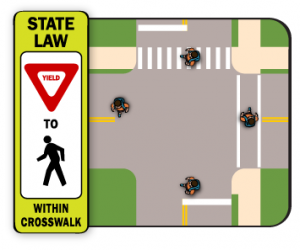
How well do you know Florida’s Maryland’s pedestrian-related traffic laws?  If you’re like many folks you have some misconceptions.  Here are some little-known truths about pedestrian law. See how well you understand them.

There Is No “Jaywalking” Law

Jaywalking is not a legal term.  It is not found in Florida Maryland statutes and has no legal meaning. Jaywalking is a derogatory slang term coined in the early 1920s by automotive interests (only about 10 to 20 percent of street users at the time) during propaganda campaigns to get traffic laws changed in their favor.  Their strategy was to put the blame on pedestrians who continued to walk the streets in the way they had for centuries – crossing wherever and whenever they wished – before the automobile became popular.  A “jay” was someone from the country who didn’t understand “big city” ways. So a “jaywalker” was someone the city folks could poke fun at for being ignorant.  This is well-documented in the book Fighting Traffic by Peter Norton.

Some actions that people call jaywalking – such as crossing against a red light – are illegal. But crossing mid-block, which is also called jaywalking, is not illegal in most locations.

Every Street Has Sidewalks on Both Sides

Well, sort-of. The legal definition of a sidewalk is “that portion of a street between the curbline, or the lateral line, of a roadway and the adjacent property lines, intended for use by pedestrians.”  So if there is no paved sidewalk, that strip of grass in the public right-of-way is still a sidewalk.  But it may not be a usable one for the pedestrian.  Tall grass, landscaping and other challenges could make it unusable.

§ 21-101.(w) Sidewalk. — “Sidewalk” means that part of a highway:

  • (1) That is intended for use by pedestrians; and
  • (2) That is between:
  • – (i) The lateral curb lines or, in the absence of curbs, the lateral boundary lines of a roadway; and
  • – (ii) The adjacent property lines.
§ 21-101.(w) Sidewalk. — “Sidewalk” means that part of a highway:

  • (1) That is intended for use by pedestrians; and
  • (2) That is between:
  • – (i) The lateral curb lines or, in the absence of curbs, the lateral boundary lines of a roadway; and
  • – (ii) The adjacent property lines.

The roadway is the portion of the public right-of-way intended for vehicles.  We all have the basic human right to walk in public spaces, so if we’re not intended to walk in the roadway, we must be intended to walk in the remaining space.

Drivers Must Yield to Pedestrians Who Are Legally In Crosswalks

Some people misunderstand the purpose and meaning of a crosswalk, believing it is the only place pedestrians are permitted to cross the street. That is not the case. A crosswalk is where drivers are expected to yield (if possible) to pedestrians. Pedestrians may cross elsewhere, but outside a crosswalk, they are required to yield to vehicular traffic.

§ 21-502. Pedestrians’ right-of-way in crosswalks

  • (a) In general. —
  • – (2) The driver of a vehicle shall come to a stop when a pedestrian crossing the roadway in a crosswalk is:
  • — (i) On the half of the roadway on which the vehicle is traveling; or
  • — (ii) Approaching from an adjacent lane on the other half of the roadway.
  • (b) Duty of pedestrian. — A pedestrian may not suddenly leave a curb or other place of safety and walk or run into the path of a vehicle which is so close that it is impossible for the driver to yield.
  • (c) Passing of vehicle stopped for pedestrian prohibited. — If, at a marked crosswalk or at an unmarked crosswalk at an intersection, a vehicle is stopped to let a pedestrian cross the roadway, the driver of any other vehicle approaching from the rear may not overtake and pass the stopped vehicle.

There Are Crosswalks on All Sides of Every Intersection
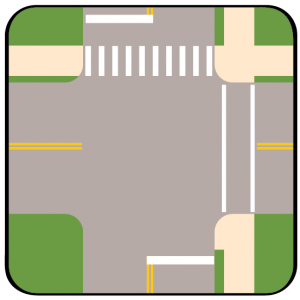
All sides of the intersection are crosswalks — marked or not, regardless of whether the sidewalk is paved or not.

The crosswalk is defined as the continuation of the parallel lines of the sidewalk across the roadway, so since every street has sidewalks, every intersection has crosswalks.  The only exception is where a state or local government has explicitly closed a particular crosswalk, and a sign must be placed at such a crossing to indicate it is closed.  So this means if you are driving along a road and there is a cross-street, you must yield to any pedestrian in an unmarked crosswalk at that intersection, just as you would yield if the crosswalk was marked.  This is true even if you are not facing a stop sign or traffic signal.

§ 21-101.(i) Crosswalk. — “Crosswalk” means that part of a roadway that is:

  • (1) Within the prolongation or connection of the lateral lines of sidewalks at any place where 2 or more roadways of any type meet or join, measured from the curbs or, in the absence of curbs, from the edges of the roadway;
  • (2) Within the prolongation or connection of the lateral lines of a bicycle way where a bicycle way and a roadway of any type meet or join, measured from the curbs or, in the absence of curbs, from the edges of the roadway; or
  • (3) Distinctly indicated for pedestrian crossing by lines or other markings.

The Pedestrian Does Not “Always Have the Right-of-Way”

No-one “has the right-of-way.”  The law only defines who is required to yield the right-of-way, or “give way.”

Pedestrians attempting to cross mid-block are required to yield right-of-way to vehicle drivers on the roadway.  Pedestrians at crosswalks at signalized intersections must yield if they face a red signal or steady Don’t Walk signal.
[B’ Spokes: While this is true, Maryland law gets complicated because drivers are required not to hit pedestrians.]

§ 21-504. Drivers to exercise due care

  • (a) In general. — Notwithstanding any other provision of this title, the driver of a vehicle shall exercise due care to avoid colliding with any pedestrian.
  • (b) Duty to warn pedestrians. — Notwithstanding any other provision of this title, the driver of a vehicle shall, if necessary, warn any pedestrian by sounding the horn of the vehicle.
  • (c) Duty to exercise precaution on observing child or certain other individuals. — Notwithstanding any other provision of this title, the driver of a vehicle shall exercise proper precaution on observing any child or any obviously confused or incapacitated individual.

Drivers approaching crosswalks – either marked or unmarked – must yield to pedestrians who are legally in the crosswalk and approaching closely enough to be in conflict.  Drivers entering a public street from a private driveway must yield right-of-way to a pedestrian approaching on the sidewalk or roadway, just as one yields to other traffic.

Pedestrians cannot enter the crosswalk at any time they wish.  One cannot expect a driver to do the impossible, such as coming to a stop from 45 mph in 100 feet.  Pedestrians must give drivers adequate time and distance to react and stop.

If Another Vehicle Is Stopped Ahead of You at a Crosswalk…
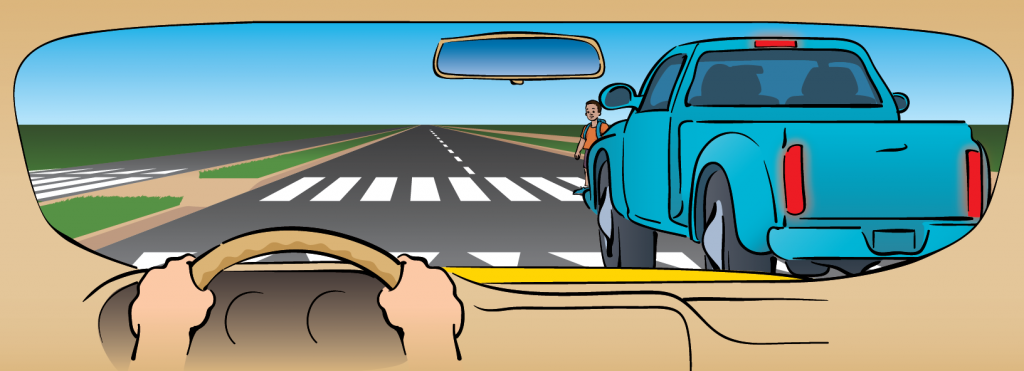
… you are not permitted to pass!  Even if you are in another lane.  There may be a crossing pedestrian hidden behind that first vehicle.  You have to assume a pedestrian is there, and can only proceed once you are sure the crosswalk is clear.

§ 21-502.(c) Passing of vehicle stopped for pedestrian prohibited. — If, at a marked crosswalk or at an unmarked crosswalk at an intersection, a vehicle is stopped to let a pedestrian cross the roadway, the driver of any other vehicle approaching from the rear may not overtake and pass the stopped vehicle.

Crossing Mid-Block Is Legal in Most Situations
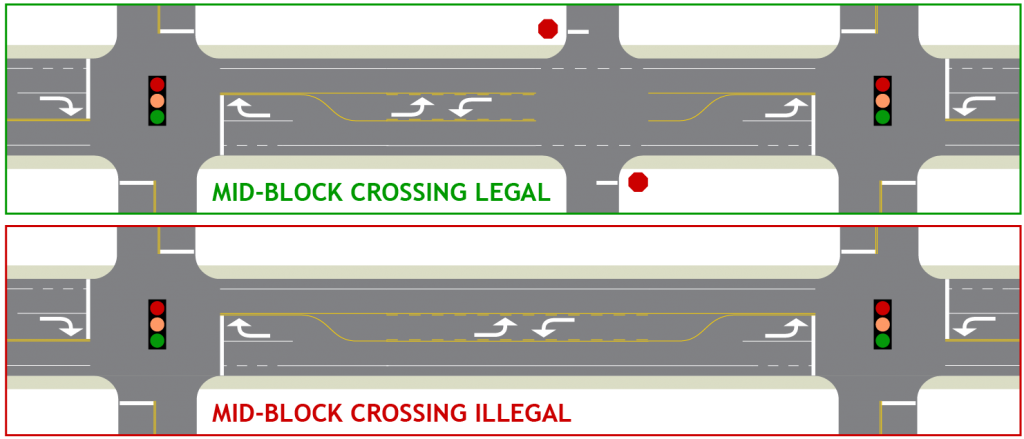
The law says pedestrians may not cross “between adjacent intersections at which traffic control signals are in operation.” So if you want to cross the street between intersections and both of the closest intersections have working traffic signals, then you may not cross, unless there is a marked crosswalk at that mid-block location.  If one of the closest intersections does not have a traffic signal, then you may cross, provided you yield to approaching vehicles.

§ 21-503. Crossing at other than crosswalks

  • (a) In general. — If a pedestrian crosses a roadway at any point other than in a marked crosswalk or in an unmarked crosswalk at an intersection, the pedestrian shall yield the right-of-way to any vehicle approaching on the roadway.
  • (b) Where special pedestrian crossing provided. — If a pedestrian crosses a roadway at a point where a pedestrian tunnel or overhead pedestrian crossing is provided, the pedestrian shall yield the right-of-way to any vehicle approaching on the roadway.
  • (c) Between adjacent intersections. — Between adjacent intersections at which a traffic control signal is in operation, a pedestrian may cross a roadway only in a marked crosswalk.
  • (d) Crossing intersection diagonally. — A pedestrian may not cross a roadway intersection diagonally unless authorized by a traffic control device for crossing movements. If authorized to cross diagonally, a pedestrian may cross only in accordance with the traffic control device.

The Flashing DON’T WALK Signal Does Not Mean You Can’t Be In the Crosswalk

It means you cannot enter the crosswalk.  If you are already in the crosswalk you can finish crossing.  The flashing DON’T WALK phase is timed so that you can make it all the way across at a normal adult walking pace – provided drivers are not cutting you off by turning across your path.  This is important for you drivers to know, too.  If the pedestrian is in the crosswalk and the DON’T WALK signal is flashing, you still have to yield!

§ 21-203. Pedestrian control signals

  • (a) In general. — Where special pedestrian control signals showing the words “walk”, “dont walk”, or “wait” or the symbols of “walking person” or “upraised hand” are in place, the signals have the indications provided in this section.
  • (b) Walk. — A pedestrian facing a “walk” or “walking person” signal may cross the roadway in the direction of the signal and shall be given the right-of-way by the driver of any vehicle. At an intersection where an exclusive all-pedestrian interval is provided, a pedestrian may cross the roadway in any direction within the intersection.
  • (c) Dont walk. — A pedestrian may not start to cross the roadway in the direction of a “dont walk” or “upraised hand” signal.
  • (d) Wait signal — Beginning crossing prohibited. — A pedestrian may not start to cross the roadway in the direction of a “wait signal”.
  • (e) Wait signal — Partially completed crossing. — If a pedestrian has partly completed crossing on a “walk” or “walking person” signal, the pedestrian shall proceed without delay to a sidewalk or safety island while the “dont walk”, “wait”, or “upraised hand” signal is showing.

How did you do?  How well do you think your friends, family members or co-workers would do?  If we don’t have a common understanding of the rules, how can we know what we or others should be doing to keep our friends and neighbors safe?

What likely has some of you nervous now is the idea of having to stop for a pedestrian at a crosswalk with no stop sign or traffic signal along a high-speed arterial.  You may be thinking, “If I do that I’ll get rear-ended.” Braking gradually gives the drivers behind you more time to react, so the earlier you brake to yield to a pedestrian, the less chance there is of a rear-end collision.  As drivers on arterial and collector streets we have to be prepared to slow or stop at any time – for emergency vehicles, transit buses, school buses, animals, bicyclists, other motorists slowing to turn, and for many other situations.

Our first priority will be getting drivers to yield on lower speed streets and getting pedestrians to clearly communicate their intention to cross.  Over time, we can work on getting the same type of good behaviors on our higher speed roads.

Continue reading “Surprising Aspects of Pedestrian Laws”
Ten key things to know about the new transportation law

For those looking for a good summary of the federal transportation law: https://t4america.org/blog/2012/07/13/ten-key-things-to-know-about-the-new-transportation-law/
A worthwhile quote:
"Even as some House Republicans were claiming that the tiny share directed toward safe walking and biking was the reason that our roads and bridges were crumbling, they were pushing to eliminate the repair program to fix our roads and bridges. The bill they negotiated ends up being as blasé about funds for maintenance and repair is it is about the safety of people on foot or bicycle."

‎"You have a lower BMI than 90% of males aged 45-59 in your country" – No duh

B’ Spokes: May I assert the other 10% also have an active life style. To find your stats: https://www.bbc.co.uk/news/health-18770328
I found this site via: https://well.blogs.nytimes.com/2012/07/18/the-couch-potato-goes-global/?smid=fb-share
And to highlight a bit from that article:
The latest figures suggest that the world’s population has become disturbingly inactive. According to the researchers’ calculations, 31.1 percent of the world’s adults, or about 1.5 billion people, are almost completely sedentary, meaning that they do not meet the minimum recommendation of 150 minutes of walking or other moderate activity per week, or about 20 minutes a day.
Teenagers are faring even worse. More than 80 percent of young people ages 13 to 15 worldwide are not getting the hour a day of vigorous exercise recommended for their age group.
Unsurprisingly, North America and Europe lead the world in not exercising, with 43.3 percent of Americans and 34.8 percent of Europeans not reaching the low recommended threshold. But the world is catching up or, rather, joining us in sitting down. More than 30 percent of Russians are inactive nowadays; ditto in the Middle East; and about 27 percent of Africans are sedentary.
Read more: https://well.blogs.nytimes.com/2012/07/18/the-couch-potato-goes-global/?smid=fb-share
