

Save our cyclists
By Kaya Burgess, The Times (UK)
…
Mary, a news reporter, would be first to ask why it is not mandatory for lorries driving on city streets to be fitted with sensors and mirrors to pick up cyclists in their blind spots. Or why training for cyclists and drivers on how to share the road responsibly is so poor. Or why some junctions are so dangerous that jumping a red light can actually be a safer option than lining up alongside HGVs [Heavy Goods Vehicle] at the lights like a racetrack starting grid. Or why London trails so far behind cities such as Amsterdam and Copenhagen in terms of the infrastructure and legislation to protect vulnerable cyclists and to help the drivers who are trying to avoid them.
…
https://www.thetimes.co.uk/tto/public/cyclesafety/article3306502.ece
*****************************************************************************
[B’ Spokes: I would not recommend running red lights but the problem is what I would recommend is top-secret or might as well be since so few know about it. You just can’t squeeze cyclists into car only designs and not expect some bad consequences. You cannot treat safety education as something for only a privileged few, everyone needs to know what to expect from fellow road users. We have a triple whammy, poor facilities, poor education and poor laws to protect us.]
SIGNALIZED INTERSECTION ENHANCEMENTS THAT BENEFIT PEDESTRIANS
Highlight from American Walks:
No Right-Turn on Red
When attempting to turn right on red,
vehicles must look left to see if the road
is clear; drivers often forget to look
right before turning and may not see
pedestrians to their right. Restricting
right-turns on red can reduce confl icts
between vehicles and pedestrians.
Blank out turn restriction signs are more
effective than conventional “No Right
Turn on Red” signs. “No Right Turn on
Red” signs that specify time-of-day
restrictions or “When Pedestrians are
Present” are confusing to motorists and
are often disregarded.
Pedestrian Recall
Pedestrian recall gives pedestrians a
“Walk” signal at every cycle. No pushbutton or detection is necessary since
a “Walk” signal will always be given.
Pedestrian recalls are useful in areas
with high levels of pedestrian activity.
They demonstrate that an intersection
is meant to serve both vehicles and
pedestrians. In general, pedestrian recall
should be used if pedestrians actuate
a “Walk” signal 75 percent of the time
during three or more hours per day
https://americawalks.org/wp-content/upload/America-Walks_Signalized_Intersections_Report_2012.pdf
Fix the roads by killing alternate transportation

Activists Fight Green Projects, Seeing U.N. Plot
By LESLIE KAUFMAN and KATE ZERNIKE, New York Times
…
They are showing up at planning meetings to denounce bike lanes on public streets and smart meters on home appliances — efforts they equate to a big-government blueprint against individual rights.
…
https://www.nytimes.com/2012/02/04/us/activists-fight-green-projects-seeing-un-plot.html?_r=1&pagewanted=all%3Fsrc%3Dtp&smid=fb-share
Raise Maryland’s gas tax? Only if it’ll be spent wisely
by Laura DeSantis and Cheryl Cort, Greater Greater Wasington
…
The county transportation lists also contain important transit, bike, and pedestrian projects, but often these proposals languish while road projects advance. Other important transit, pedestrian, bicycle, and complete streets solutions never even make the list. We need to fund projects that meet the growing demand for more transportation choices that save time, energy, and money.
If Marylanders are asked to pay more, each dollar must be invested wisely. Residents need better and more affordable transportation choices. So where should this money go?
First, let’s fix Maryland’s existing infrastructure, like our aging roads, bridges and transit systems. Then, let’s build modern transit to move more people efficiently and competitively, while providing alternatives to congested highways like the Beltway, I-95, and I-270. It’s long past time for critical rail investments like the Purple Line, Baltimore Red Line and MARC expansion, and better bus service.
At the local level, state revenue to local governments should go to fix and maintain local street connections, sidewalks, and bikeways for existing communities.
Moreover, given high unemployment, smart growth transit options can help the economy. Public transportation and road maintenance are the biggest job creators. According to the Surface Transportation Policy Partnership, investments in road maintenance projects create 9% more jobs than spending on new highway capacity; increasing transit capacity creates 19% more jobs than new highway capacity. [And bike/ped projects even more jobs per dollar spent.]
If Marylanders are going to pay more, we deserve to know what the money will buy. We need a bill that that specifies smart, fix-it-first policies for the state. Otherwise, we’re just throwing our money into the dark.
Continue reading “Raise Maryland’s gas tax? Only if it’ll be spent wisely”
MICA Town Hall Meeting
MICA’s townhall meeting, while mainly for the benefit of students, is open to the public. This is when we can hear from MICA’s president and director of operations directly, and when I would like to present student signatures and letters, and letters and signatures from the community supporting bicycle lanes on Mt Royal Avenue. If anyone wants to wear shirts, hold helmets, or somehow identify themselves as present for this reason, that might be a good idea.
MICA Townhall Meeting
Wednesday, Feb 15. 2:30pm
1300 W Mt Royal Avenue, Room 110 (First floor, bring identification),
Continue reading “MICA Town Hall Meeting”
If LAB ranks Maryland in the top ten, what does below average look like?
B’ Spokes: There is no doubt Maryland is putting a lot of energy to a “Strategic Trail Network” but Ohio got my attention (Ranked #37 by LAB) with this:
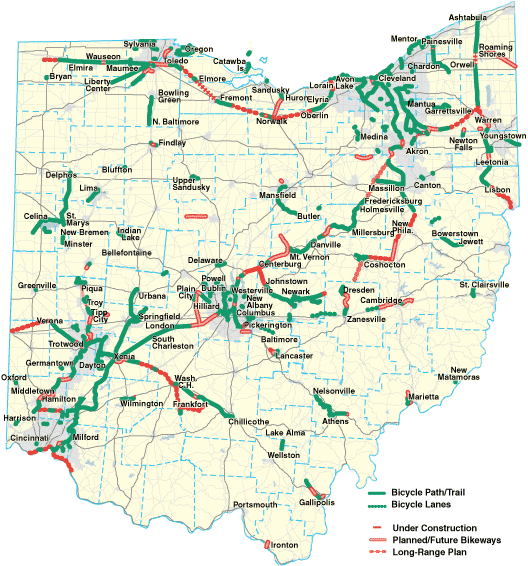
Note how much is already on the ground (green) vs what they need to do to (red). They have trails in urban areas they have trails that connect urban areas .
They have 3000 miles of trails and what do we have, like 500 miles? (I have to look that up) Even if you adjust for population (Ohio has twice the population we do) things still don’t add up.
Continue reading “If LAB ranks Maryland in the top ten, what does below average look like?”
Traffic Evaporation
[B’ Spokes: This needs to be part of BDOT’s vocabulary.]
******************************************************************
from OneStreet.org
Traffic evaporation is a phenomenon that has resulted from strategic removal of road space previously dedicated to motor vehicles. This is not the expected result. Imagine improving traffic flow by closing roads or lanes to cars! By recognizing this phenomenon and understanding the necessary factors to reach traffic evaporatation, some progressive cities around the world are enjoying a reduction in traffic as they transform these sequestered public spaces back into places for people to play, shop, relax and connect.
The European Commission is one of the first agencies to formally recognize and demonstrate this phenomenon in their 2004 report: Reclaiming city streets for people — Chaos or quality of life?
One of the most profound examples of reclaiming streets for people is taking place all across New York City. Make sure to click through this slide show of changes along Broadway and take a look at this video that highlights their experience with traffic evaporation:
…
https://www.onestreet.org/resources-for-increasing-bicycling/115-traffic-evaporation
Building Bike advocacy in Baltimore: Founders’ Summit
Saturday, February 25, 2012 from 9:00 AM to 5:00 PM (ET)
Baltimore, MD
I want to help plan the strategy of this new bicycle advocacy organization in Baltimore.
RSVP https://baltimorecycling.eventbrite.com/?ref=esfb
Event Details
Building Bike advocacy in Baltimore: Founders’ Summit
Cycling advocates have joined forces to create a new advocacy organization to serve the people who bike in Baltimore. You are invited to join other Baltimore cyclists to help create the strategy and next steps for success.
Join with others as committed stakeholders as you come together to ensure the future success of a new advocacy organization in Baltimore and its efforts to build a strong, inclusive, cycling community.
We will explore what we need from the new organization as cyclists.
We will learn from strategies and successes of other organizations who have been doing this work for a number of years.
We will build commonality around how to lead, support, and drive the new organization to success.
Ultimately, we will kick off a new era of cycling in Baltimore, and we hope you will give your valuable time and wisdom to create a strong advocacy organization to serve the people who bike in Baltimore.