
Location of Fatal Crashes – Maryland

https://www-nrd.nhtsa.dot.gov/departments/nrd-30/ncsa/STSI/24_MD/2009/Maryland_Map_1_GIS_DATA_2009.HTM
Howard County Bikeshare Survey
The Columbia Association, as part of a joint grant application with the County to study implementing a bikeshare system in the county, has created a short questionnaire. Your input would be greatly appreciated in understanding who would support a bikesharing program in Howard County and where users would like to go.
What is a bikeshareing system? Think of it as a bike taxi for short, one-way trips. One is able to pick a bike for a short trip and return in to a station near your destination. Check out a bike for your trip to work, get to the bus or train, run errands, go shopping, or visit friends and family. The stations, usually with 5-15 bikes are strategically placed to allow users to walk to a station and bikes are also equipped with locks so if you want, you can lock it and comeback to it later.
Please complete the questionnaire by Saturday, December 10, to assist us in our application for funding.
County Council accepts donation of Short Line Railway in Catonsville
"Under the agreement, Baltimore County will accept the 22.5-acres as a donation and take over maintenance of the trail in 10 years. In the interim, Catonsville Rails to Trails will complete construction on the 2.2-mile trail and maintain it until the 10-year period is up."
https://www.baltimoresun.com/explore/baltimorecounty/news/community/ph-ca-railstotrails-20111206,0,5434782.story
Janette Sadik-Khan: Taming New York’s streets [video]
Nicely done interview which got me thinking maybe Baltimore needs to institute some "pilot" projects. We need "more lets wait and see how this works out" then giving one community the power to rip out a bike lane withing a week that could effect half of Baltimore cyclists.
https://video.msnbc.msn.com/rock-center/45562585/#null
Holiday Lights Ride
When Friday
Time 7:00pm until 10:00pm
Description
Slow ride up to 34th St in Hampden [starting from City Hall] followed by ambiguous route on return
Biking on the ICC Shoulders?
[B’ Spokes: Since the ICC is just a few miles from the B&A Trail I consider this trail part of cycling amenities that we can enjoy, so this may be of interest.]
From MoBike
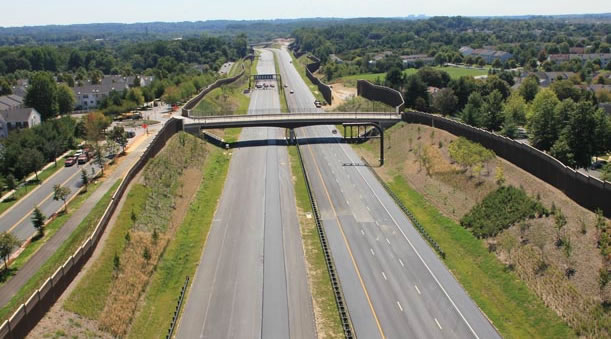
Bike advocates are asking the Maryland Transportation Authority (MdTA) to let people bike on the shoulders of the gleaming new ICC highway. Is this a crazy idea? Well, many other highways in the country allow it. Maryland already allows shoulder riding on parts of US 15 north of Frederick and many miles of US 29, including areas with highway interchanges where vehicles enter and exit via high speed ramps. To make the ICC shoulder use a greater possibility, in 2008 the Maryland General Assembly repealed the law prohibiting the state from allowing cyclists from all toll roads. But MdTA must still pre-approve it on individual toll roads.
Allowing cyclists on the ICC shoulders should be easy through the simple interchanges such as the ones at Georgia Ave., Layhill Road, New Hampshire Ave. (though heading west across Georgia Ave. may require getting off and back on the highway). A better level of usefulness is achieved if cyclists can ride on the shoulders at least from Emory Lane to Old Columbia Pike. That way riders can bypass several missing sections of the ICC Hiker-Biker Trail (one gap is between Emory and Georgia, a second between Layhill and Notley Road, and a third between New Hampshire and Briggs Chaney Rd.).
Fortunately there’s a service entrance at Muncaster Mill Road (a bit west of Emory) where cyclists should be able to get onto the shoulder from either Muncaster Mill or from the path (if MdTA is willing to unlock the gate). At Old Columbia Pike (a few miles east of New Hampshire), access to the south shoulder is easy, but getting to the north shoulder means building a short connector path running down the bank next to the highway. That requires money and federal re-permitting, so it would be a tough sell. But it would address the longest and most intractable gap in the ICC trail – namely the section through the Upper Paint Branch Park. Other non-interchange crossings – Redland Road for example – would require pushing enough dirt around (re-grading) that they’d probably be summarily rejected by MdTA. At the US 29, I-95 and I-370/Metro interchanges, shoulder use might be precluded by the complex arrangement of ramps and flyovers, at least for some directions of travel, but this should be investigated.
Access to the ICC shoulders east of Briggs Chaney Rd. may be possible at the Briggs Chaney interchange, but it’s sandwiched by two difficult interchanges.
You can decide for yourself where to provide shoulder access using the following map (click for a larger map). Assume access is easy at the blue stars and somewhat expensive at the green stars. Shoulder use might be limited or prevented at the red stars due to complex interchanges (TBD).
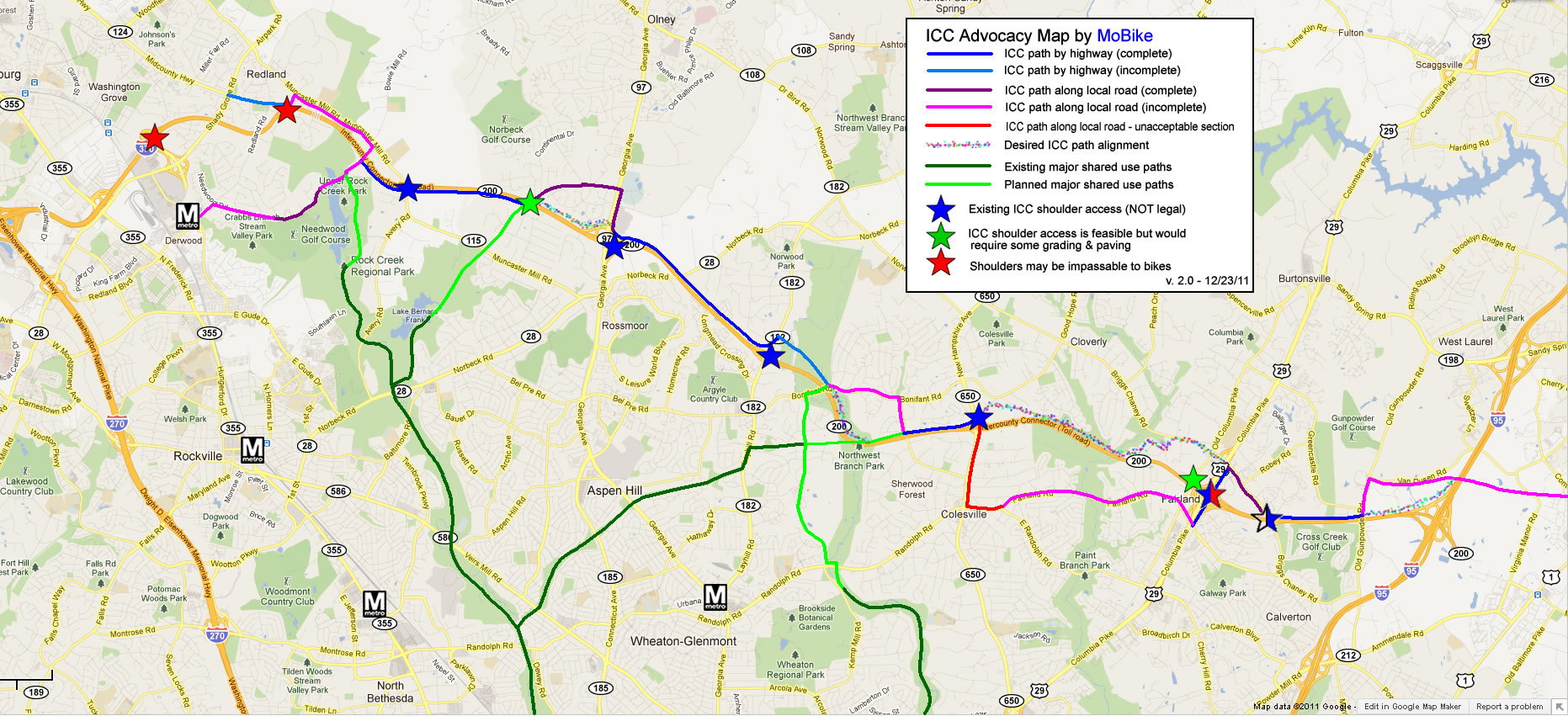
ICC map showing various trails and shoulder access points (click to enlarge)
The state’s response to our request for shoulder access was disappointing. Here are their basic reasons for opposing shoulder use (I’m not agreeing, just summarizing):
- Inexperienced cyclists or families might use the shoulders to get from one section of the path to another (since the path is not continuous).
- Cyclists would have to cross high speed ramps, especially at the US 29 and 1-95 interchanges.
- Drivers wouldn’t expect cyclists and might slow down when they encounter one, adding to congestion.
- The tolling system would register a toll violation that would have to be cleared manually.
- Cyclists might venture too close to the travel lanes and might not understand the wind effects of trucks.
- Cyclists could interfere with emergency vehicles and would have to ride around vehicles stopped in the shoulder.
- Addressing these concerns may require physical design changes which could impact cost, environmental permits and the functionality of some features (like guardrails).
Our answers:
- Use well-established ramp crossing designs (see below).
- Do not allow bikes on the flyover ramps, but investigate alternatives such as permitting cyclists to ride straight through the US 29 interchange, etc.
- Prohibit all cyclists under 16 (or whatever).
- Require riding in single file and in the direction of traffic.
- Post warning signs about truck drafts, etc.
- Build more path so the shoulder doesn’t look so attractive. We especially need the path between Layhill Rd. and Notley Rd. (Northwest Branch Park) and between New Hampshire Ave. and US 29 (Upper Paint Branch Park).
- Done right, there wouldn’t be any locations where the path ends where riders could conveniently hop onto the shoulder, so novice users would not be tempted to ride on the shoulder when the path ends.
Bikes would cross on-ramps something like this (but without the bike lane symbols on the pavement):
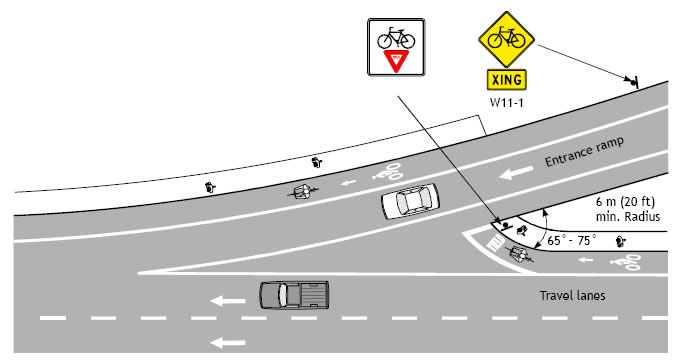
On-ramp crossing design for bikes (from Oregon Bicycle/Pedestrian standards).
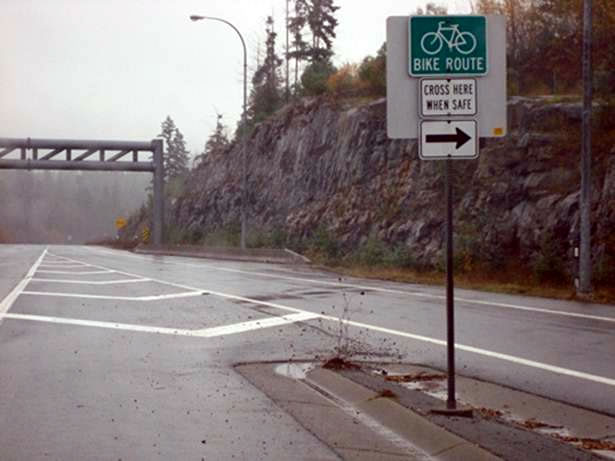
A real life example from British Columbia
Now if we could just get more of the ICC path and the connector paths built. For now we have this (where the trail ends at Needwood Road):
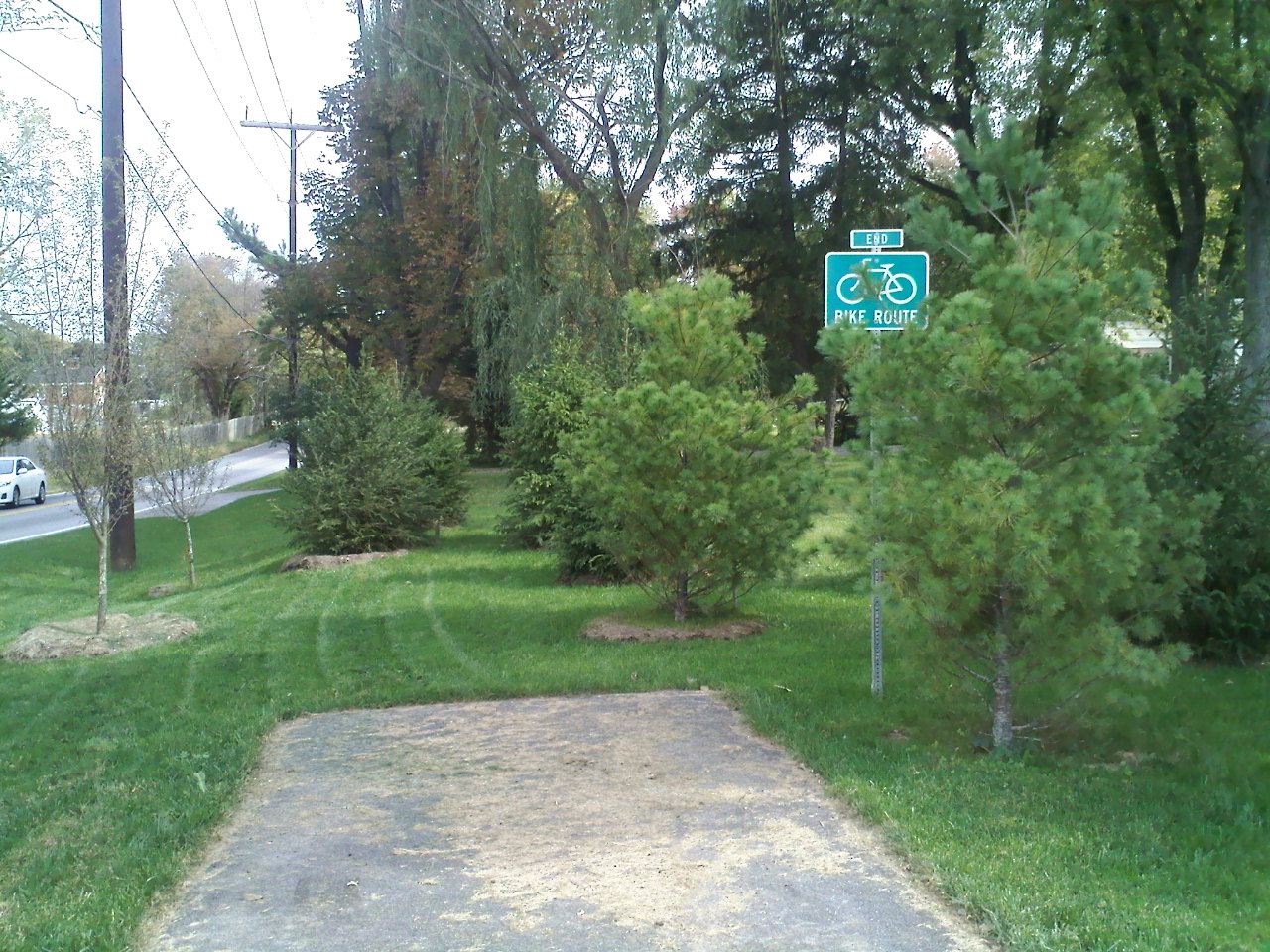
End of the road (for bikes)
Jack Cochrane
MoBike
NYPD’s Handling Of Traffic Crash Investigations Will Be Investigated
From the Gothamist (follow the link in Read More for the links and a list of horrific stories where the driver went without charges.)
About 100 people gathered outside NYPD headquarters this morning to call on the NYPD to hold reckless drivers accountable, instead of routinely letting them cruise off into the sunset with "no criminality suspected." Many of those in attendance identified themselves as cyclists—or relatives of killed cyclists—but others turned out to represent pedestrians, including one Park Slope resident who was nearly killed while crossing Carroll Street in 2009. Witnesses, including a reporter for the NY Times, said the driver was speeding when he ran over Hutch Ganson at the intersection of Eighth Avenue and Carroll, but no charges were filed.
"I lost half my head," Ganson told us, adding that he sustained traumatic brain injury, a broken leg, all his ribs were broken, as well as the bones in his face, he was in a coma for a month, and wasn’t released from the hospital until four months after the accident. Formerly an executive at AIG, he has been unable to work since the accident, and he now suffers from aphasia. Ganson and his wife Donna said they attended the rally because they want reckless drivers to face consequences for their actions.
Relatives of deceased artist Mathieu Lefevre, who was killed by a flatbed truck driver while biking in Williamsburg last month, were also at the rally, once again demanding an explanation from the NYPD about why the man who ran over their son and left the scene wasn’t charged. Lefevre’s mother Erika Lefevre told reporters, "I never expected to be standing in the same spot today where I stood over a month ago, asking the NYPD to please release the information it has about the death of Mathieu. In that month, we have made many, many requests to the NYPD for information, including Freedom of Information requests. But we’ve gotten almost nothing." (FYI, here’s the accident report.)
Mathieu Lefevre (Courtesy Lee Brunet) Lefevre’s family is seeking a copy of the coroner’s report, the videotapes that the NYPD says they have, and any other evidence. As previously reported, the detective at the NYPD’s Accident Investigation Squad has not been responsive, and Lefevre’s mother only learned that the driver—who was not found for several days—would not be charged by reading it in the media. Last month, an NYPD spokesman told us simply that the driver "did not know that he hit the cyclist." Lefevre’s former wife, Juliana Berger, also spoke, and said that after the driver parked his truck two short blocks away, he drove past the scene of the accident in his personal car. "Why didn’t he stop then?" she asked.
Transportation Alternatives Executive Director Paul Steely White announced this morning that the group would launch a comprehensive investigation into the NYPD’s traffic crash investigation practices. The investigation will "closely review and evaluate" the NYPD’s reports on scores of recent crashes that resulted in serious injuries or deaths. The group, which brought almost 3,000 letters from New Yorkers demanding "traffic justice," hopes the probe "will uncover whether police investigators followed proper procedures." The NYPD’s "cavalier attitude to the epidemic of lawless driving is absolutely unacceptable," White said.
Public Advocate Bill de Blasio also announced that his office is looking into the NYPD’s Accident Investigation Squad. Spokesman Wiley Norvell told reporters, "To New York State’s credit, recent laws enacted in Albany have put new tools in the hands of prosecutors to hold accountable people who kill or seriously injure others through negligence behind the wheel. One such law—Elle’s Law—serves the critical purpose of taking dangerous drivers off the road. But we must ensure those laws live up to their potential and intent. To do so, today my office requested data from the New York City Police Department on its enforcement relating to Elle’s Law and regarding the circumstances under which it deploys its Accident Investigation Squad."
Transportation Alternatives announced that between 2001 and 2010, 1,745 pedestrians and bicyclists have been killed in New York City traffic and 142,485 have been injured. According to an analysis of 80 contributing factors associated with crashes tracked by the New York State Department of Motor Vehicles, 60 percent of fatal pedestrian and bicyclist crashes with known causes are caused by driver’s dangerous and illegal behavior. Yet the NYPD routinely declines to charge drivers involved in these accidents, and today the group released this heavy tally of carnage, from 2011 alone:
Continue reading “NYPD’s Handling Of Traffic Crash Investigations Will Be Investigated”
City building bike trail to connect Penn Station and Inner Harbor
About 16 months from now, bicyclists will be able to ride from the Inner Harbor to Pennsylvania Station on a smooth path all their own.
…
https://www.baltimoresun.com/news/maryland/bs-md-bike-trail-construction-20111129,0,4417518.story
Haiku Traffic Signs Bring Poetry To NYC Streets
[B’ Spokes: I wish there was this kind of creativity here. We are pretty much stuck with just ticketing j-walkers as the most anyone will do around here. ]
A sampling from the article by NPR
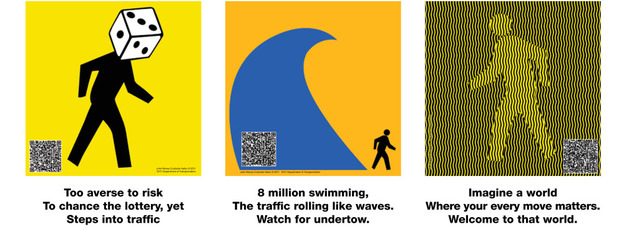
https://www.npr.org/2011/12/03/143053082/haiku-traffic-signs-bring-poetry-to-nyc-streets