Wrong way sidewalk bicyclist hit

A bicyclist was rushed to the Maryland Shock Trauma Center in Baltimore on Monday night after he was hit by a sport utility vehicle on Chinquapin Round Road in Annapolis.

At 10:13 p.m., police and firefighters were called to Chinquapin Round Road near the Lincoln Park Laundry. There they found a man lying next to his bicycle and the Nissan Xterra that struck him.

Police said the victim was riding southbound on the northbound sidewalk of Chinquapin Round Road and was riding across the cross street when he was hit by the SUV as it pulled into the laundry.

He was flown to shock trauma and his condition became critical en route, police said.

On Tuesday, police said the man was recovering and was likely to be released from the hospital by yesterday.
Continue reading “Wrong way sidewalk bicyclist hit”

Plan proposes 34 miles of bicycle routes around Annapolis

[B’ Spokes: Historically Maryland gets $1 million a year just for trails like this (Recreational Trail Program) but sadly MDOT’s made up policy says no we don’t want to fund trails like this and we don’t want to put out any public accounting on how we spend a million bucks. Ref https://www.baltimorespokes.org/article.php?story=20100430170721104 ]
********************************************************************************
By Andrea F. Siegel, The Baltimore Sun
An off-street bike trail links Truxton Park in Annapolis to the Bates Sports Complex. A bicycle lane runs along Edgewood Road between the Back Creek Nature Park and Bay Ridge Road. A snippet of shared bicycle-motor vehicle lane cuts the angle from Bladen Street to Northwest Street.
There are six miles of trails in the city, but few connections between them, and almost no markers to point out routes to popular destinations.
The city council is considering a plan to create a network of 34 miles of marked bicycle routes: a mix of bike lanes on city streets, shared-use lanes for drivers and cyclists, and off-road paths.
In addition to routes that avoid the busiest sections of major roadways, said Iain Banks, the city’s personal transportation and parking specialist, the plan also includes safety and educational programs, promotion of bicycling, links to other forms of transportation and bicycle parking.
Bicyclists praised the plan, an 86-page document that lays out a long-term strategy, and officials say the point is to create an environment that allows bicycles to be used safely for transportation and recreation.
But the larger issue may be whether the cash-strapped city will be able to implement it. The price for turning the plan into reality is $2 million in the first five years, with a total of $3.4 million over a decade.

Continue reading “Plan proposes 34 miles of bicycle routes around Annapolis”

Leopold Seeks Input on County Pedestrian/Bicycle Plan Update

County Executive John R. Leopold has started a comprehensive study of pedestrian and bicycle facilities in the County’s suburban and urbanized areas and has called upon citizens to become part of the process by attending public meetings and/or applying for appointment to the Citizens Advisory Committee.

The study aims to identify deficiencies in the current network of sidewalks, trails, on-road travel lanes, crosswalks, etc. and develop a systematic way to prioritize improvements as funds become available or as development occurs. The study will focus primarily on accommodating day-to-day transportation activities, such as travel to work, school, libraries and shopping.

Approximately 80% of the study is funded through a Federal transportation planning grant and it is expected to take about eighteen months to complete.

"Walking and bicycling are alternate modes of travel that should be encouraged and supported within our infrastructure," said Mr. Leopold. "This study will identify areas where improvement is needed."

In the meantime, the study will help the County identify those important projects that can be undertaken with limited resources and will serve as a guide for projects constructed by developers and Federal and State funding opportunities.

In addition to conducting a series of public meetings, the County Executive will appoint a Citizens Advisory Committee (CAC) who will work with the Office of Planning and Zoning (OPZ) and project consultant to provide ongoing citizen and community perspective.

OPZ will announce dates and locations for three public listening sessions in order to solicit citizen input regarding the presence, adequacy or lack of pedestrian and bicycle facilities and amenities in their communities. Members of the public who wish to apply for an appointment to the Citizens Advisory Committee should contact the Office of Planning and Zoning, Transportation Division.
Continue reading “Leopold Seeks Input on County Pedestrian/Bicycle Plan Update”

ICC director appointed to lead state highway agency

[B’ Spokes: Since Neil Pedersen was bike friendly, we hope Melinda Peters well be as well.]
***********************************************************************************************************************************
"[Melinda] Peters replaces Neil Pedersen, who retired in the summer as state highway administrator."
https://www.washingtonpost.com/local/commuting/icc-director-appointed-to-lead-state-highway-agency/2011/11/17/gIQAtW6lVN_story.html?socialreader_check=0&denied=1

Fort Meade project hearing Thursday

[B’ Spokes: Sorry too late to go to the hearing but at least accommodating bicycles is part of the project.]
**********************************************************************
FORT MEADE — State and federal officials will hold a public hearing Thursday to discuss a project on Route 198 that would improve access to Fort George G. Meade.

A planning study has focused on Route 198 in Anne Arundel County. The goal is to improve traffic capacity along the roadway and increase motor vehicle and bicycle safety, while supporting development in the area. Route 198 provides direct access to Fort Meade from Route 32, the Baltimore-Washington Parkway and points south and west of the study area.

Continue reading “Fort Meade project hearing Thursday”

Metrolink bike train cars

from Rebuilding Place in the Urban Space by Richard Layman

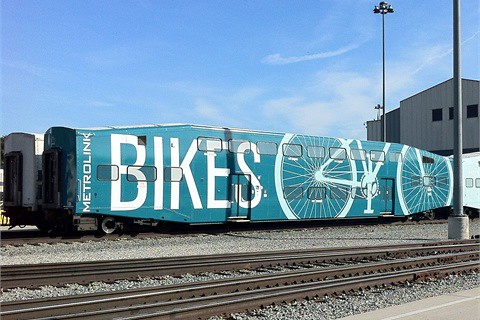
Notions Capital sends us the link to this piece from Metro Magazine, “Metrolink launches ‘bike cars’ to transport cyclists,” which includes this great image.
Metrolink bicycle train car
Standard Metrolink cars can carry two bikes (presumably on hooks), the cars with the bike wrapping (or other indicators) can carry 18 bikes and at least initially will run on weekends on the “Inland Empire” trains providing service to beach communities.

This Streetsblog LA entry from August, “Box: Metrolink Passes Bike Friendly Test,” has images of the interior of the train cars.

Continue reading “Metrolink bike train cars”

Details of Baltimore’s bikesharing deal

From Beyond DC

Baltimore is planning to launch its bikesharing system next summer, and is moving forward ironing out the details.

According to The Bike-sharing Blog, Baltimore is shooting for a 30-station, 250-bike system focused around downtown and Fells Point. They are planning on calling the system Charm City Bikeshare, to compliment the branding of the Charm City Circulator bus system.

Earlier today the city announced that they have officially selected Bcycle to build and operate the system. Bcycle operates Denver’s extensive bikesharing network, as well as smaller networks in nine other US cities. They are the primary US competitor to Bixi, which operates four networks in the US, including Capital Bikeshare.

It’s unfortunate that Baltimore and DC will be using different systems, and therefore won’t be able to cross-honor memberships. Nonetheless, bikesharing has proven to be an effective and affordable form of urban transportation, so it’s exciting to see more and more cities taking it up.
Continue reading “Details of Baltimore’s bikesharing deal”

"auto-oriented cities spend twice as much"

-> "’As people drive less, governments also should prepare for a drop in revenue from fuel taxes, an eventuality that could in itself limit how many roads are built,’ Mr. Tomer says. But over the long term, building fewer roads could bring economic relief to cities and their residents, as auto-oriented cities spend twice as much to get people around than cities that rely more heavily on public transit, walking and cycling."
— Anita Elash, The Globe and Mail
https://bit.ly/rIUEhs
from CenterLines, the e-newsletter of the National Center for Bicycling & Walking.