Belinda Conaway and the bike lane

[B’ Spokes: I’m bring this to the top again to express my reaction to Conaway seeking write-in votes.]


from Charm City Current by Adam Meister

The following Light Street Cycles Facebook post  speaks for itself. I have no idea why Belinda Conaway would want to get rid of a functional asset in a poor community. It does not seem very logical (like another decision of hers).

“A letter sent to City Council Representatives, DOT, and leaders in my communities:

This has been an interesting first month for me as the Interim Chair of the Mayor’s Bicycle Advisory Committee in Baltimore. On the day that I volunteered to fill in, I discovered that the City had just installed a new bike lane. This bike lane is on Monroe St. It is nicely done, provides a safe exit from the Target store, leaves plenty of room for car traffic…and is scheduled to be removed.

Let’s look at what other interesting facts came to light during this past month:

Baltimore’s air quality is abysmal. According to a recent Environment America report, the Baltimore metro area is one of the smoggiest metropolitan areas of the country.

Additionally, Baltimoreans are some of the most dangerous drivers in the country. In the 2011 Allstate Best Drivers Report, Baltimore ranked 2nd to last in safe drivers for the second year in a row.

Now remember that a large portion of our population does not have access to a car – about 32%, according to a 2005 report by the Abell Foundation. Six years later and three years into a recession, and the need for safe, affordable transportation for low and middle income residents such as those in the Monroe St. area is growing.

The Councilwomen demanding to have the bike lane removed, Belinda Conaway, is acting in direct contradiction to a recent City Council Resolution known as “Complete Streets,” which requires the City’s DOT to, when possible, make a street bike and pedestrian safe when repaving is done. She is circumventing a Resolution that she herself co-sponsored.

In Summary:
Councilwoman Conaway has succeeded in convincing the Baltimore Department of Transportation to circumvent the Council resolution she co-sponsored just last year. Baltimore’s current air quality is unsafe, and bike lanes will encourage people to drive less, thus reducing emissions and improving the health of everyone in the city. Bike lanes do exactly what car lanes do – help prevent accidents by separating the traffic, and this lane is being removed in the face of a report telling us that Baltimore is 192nd out of 193 major cities in the U.S. with respect to safe driving. Not only do young, energetic people and environmentally concerned citizens want to bike commute, but some of our residents have very little choice economically. At present, all of these individuals, throughout the socio-economic spectrum, are risking serious injury just to get to work, school, or the grocery store.

Whether by choice or necessity, more people are bicycling in Baltimore. They have a right to do so safely. The cycling community worked to get City Council to agree to Complete Streets, only to see Council abandon the Resolution rather than stand up for the underserved. Bike commuters in Baltimore include fathers and mothers, students, teachers, doctors, waiters, IT specialists, state’s attorneys, construction workers, business owners, professional athletes, the underemployed, and the homeless. Bicyclist fatalities from car accidents in the Baltimore metro region in recent years have included a retired grandfather, a Hopkins engineering student, a 13-year-old child, the owner of a construction company, and a Green Party politician. City Council needs to support it’s own resolution on Complete Streets. We need our city government to lead us with a clean, healthy, progressive vision for the future – not just coast along aimlessly on this issue. Otherwise, in the future, we will continue burying more than just our City’s prospects for growth and prosperity.

Penny Troutner, Interim Chair, Mayor’s Bicycle Advisory Committee
City resident, 3rd Council District
Business owner, 10th Council District

https://content.usatoday.com/communities/greenhouse/post/2011/09/smoggiest-us-cities-not-just-calif/1 
https://www.allstatenewsroom.com/channels/News-Releases/releases/seventh-annual-allstate-america-s-best-drivers-report-reveals-safest-driving-cities 

https://www2.citypaper.com/news/story.asp?id=11464  


Continue reading “Belinda Conaway and the bike lane”

What the Cycling Movement Can Learn from Occupy Wall Street

Excerpt from Streetsblog Capitol Hill by Angie Schmitt

Jonathan Maus at Bike Portland attended both his local protests and it got him thinking about the parallels between Occupy Wall Street’s rallying cry — “We are the 99 percent” — and the 68 percent of city dwellers who say they would bike if they felt safe enough. He wonders if bike advocates could take a page from this phenomenon:

Let’s, for the sake of discussion, compare the “top 1 percent” with the last century of auto-dominated urban planning and its ongoing primacy due to the politics around transportation funding.

And many of you are aware that bicycling dominated American life in the late 19th century, only to be all but eradicated by the onslaught of the automobile (which, ironically, took over the “good roads” bike lovers pushed for). The dominance of auto-centric development, policies, and roads are what have led to the situation where we currently have only 0.6 percent of our fellow citizens who use a bicycle as their primary means of getting to work.

Outrageous right? The 68 percent should be marching in the streets! People deserve equal levels of safety whether they choose to drive a car or ride a bike!

To make change in America that’s not supported by corporations or the existing power structure (both of which apply to bicycling), you need people in the streets. It’s as simple as that. Conferences, summits, meetings with politicians, and new laws will only get you so far.

Continue reading “What the Cycling Movement Can Learn from Occupy Wall Street”

GM ad urges college students to ‘Stop pedaling…start driving’

From Bike Portland:

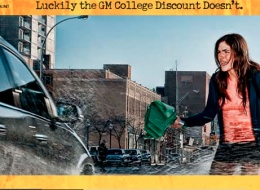
General Motors’ latest ad campaign running in college newspapers throughout the country urges students to ‘Stop pedaling…start driving.’

image

Image from GM website.

The newspaper ad features a guy on a bike ashamed that his “reality” involves riding a bike while a cute girl drives by in a car. “Reality Sucks,” says the campaign, “Luckily the GM college discount doesn’t.” GM’s website  continues the mockery of active transportation by featuring a woman on the sidewalk being sprayed by a passing GM vehicle.

An image of the ad was sent to me by a source who saw it in the UCLA Daily Bruin  newspaper. The source is a professor at UCLA and he included this note (emphasis mine):

“Not only has GM violated the norms of decency with the use of this crudity in a student newspaper, UCLA’s Daily Bruin, it has violated the decency and courtesy appropriate of a debtor. GM, the company that required us taxpayers to bail it out in 2009, is now biting the young people who bear and will bear the environment and health damage of its gas swilling ways. While every driver in LA knows that the reality which truly “sucks” is the grid-locked, car-loaded, obesity-enhancing, stress-generating car-toxicity of simple commuting in this region. The company that helped destroy public transit in Los Angeles is now running a campaign to convince students who travel by environment-, fitness-, and efficiency-friendly bicycles that they are inferior to those who travel in highly discounted mini-trucks. Shameless, isn’t it?”

Yep. Shameless. But just more of the same from the auto industry.

Continue reading “GM ad urges college students to ‘Stop pedaling…start driving’”

Bikepath-crazy in Clarksburg

[B’ Spokes: Please see our poll and vote for what kind of bicycle accommodations you want to see.]


from CycleMoco by MoBiker

The 1994 county master plan for Clarksburg  called for many bikeways in rapidly growing Clarksburg.  Check out the plan map .  But almost all of the bike routes called for by the plan for east of Rt. 355 in Clarksburg were shared use paths next to roads.  None of the roads, including brand new roads, were to have wide lanes or bike lanes.  That makes Clarksburg pretty unaccommodating to cyclists wanting to go more than 10 mph, avoid collisions with turning cars, or avoid dogs and small children (or children and small dogs?) for their sake if not for yours.   I guess planners had different views then.  There were comments like this:

Emphasize bike paths which are separated from streets and roads:  The recommended rights-of-way for arterial roads and highways in Clarksburg are intended to be wide enough to allow space for separate bike lanes.

Wow, they confused the term “bike path” with “bike lane”.  They actually mean bike path (the correct term is “shared use path”).

At least they’re consistent.  Having only shared use paths means bicyclists who prefer paths never have to ride in the road.  It serves one set of bicyclists very well, albeit with lots of hidden dangers.  But it leaves lots of other cyclists (those who don’t like to take the lane, anyway) in the cold.  MoBike has tried to steer the county towards safe bikeable roads as well as paths.

Jack Cochrane
MoBike

Continue reading “Bikepath-crazy in Clarksburg”

Swift justice for a cyclist in PA

From The Sentinel

A Walnut Bottom bicyclist was taken to Chambersburg Hospital after he collided with a truck in Southampton Township earlier this week.

State police at Carlisle said David E. Klopp, 33, was riding his bicycle south on Baltimore Road when a 2008 Dodge 1500 passed him just before the intersection with Koser Lane.

After passing Klopp, the driver of the truck, Roger E. Chestnut, 54, of Shippensburg, made an immediate right turn onto Koser Lane, police said.

Klopp was unable to stop his bicycle as the truck turned in front of him, and the bicycle hit a trailer being towed by the truck, police said.

Klopp suffered a minor injury and was taken to Chambersburg Hospital for treatment, police said. He was wearing a hospital. [Probably meant helmet.]

Chestnut was not injured and was charged with careless driving, police said.

Continue reading “Swift justice for a cyclist in PA”

The death penalty for being in full compliance with the law

From the Baltimore Sun Bicyclist struck, killed by vehicle in Anne Arundel County

Police said Young was riding on the right lane of the highway, which did not have a shoulder and had little ambient lighting.

Young was wearing dark non-reflective clothing on his bike that had a makeshift headlight, which was on. The bike also had a red LED-flashing light on the back which police say did not appear to have been turned on, leaving one small reflective lens to make Young visible.

Police say the driver did not see Young in the lane in front of him.

Bicyclist visibility and possible driver error appeared to be significant factors in the accident, police said. Alcohol or speed were not suspected.

First our law:

§ 21-1207.(ii) On the rear, with a red reflector of a type approved by the Administration and visible from all distances from 600 feet to 100[0 ??] feet to the rear when directly in front of lawful upper beams of head lamps on a motor vehicle.

That “one small reflective lens” is our legal requirement and no more is needed to be legal. Are there issues with the national [and local] standards, you bet. And have we tried to change those standards? Again yes but the Consumer Product Safety Commission asserts that this“one small reflective lens” is the “best” standard.

So could a cyclists go to an automotive or hardware store and get a better reflector then one that comes standard on the bike, sure but would that be legal? Technically probably not so if AA Police assertion is valid cyclists are in a legal Catch 22 but more to the point why are we not asserting the Basic Rule for driving on the highway:


§ 21-801. Basic rule

(a) Reasonable and prudent speed required. — A person may not drive a vehicle on a highway at a speed that, with regard to the actual and potential dangers existing, is more than that which is reasonable and prudent under the conditions.

(b) Driver to control speed. — At all times, the driver of a vehicle on a highway shall control the speed of the vehicle as necessary to avoid colliding with any person or any vehicle or other conveyance that, in compliance with legal requirements and the duty of all persons to use due care, is on or entering the highway.

Drivers CANNOT overrun their headlights, so not seeing the cyclist is a confession of guilt of not driving at a prudent speed for conditions. If the police have a problem with bicycles reflective standards then take it up with Consumer Product Safety Commission in the meantime that is what is legal and we are not at fault for not exceeding what the law requires.

If you are concerned contact:
Col. James E. Teare, Sr., Chief (410) 222-8500
8495 Veterans Highway, Millersville, MD 21108
e-mail: jteare@aacounty.org


Washcycles coverage:

A cyclist – 40 year old Matthew Young – riding on Veterans Highway in Severna Park on Friday night (7:30pm) was hit from behind and killed. “Investigators do not believe that either speed or alcohol were factors in the crash. They have cited “bicyclist visibility” as the apparent cause of the accident, and noted the fact that the accident occurred at a particularly dark location on Veterans Highway, as well as the fact that Young was wearing dark non-reflective clothing.” There’s a pretty wide shoulder there. Was the cyclist on it? More here: “Police said the bike he was riding had a makeshift headlight, but a flashing light on the back of the bike does not appear to have been on.” Can they tell after a bike has been hit from behind? Maybe they have witness testimony?