Hagerstown receives Bicycle Friendly Community Honorable mention

from Bikeleague.org Blog by Meghan

The League of American Bicyclists announces a new round of Bicycle Friendly Community (BFC) designations that includes 11 new and 14 renewing communities today at the Interbike Expo in Las Vegas, Nev. “The League congratulates all of our BFC winners for implementing successful, long‐term bicycle plans and programs that provide quality of life improvements for their citizens,” said League President Andy Clarke. “Cities are choosing investment in bicycling, even in tough economic times, as a key to building the places people want to live, work and visit.” There are now 190 BFCs in 46 states.

Fall 2011 Honorable Mentions

  • Hagerstown, Md.


Continue reading “Hagerstown receives Bicycle Friendly Community Honorable mention”

Best way to get to the Solar Decathlon: On a Bike!

[B’ Spokes: In case anyone is thinking of going.]
*****************************************************
from WABA Quick Release by Greg Billing
[Thursday, Sept. 22 – Sunday, Oct. 2]
The 2011 United States Department of Energy Solar Decathlon brings twenty college teams from the around the country and world to compete this month in Washington DC to build the most energy efficient solar powered house. The project teams have been working for the past two years to design, build and transport an 800 square foot house to be judged in 10 different categories (hence a decathlon) including engineering, architecture, communications and more.

Learn more about the Solar Decathlon at solardecathlon.gov and about WABA’s bicycle routes and valet for this event at https://www.waba.org/events/solardecathlon.php. We would like to thank Perkins + Will for their generous support of the Solar Decathlon and the bicycle valet.
Take our advice – bike to the Solar Decathlon!
https://www.waba.org/blog/2011/09/best-way-to-get-to-the-solar-decathlon-on-a-bike/

Memorial bike ride honors 2010 Green Party U.S. Senate candidate

Victim’s mother, cyclists continue fight for safer roads
by Natalie McGill, Staff Writer – Gazette
Sophie Chan-Wood didn’t know Natasha Pettigrew, but when the avid cyclist heard about a Saturday morning memorial ride honoring the Cheverly woman, she saw an opportunity to ride to Prince George’s County via the Watts Branch Trail from Washington, D.C.
However, it wasn’t until the Rockville woman was hundreds of feet from the site of the Sept. 19, 2010, hit and run that claimed cyclist Pettigrew’s life that the car honking began, a reminder that both motorists and bicycles should be able to share the road.
Chan-Wood was among a group of 20 including Pettigrew’s mother Kenniss Henry that gathered on Largo’s Prince George’s Community Campus for a memorial bike ride in honor of Pettigrew and Henry’s mission to make roads safer for cyclists and pedestrians.
"Unfortunately the circumstances of why we’re here still bring a lot of pain to me," Henry said to the group before the ride which circled Upper Marlboro’s Watkins Regional Park before returning to campus. "She grew from being my daughter to being my best friend."
Pettigrew, 30, was riding her bike about 5:30 a.m. near the intersection of Campus Way South and Route 202 when driver Christy Littleford of Upper Marlboro struck her from behind with her sport utility vehicle. Pettigrew, a Green Party U.S. Senate candidate who was training for a half-triathlon, died from her injuries on Sept. 20, 2010.
Littleford, who thought she hit a deer according to Maryland State Police, dragged the bicycle underneath her SUV all the way back to her Upper Marlboro home before realizing she had struck Pettigrew instead. The most Littleford could face is a charge for leaving the scene of the accident but Henry said she doesn’t know what penalty she could face. Littleford will not face wrongful death charges because there were no witnesses, Henry said.
Michael Turner of the Mount Rainier Bicycle Co-Op, helped plan the ride, wanting to have it close to the site of the Sept. 19, 2010, incident as a gesture of healing. Henry said Turner reached out to her earlier this year after hearing about Pettigrew’s story.
Henry went to Annapolis two to three times a week during the 2011 Maryland General Assembly session, encouraging legislators to toughen the laws on vehicular manslaughter. Her persistence paid off when elected officials passed Maryland House Bill 363 "Manslaughter by Vehicle or Vessel Criminal Negligence." The bill, which becomes law on Oct. 1, lessens the burden of proof a prosecutor needs to prove a driver was grossly negligent and could guarantee an offender three years in jail, a $5,000 fine or possibly both, Henry said. Previously prosecutors needed to meet a high burden of proof such as intentional gross negligence on the part of the driver, Henry said.
Henry said she encountered push back from legislators who told her she was trying to put mothers and grandmothers in jail who hypothetically could be distracted by children or grandchildren and accidentally strike a pedestrian or cyclist, Henry said.
It’s not an issue if the driver actually stays on the scene, Henry said.
"When you hit someone and you leave and you act as if you had the right to hit them and the right to leave, that’s my issue," Henry said.
Turner said more people would bike rather than drive if major roads such as Routes 202 and 450 had more bike lanes but the perception is you cannot because the roads don’t allow space for bike lanes. Any development scaled to accommodate a wheelchair could likely benefit pedestrians and bicyclists, he said. Turner cited an example of parents of Mount Rainier Elementary School students who drive across Rhode Island Avenue to drop off kids rather than walk because it’s safer.
"Our infrastructure should accommodate the mobility of everyone and our infrastructure doesn’t do that right now," Turner said. "It accommodates the motorist foremost."
Continue reading “Memorial bike ride honors 2010 Green Party U.S. Senate candidate”

Your bicycling as a regular mode of transportation dollars at work

[B’ Spokes: So Maryland limits its use of Transportation Enhancement money to just trails and the federal regulation says that it MUST be used for transportation purposes and not recreational. While the form below is certainly better then the ticketing going on the Anacostia trails that close at dusk but I do have to ask why are so many roads in Maryland not really bike friendly? Oh, there is no money and/or no plan to accomplish that that. That’s because the State’s Strategic Trail Plan is the cat’s meow, that is till you realize that it is keeping money from on-road bicycling facilities. I guess we should modify State Law to read as follows [additions in square brackets] § 2-602 "State to include enhanced transportation facilities [that require liability wavers or to be closed at dark] for pedestrians and bicycle riders … (1) Access to and use of transportation facilities by pedestrians and bicycle riders shall be considered and best [minimal] engineering practices regarding the needs of bicycle riders and pedestrians [and liability wavers for the use of the aforementioned facilities shall be in the best legal practices."
There has to be something better then the current practices, I’m OK with accepting some responsibility if I bike a trail at night but it would not kill these guys to use more reflective tape either (in other words think about night time use and make some accommodations.) Removing the barriers for biking and walking and providing more options for biking and walking should be the goal here and liability wavers should be a warning sign that we are not were we should be.]
********************************************************************************************************************
APPLICATION AND WAIVER OF LIABILITY FOR AFTER HOURS BICYCLE USE
“BICYCLE COMMUTING”
This form is an application and waiver of liability/assumption of risk for after-hours
bicycle use (“Bicycle Commuting”) for commuting within the Avalon/Glen Artney area of
Patapsco Valley State Park.
The Maryland Department of Natural Resources (“DNR”) and the Maryland Park Service
(“MPS”) support green alternatives in commuting. As such, DNR/MPS recognizes people
interested in commuting by bicycle as an alternative to heavily traveled roadways. However, most
areas of Patapsco Valley State Park were not designed for night time use. There is no lighting –
either walk-way lights or street lights – in most of the day-use areas. Staffing levels do not allow
staff on duty 24 hours a day; therefore, there is no commitment or guarantee by DNR/MPS for
response to injuries or incidents after hours. In addition, the Avalon/Orange Grove/Glen Artney
areas of Patapsco have very poor cell phone coverage and only one pay phone is located along the
route that most bicycle commuters would travel. DNR/MPS cannot guarantee or ensure road and
trail conditions nor ensure road and trail conditions during inclement weather that occurs outside
of normal operating hours for the park. The Grist Mill Trail does not have ice or snow removal as
part of routine maintenance.
Anyone wishing to commute after-hours through this area is required to obtain a permit and sign a
waiver of liability. The following safety equipment must be used by all after-hours commuters:
Headlights, reflectors, and helmets. In addition all Bicycle commuters will be required to use the
paved portion of the Avalon, Orange Grove, Glen Artney areas of Patapsco to commute via bicycle
between South Street (Baltimore County) or River Rd. (Howard County) and Illchester
Rd.(Howard County). Map of acceptable routes are attached. Further, due to poor cell phone
coverage you are responsible to alert a family member or co-worker of your intended route and
travel time frame and provide them with the Park Watch number 800-825-7275 or 410-260-8888,
for emergency assistance.
Continue reading “Your bicycling as a regular mode of transportation dollars at work”

Finding Smart Growth along the GAP Trail

By David T. Whitaker, AICP 

A seldom discussed element of Smart Growth involves trail corridors and the ability of communities large and small to create profitable businesses, home-grown employment opportunities and a renewed sense of place along abandoned rail lines and other newly developed multi-purpose trail corridors.

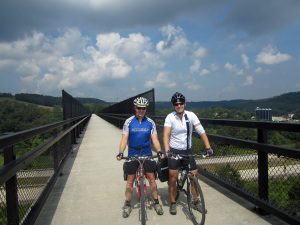
David and Jamie on GAP Trail

An exceptional example of rural recreational tourism-related Smart Growth can be found in the communities along the Great Allegheny Passage (GAP) Trail in Southwestern Pennsylvania and Allegany County, Maryland.

Last month, Jamie Bridges of the Baltimore Metropolitan Council and I bicycled 215 miles on the Great Allegheny Passage (GAP) Trail and the C&O Canal. It was a superb and highly memorable bicycle outing to check out the route for a possible future Maryland Department of Planning bicycle ride from Pittsburgh to Cumberland on the scenic and historic GAP Trail.  What was to be unique cycling adventure also turned into a lesson on the economic benefits of long-distance trail facilities on municipalities and boroughs along an extraordinary rail to trail link between Pittsburgh and Cumberland.

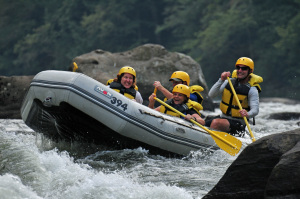
 We started out with lights on our bikes before dawn on Friday, August 19thin the suburbs of Pittsburgh. We rode 60 miles to Ohiopyle, PA arriving a half-hour early for an extraordinary white water rafting trip on the Lower Youghiogheny River. We learned at the raft outfitters that cyclists are quite often riding along the GAP Trail to Ohiopyle to join rafting trips through the Class 3 & 4 rapids of the mighty Lower Yough. After our five-hour rafting trip, we opted to stay at a guest house in Ohiopyle for the night and enjoy the local restaurants.

Whitewater rafting on the Lower Yough

On Saturday, we continued our ride at a more leisurely pace stopping at the communities of Confluence, Rockwood and Meyersdale to check out the coffee shops, bakeries, bicycle stores, restaurants and the many bed and breakfast operations that have sprung up near the GAP Trail. These businesses opened as a result of the trail. They employ local residents in communities where high unemployment was the norm in the years prior to the opening of the GAP Trail. Municipalities along the GAP Trail clearly have invested a lot in bridges, streetscape improvements, campgrounds, restroom facilities, signage and other public investments to draw GAP Trail users onto their streets. It is also clear that local property owners have invested substantial sums in beautification of their buildings to attract a flow of trail users to their businesses and B&B’s.

Saturday, Jamie and I rode through the communities and over the Eastern Continental Divide and through the Big Savage Mountain Tunnel, eventually down to Frostburg for a stop at the Trail Inn for a late lunch. The Trail Inn represents a significant investment by a local entrepreneur to provide a restaurant, rooms and a campground for users of the GAP Trail.

After Frostburg, we rode downhill to Canal Square in Cumberland. This being a Saturday, quite a lot was going on in Downtown Cumberland. After checking in to our accommodations, we had a nice meal and listened to excellent music in an outside venue on Cumberland’s Downtown Mall. Following that, we walked over to Canal Place to hear additional music and see events associated with an arts festival there. We also paid a visit to the excellent Queen City Creamery, which was really packed by ice cream lovers on Saturday evening.  This was quite a change from 20 years ago when, it seemed, most Cumberland businesses closed their doors early on a Saturday.

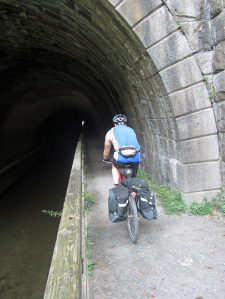
Riding through the Paw Paw Tunnel

Sunday morning, we woke before dawn, rode to Canal Place with our lights and started down the C&O Canal towards Hancock, MD. We stopped for a nice breakfast at the Oldtown Kitchen, located in the former Oldtown School. Then we rode through the Paw Paw Tunnel and onto Hancock to refill water bottles. We were impressed by the sheer number of users of the Western Maryland Rail Trail that runs through Hancock. The local bicycle shop near the trail had a constant flow of trail riders coming through its door and nearby restaurants had bicycles stacked near their front doors. The sound of cash registers catering to trail users filled the air in many local businesses in Hancock. After a stop in Hancock, Jamie and I then rode onto Williamsport, MD, near Hagerstown, where a soon-to-be-upon-us thunderstorm with the threat of quite large hail ended our ride for the day.

Some observations: The GAP Trail has one of the best riding surfaces of any non-paved trail I have ever cycled. The route from Pittsburgh to the Big Savage Mountain Tunnel has very little grade and is a preferred riding option over the route up from Cumberland with its 20-plus mile hill climb from the ride start at Canal Place to the Eastern Continental Divide.

One really needs to come out firsthand to see the large number of businesses that have opened recently to cater to trail users. From Connellsville to Confluence, PA, Meyersdale, PA to Frostburg, MD, the GAP Trail is an amazing recreational tourism success story. Many B&B’s, bicycle stores, coffee shops, bakeries, delis and restaurants are now open all along the route catering to GAP trail users. The Trail Inn at Frostburg is busy almost all hours of the day, primarily from users of the GAP trail. The great staff at the Trail Inn makes a fine sandwich and they provide nicely furnished rooms and a campground for those inclined to stay overnight near the Maryland portion of the GAP Trail. These trails and their nearby towns offer the most compelling example I have yet seen of the impact that trails facilities and recreational tourism can have on economic development in municipalities.

This is rural “Smart Growth” at its core and many lessons can be learned from the economic impact that the relatively small monetary investments to construct the GAP Trail and the Western Maryland Rail Trail are having on rural communities and small cities in Maryland and Pennsylvania.  The latest economic estimates show an infusion of $40 million per year resulting from completion of the GAP Trail alone.  

These trails offer clear proof that if we “build it they will come.”

Continue reading “Finding Smart Growth along the GAP Trail”

Allegany County Bicycle and Pedestrian Master Plan

By Matthew Bieniek -Cumberland Times-News

The company will prepare the Allegany County Bicycle and Pedestrian Master Plan. The plan is designed to connect bikers, pedestrians and local transportation systems into a network throughout Allegany County, county planning staff have said.
The selected consultant will meet with members of the Cumberland Area Metropolitan Planning Organization’s technical committee to nail down the scope of the work, the request for proposals stated.
An integrated plan could make more recreational opportunities available for residents and tourists, Siera Wigfield, a county planner, has said.
Ideally, the plan would provide a way to use the county’s transit buses to carry walkers, hikers and bikers from one path to another when direct access is limited. And it’s not only about recreational uses, the plan would also aid those walking or biking to work or to shop, Wigfield said.

Continue reading “Allegany County Bicycle and Pedestrian Master Plan”

No answers in surge of hit-and-run incidents

Victims and their families don’t understand how someone could drive away
By SCOTT DAUGHERTY, Staff Writer – Hometown Annapolis.

image

Courtesy photo

County police have released this surveillance photo of the vehicle in the Aug. 24 hit-and-run incident that killed James Schreiber Jr., 38, of Pasadena. It is believed the vehicle had a temporary, dealer or transporter tag attached to the left side of the rear tailgate just below the rear window.


Manuel Minchev doesn’t remember how his right arm came to be in a sling.

One minute he was riding his bike in Annapolis with two friends. The next he was in a Baltimore hospital bed with a broken clavicle.

“It was strange,” recalled the Bulgarian college student who came to Maryland earlier this year to work as a lifeguard. “I asked myself, ‘What am I doing here?’ “

What Minchev learned – like a startling number of other county residents in the past few months – was that he had been a hit-and-run victim. The motorist who knocked the 20-year-old off his bicycle Aug. 23 on Forest Drive didn’t stop to offer help or even see if he was OK.

Local police departments acknowledged a recent uptick in such incidents in the past three months.

There have been two fatal hit-and-runs in Anne Arundel County since July 14 – plus at least four crashes that resulted in serious injuries.

“This is definitely an anomaly this year,” said Sgt. Brent Weaver, one of eight officers tasked with investigating fatal and other serious traffic accidents for the county Police Department. “It is an unusual event, definitely.”

Police can’t pinpoint a reason behind the recent surge. Detectives hypothesize it might be the bad economy prompting more people to drive without insurance or without proper registration.

Exact statistics on how many hit-and-run wrecks happen a year in Anne Arundel County are not readily available. Computerized records maintained by the county Police Department regarding fatal wrecks were significantly different from paper records maintained by the department’s Traffic Safety unit. The disparities draw into question the accuracy of the department’s other computerized records for personal injury hit-and-run crashes, which showed about 90 each of the past four years.

Accident investigators and prosecutors said they have no reason to believe the recent rash will continue.

“It’s too soon to call it a trend,” said Deputy State’s Attorney William Roessler, who prosecutes the bulk of the county’s automobile manslaughter cases. “I’m hoping this is just an unusual coincidence. Hopefully we won’t see this next year.”

‘Why did it happen?’

For those injured in hit-and-runs – or left to carry on after the death of a loved one – the question is less “why so many?” and more “why did this happen?” They don’t understand how anyone could drive away from an injured person.

“This is all very foreign to me,” said Jenna Schreiber, whose husband, James, was killed Aug. 24 while he prepared to tow a vehicle from the side of Route 100 near Oakwood Road in Pasadena. “It is just deplorable. I simply do not understand it. I cannot perceive the mentality it takes (to drive away).”

There is no easy answer to explain why people flee the scene of the wrecks they were involved in, police, attorneys and psychologists said.

Some are simply in shock and don’t realize what they have done until they are a mile or two down the road. Others panic because they are drunk or driving without a license.

In general, experts dismiss the “I thought I hit a deer” excuse voiced by many people eventually arrested for hit-and-run wrecks.

“It’s case by case, but it’s mostly crap,” said Dr. Thomas Dalby, an adjunct professor at the University of Calgary who co-wrote a scholarly article in 2008 about the psychology of hit-and-run. “If you hit a deer, wouldn’t you still stop? Wouldn’t you see if it’s all right? Wouldn’t you see if your vehicle was all right?”

Police understand how unanswered questions can gnaw at victims and their families. With the help of witnesses, officers work hard to give them answers – tracking down security video from around the accident scene, visiting dealerships to identify vehicle parts left behind and contacting repair shops to see if any suspicious jobs roll up to their doors.

“Sometimes it is very difficult. We sometimes have nothing to go on,” Weaver said. “It really helps if we have eyewitness testimony … they are key. It is a cooperative effort between us and them.”

Troubling stats

Since Jan. 1, 2008, there have been nine fatal hit-and-run crashes in the county – resulting in the deaths of 10 people. Seven of the dead were pedestrians, two were riding a motorcycle and one was riding a bicycle.

Detectives with the county and state police departments have been able to solve about half those cases.

Of the seven fatal crashes that occurred before July 12 of this year, police located four drivers.

“We have a pretty good closure rate, believe it or not,” Weaver said.

But both of the county’s most recent fatal hit-and-runs – and three of the county’s four recent serious injury hit-and-runs – remain unsolved.

Punishment varies

Prosecutors and defense attorneys contacted by The Capital last week urged drivers involved in hit-and-run crashes to turn themselves in to police.

While simply leaving the scene of a fatal accident carries the same maximum sentence as automobile manslaughter, judges usually go easier on motorists who surrender, they said.

“There is no good-case scenario … (but) I think you get some benefit if you own up to it,” said Ted Staples, a prominent Annapolis attorney who has represented several clients in hit-and-run cases.

He advised against staying quiet, because police will never give up.

“They are going to come find you,” he said, arguing the best bet is to contact an attorney and arrange to give a statement. “It may take awhile, but they will find you.”

If police can link a driver to a fatal hit-and-run crash, that does not mean he or she will receive a significant jail sentence.

In June, Thomas Leonard Judge III, 22, of Annapolis Cove outside Annapolis, received a probation before judgement for the Jan. 1, 2010, death of a man killed while walking across Bay Ridge Road near Edgewood Road.

Judge turned himself in to police the next day and prosecutors allowed him to plead guilty to a reduced charge of failing to render aid to the victim as part of a plea agreement. He was placed on one year of unsupervised probation and ordered to complete 50 hours of community service.

About a year earlier, though, Matthew Evan Norwood, 27, of Linthicum, received one of the longest sentences ever handed down in the county in an automobile manslaughter case. After pleading guilty in the Aug. 22, 2009, hit-and-run death of a woman walking to church in Glen Burnie, he was sentenced to 10 years in prison with three years suspended.

Roessler, the prosecutor, said each case is different.

He noted Norwood went to court with a criminal record and an “egregious” set of facts that placed him at fault in the woman’s death. Judge, however, had no record and turned himself in to police. He added that Judge probably wouldn’t have been charged with any crime if he had stayed at the scene. The victim in that case was intoxicated and crossing the street at night outside a crosswalk.

“Sometimes they are driving away from an automobile manslaughter and sometimes they are not,” Roessler said. “That’s going to be a big difference (at sentencing.)”

‘Someone knows’

In interviews over the past month, several hit-and-run victims and the family members of those who were killed asked the public to help them gain some closure. Someone, they said, helped repair the damage or heard a friend’s confession.

“If anyone knows anything, they shouldn’t be silent. They should do the right thing,” said Ziad Sabra, whose brother, Ghassen, was killed 15 months ago on Route 50 while checking on traffic-counting equipment.

“We need someone from the public to come forward and point us in the right direction,” added Jenna Schreiber. “Someone knows what happened.”

Until someone comes forward in his case, Minchev – who is preparing to return home to Bulgaria in a few weeks – can only wait and wonder who was responsible.

“I can’t believe this happened to me,” said the rising junior at the University of Ruse in Bulgaria. “I can’t do nothing with my right hand and he is at home. Maybe drinking a beer. Maybe watching TV.”

Continue reading “No answers in surge of hit-and-run incidents”