
Of all the agencies who I would think would have control over this issue, State Highways is the last one that would come to mind. SHA says "Safety concerns" farmer says in the 10 years of operating there hasn’t been a single accident. Of course SHA knows all about safety having in those same 10 years brought Maryland pedestrian fatality rate from near average to be a contender for the highest fatality rate in the nation. [/sarcasm]
For me this underscores the issue at SHA, they would rather kick off legitimate road users (and side of road users) then accommodate them. Make things safer if they think it is unsafe, it’s that simple. Kicking off otherwise permitted users is just the wrong type of thinking.
Petition: https://www.change.org/petitions/the-governor-of-md-bring-country-thyme-back-to-its-river-road-location
More info: https://wamu.org/news/11/08/12/marylands_highway_administration_wants_small_farm_stand_out.php
R4-11 in the news
by Abby Brownback – Gazette
…
“We recognize the value of the R4-11 to communicate the rights of bicyclists to use the full lane when the lane is of substandard width,” he said.
R4-11, a square white sign, was approved by the Federal Highway Administration in late 2009, but states and municipalities can alter the sign’s color, size and font, said Shane Farthing, WABA’s executive director.
“We really do want something that communicates clearly both a warning and a right of usage of that portion of the road,” he [Michael Jackson, the director of bicycle and pedestrian access for the Maryland Department of Transportation] said.
The Maryland-National Capital Park and Planning Commission supports the use of the signs, said Fred Shaffer, the commission’s planning department’s bicycle and pedestrian coordinator.
“When treatments are accepted on a national level, we tend to think it’s acceptable to start incorporating them into development planning,” said Shaffer, who also works with the county’s Bicycle and Trails Advisory Group. The volunteer cohort, organized in 1998 by the county executive’s office, recommends trail priorities and comments on local development plans.
…
Continue reading “R4-11 in the news”
I have seen a brighter future and it is this [video]
In Praise of Sidewalk Cycling
[B’ Spokes: While I am not a huge fan of sidewalk cycling I do understand why many prefer it over riding in the street and as the article points out the criteria for when it is allowed and when it is not is … well all messed up. But for safety my own research points to the fact that riding against traffic either on the sidewalk or on the street is very risky and a lot of people do it. I will further assert including wrong way riding in the stats for comparative risks throws the whole comparison off IMHO.
It is also noteworthy that you cannot safely do near traffic speeds on the sidewalk like you can in the street. Viable transportation needs to have an element of being swift. So while accommodating slow beginners is a good thing but there is a fear that allowing sidewalk riding will make street riding seem unsafe, thus penalizing those of us who go faster and further by bike. This topic should be approached with caution as both can be safe if precautions are taken and both can be unsafe if no thought to the potential hazards (common crash types) is ever done.]
By googlemapsbikethere.org
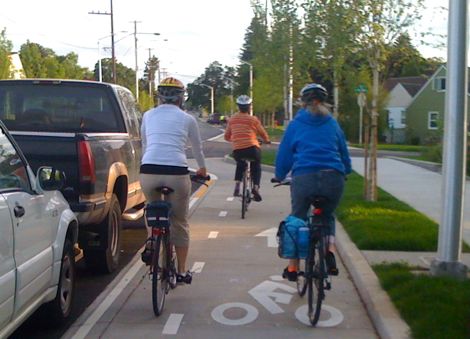 Horrendously Dangerous Cycletrack and Sidewalk!
Every few weeks a cycling ‘advocate’ will tear into people for daring to ride their bikes on the sidewalk — usually after someone riding a bike on the sidewalk was killed. We get some of the same from many cycling ‘advocates’ when cyclists riding in the road are killed, but the pomposity really flows when the killed cyclist was cycling on the sidewalk. This ‘criticizing the dead’ behavior is boorish, but it doesn’t seem to stop people. C’est la vie.
The concern these ‘sidewalk cycling bloggers’ are trolling is one of ‘safety’ — in theory, presumably they care, or claim to care, about the safety of the person doing the sidewalk cycling — not the drivers and walkers.
These bloggers point to various dubious studies by vehicular cycling advocates, and they fail to provide context for the studies. For instance, I could probably find data that shows walking on one-way streets is much safer than walking on two-way streets. But what use is the study if we don’t talk about the fact that people don’t walk on one-way streets because they’re so anti-human? Not much.
Ditto with these ‘sidewalks are dangerous’ studies — they simply don’t hold water if we claim to care about implementing policies which allow people to ride their bikes. We need studies that look at the totality of safety effects of riding on sidewalks vs. riding on the street — to the extent that such studies can even be statistically significant.
For instance, this safety page (which is, overall, very good — even if it’s old school, and has some nonsense in there about headphones and other alleged dangers) says don’t ride on the sidewalk, except in certain cases where it is OK to ride on the sidewalk – so, which one is it? Always, never, or sometimes? And who gets to decide the criteria?
This video makes a strong case for sidewalk cycling (the narrator clowns League cyclists while he’s at it — funny):
Someone at Treehugger called ‘bs’ on the anti-biking brigade a couple of years ago:
As a new or continuing city cyclist, you are bound to hear the admonishment: “Don’t ride on the sidewalk. It’s dangerous.” I swallowed that Kool-Aid for quite a while. After all, I want cycling to be a respected part of the transport infrastructure, I want cyclists to be generally law abiding and not continually agitate either pedestrians or car drivers (or each other!). But that word “dangerous,” bandied about as it is so frequently in cycling, should serve as the first clue that the warning to not sidewalk ride is a complicated, multi-faceted subject.
One oft-cited study seems to make some sense — it says, at a minimum, the haters need to stop hating:
Whatever the reasons, sidewalk cyclists should not simply be taught that sidewalk cycling is dangerous and should, therefore, be discontinued. Attempts to teach cyclists effective cycling skills should be considered.
This study from Toronto says sidewalk collisions are lower than riding in the street:
The rate of collision on off-road paths and sidewalks was lower than for roads.
And, if riding on sidewalks and sidepaths is so dangerous, why are they primary features of the roadway infrastructure of The Netherlands, the safest place on earth to ride a bike?
Because sidewalk and sidepath cycling is safe.
If you were ever told otherwise, you were fed a line — by the same people who probably admonished you to wear a helmet.
And when measured in the most critical terms — your ability to bike another day — you are almost certainly safer on the sidewalk than in the road — because most collisions occur in the road — i.e. doorings, hit from behind, etc.
So when certain ‘advocates’ tell cyclists not to ride on the sidewalk — they are effectively telling these cyclists to stop riding — which makes riding overall that much more dangerous for everyone else — because of the safety in numbers effect, in reverse.
So, if you are confused as to what you should tell a new sidewalk rider who has been accosted by the anti-cycling zealots, go with this:
Dude(tte) — I am so happy to hear you’re riding your bike — that’s so cool. Keep it up. Don’t let the haters get you down — haters gonna hate. Just keep doing what you’re doing, and if you feel more comfortable on the sidewalk, then you keep riding on the sidewalk. It’s probably safer there anyways.
I would advise that you not injure, maim, or kill any pedestrians — that just goes without saying — the same argument for cars — they shouldn’t injure, maim, or kill any cyclists or pedestrians — so watch out for pedestrians, and just generally be considerate of them, especially if they’re old — flying by a walker on the sidewalk can make them jump (make the jump/twitch! move here), and that’s kinda scary and just not cool. But other than that, have at it.
You’ll learn that the slower you ride on the sidewalk, the generally-more comfortable ride you’ll have, just because you can relax more, not worry about hitting walkers so much, etc. Try to watch out for blind entrances/exits from shops/apartments — if you start taking the same route every day you’ll learn which doors are busy. It might be technically illegal to ride your bike on some sidewalks, so some cops might harass you if you’re blazing down the sidewalk and menacing people, but if you’re kinda chillin and just moseying then they probably won’t bug you.
All the same rules apply as if you were riding in the road — so read this page if you haven’t yet — watch out for the right hook, definitely watch out for the left hook, watch out for all the cars that are going to blow through every Stop sign on every street along your route — you know, all the usual stuff.
Ride on!
Oh, don’t forget to top up your tires once a week (get a good pump — it’s worth it) — you won’t notice the difference until you top up and then you’ll be like, “Dang! I wish I topped up earlier!” And, it’ll help keep you from getting pinch flats, which are super-common for noob riders like you.

A couple of other points — telling people to ride in the street is akin to telling them to subject themselves to harassment, random violence and threats of violence (i.e. terrorism) — from outlaw drivers — I don’t think that’s a very nice thing to do.
Also, telling cyclists to do anything other than not kill pedestrians absolves drivers of…injuring, maiming, and killing people. Just because it is legal to kill bikers and walkers doesn’t mean that it should be legal. The laws should be changed, and we should push for them to be changed. We should pass a radical new law that says ‘Nobody is allowed to kill walkers and bikers.’ — something like that.
Happy sidewalk cycling!
Police Arrest Annapolis Man in Connection with Cyclist Hit and Run
[B’ Spokes: We still have more to catch, please be on the look out for a black SUV with suspicious front end damage.]
********************************************************************************************************************************
By Laura Tayman – Broadneck Patch.
Anne Arundel County Police have arrested and charged an Annapolis man with multiple traffic violations in connection with a hit-and-run incident involving a cyclist on East College Parkway on July 26.
William Christopher Kirby, 25, of the 300 block of Forest Beach Road in Annapolis, has been charged with multiple violations,
…
A police press release said that officers then received a tip that the damaged vehicle was seen on Forest Beach Road and the driver was Kirby. Officers later located the damaged car at a repair shop in Jessup and retrieved it along with the damaged parts as evidence. Detectives also interviewed a potential passenger of Kirby’s involved in the incident.
Kirby was arrested on Aug. 9 and is currently being held at the Anne Arundel County Detention Center on $75,000 bail.
Continue reading “Police Arrest Annapolis Man in Connection with Cyclist Hit and Run”
Jeremy Guthrie on bicycling
Jeremy Guthrie is a pitcher for Major League Baseball’s Baltimore Orioles. An avid urban cyclist, Jeremy is a mainstay on Baltimore’s busy streets. On July 27th, the Orioles played the Blue Jays in Toronto, providing Jeremy an opportunity to cycle through T.O.’s streets. Spacing caught up with him at the Rogers Centre and discussed his thoughts on cycling, the city, and what inspires him to bike everywhere.
…
“Wider, straighter, faster” paradigm of traffic planning needs to change
[B’ Spokes: Excellent article, I hope the following highlights encourage you to read the whole thing.]
***************************************************************************************************************
by Gary Toth
…
As a result, construction costs for adding new traffic capacity have been escalating sharply, at exactly the same time that our aging transportation infrastructure demands more attention. States are facing steep financial difficulties, exacerbated by the recent recession, and state legislators are loath to speak of raising taxes. Meanwhile, many roads and bridges built in the highway boom years between the 1940s and 1960s have aged to the point of needing major repairs or replacement, creating a towering backlog of fix-it-first projects. All of these factors make it far less likely that even the most determined state departments of transportation can build their way out of congestion.
…
1. Target the “right” capital improvement projects. The first step is to recognize that transportation decisions have a huge impact on community and land-use planning — and vice versa. Major investments in roads should be pursued only in communities and regions with effective land-use plans in place,
…
2. Make place-making and far-sighted land use planning central to transportation decisions. Traffic planners and public officials need to foster land-use planning at the community level, which supports a state’s transportation network rather than overloading it.
…
3. Shift away from single-use zoning. We must begin to phase out planning regulations that treat schools, affordable housing, grocery stores, and shops as undesirable neighbors.
…
4. Get more mileage out of our roads. The nineteenth- and early-twentieth-century practice of creating connected road networks, still found in many beloved older neighborhoods, can help us beat twenty-first century congestion. Mile for mile, a finely-woven, dense grid of connected streets has much more carrying capacity than a sparse, curvilinear tangle of unconnected cul-de-sacs, which forces all traffic out to the major highways. Unconnected street networks, endemic to post-World War II suburbs, do almost nothing to promote mobility.
5. View streets themselves as places. Streets take up a high percentage of a community’s land — nearly a third of the area of parts of some cities. Yet, under planning policies of the past seventy years, people have given up their rights to this public property.
…
6. Spread transportation investment money around. If we continue with the practice of chasing big engineering projects as our first choice in solving congestion, … In contrast, investments in transportation and land use that support choices on travel and shape development to keep our roads congestion-free will focus our limited funding on better uses.
…
Continue reading ““Wider, straighter, faster” paradigm of traffic planning needs to change”
Stupid law firm promoting fear and unsubstantiated "facts"
Popularity Of BikeShare Increases Risk of Bicycle Accidents in Washington D.C.
https://www.marylandcaraccidentlawyerblog.com/2011/08/capital-bikeshare-increase-in-popularity-and-increases-risks-of-bicycle-accidents-in-washington-dc.html
Buzz, Wrong! Dear law firm that wrote the above please understand the more people that bike the safer it is, not the opposite, Thanks. B’ Spokes
Even more stats in support of bike sharing:
Bike-Sharing Is Safer Than Riding Your Own Bike
https://www.streetsblog.org/2011/06/16/from-london-to-d-c-bike-sharing-is-safer-than-riding-your-own-bike/
Read more for links to "Safety in numbers"
Continue reading “Stupid law firm promoting fear and unsubstantiated "facts"”
Medians and Refuge Islands & Walkways and Shoulders
FHWA Safety Program on Medians and Refuge Islands:
Adding medians and refuge islands can increase both pedestrian and motor vehicle safety, helping to solve multiple challenges faced by DOTs. They do this by allowing pedestrians to cross one direction of traffic at a time—often allowing them to focus on just two to three lanes rather than having to anticipate traffic for the entire width of the road. They also provide a space to install improved lighting at pedestrian crossing locations. Improved lighting has been shown to reduce nighttime pedestrian fatalities at crossings by 78 percent
Raised medians provide additional benefits above and beyond reducing pedestrian crashes, including the following:
Reducing motor vehicle crashes by 15 percent
Decreasing delays (>30%) for motorists
Increasing capacity (>30%) of roadways
Reducing vehicle speeds on the roadway
Providing space for landscaping within the right-of-way
[Note: The improved pedestrian safety is attributed to lighting and not the median. So we are basically spending money for pedestrian "improvements" that are proven to benefit motorists and they might or might not help with pedestrian safety. After all, if we design our roads like a easy level of "Froger" it should be better for pedestrians to play Froger with their lives, right?]
***************************************************************************************************************
FHWA Safety Program on Walkways and Shoulders
Walkways and shoulders create safer pedestrian environments. Pedestrians killed while "walking along the roadway" account for almost 8 percent of all pedestrians killed in traffic crashes. Many of these tragedies are preventable. Providing walkways separated from the travel lanes could help to prevent up to 88 percent of these "walking along roadway" crashes. Widening paved shoulders also provides numerous safety benefits for motorists as well as benefits for pedestrians including:
Reducing numerous crash types
– Head on crashes (15%-75% reported reduction)
– Sideswipe crashes (15%-41%)
– Fixed object crashes (29%-49%)
– Pedestrian "walking along roadway" crashes (71%)
Improving roadway drainage
Increasing effective turning radii at intersections
Reducing shoulder maintenance requirements
Providing emergency stopping space for broken down vehicles
Providing space for maintenance operations and snow storage
Providing an increased level of comfort for bicyclists
[Note: Again I’ll point out that this bike/ped improvements it is motorists that benefit the most, so why all the resistance?]
Continue reading “Medians and Refuge Islands & Walkways and Shoulders”
Black Hawk bike ban appeal to Supreme Court
For those of you following this. I found it interesting that the lower court judge who ruled against the cyclists that the town of Black Hawk has the power to fire him if they so chose, not much incentive to uphold state rights.
https://www.cyclelicio.us/2011/black-hawk-supreme-court/