
In response to one of our alerts the Secretary of Transportation responds:
**************************************************************
Thank you for your email to Governor Martin O’Malley regarding sample test questions for the Maryland driver’s license knowledge examination on the Online Tutorial on the Motor Vehicle Administration’s (MVA) website. The Governor has received your email and asked me to respond on his behalf.
The MVA is scheduled to release its new Maryland Driver’s Manual in July 201 1. The revised manual will address bicycle-related issues in greater detail than in previous editions of this publication. It is my understanding that the staff of the MVA, the State Highway Administration, and Mr. Michael Jackson, MDOTs Director of Bicycle and Pedestrian Access, worked with both you and the members of the Maryland Bicycle and Pedestrian Advisory Committee to revise the text regarding motorist responsibilities toward bicyclists and sharing the road with bicyclists. These changes will be reflected in the revise manual.
Test questions including practice test questions within the Online Tutorial will be updated to reflect the revised information in the new Driver’s Manual. We will give consideration to your comments when developing the new test questions.
Thank you, again, for your email. The Governor appreciates hearing from you, and, on his behalf, I thank you for your interest in this issue. For additional information on bicycle traffic safety in Maryland please feel free to contact Mr. Jackson at 410-865-1237 or via email at mjackson3@mdot.state.md.us. He will be happy to assist you
Beverley K. Swaim-Staley
Secretary of Transportation
Continue reading “New Drivers’ Test and Manual Coming Out This Month”
Alert: Please let ALL road users know what’s safe a legal for cyclists
Update: Bikes May Use Full Lane still under consideration
[B’ Spokes: If you happen to run across O’Malley at the 65th Annual Catonsville July 4th Parade give a complement and ask nicely for him to reverse SHA’s staff decision about R4-11 as it is approved by FHWA.]
Dear Maryland Cyclists,
 The Maryland State Highway Administration SHA is posed to make one fo the most anti-cycling decisions in the last few decades.
After years of careful research and debate, the federal Department of Transportation has approved signs that say “Bicycles May Use Full Lane” for lanes that are too narrow for a car to safely pass a bicycle in the same lane. Experienced cyclists know that it is safer to use the full lane on these roadways, but motorists often don’t. These signs would both give notice to motorists to be aware of the potential presence of cyclists taking the lane, and would provide greater clarity than the common, but ambiguous “Share the Road” sign. These signs make the roadways safer for cyclists.
But the Maryland State Highway Administration wants to block the use of the signs in Maryland, so that most cyclists will continue to ride on the extreme right side of the roadway–even on roads where doing so is more dangerous than using the full lane. And some drivers will continue to be surprised—and sometimes angry—when cyclists do use the full lane. Maryland law explicitly allows cyclists to use the full lane when doing so is safer than keeping right, but some state officials do not seem to agree with the law. And they are expressing their own disagreement by disapproving a sign that makes us safer.>
Sadly, this decision is coming at the end of the distinguished career of SHA Director Neil Pederson, who retires this week. A cyclist himself, Mr. Pederson has often pushed his agency to accommodate cyclists. Because the decision seems to have been made at a lower level, we do not know whether Mr. Pederson has been fully informed or not. We also do not know whether Governor O’Malley, who has been actively promoting Cycle Maryland in recent weeks, is aware of or supports this anti-cyclist decision by his Highway Administration.
1. Asking them to reverse SHA’s staff decision, and approve the use of the R4-11 “Bicycles may use full lane” sign so that cyclists and drivers alike will realize which roads are most safely ridden using the full lane, and>
2. Thanking Neil Pederson for his years of service and asking the Secretary and Governor to ensure that he is replaced by someone with a commitment to making Maryland’s roads safe for all road users.
Click here to email these officials. A sample email is provided, but feel free to customize the text to suit your needs.
Thank you,
The Washington Area Bicyclist Association
Continue reading “Alert: Please let ALL road users know what’s safe a legal for cyclists”
Annapolis, Maryland calls in outside bike planner
Bike Radar Has a nice article about the development of Annapolis’ Bike Master Plan but I would like to take a moment to contrast what good planning considers as an economical and viable Enhancements to our road network to include comfortable accommodations for bicyclists versus what the State will spend Enchantment funds on.
First form the article:
“The biggest challenge is something you see everywhere and that is funding. As a country we don’t do a great job of funding that type of transportation.”
Instead the funding often is part of other projects, and TDG is looking to include bicycle paths, bike lanes and other improvements in those other projects. “We have to look at capital improvements and resurfacing and include bicycle paths into those.” Cruse says, “It is just hard to make it about bikes unless it is part of a larger project.
********************************************************************
Maryland with $31 million available in just Transportation Enhancement funds that could go to projects like those described makes the following ADDITIONAL requirements over and above the federal requirements: From Maryland’s Transportation Enchantment Program Eligibility:
[Must] Be independent projects unrelated to planned or existing highway projects or routine highway improvements [such as resurfacing].
********************************************************************
I sympathize with Toole Design Group {TDG) as they work all over the country and Maryland is certainly the odd man out when it comes to following the recommended federal policy but I really have to question MDOT on it’s policies of accommodating bicyclists any time SHA adds accommodations for bicyclists it’s ALWAYS related to planned highway projects and NEVER a stand alone project. So why is MDOT putting this requirement on the localities?
Continue reading “Annapolis, Maryland calls in outside bike planner”
MDOT hires experts to make recommendations and then ignores recommendations
This 2009 report from Cambridge Systematics, Inc. with Toole Design Group on our Maryland Trails Strategic Implementation Plan makes the following recommendations (just highlights) that still have not been done:
• Explore new approaches to trail program management and policy processes to relieve the administrative burden of trail funding programs. Opportunities exist to pursue advanced streamlining process and to adapt existing funding programs to better fit of the character of trail development. For example, providing assistance in preparing aid packages for municipalities may help ease the administrative burden of the application process. Assistance to jurisdictions on how to leverage funding sources (i.e., use of POS [Project Open Space] as a match for TEP [Transportation Enchantment Program] funds) could also be helpful. Other approaches that might help alleviate the administrative and funding burden to jurisdictions include:
− “Phasing” funding and project development;
− Reducing the TEP minimum request and match requirement;
− Reducing or removing the TEP engineering and design requirement; Providing technical assistance for RTP and TEP project planning to address deficiencies in project sponsors’ trail planning and project scope development.
− Re-evaluating the types of projects eligible by RTP and TEP and the phases of projects for which funding is available (i.e., preconstruction/acquisition);
Continue reading “MDOT hires experts to make recommendations and then ignores recommendations”
Driver tells police about inconsiderate cyclists and gets arrested for assault with a deadly weapon
Filed under news you will not see in Maryland. The highlight of the story:
When deputies questioned Cox, he said that he was driving to work when he approached a pair of cyclists who he believed were in his lane and not being considerate of drivers. Cox said that he drove close to the right shoulder and yelled at them, and then encountered two more cyclists and attempted to confront them about their cycling manners, according to the report.
Cox told deputies he stopped his car directly in front of the cyclists.
According to the report, deputies said that Cox displayed “road rage” and had complete disregard for the safety of the cyclists. The deputies said that Cox showed no remorse for his actions.
Police said based on the dangers of the Angeles Crest Highway – three motorcyclists have died in the last few weeks – and the potential for Cox’s actions to have caused a traffic hazard, they arrested him. Cox was arrested on suspicion of assault with a deadly weapon and booked at the Crescenta Valley Sheriff’s Station.
https://sierramadre.patch.com/articles/alleged-angeles-crest-road-rage-incident-involves-cyclists-3
Horizontal Mural Art: A Life Saver!
From the Knott Foundation Newsletter
Local community artists and volunteers assembled at a very early 5:30 a.m. on June 26 to paint a horizontal mural at the intersection of Harford Road and Montebello Terrace in the Beverly Hills and Lauraville neighborhoods of Baltimore City.
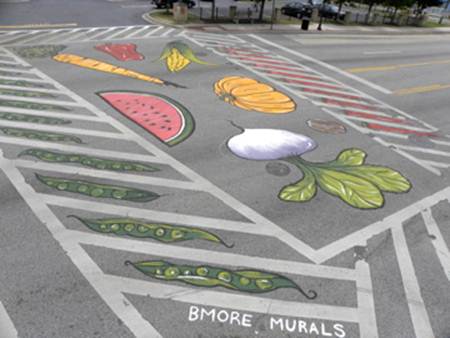
Horizontal murals, which are painted directly on the street, may have benefits beyond aesthetics. “Bright, vibrant artwork in busy street intersections may have a traffic calming effect,” stated Greg Cantori, who supported the project with a discretionary grant. “Murals like these in New York and Portland have successfully engaged the community with their ‘public right of ways.’ They are painted next to schools or in busy neighborhood intersections to encourage drivers to pay more attention to their surroundings, while hopefully appreciating the art as well.”
The project represents the hard work of numerous partners, including Whitney Frazier, lead artist, New Lens, Hamilton Lauraville Main Street, and the Baltimore City Department of Transportation. We hope to see more horizontal murals this summer and fall. Congratulations to all who were involved!
Latest round of federal transportation funding cuts!
From League of American Bicyclists:
Your state DOT may be ready to cut millions in bicycle and pedestrian funding
Another $2.5 billion rescission – by July 8
Yesterday, June 30, the Federal Highway Administration informed state Departments of Transportation of another rescission of funds, this time totaling $2.5 billion. The action is taken under the 2011 Full-year Continuing Appropriations Act. Attached is the FHWA notice, which includes the total amount of funds each state is to send back to Washington
.
States are given maximum flexibility about the source of the funds that are rescinded – from among the following programs: Interstate Maintenance, National Highway System, Highway Bridge , Transportation Enhancements, Surface Transportation Program (only the funds available for any area), Congestion Mitigation and Air Quality Improvement, Recreational Trails, Metropolitan Planning, State Planning and Research, and Equity Bonus. You will note that Safe Routes to School and Highway Safety Improvement Program funds are NOT included.
States have to respond by July 8 – yes that’s right: one week from today. The memo recommends that “Division Administrators
should encourage their State department of transportation officials to reach out to stakeholders in considering how to implement the rescission.”
By now you all know the drill.
Transportation Enhancement and Congestion Mitigation Air Quality funds have consistently been inequitably targeted for rescissions in most states – and this will likely continue unless State DOT’s hear from you. In August of 2010, almost $1 billion of CMAQ, TE and Recreational Trails funds were returned to Washington , out of a $2.2 billion rescission. See our Rescissions FAQs for more information.
Please contact your Governor, or in the District of Columbia’s case, your Mayor, today to urge them to work with their departments of transportation to ensure balanced cuts.
Thank you in advance for your help
!
Sorry to rain on your July 4th parades…
SHA not obligated to accommodate bicyclists per policy and wins an award from LAB for policy
From 4/11 Maryland Bicycle and Pedestrian Advisory Committee (MBPAC) minutes
Jim Titus expressed concerns regarding the
Maryland National Capital Park and Planning Commission –Prince George’s County’s
designation of MD Route 564 as a bikeway was not recognized by the State Highway
Administration. Michael [Jackson Director of Bicycle and Pedestrian Access] stated that because MD Route 564 is a State highway SHA was
not bound to accept M-NCPPC-PG’s designation but recommended that Jim contact SHA staff about his concerns.
For a little background: SHA intermittently removed a bikeable shoulder for bypass lanes around left turns lanes on a designated bike route when for “the same money” they could have centered the striping on the roadway and have comfortable cycling conditions on both sides of the road (the road in question is along RR tracks so in this one direction there is only lefts and no right turns.). This should have been a no brainier on how to accommodate bicyclists but as it stands now it’s forcing cyclists to weave in and out of fast traffic, not cool at all but per the Director of Bicycle and Pedestrian Access it is at least part of SHA policy. 🙁
Let’s look at excerpts from our State’s bike master plan:
S t r a t e g y 4 B :
Increase Communication with Stakeholders
…
Strong State coordination with local programs is also encouraged.S t r a t e g y 5 B :
Initiate a Bicycle and Pedestrian Partnership Program (BPPP)
…
The BPPP will provide a much-needed framework for State/local partnerships
focused on bicycling and walking. Bicycle and pedestrian travel is inherently a local
activity, so it is essential that improvements on State facilities complement local networks.
While policy is legally non-binding you would think a more tactful and more helpful response would be more forth coming from our Director of Bicycle and Pedestrian Access. But doesn’t State law cover this as well?
§ 2-602. Public policy.
The General Assembly finds that it is in the public interest for the State to include enhanced transportation facilities for pedestrians and bicycle riders as an essential component of the State’s transportation system, and declares that it is the policy of the State that:
(1) Access to and use of transportation facilities by pedestrians and bicycle riders shall be considered and best engineering practices regarding the needs of bicycle riders and pedestrians shall be employed in all phases of transportation planning, including highway design, construction, reconstruction, and repair as well as expansion and improvement of other transportation facilities;
(2) The modal administrations in the Department shall ensure that the State maintains an integrated transportation system by working cooperatively to remove barriers, including restrictions on bicycle access to mass transit, that impede the free movement of individuals from one mode of transportation to another;
(3) As to any new transportation project or improvement to an existing transportation facility, the Department shall work to ensure that transportation options for pedestrians and bicycle riders will be enhanced and that pedestrian and bicycle access to transportation facilities will not be negatively impacted by the project or improvement;
So somehow SHA has worked up a internal policy (not really subject to public preview) that they feel they CAN negatively impact bicyclists and the Director of Bicycle and Pedestrian Access can find no fault in that methodology. Tsk, tsk, that is just so wrong.
From MDOT’s press release: [edited to be more to the point.]
HANOVER, MD – The League of American Bicyclists [LAB] named Maryland as an Honorable Mention in its Bicycle Friendly State program.
…
The League of American Bicyclists cited a number of specific efforts Maryland is making that made them stand out including [edited for emphasis]:۰ coordination with other states; [but not with it’s own localities.]
۰ creation of a Director of Bicycle and Pedestrian Access position at MDOT; [that stands up for SHA’s “right” to ignore the 20-Year Bicycle and Pedestrian Access Master Plan and to negatively impact bicyclists.]
۰ creation of popular Competence and Confidence adult bicycle safety video specific to Maryland; [OK that was fairly cool but that was made years ago] and
۰ establishment of a 20-Year Bicycle and Pedestrian Access Master Plan that provides a detailed perspective from the State’s vision of becoming the best State for bicycling by 2023 and the 66 action items needed to get there. [This plan is so ancient that we had to pass a law last year to get MDOT to update the darn thing just like other transportation plans. It should have been updated twice by now but MDOT has refused and it gets an award for a modest 3% improvement in roads over 20 years? And if LAB would take the time to actually read the reports it basically says that Maryland state roads are already as good as they need to be for the best State for bicycling, ya right, some “20 year” plan with goals so low they knocked them out in the first year and cyclists have been on the back burner ever since.]Both Maryland and Delaware were given honorable mention awards…
So who can you complain too? Absolutely nobody.
Why? Because thanks to LAB in giving credit to a ancient, gathering dust, 10 year old bike master plan we have a great bicycling policy even though the policy that SHA actually uses is more like “When we put shoulders on a road make sure they are consistent so we can charge bicyclists for a break down lane.” Well, that might be overly sarcastic (and don’t get me wrong, I really do like shoulders and things in general that benefit a wide range of users) but still we have MD Route 564 where they did not “need” to think about bicyclists (so take their shoulder away) and there is Hammonds Ferry Road bridge where they did not “need” to think about bicyclists (so sever their route.) I could go on but these have been in recent months from SHA.
But wait there’s more! LAB is not necessarily the bad guy here as the application for Bike Friendly States is filled in by… are you ready for this?… The Director of Bicycle and Pedestrian Access, that’s right the same guy who says that SHA is under no obligation to work with local plans (and by inference, SHA can negatively impact existing bicycling conditions) says we have a great bicycling policy even though the “great” bicycling policy says no that’s all wrong what SHA did and the policy in use by SHA says … well something different.
All this is to give you some idea of the current double talk cycling advocates have to put up with and to stress the importance of getting a director of MDOT that is supportive of improving conditions for cyclists. More on this point when I get a chance. Meanwhile enjoy biking on state roads as they are “the best for bicycling” per MDOT and I guess LAB thinks that as well. Heavy sigh.
Major L.A. study shows importance of bike-transit connection
Excepts from Bike Portland:
* Bicycle-rail trips would replace approximately 322,000 motor vehicle trips and reduce 3.96 million vehicle miles traveled each year, offsetting approximately 2,152 metric tons of carbon dioxide equivalents (CO2e) annually. This would be equivalent to taking 422 motor vehicles off the road.
* Survey respondents overwhelmingly said that being allowed to take their bike on the train influenced their decision to travel by bike and rail. Of the 477 people who responded to the question, 65 percent chose “allowed to take bike on train” as a factor that influenced their decision.
* Respondents with access to a motor vehicle are more likely than those without access to a motor vehicle to cite “allowed to take bike on train,” “no car parking at station,” “bike lockers at station,” and “have to pay for car parking at station” as factors that influenced their decision to bicycle.
Continue reading “Major L.A. study shows importance of bike-transit connection”
End of the Easy Road
[Excerpt] By Brian Friel – Roll Call
The federal fiscal crisis started to affect transportation programs three years ago, when the economy tanked and dedicated gas and vehicle tax revenue fell off. In 2008, Congress began infusing the Highway Trust Fund with general funds from the Treasury. Lawmakers have propped up the transportation programs with $35 billion in such infusions since then and will have to do so again this fall — or agree to begin making cuts.
Continue reading “End of the Easy Road”