
Wayfinding: I know, only cars need to know where something is and how to get there. Bicycles can only get wayfinding if there is a bike lane or trail and pedestrians, well just forget about it. We need to rethink this. Here are some sidewalk mosaics from California that point to local attractions:
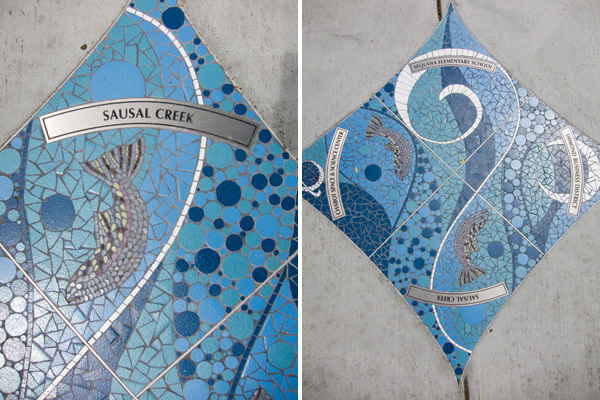
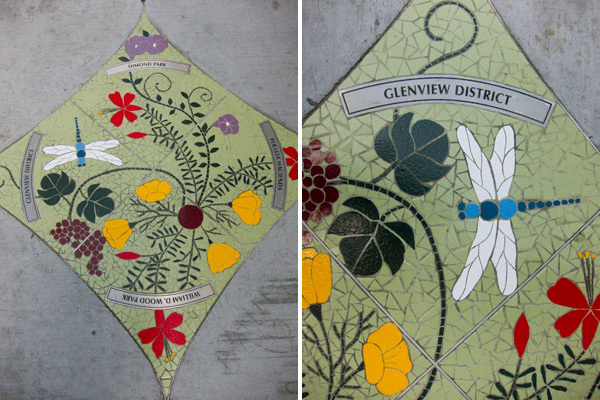
Continue reading “Dimond Wayfinding Mosaics”
5 Easy Ways to be a Bike-Friendly Business
Highlights from The Path Less Pedaled by Russ
5. Have a basic flat repair kit / pump handy.
4. Have some maps handy.
3. Offer u-locks or bike check-in
2. Roll-in to the Rooms
1. Have the Right Attitude
Continue reading “5 Easy Ways to be a Bike-Friendly Business”
Businesses Eager to Apply for Parklets as New Request for Proposals Issued
[B’ Spokes: Can we even do something like this in Baltimore?]
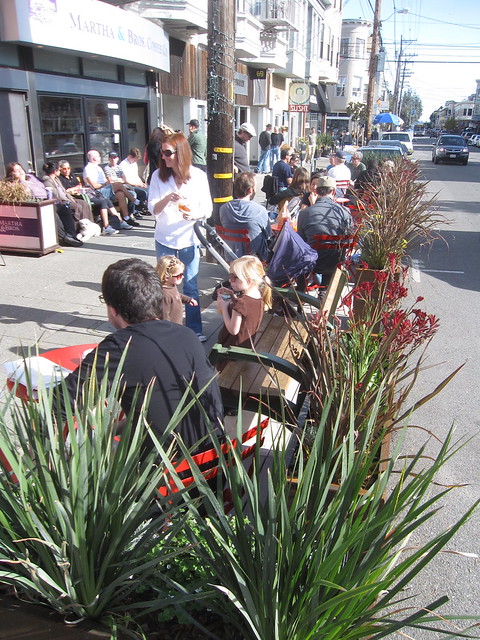
Continue reading “Businesses Eager to Apply for Parklets as New Request for Proposals Issued”
Cardin proposes capturing highway runoff
from Maryland Politics by John Fritze
Rain water that rolls off new or newly renovated federally funded highways would be collected and treated for pollution before it reaches nearby waterways under a bill introduced this week by Sen. Benjamin L. Cardin.
Heavy rains wash tailpipe emissions, brake dust, oil and other pollutants off highways and ultimately into drinking water supplies, Cardin’s office said Thursday. The bill, similar to legislation the Maryland Democrat introduced last year, would require the U.S. Department of Transportation to develop design standards for how to address the problem.
There are more than 985,000 miles of highway in the United States. During a hearing last year, Cardin said that every inch of rain that falls on a mile of two-lane highway produces 52,000 gallons of polluted runoff.
“Stormwater is the largest source of water pollution in our nation,” Cardin said in a statement. “We must design and construct roads in ways that address contaminated highway runoff at its source, reducing the chance of flash floods and stopping pollution before it reaches the waters of the Chesapeake Bay.”
Cardin, a longtime proponent of addressing runoff issues, is a member of the Senate Environment and Public Works Committee and chairs a subcommittee on water and wildlife. It’s not clear how much his proposal would cost. [B’ Spokes: It is also not clear how much not doing this costs.]
Continue reading “Cardin proposes capturing highway runoff”
Keep Left
by Jeffrey Marks
The picture shows the bike lane on the right-hand side of St. Paul Street abruptly ending at Mount Royal Avenue, where traffic exiting the JFX merges onto Saint Paul (“Where the Bike Lanes End,” Feature, April 20). But perhaps the better choice would be to place the bike lane on the LEFT SIDE of St. Paul. That way the cyclist could avoid this hazardous traffic merge. Other advantages of a LEFT SIDE bike lane would be not having to deal with buses that are constantly pulling to the curb to drop off and pick up passengers. And drivers exit parked cars onto the sidewalk instead of the bike lane.
At the April 18 Bicycle Meeting at Johns Hopkins University, City Bicycle Planner Nate Evans indicated that he is leaning toward placing the bike lane on the left side of Maryland Avenue once the street is repaved. Why the left instead of the right? To avoid the hazard at Lafayette, where cyclist John Yates was killed by a right-turning tanker truck. Also to avoid conflicts at Franklin Street, where right turns are authorized from both the right-hand and right-center lanes. I look forward to the city carefully evaluating, when designing bike lanes, which side of a one-way street works best for bicyclists. Maryland law provides an exception, when operating on a one-way street, to our state’s general rule for cyclists to keep right. And other cities, like New York City, often have bike lanes on the left-hand side of a one-way street.
Lastly, a bike lane is no substitute for paying attention and evaluating whether to use the bike lane or roadway. Bike lanes work best when the road follows a stream, railroad track, freeway, etc., where right-hand turns aren’t authorized. Bike lanes are new to Baltimore, and motorists haven’t been instructed to slow down and merge into the bike lane behind the cyclist when preparing to make a right-hand turn. Consequently, bicyclists need to be alert. When a motor vehicle pulls beside you but doesn’t complete the pass or passes and slows down, WATCH OUT. The motorist may be preparing to make a right turn. The safest thing is for you to slow down, and when safe pull directly behind the motor vehicle, preparing to stop if the vehicle slows down further or turns right. And there are downhill bike lanes, where right-hand turns are authorized, that I leave the bike lane and use the regular traffic lanes. The University Parkway downhill bike lane north of 39th Street, where cyclist Nathan Krasnopoler was critically injured by a car turning right into Broadview Apartments driveway, is the tragic but classic example of why the bike lane isn’t always the safest place to ride.
Jeffrey Marks
Baltimore
Continue reading “Keep Left”
Bowie City Council Approves Overtime, New Bikes for City Officer
By Mimi Rauck
With one dissenting vote, the City Council Tuesday approved a request from Police Chief John Nesky to add $38,240 to the budget to put more bicycle officers on patrol.
Nesky proposed using two officers for seven hours a day on an overtime basis. In addition, the city would purchase four new police bikes at $2,000 each. The overtime funds would be used over the next two summers.
The officers would patrol areas throughout the city, including the city’s many trails, according to Nesky.
…
Continue reading “Bowie City Council Approves Overtime, New Bikes for City Officer”
Planet D.C.: Rising Gas Prices + Rising Transit Ridership = Cut Transit Funding
by Ya-Ting Liu
Congress returned to work this week just in time for a new round of political football over soaring gas prices, which have topped over $4/gallon in our region. Two weeks earlier, President Obama ordered a Department of Justice task force to “make sure that no one is taking advantage of the American people for their own short-term gain” by investigating the role of traders and speculators in oil markets. The House majority is laying the ground work to move two bills that will expand domestic oil and gas production while Senate majority leaders are planning to introduce a bill to repeal tax subsidies to oil companies.
As the President, the House and Senate majority leaders scramble to address rising gas prices, Americans are doing what they did when national gas prices rose to over $4/gallon in 2008: they’re driving less, buying smaller cars, and turning to transit. Type in “transit ridership” in Google News and one will see reports of upticks in transit ridership across the country, from large cities to small towns (Pierce County, WA; Lake Tahoe, CA; Palm Beach, FL; Luzerne County, PA; Nashville, TN; Montrose, CO; Valparaiso, IN to name just a few).
Unfortunately for those turning to public transportation for a reprieve, they’re most likely experiencing a system that has been cut to the bone in the past 18 months as lawmakers in D.C. stood by. Not only did the 111th Congress fail to pass the Public Transportation Preservation Act of 2010, which would have provided emergency federal funds to restore and maintain transit service across the country, the 112th Congress has recently slashed transit funding as a way to curb federal spending. More could be on the way. The House Budget Committee recently passed Congressman Paul Ryan’s proposal for fiscal year 2012 that would slash federal transportation spending by 30%, bringing it from $50B/year to about $35B/year. According to an analysis conducted by House Transportation & Infrastructure Committee minority staff, the tri-state region would lose over $1 billion in federal transportation dollars and 38,515 jobs.
…
Continue reading “Planet D.C.: Rising Gas Prices + Rising Transit Ridership = Cut Transit Funding”
Guaranteed Ride Home Program

Guaranteed Ride Home Program Registration
Guaranteed Ride Home is a free commuter insurance program for those commuting using alternative modes of transportation within the Baltimore and Washington D.C. Metropolitan Areas.
Offers up to 4 free rides home per year to those who ride transit, commuter rail, bike, walk, carpool, or vanpool to work at least twice a week. Typically, the ride home will by cab or rental car.
Free to all working in the Baltimore, Central Maryland, and Washington D.C. regions.
It’s there when you need it. For when you stay late and miss your ride home or have to leave work early due to illness, kids, or an emergency.
Makes it easier to depend on alternative modes of transportation.
Easy-to-use phone number: 1-800-745-RIDE.
Operators on call between 6 a.m. and 10 p.m., Monday – Friday.
Your privacy is guaranteed too. We don’t like spam either.

Fill out the secure form below to register for Guaranteed Ride Home.
Once your application has been processed (normally within 24 hours), you will recieve an e-mail from your rideshare coordinator. You should also recieve a card in the mail from Commuter Connections.
Guaranteed Ride Home is a program of Commuter Connections, The Baltimore City Department of Transportation, and the Maryland Transit Administation.
Peopleforbikes.org wants to know how you roll
 |
||||||||
|
||||||||


Rules of road for bicyclists proposed
Once again Michael Dresser shows that he is a motorist that "get’s it." Job well done Michael!
Read the full article here: https://weblogs.baltimoresun.com/news/traffic/2011/05/rules_of_road_for_bicyclists_p.html
I have a few comments (of course 😉 )
I find the comments interesting that a bike horn is near useless because of drivers having music blaring vs the comment on cyclists using music players and "need" to hear things. Which leads me to the thought I wish bills going through Annapolis had options to pick, like: 1) Playing music in a motor vehicle is prohibited because drivers need to hear pedestrians and bicyclists they are about to run over OR 2) Allow bicyclists to wear headphones and listen to music at a reasonable volume. (Under the principle fair is fair and what’s good for one is good for the other.)
My point here is not to encourage headphone use but to encourage driving a bicycle just like a motor vehicle so hearing is not necessity. That is to say if you are always running red lights and such,* hearing is very necessary so doing that with headphones, well that’s just crazy.
On the subject of horns and bells; Never use a horn on a trail, I know iZombies are a pain but they are out there the same as you to have a pleasant experience away from cars. Don’t bring that car honking attitude to the trails but …
Joggers and walkers please stay right and leave enough space for a cyclist to pass before having to have a horn on the trail becomes a necessity. And Park Services please get this information out rather then put sole responsibility on cyclists. We are willing to do our part but others have to do their part as well.
Avoid busy streets: While Michael’s comments are very good on this point I feel it’s necessary to point out that bicyclists on average don’t like riding busy roads any more the motorists like seeing us there but too often there is no choice if there really was a convenient route with less traffic we would be on it. Or … Dear motorists look at it this way: why are you not using the freeway where bikes and pedestrians are prohibited? If you have limits on how far out of the way you drive, well surprise, bicyclists have limits too. But the main point is very valid the route you take by car and the route you would take by bike are very often very different and it takes a while to think differently.
So if you are thinking of bike commuting and are unsure of a route, use our forum and we’ll try and get a decent bike route together for you.