Mendelson asks about Idaho Stop and Riding outside the bike lane

[B’ Spokes: this is from DC but still applicable in Maryland.]


By Washcycle

I’ve been watching footage from Mendelson’s Bicycle and Pedestrian Safety hearing and there are a couple of conversations that were not reported on earlier.

At around the 27:00 mark, he asks WABA director Shane Farthing about the Idaho Stop saying that it was something “we should be looking into.” That’s encouraging, but don’t get too excited. We probably need to replace the current contributory negligence law with comparative negligence law first. If not, anytime a cyclist is hit in an intersection it will be almost impossible to recover for injury or property damage. Some people fear that the simple existence of the Idaho Stop law will be enough for 1% fault.

The contrib/compare discussion comes up at the 39:00 mark. Farthing proposes changing the law just for vulnerable roadway users insted of changing the entire legal system in DC (which has some opposition from lawyers and insurance companies).

The last part of interest is at the 01:37:00 mark when Mendolson asks BAC representative David Alexander why cyclists sometimes don’t ride in a bike lane. As an example he mentioned almost being hit by a cyclist on Pennsylvania Avenue by a cyclist riding to the right instead of in the center bike lanes. Mendolson wanted to know: What up with that?

It’s a question a lot of non-drivers probably ask and of course there are probably dozens of possible answers (Some bike lanes aren’t well designed. Some cyclists don’t like them. Sometimes the bike lane is inconvenient, or goes over bad pavement. Sometimes it’s blocked) though mine would probably be this: that cyclist didn’t think the bike lane met their safety or use needs as well as the all-traffic lane. I’m not sure where Mendolson was going with the question (bike lane enforcement? bike lane design? Get off my yard complaining?). Maybe he was just curious.

Continue reading “Mendelson asks about Idaho Stop and Riding outside the bike lane”
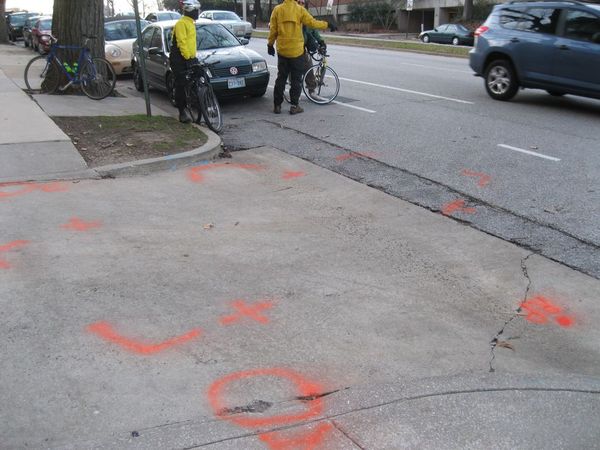
RIGHT OF WAY

by Donal


Investigation pending in accident that critically injured bicyclist

City police are stressing that the investigation into an accident that critically injured a Johns Hopkins University student who was riding a bicycle near campus is still pending. Nathan Krasnopoler, 20, was hospitalized after being struck Saturday by a vehicle being driven by an 83-year-old woman. …

The student was riding his bike in a marked bike lane on West University Parkway at the intersection with West 39th Street when he was hit by a vehicle trying to turn right, police have said. When officers arrived, Krasnopoler was trapped under the vehicle, according to a police report.
*****************************************************

They’re stressing that because the local cycling community is incensed at early reports that the cyclist was found at fault, which happens with depressing regularity. Bike Baltimore responds by citing the law:

§ 21-1209.(d) Yielding right-of-way – Unless otherwise specified in this title, the driver of a vehicle shall yield the right-of-way to a person who is lawfully riding a bicycle, an EPAMD, or a motor scooter in a designated bike lane or shoulder if the driver of the vehicle is about to enter or cross the designated bike lane or shoulder.

A few weeks ago, I sat in on a meeting of the Mayor’s Bicycle Advisory Committee. I’ve been following the Bike Baltimore blog for over a year, almost since it started. Bike Baltimore recently started a Facebook group, which I joined, which got me invited to the meeting. I dithered a bit but the office building is only a short walk from the office. Even though the snow had been cleared from the roads, I was leery of black ice, so I had been walking to the light rail stations. I walked past the red light block on Baltimore Street, where some fellow told me I was passing up the finest show in town. Everyone else at the meeting came by bike, and were allowed to bring them up to the office.

They all seemed to know each other, except for the the invited guest, Police Major Tony Brown, who seemed ill-at-ease at first, but asked very direct questions about what we cyclists felt were the biggest problems facing us. Some of the others offered a few complaints about being harrassed by aggressive drivers at certain locations. I was thinking that we were not addressing the real issue, but being new, I decided to be more of a listener. Someone blamed cyclists that disregard the law, and others blamed bicycle messengers, the buccaneers of pedaling, for pissing off drivers.

I see reality a bit differently. We build roads for traffic. Often the roads have sidewalks. According to the letter of the law, trucks, cars and bikes are supposed to use the roads, and pedestrians and perhaps children on trikes are supposed to use the sidewalks. The law varies as to how bikes may use the road. The old standard was that bikes stay to the right, while newer laws entitle a bike to full use of a lane.

That last part is the fundamental disagreement. Auto drivers don’t even want to slow down for other cars, much less to follow bikes. They don’t even want to change lanes to pass bikes, and cyclists don’t want to be forced into the curb by cars passing in the same lane. But trying to claim the entire lane really ticks off drivers.

One solution is to build separate bike lanes, but even if money can be found, taxis and even city officials park in those lanes. Another is to require that autos and trucks stay at least three feet away from bikes, but enforcement seems unlikely. In some respects I think this will play out like the situation with LGBT rights. I don’t think American drivers will tolerate bikes until more and more of them have cyclists in their family, or in their workplace, or in some way identify personally with cyclists.
Continue reading “RIGHT OF WAY”

Put the brakes on bike larcenies

From the Arlington Police Department
In 2010, 390 bikes using cables or chains as locks were stolen. The cables can quickly be cut with a rechargeable cutting tool and the padlocks are easily broken.
To prevent your bike from being stolen:
1) USE A U-LOCK. Properly secured this offers the best protection against theft. Secure the frame of your bike to a solid object, preferably one weighing more than the bike. And if you have a releasable wheel, it too should be secured with the frame.
2) ALWAYS LOCK YOUR BIKE. No matter what its value.
3) REGISTER YOUR BIKE with the Police Department. [WC: while I think this is a fine idea, it won’t keep your bike from being stolen. And registering with one of the two National online registries is a good additional – if not preferable – suggestion]
Bike registration is easy and free and you can do it online at www.arlingtonva.us. Go to Online Services and click on Register your Bike. You must use the serial number engraved on your bicycle, not from a receipt. You will receive an ACPD decal in the mail within 7 days to place on your bicycle which, when visible, is a definite deterrent to theft.
AND IF YOU DO BECOME A VICTIM:
Stolen Bikes: File a report online immediately. Go to www.arlingtonva.us/police and click on Report a Crime. Include brand, model, color and serial number.
AND REMEMBER — AN ABANDONED BIKE MAY BE A STOLEN BIKE
Abandoned Bikes: Call 703-228-4057. Report it immediately. Leave your phone number and a description and location of the bicycle.
Heather Hurlock, Lt. APO
Crime Prevention Specialist
Special Operations Section
Continue reading “Put the brakes on bike larcenies”

GAO: Trucking the least efficient mode of freight shipping

from Greater Greater Washington

The Government Accountability Office published a study finding that the costs of freight trucking that are not passed on to the consumer are at least six times greater than the equivalent rail costs and at least nine times greater than the equivalent waterways costs.

"When prices do not reflect all these costs, one mode may have a cost advantage over the others that distorts competition," writes the GAO. "As a consequence, the nation could devote more resources than needed to higher cost freight modes, an inefficient outcome that lowers economic well-being."

***************************************************
[B’ Spokes: note the contrast with AASHTO asking more "support" (money from tax payers) to expand roads to handle more freight trucking as that’s "vital" to the economy.]
Continue reading “GAO: Trucking the least efficient mode of freight shipping”