Bella Awards

from Maryland Injury Lawyer Blog

It is time for the 2011 Bella awards. Without further ado:

  • #5: On October 10, 2010, after three days of deliberation, the jury read a verdict of $10.10 in an Atlanta, Georgia wrongful death case. Asked later, a juror said, “We are sorry that guy died. But the irony of awarding $10.10 was irresistible. We actually waited a few minutes to give our verdict at 10:10 a.m. Get it now? $10.10. Great, right?”
  • #4: A jury in Orlando, Florida gave a defense verdict in a rear end accident case. The defendant claimed he put his Winnebago on cruise control and went back and made himself a sandwich. The jury agreed that it was reasonable to assume the cruise control would drive the Winnebago to its destination.
  • #3: A Richmond, Virginia jury awards no damages to a 23 year-old pedestrian who was hit by an F-150 truck while walking on the sidewalk. The jury found the Plaintiff contributorily negligent because she was singing while she was walking.
  • #2: Calvert County Maryland jury finds Defendant wrongfully shot plaintiff. With a gun. In the back. Jury awards $1.
  • #1: Patient goes to Jackson, Mississippi hospital for gallbladder surgery. Doctor amputates leg. A Houston, Texas jury finds in favor of the doctor. Afterwards, the jury told the gathered press: “Hey, anyone could make that mistake.”
Continue reading “Bella Awards”

Symposium and snow

Update: The Bicycle Symposium will be held today – February 22nd with a one and a half hour delay. The Symposium will start at 10am.
Thank you and please be safe.
*********************
Last year, there was also snow, school closings and delays but the Symposium did take place as it is not possible to have a rain (snow) date for this type of event. By 6:30am a message will be posted on the home page of the Bike Maryland website (https://www.bikemd.org) if the event is delayed or canceled (this not likely).

Abandon ‘Share The Road’

from Cyclelicious by Richard Masoner

What does “Share the Road” mean to you and me?

 
Who: Me and the driver of a plum Dodge Caravan minivan.
When: Last Saturday morning.
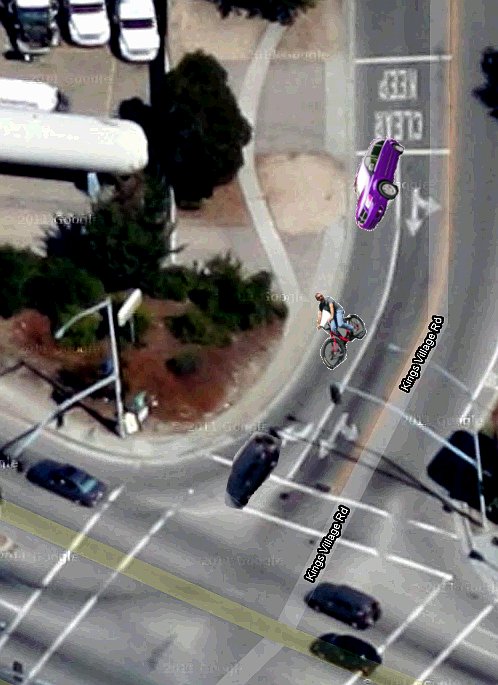
Where: The corner of Kings Village Road and Mt Hermon Road, Scotts Valley, California.

I was running errands last Saturday morning and preparing for a right turn from Kings Village Rd. The right turn lane is about 11 feet wide. Me and my bike take up roughly three feet. The Dodge Caravan behind me is 79 inches; with the mirrors the minivan uses up 8.5 feet of lane width. 8.5 + 3 = 11.5 feet, so even if we’re touching there’s clearly not enough room in the lane for us to ride side by side. And besides it’s stupid to pass in a turn.

So I position myself smack in the middle of the lane for the turn and queue up behind the car ahead of me.

Scotts Valley Kings Village and Mt Hermon w/ bike

The driver behind me then guns her engine, moves left to pass then cuts right with me right next to her, pushing me into the curb!

I squeeze the brakes to avoid becoming road pizza, then pull around to the driver’s side window to explain (politely) that she should wait until it’s safe to pass. Her smug, snotty response? “Bikes are supposed to share the road.

Share the Road with bicycles sign

Anybody who cycles with traffic in America learns pretty quickly to ride defensively, and it’s no surprise to us that many motorists have little understanding of the Pauli Exclusion Principle, which is the law of physics that explains why a car can’t occupy the same space as a bicycle. Most of us realize that we share the road with a few idiots, shrug our shoulders and deal. I’m a big believer in politely cooperating with other traffic and I yield right of way where appropriate, but when there’s no space in the lane, I’m going to assert my right to be there through my position.

Last Saturday’s “Share the Road” incident was on my mind during Thursday night’s Twitter Bikeschool discussion when Martha from El Paso, Texas asked “What are you doing to raise awareness to share the road?”

There were many good answers, but some of the responses affirm my belief that cyclists are sometimes our own worst enemies. A number of people responded that they wear helmets to affirm road sharing (huh?). There was a big emphasis from several on safety education for cyclists, with somebody in Akron even tweeting that he reprimands badly behaved cyclists. Visibility was another big theme in road sharing, which I don’t understand. Safety and visibility are good things, but the driver last Saturday clearly saw me, she just didn’t care that I happened to be in the lane. The visibility arms race does not promote road sharing. I wear a yellow jacket and equip my bike with bright flashing lights, but less conspicuous cyclists should not be blamed when a careless motorist fails to share the road and causes a crash.

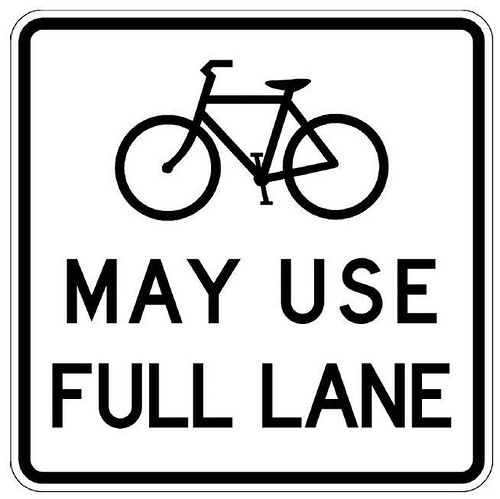
My response to Martha’s question? The “Share the Road” message doesn’t work. It’s time to abandon it in favor of this message.

Bicycles May Use Full Lane sign

Continue reading “Abandon ‘Share The Road’”

Video Detection Cameras

You may not be aware but Maryland is moving toward the new video detection cameras that control lights. The good news is they can detect bicycles, the bad news is they have to be set up so the detection area includes where bicyclist will stop. My impression so far is that a cyclist stopping far right will not get detected, additionally at intersections which have one really wide lane that unofficially accommodates a right turn lane a cyclist in the center of the "right" lane doe not register as well. You essentially have to be in the middle where a car would be to be registered by the light. While this might be sound safety advice it still is not the default behavior of most cyclists and what will a cyclist do if not detected by the light, run the red light of course.
We have decades of training that lights do not detect bicycles so we run red lights as a mater of course. To put an end to this we need to place a symbol on the ground where a cyclists should be to get a green light or detect a cyclist wherever they might be. This is already Maryland policy but I have never seen any symbol on the ground at lights and detection of my bicycle is really hit or miss at most intersections and I know how to place my bike on various loop detectors while most cyclists don’t. I really think Maryland goes out its way so bicycles are not detected rather then are detected.
from The Bike Nazi by Bikeboy he adds:
"Ya know what would be really nice? If both the detection cameras and ground loops triggered some subtle signal – a small yellow light, or a beep, or whatever – to acknowledge to the driver, "I’m aware you are there. Sit tight – I’ll let you through." That would let us know whether we should wait, or start looking for an opening in traffic."
Acknowledgment by the system that it is "working" is standard engineering practice in all fields except traffic engineering for bike/peds and it amazes me that their has not been a malpractice lawsuit yet.
John Allen has this to say:
"However, the problem of bicyclists’ running red lights has an additional and even more troubling dimension. If I told you that bicyclists are being psychologically programmed by evil, unseen forces to run red lights, would you think that I am paranoid?"
Should I remind traffic engineers of what negligence is? You don’t need to do this on purpose, in Maryland (at least) you are neglecting your responsibilities per state law in accommodating cyclists as part of the transportation network.
Bikeboy has a nice article on this topic as well as a link to a video that enplanes the traffic detection cameras https://bikenazi.blogspot.com/2011/02/video-detection-cameras.html
John Allen goes into some detail about the problems and solutions with ground loop detectors.
"Putting an end to the actuator problem is a job for bicyclists’ organizations: put your local and state authorities on notice that bicycle-insensitive traffic signal actuators are defective and illegal. "
https://www.bikexprt.com/bicycle/actuator.htm

‘Vulnerable user’ law would protect bicyclists, pedestrians

The St. Petersburg Times: ‘Vulnerable user’ law would protect bicyclists, pedestrians
Dan DeWitt, Times Columnist
In Print: Friday, February 18, 2011
This seems like a natural for the most lethal state in the country for walkers and cyclists — a "vulnerable user" law.
I received an e-mail on this subject in response to Sunday’s column about Brad Ash, the Pasco County middle school teacher who was killed after being hit while riding his bicycle on St. Joe Road.
Like many other such drivers, the woman whose car struck Ash received only a minor traffic citation: careless driving. It was a charge that suited the action — briefly taking her eyes off the road — but not the consequence, thereby creating a legal puzzle.
The solution? Maybe a vulnerable user law.
Ash died mainly because, like all cyclists and pedestrians, he was traveling without the protection of what Portland, Ore., lawyer Ray Thomas calls a car’s "steel ectoskeleton."
Other aspects of law have long recognized that certain populations, including children and the elderly, are more susceptible to harm than others, said Thomas, who helped pioneer vulnerable user legislation in the United States.
So why don’t traffic statutes do the same for walkers, people in wheelchairs and on bikes and, ideally, motorcyclists? The idea is not to make criminals of drivers who hit them — just to make sure these motorists reflect on the potentially grave results of distracted driving and spread that word to others.
Before the passage of the 2008 Oregon law, based on similar ordinances in several European countries, the maximum fine for a careless driver who caused a death in that state was $750. Now, if the victim is a vulnerable user — as they often are when minor slip-ups end tragically — that amount is $12,500.
Drivers can greatly reduce this fine by taking traffic classes and doing community service, usually giving talks about their experience. The drivers in these fatal crashes "of course feel terrible, and this gives them an opportunity for reconciliation," Thomas said.
In doing so, of course, they increase public awareness of the danger faced by cyclists and pedestrians. So did just passing the law — the state giving its stamp of approval to a legal shield for these folks.
Since then, Thomas said, the law has received lots of publicity, including in this month’s trial of a Portland bus driver who was convicted of striking five pedestrians, killing two of them.
Said Thomas: "Law enforcement people aren’t as likely to think, ‘What is that goofy guy doing riding his bike on the road? Doesn’t he know he can get killed?’ "
Some enhanced penalties are already in Florida law.
Tuttle, for example, could lose her license for as long as a year and be fined as much as $1,000; if there was no fatality or injury, she’d keep her license and probably face a smaller fine. Another provision allows judges to impose as much as 120 hours of community service, though they rarely do, according to lawyers to whom I spoke.
"I’ve never seen it. Never, ever, at all," said J. Steele Olmstead, a Tampa personal injury lawyer and cyclist.
Bike and motorcycle groups in Florida have lobbied for tougher penalties for careless drivers who cause deaths — and gotten nowhere.
Which is too bad, and not only for the main reason — that people’s lives are in danger — but because scary roads are expensive.
People who, say, liked to ride their bikes to hang out at a coffee shop or play a game of basketball at a park will now drive. That puts more cars on highways and eventually more burden on us to pay for widening projects.
And the roads in Florida are more than scary; they’re terrifying. Not just recently, and not just because of the dozen cycling deaths in the Tampa Bay area since late July. Year after year, more cyclists and almost as many pedestrians die in Florida as in California, which has twice our population. Mike Lasche, a longtime cycling activist from Sarasota, found that between 2001 and 2008, Florida ranked among the top three states in per-capita cycling and pedestrian deaths.
Nowhere else came close, certainly not New York or Delaware, both of which followed Oregon’s lead and passed vulnerable user laws last year.
Can anyone seriously argue that Florida should not do the same?
Continue reading “‘Vulnerable user’ law would protect bicyclists, pedestrians”

CARROLL COUNTY POLICE CHARGE BALTO. DEPUTY AFTER ‘ROAD RAGE’ INCIDENT NEAR HAMPSTEAD

— I.V. Staff report

Cyclist admits flipping off officer — two times;
says deputy illegally passed him on Md. Rte. 30

DEPUTY CHARGED WITH ASSAULT; CYCLIST NOT

A Baltimore City Sheriff’s Office deputy has been charged with assault after allegedly pointing his gun at a motorcyclist who made an obscene gesture toward him on Maryland Rte. 30 in Carroll County, the Carroll County Times reported this weekend.

The motorcylist told police the deputy pointed his gun at him after the cyclist had flipped the deputy off — twice.

According to online court records, the deputy, Michael Savage, 38, of the 7900 block of Galloping Circle in Baltimore, is charged with two counts each of first-degree assault, second-degree assault and reckless endangerment, and was released on his own recognizance.

The “road rage” incident occurred just after 5 p.m. Thursday, south of Maryland Rte. 91.

As reported by the Times, the motorcyclist — who was not identified — told investigators he made “an obscene gesture” when Savage’s van “illegally passed him” on the highway and then repeated the gesture as they approached a traffic circle.

Whereupon the deputy “pointed a black handgun at him and made a motion as if the gun had been fired, according to court documents.”

Hampstead (Carroll County) police officers subsequently stopped the van and identified the driver as Savage, according to the Times.

“Savage was wearing his Baltimore Sheriff’s Office uniform and carrying a .40-caliber Glock handgun with one round in the chamber and 14 in the magazine, according to court documents,” the Times reported.

“The gun was determined by investigators to be the one Savage had been issued as a sheriff’s deputy.

“Savage told police the motorcycle had been driving below the posted speed limit and the driver had motioned him to go around. He denied pointing his weapon at the man.”

Reached by Times Staff Writer Ryan Marshall by telephone Friday, Savage “declined to comment,” Marshall said.

Savage’s wife, who was in the van but had not been paying attention, she said, told police she did not see her husband point the gun.

Continue reading “CARROLL COUNTY POLICE CHARGE BALTO. DEPUTY AFTER ‘ROAD RAGE’ INCIDENT NEAR HAMPSTEAD”

Bake sale for bike lanes?

From the Gazette:
"McClement said the best way for the city to contribute to the project was through in-kind work, and said fundraising could be done to help finance the rest of the project."
*********************************
There is an underlying error in the Aldermen’s thinking and it goes something like: cars pay for roads and cyclists don’t. Not to mention cars have superior rights for exclusive use of roads and can lawfully harm people, property and the environment in pursuit of fast transportation, as every second counts and it is totally worth killing at least a person a day so cars can save a few seconds.
Let’s look at the latter first. In order to save money Government can’t dump toxic waste in your back yard but some how they think they can do the equivalent when building roads. State laws say that the needs of bicyclists and pedestrains are part transportation planing and building. And that there is appropriate money available for this. (Laws after the fold.)
As for the first part, I’m thinking why not set up bicycle "user fee" just like cars. Let’s have a specialty tax that goes into a Bicycle Bank Trust Fund, just like cars who’s specialty taxes don’t go into the General Fund but into the Highway Trust Fund. So all the sales tax we are now paying would go into a separate account for our exclusive benefit just like cars. Of course the road building budget could not be supplemented by the General Fund to the same extent that it has been but why should cyclists be paying for exclusive car use anyway? If cars are not willing to share "their" money we should not be willing to share our money either.
From memory I remember seeing studies of several trails that brought in ~.$3 million to the local economy each. That’s $180,000 in sales tax revenue per year from cyclists. And unlike cars where only 16% money spent stays in the local economy cyclists support a wider verity of goods and services that support a stronger local economy.
In summary supporting car centricity is supporting foreign oil and an inactive life style. The public roadways should be serving the greater public good. Supporting bicycling financially is not the end of the automobile nor the road to economic ruin, it is in fact the opposite, the more people who we encourage to bike and walk by complete street designs the safer our roads will become for everyone and helps put more money into the local economy.
Continue reading “Bake sale for bike lanes?”

The slippery slope – letting machines do our basic transportation [video]

With 60% of car trips being 5 miles or less and 60% of adults who can’t find time to do moderate exercise for a half hour resulting in 60% of the population being over weight or obese. Not to mention community plans devoted to the “well being” of cars. I think that slippery slope has already begun in earnest.

And there there is the false advertising bit of the video. There is no doubt, if there was only one other car on the road that we could aggressively pass on the right, driving would be fun. But there are 20 drivers ahead of us if not thousands and driving like shown in a real environment if even possible, would probably result in an accident, heavy fines or drivers license suspension.