Note: these funds could be used to help localities to be more bicycle friendly.
| Year | 03 | 04 | 05 | 06 | 07 | 08 | 09 |
| State | Avail. | Avail. | Avail. | Avail. | Avail. | Avail. | Avail. |
| Maryland | 20% | 29% | 22% | 22% | 38% | 2% | 23% |

Biking in Baltimore
Note: these funds could be used to help localities to be more bicycle friendly.
| Year | 03 | 04 | 05 | 06 | 07 | 08 | 09 |
| State | Avail. | Avail. | Avail. | Avail. | Avail. | Avail. | Avail. |
| Maryland | 20% | 29% | 22% | 22% | 38% | 2% | 23% |
From Sustainable Stormwater Management
Every time I purchase a bottle of water I feel like I did something good for myself. After all, water is so much better for you than some of the alternative beverage choices! However, I was recently shocked to learn that maybe that bottle of water isn’t as wonderful as I thought.
I just finished watching a documentary called Tapped, produced and directed by Stephanie Soechtig and Jason Lindsey. 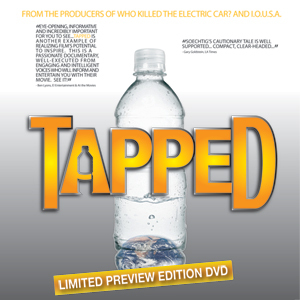 The film questions whether water is a basic human right or a commodity that should be bought and sold like any other article of commerce. According to the film, much of the bottled water is drawn from municipal water sources (aka tap water), which gets filtered, bottled, and sold back at 1900X the cost of tap water. They come into small towns in places such as Maine and Georgia and start pumping huge volumes of water, sometimes despite severe drought conditions.
The second issue the movie explores is that actual production of plastic bottles and the chemicals which they can contain. Oil is made into plastic during the refining process.
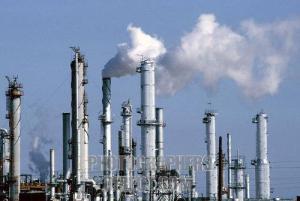
Corpus Christi, TX oil refinery.
Some of the chemicals in the bottles have been shown to leach into the water, especially after the water is warmed, say while sitting in the trunk of your car. The horrible chemicals in the plastic bottle themselves, including Bisphenol-A (BPA), have been linked to cancer, ADHD, reproductive issues and a whole lot of other nasty things by independent researchers.
Only about 20% of plastic bottles are recycled in the United States. The bottles that are not recycled end up in landfills or in the ocean.
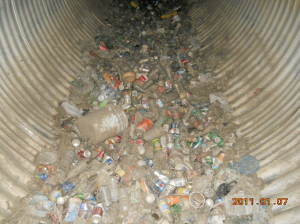
Plastic bottles inside a storm drain, taken during an annual site inspection.
Huge garbage patches filled with partially decomposed plastic have been found in both the Pacific and Atlantic Ocean. Within these patches, one the size of Texas, the composition of the ocean is changing and plastic is becoming more prevalent than the plankton population. We’ve written about these on this blog before.
As the Tapped movie website says “I had been naïve enough to think recycling alone was enough. The only thing we can do is to stop putting plastic in the ocean. Be more aware of the way things are packaged, say no to plastic bags, don’t buy Styrofoam cups, order less take out (or bring your own containers when you do), stop drinking bottled water, reduce, reuse and recycle.”
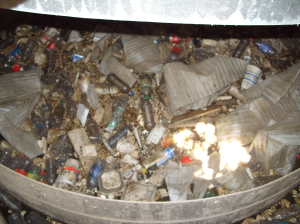
Bottles and other plastics found in vortex unit inside of a catch basin at a local shopping center.
Closer to home, we see the results of bottled water every day in our work at Stormwater Maintenance, LLC.
The volume of bottles we see, especially in underground structures, never ceases to amaze all of us. And to think, everyone who drinks it thinks they are doing the right thing.
Michael Dresser did some excellent reporting on this issue.
When it comes to pedestrians, Maryland is the anti-Vegas. What we have here is a dysfunctional relationship between drivers and walkers that helps ensure a seemingly permanent spot among the most dangerous states for pedestrians.
…
But there are also cultural factors at work. Hedlund said that in California when a pedestrian moves to step off a curb, traffic cars are likely to stop. In Baltimore, they’re just as likely to speed up.
…
Jamie Kendrick, Baltimore’s deputy transportation director, said that over the next month or so the city will seek bids on a project to install about 40 flashing signals, repaint the stripes on nearly 600 crosswalks, install more than 150 new handicapped-accessible ramps and curb cuts and put up nearly 700 pedestrian countdown signals.Kendrick said all of the projects will be undertaken in school zones. In addition, he said, the city will announce a significant investment this spring on traffic-calming measures.
These initiatives are quite welcome, but they don’t add up to a comprehensive policy. It does nothing about crosswalks that aren’t in school zones. It doesn’t crack down on scofflaws.
For that, the city and other Maryland jurisdictions need to step up enforcement.
According to Jonathan Adkins, spokesman for the governor’s safety group, other states have stepped up enforcement efforts using “decoy” pedestrians to nab drivers who ignore crosswalks.
Such operations have been used to good effect in the areas of drunken-driving and seat belt use, but they don’t make much of a dent without a media effort that gives each citation a multiplier effect.
Kendrick said Baltimore last mounted a sting operation in September but he acknowledges that it wasn’t well-publicized. These programs need to be done with a splash — including inviting video coverage of the enforcement actions. It would be fair if they targeted crosswalk-violating drivers and jay-walking pedestrians equally.
Meanwhile, the General Assembly ought to reconsider its current fines for pedestrian-related offenses. Right now, a ticket for a motorist failing to yield to a pedestrian in a crosswalk — one of the most dangerous of moving offenses — carries a measly $90 fine. Shouldn’t it be closer to the penalty for passing a school bus with flashing red lights? A $570 fine would certainly get motorists’ attention.
Last year, New York adapted the “Elle’s Law” statute, named for a 3-year-old girl who was struck in a crosswalk and left in a coma by an SUV traveling in reverse on a one-way street to grab a convenient parking space. The law automatically suspends the license of any driver who strikes a pedestrian while driving recklessly. Not a bad idea.
…
There is growing evidence that roads safer for pedestrains are safer for cyclists and roads safer for cyclists are safer for pedestrains. In the discussions that came up on this topic the following PBS video was highlighted how our road are dangerous by design:
Continue reading “Maryland has a pedestrian problem”
rain days got you down?
check it
https://baltimorevelo.com/2011/01/fresh-product-from-seated/#more-1648
B’ Spokes: I thought I would add some pictures as that is the cool bit:


More info at: https://baltimorevelo.com/2011/01/fresh-product-from-seated/#more-1648