by Tom Vanderbilt
…
Even if the lanes were narrowed, as John LaPlante recently argued in the journal of the Institute for Transportation Engineers, “there is no significant crash difference between 10-, 11-, and 12-foot lanes on urban arterials where the speed limit is 45 mph (or less).” (a finding, he notes, that was unfortunately left out of AASHTO’s recent Highway Safety Manual). [Also note there is no difference in capacity for 10-12 lanes as well.]
…
But in non-highway environments, there’s all kind of evidence that reducing the number of lanes (a.k.a. the ‘road diet’) can have positive safety benefits. As the Federal Highway Administration has noted:
Road diets can offer benefits to both drivers and pedestrians… road diets may reduce vehicles speeds and vehicle interactions, which could potentially reduce the number and severity of vehicle-to-vehicle crashes. Road diets can also help pedestrians by creating fewer lanes of traffic to cross and by reducing vehicle speeds. A 2001 study found a reduction in pedestrian crashing risk when crossing two-and three-lane roads compared to roads with four or more lanes.
But what if one of those lanes your crossing is a bike lane? Surely that must make things less safe, no? More interactions in less space. In a forthcoming paper to be published in the Journal of Environmental Practice Norman Garrick and Wesley Marshall examined 24 California cities (12 with relatively low traffic fatality rates, 12 with relatively high rates). They found that the cities that had a higher bicycle usage had a better safety rate, not just for cyclists but all road users. They write:
"Our results consistently show that, in terms of street network design, high intersection density appears to be related to much lower crash severities. Our street design data also contains strong indications of these trends; for example, the high biking cities tend to have more bike lanes, fewer traffic lanes, and more on-street parking. At the same time, large numbers of bicycle users might also help shift the overall dynamics of the street environment – perhaps by lowering vehicle speeds but also by increasing driver awareness – toward a safer and more sustainable transportation system for all road users."
And as Eric Dumbaugh, of the University of Texas A&M, notes, “most recent research reports that wider lanes on urban streets have little or no safety benefit, at least to the extent that safety is measured in terms of empirical observations of crash incidence” (e.g., Potts, I.B., Harwood, D.F., & Richard, K.R. (2007). Relationship of Lane Width to Safety for Urban and Suburban Arterials. Transportation Research Board 2007 Annual Meeting; Milton, J., & Mannering, F. (1998). The relationship among highway geometries, traffic-related elements and motor-vehicle accident frequencies. Transportation 25, 395–413; and so on).
…
Continue reading “On Bike Lanes, Road Widths, and Traffic Safety”
Iz Tryna Go Green, Butt (!) Ai Cant Reech teh Pedalz…

Drunk driver who killed Stan Miller gets eight years prison, then five years probation
By The Daily Randonneur
A group of D.C. Randonneurs and many others who cared about slain cyclist Stan Miller attended the sentencing of Stan’s killer, Quinzy Fraser, today in Rockville. Md. They were among about 75 friends of Stan who appeared, and another 75 or so on behalf of Mr. Fraser.
I’m told by one of those who were there that the judge sentenced Mr. Fraser to the full 10 years allowable for vehicular manslaughter, with two years suspended. Mr. Fraser was also given five years probation.
Both the prosecution and Mr. Fraser’s defense argued their respective cases. It came to light that this was Mr. Fraser’s third drunk driving incident, one more than was commonly known.
Stan died last June 25th when a drunk Fraser, driving his SUV with a .20 blood alcohol content, hit him at high speed on the shoulder of Maryland Rt. 27 during the evening rush hour.
************************************************************************************************************
[B’ Spokes: This is the first conviction of Vehicular Manslaughter that I am aware of. You’ll note the very high bar to prove "driving in a grossly negligent manner." Three prior DUI’s, near three times the legal limit of blood alcohol content, resisting arrest, assaulting a police officer and driving at a high rate of speed.
I also find it interesting that this is not in addition to DUI charges but instead of DUI charges. I am guessing here but perhaps that’s why we rarely see this charge because if you can only charge one or the other you risk not getting a convection if you go for the harder to prove gross negligence. If any lawyers want to chime in on this point, please do.]
Continue reading “Drunk driver who killed Stan Miller gets eight years prison, then five years probation”
The List: Arrested Development
On Jan. 10 police in New Castle caught a bank robber by following the tracks left in the snow by his bicycle.
Continue reading “The List: Arrested Development”
The conclusion of the Swanson case in DC
"Swanson’s mother and aunts had pushed hard to have him charged criminally in DC after the accident. But a long Metropolitan Police Department investigation concluded Swanson most likely rode her bicycle into the truck. That conclusion is fiercely disputed by the promising young student’s family."
Outrageous! Get right hooked by a truck and the cyclist is at fault for not yielding. What ever happened to:
§ 21-303(c) Overtaking vehicles going in the same direction.- The driver of a vehicle overtaking another vehicle that is going in the same direction, until safely clear of the overtaken vehicle, may not drive any part of his vehicle directly in front of the overtaken vehicle.
Note that the DC police made the same wrong flop of logic of who did the "action" as in the Yates case: "The tanker truck that the cyclist struck was a large one. The cyclist struck it in the rear." https://www.baltimorespokes.org/article.php?story=20101202133743715
We really need to correct this kind of misunderstanding by the police and hopefully that is in the works.
Related: Cyclists ‘left unprotected by police and courts’ https://www.baltimorespokes.org/article.php?story=20110109095139244
Continue reading “The conclusion of the Swanson case in DC”
BTAG Meeting Next Friday, January 21, 8:30 AM in Bowie
Prince George’s County’s BTAG (Bicycle and Trails Advisory Group) is comprised of citizens and government officials who want to promote bicycling in Prince George’s County and to improve the conditions for people riding bicycles in the county. Anyone is welcome to attend and participate in the quarterly BTAG meetings. The January Quarterly Meeting of BTAG is scheduled for Friday, January 21 from 8:30 AM – 10:30 AM at the Bowie Senior Center.
I encourage anyone interested in bicycling in Prince George’s County to attend the meeting. We will be meeting in the Ceramics Room in the Bowie Senior Center. The Senior Center is located along Health Center Drive near the Bowie Town Center. The senior center is the second building on the left after you turn onto Health Center Drive from Northview Drive.
Topics submitted so far for the agenda include:
- The cycle track concept along US 1 (see note below)
- The Bowie Heritage Trail
- The Potomac Heritage Trail On-Road Bicycle Route Signage Plan
- The Dinosaur Trail proposal in northern Prince George ‘ s County
- Anacostia River Trail Update
- Piscataway Creek MOU
- Star Spangled Banner Trail (Croom Road corridor and Cheverly to Bladensburg)
- The 2011 Maryland Bicycle and Pedestrian Symposium in Annapolis
Please contact Fred Shaffer via e-mail or at 301-952-3661 if you have any additional agenda items, questions or would like to follow-up regarding a specific issue.
Fred Shaffer
Planning Department, M-NCPPC
Fred.shaffer@ppd.mncppc.org
301-952-3661
Note on Cycle Track along US 1:
Councilmember Olson will probably be at the meeting and he is hoping for support for the cycle track concept on US 1, a cycleway along US 1 that would be separated from motor traffic. There will be a brief presentation on the proposal which is included in the new US 1 Sector Plan. SHA has written a fairly strongly worded memo against the concept. But, the hope is that if enough cyclists support the idea, SHA might reconsider. The cycle track it is an extremely long-term proposal and the Sector Plan still supports bike lanes in the short and mid-terms. However, due to the 1) vehicular speeds, 2) traffic volume, and 3) the amount of truck traffic on US 1, the plan supports a separate, dedicated facility for cyclists as part of the long-term vision. Also, it is hoped that this type of protected, dedicated facility will encourage more people to make some trips by bicycle. By providing a facility that people feel comfortable on will encourage more people to make trips in the corridor by bike.
Directions from the Capital Beltway to the BTAG meeting:
Take US 50 East
After approximately 7 or 8 miles, take MD 197 south.
Turn right at the first light ( just past the pedestrian bridge) for Northview Drive
After less than ¼ mile on Northview Drive, turn right at the first light for Health Center Drive.
The Bowie Senior Center is the second building on the left ( 14900 Health Center Drive ) .
The Ceramics Room is located past the front desk along the hallway to the right.
Take US 50 East
After approximately 7 or 8 miles, take MD 197 south.
Turn right at the first light ( just past the pedestrian bridge) for Northview Drive
After less than ¼ mile on Northview Drive, turn right at the first light for Health Center Drive.
The Bowie Senior Center is the second building on the left ( 14900 Health Center Drive ) .
The Ceramics Room is located past the front desk along the hallway to the right.
[B’ Spokes: While I have not seen the cycle track design above I will put in a cautionary bit of info:
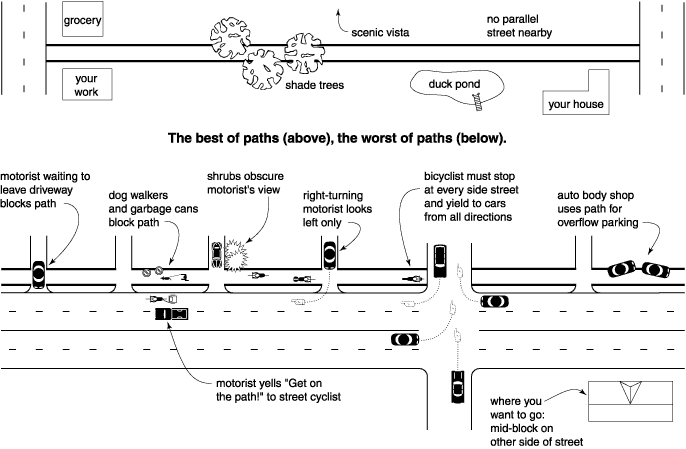
Maryland’s over stress on off-road encourages the worst of off-road facilities (bottom half) over and above more appropriate on-road facilities. And even with the best of paths (top half) most MD paths do not allow for comfortable biking from home to the trail (Per NHTSA survey 89% of bike trips begin at a residence and only 7% at a recreational site), nor do paths generally allow comfortable biking from the trail to work or grocery stories, such an idea is not even in the works. We need a more workable solution then what’s being offered and more verity in the offering of bike facilities at not only the state level but the local level as well.
Additionally: Bicycle Facility Design by Richard C. Moeur, P.E., L.C.I.]
Continue reading “BTAG Meeting Next Friday, January 21, 8:30 AM in Bowie”
It’s tough to talk on a cell phone and look out for pedestrians entering crosswalks
Crosswalk violations call for strategic plan
from Getting There by Michael Dresser
Jen Gaffney of Baltimore raises what has become a perennial issue in Baltimore — one that the city needs to address with a comprehensive strategy rather than a Band-Aid. It’s the penchant of local drivers to tune out the existence of pedestrian crosswalks. For a past column, I observed the behavior of Baltimore drivers around a well-marked pedestrian crosswalk. What I found is that any pedestrian who relies on a crosswalk to assure the right-of-way better have paid-up life insurance.
…
…
What this city requires is a coordinated strategy of using signage, advertising, law enforcement and political leadership to send a message to drivers to watch out for pedestrians — or else. At the same time, city officials ought to show they’re ready to crack down on wayward pedestrians.
First, that would involve a signage strategy. The city should start with the premise that what it’s doing now is insufficient to grab drivers’ attention. After all, it’s tough to talk on a cell phone and look out for pedestrians entering crosswalks. Flashing yellow lights might help, along with pedestrian-activated crosswalks.
That’s expensive though. And by itself, it’s likely to be ineffective. Baltimore drivers are just too used to plowing through crosswalks without slowing down.
What’s also needed is a highly visible, well-publicized enforcement campaign. The police ought to set up sting operations at strategic crosswalks such as the one in Harbor East and relentlessly ticket drivers who fail to stop. Special attention should be given to those who plow through crosswalks while talking on cell phones.
…
When the sting occurs, local news media ought to be invited to cover the event. Believe me, they’ll show up for that. It’s great street theater. Repeat a few times at different locations, back up the message with a public service ad campaign, and the message will filter out.
Don’t count on police to make this a priority on their own, however. It would likely require a push from the mayor herself. And to get the mayor’s attention, it sometimes requires the City Council to weigh in.
So what does the city have to say to this? Getting There invites a response.
Senator Brochin and Save the Raven

I know everyone has been anxiously awaiting new information pertaining to single-track trail usage at Loch Raven Reservoir. As everyone knows, it was stated by DPW at the last public meeting that they would have a review of our plan by the end of November. This however did not happen. Due to the overwhelming support from the public in their reach out to Senator Brochin, the Senator called a meeting to talk about the issue at hand.
Today January 11th 2011 I was afforded the chance to sit down with the Senator. The meeting consisted of Gary Nusinov (STR) and Bob Compton (MORE) in the role of “constituents and recreational advocates”, Senator Brochin, representatives from DPW including Director Foxx, Clark Howells, Marcia Collins, Ralph Cullison, Celeste Amato, Frank Boston III (representing UNDER AMOUR), and two gentlemen that I can not remember their names, one from DPW and the other with Mr. Boston.
First let me say what a pleasure it was to meet Senator Brochin. He is very passionate about Loch Raven. He has been on the forefront of issues effecting the watershed for more than twenty years. Mr Brochin clearly stated that the number one threat to Loch Raven is Deer. That statement is backed up by twenty years of DPW science. He lobbied for deer management through three Mayors.
Without going into the whole word for word analysis of the meeting, I will layout the general theme.
DPW presented their view of the history and current state of Loch Raven Reservoir. It was stated that we would not be told what the evaluation of our plan is UNTIL the mayor is informed. A couple of facts were out of place but with so much time between meetings, that is almost expected. However if you would like to see what DPW and John Markley from Baltimore County DEPRM have to say, you can visit Baltometro.org (Baltimore Metropolitan Council) and search for articles Titled “Reservoir bike trails RTG brief” by Clark Howells [I think that’s the right link] and “Comments on Mid-Atlantic Off-Road Enthusiasts, Inc. Recreational Trail Use Plan Proposal” by John D. Markley. The comments will astonish you.
Senator Brochin Shortened the DPW presentation in order to let Bob and Gary speak
Bob Compton, Timonium resident and MORE’s Co-Chair of the MTB task Force reorganized the history of our plight while placing on the table a stack of support that has come from citizens and businesses in and around Maryland. This included petitions, letters of recommendation, letters of support and some incriminating pictures of some damage done to the reservoir by a local utility company. . Everyone in the room could not believe that the utility company was clearing their easement in the reservoir buffer lands and DPW was not aware. He also stated that DPW plans on hiring a local tree company to widen the woods roads so that two vehicles may pass. Bob mentioned that the Trail plan was handed in to the DPW for review. The reviewing group (Reservoir Technical Group) contained members were that already opposed to bikes in the original meetings so why would they choose any differently now.
Senator Brochin repeated that recreational activity at Loch Raven is something that his constituents are die-hard about. He repeated that the deer are the number one cause of destruction. He requested that before the Mayor is informed from DPW that we all sit in a room and try and work this out and do not leave the room until it is done. He clearly stated that this can be worked out. He offered time at his office in Annapolis for us to meet again in order to solve this mess. Director Foxx said he would still consult with the Mayor first, but agreed that he work tell her that any decision they have come to is not final.
Mr. Boston informed the group of UNDER AMOUR’s continued support of proper recreational access at Loch Raven. He stated that he liked the direction that the Senator was moving the conversation.
The DPW theme is that access is not an issue and that the plan that we submitted is only going to be turned down because of the laws that they have to follow, the Buffer Protection Management Ordinance.
Gary Nusinov was then given a chance to speak. Gary presented a pile of DPW’s scientific studies and stated that within all of the studies, mountain bikes are not mentioned and that if the problem was that bad, then the bikes would be mentioned separately from recreation. He corrected the assertion that impact is directly correlated to bikes since many trails were in existence well before mountain bikes were invented. He re-stated that the plan that MORE submitted was a trail use plan for all recreation and that DPW had no intention of creating a recreational plan that properly met the needs of all users. Gary then referred to the Buffer Protection and Management Ordinance and read out loud. In a word, trails are allowed in the area and much of the damage we see from DPW in the bufferland is strictly prohibited. An example brought up was the recent dumping of fresh un-compacted asphalt at the head of the trail next to a stream. There was a lot of back and forth talk about some things that came to light such as our impact being equal to only 6 acres, other grandfathered uses, storm-water issues, and the fact that absolutely nobody in the room could disagree with the statement that Loch Raven will be better than it is now if our trail plan is accepted.
The Senator reinforced the fact that he wants to sit down in the next few weeks to hatch this out. It was brought up that the rangers could be doing much more useful things with their time then harassing the citizens and criminalizing them. The Senator read a letter from a doctor who talked about losing weight because of Mountain Biking at Loch Raven and the direct impact that the newly enforced rules would have on him. He continually expressed his opinion that we are all neighbors and that we enjoy Loch Raven and that the DPW is using too much government and it is unnecessary and unreasonable.
The meeting ended with a promise to all get back in the room and work this out, ASAP.
Please everyone show your support for Senator Brochin. His address is 705 York Road, Towson. His email is jim.brochin@senate.state.md.us Please send him a letter of gratitude! Also, there is a town hall meeting tomorrow night Jan 12th (we just heard) about loch raven with Senator Brochin. For questions call 410-823-7087
Small Lecture : The worst thing you can do is create new trails, or use newly created trails! This is the number one argument against all recreation in the bufferland! STOP IT.
Thanks and please show your support for the Senator. I’ve got feeling…
STR
The skinny on obesity: It costs US $270B a year
By RITA DELFINER
Overweight and obesity are weighing on the US economy — costing a big, fat $270 billion every year.
So says the Society of Actuaries in a study, released yesterday, analyzing the "increased need for medical care and loss of economic productivity resulting from excess mortality and disability."
"Just shows . . . obesity has a real impact on our economy," said co-author Don Behan, whose study crunched numbers from 500 research articles.
The estimated tab:
* For medical care caused by overweight and obesity is $115 billion.
* For productivity lost to excess mortality is $45 billion.
* For productivity lost to disability for active workers is $40 billion.
* For productivity lost to overweight or obesity for totally disabled workers is $65 billion.
The annual cost to Canada? A relatively reed-thin $30 billion, the study found.
Continue reading “The skinny on obesity: It costs US $270B a year”
Bicycle Improvements Coming to Guilford Avenue
Guilford Avenue is a commonly used bicycle route through the center of Baltimore. Being a quieter, residential street, cyclists are attracted to Guilford due to less vehicular traffic. The school parking lot at North Avenue acts as a traffic diverter for cars, but allows bikes to continue through. Needing a connection in the city’s bicycle network between the Collegetown Bicycle Network and downtown, the Department of Transportation (DOT) will add improvements to Guilford Avenue between Mt. Royal and University Parkway. Guilford Avenue will be designated as a ‘bicycle boulevard’ or roadway where bikes and cars share the road at near equal speeds. Wayfinding signs, bike-friendly speed humps and mini-circles will further enhance the bicycle experience. In the planning process, the Department of Transportation sought and received valuable community input to help determine what design treatments were appropriate for specific locations.
…
Continue reading “Bicycle Improvements Coming to Guilford Avenue”