
All we need to do is introduce a new safety program and teach more Baltimoreans how to do this:
Mendelson calls for better traffic enforcement to protect vulnerable users
Filed under News you will not see in Maryland:
The story is here.
D.C. Council Member Phil Mendelson says he’s received a number of complaints in recent weeks from pedestrian and bicycle advocacy groups about traffic incidents and collisions and how police enforce the laws.
Mendelson highlights the case involving Alice Swanson, a bicyclist who was struck and killed by a garbage truck in Dupont Circle in 2008.
Mendelson says the police exonerated the driver, despite what he says was a bad driving record. Mendelson says he doesn’t think the laws need to change, just how they’re applied.
“It’s already illegal to hit somebody, so we can’t pass a second law to make it more illegal to hit somebody,” Mendelson says. “Instead, it comes down to what’s going on with enforcement.”
Mendelson, who oversees public safety on the council, says he will hold a hearing in the near future to discuss these issues.
Continue reading “Mendelson calls for better traffic enforcement to protect vulnerable users”
Cyclo-cross season comes to a close [video]
Via Twenty20 Cycling Co., via Baltimore Sun
This is a well done video that’s fun to watch even if you are not into cyclo-cross. All I can say is heck, I can get just as muddy without all that work, 🙂
Cyclocross in Our Words – Pt. 1 from Jim Fryer/BrakeThrough Media on Vimeo.
Important Change to House Rules (Fed)
(Just to keep you updated on what’s happening on the Fed level.)
At the start of every new Congress, members of the House sit down and look at their rules. This time they made several changes that effect transportation funding. Generally speaking, federal programs go through two committees: one that determines policy and the other that determines funding levels. But, for the past decade, transportation funding has been different than any other federal program. Since 1998, the Transportation and Infrastructure Committee has determined both the policy and funding levels. Now, under the new rules, transportation will have to go through the appropriations like all other federal programs. That makes things a little more difficult for advocates.
Another unique aspect of transportation funding was the certainty provided by SAFETEA-LU — the federal transportation bill passed in 2005. It set levels of funding through 2009, specifying how much would be spent on each program. But, the latest extension of SAFETEA-LU expires on March 4. Congress will have to determine new funding levels for transportation and, because of the rule change, it will be appropriations, instead of T&I, leading that decision. The unfortunate reality is the committee will be looking to make dramatic cuts.
Maintaining funding at the 2009 level is a tough sell, because that would put the Highway Trust Fund into deficit spending. Members of Congress clearly aren’t keen on that idea. To only spend what’s in the Trust Fund, though, would mean as much as a 30 percent cut across the board — a drastic, and thus unlikely, scenario. But, it’s possible programs that fund biking and walking — Transportation Enhancements and Safe Routes To School — could come under attack, and even be zeroed out.
So the grassroots ground game in the coming weeks will be critical. We need to show members of Congress that biking and walking programs are popular and cost-effective. Just as important, we need to show elected officials that it’s not worth disappointing thousands of voters to save such a small amount of money in the grand scheme of a large deficit. The stronger our showing now, the less likely our programs will come under attack again. So get ready: The very strong likelihood is that a House vote will happen the week of February 28th.
ICC project chief named a ‘top news-maker’
In an article about her selection, the ENR said Peters “finds herself continually in the spotlight as the human face of the largest, greenest and most controversial highway to be built in metropolitan Washington, D.C., in decades.”

B’Spokes: Greenest??? Because they nixed the required bike trail because as we all know bike trails are environmentally unfriendly, while six lane highways are good for the Environment. [/sarcasm]
The ICC is one of the biggest scams shoved down Maryland’s throat. But won’t it have some useful purpose? Sure, just like a gold plated Hummer with a grass planter on the roof has some useful purpose and is “environmentally friendly” but that’s not the point, the ICC will not solve the problems it was touted to solve and at billions of dollars it will never pay for itself, even with one of the highest toll rates in the nation (most highway projects are in the millions, not billions.)
Through out the life of the ICC my jaw has been just on the floor about all the underhanded tricks and scams to push the ICC through. Fast tracking to reduce the possibility of the public killing the highway yet again, threatening to fire any government employee on Maryland Bicycle Advisory Committee that would vote against killing the full and complete bike trail, calling bike trails environmentally unfriendly and expensive. And now “lets put a pleasant face on this”, this is just snake oil salesman tactics and whitewashing. I am just disgusted.
Continue reading “ICC project chief named a ‘top news-maker’”
Bike Ride and Lunch – Jan 25, noon
Location:
Katyn Circle
645 S. President St.
Baltimore, MD 21202
The WaterFront Partnership Presents: Bike ride and Lunch
Tuesday, Jan 25th, join us in Harbor East for our next BIKE RIDE & LUNCH! Leaving Katyn Circle at Noon, we’ll take a spin around downtown and have lunch at Talara for only $12. If you bring your own bike, lunch is only $8. Lunch includes soup, fire and ice crab ceviche, grilled vegetable salad, grilled chicken salad, and mojito fruit salad.
Space is limited so register early with Beth at beth@waterfrontpartnership.org
Check the link in "Read More" for updated info based on weather.
Blaming the pedestrian won’t solve the problem
From Transportation For America By Stephen Lee Davis
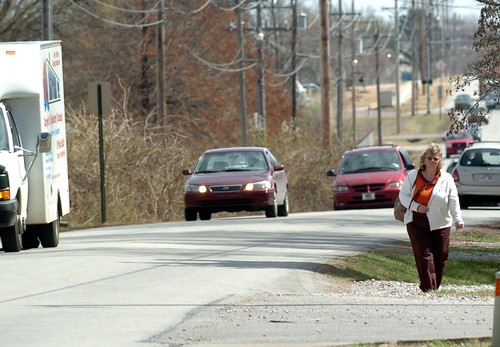 |
| Walking in the ditch Originally uploaded by Transportation for America to Flickr. |
| If this woman got hit by car, it’s probably her fault, right? Photograph by Stephen Lee Davis/Transportation for America. |
We noted on Twitter this morning a story in the USA Today about pedestrian deaths increasing in 2010, halting a decline that had been going on for quite a few years. The USA Today story took the angle offered from the head of a state safety association (Governors Highway Safety Association) that pedestrians are at fault for the increase in deaths. The Washington Examiner, not to be outdone, took some comments from the head of the association to baselessly suggest that more pedestrians are being killed because of the First Lady’s “Let’s Move” campaign to get more people active and walking to stem the obesity epidemic.
That’s right, it has nothing to do with things like 4 -and 6- and 8- lane arterials with no sidewalks and crosswalks a mile apart running through our communities. Or streets built without sidewalks. Or 55 mile per hour speed limits on roads where people need to walk. Or curved right turn lanes that allow cars to make turns at intersections at 30 mph. It has nothing to do with roads that are dangerous by design, leading to thousands of avoidable fatalities every year.
Automatically blaming the pedestrian is shameful and the GHSA should take their time to study the issue more carefully. Pedestrians are dying by the thousands, and it’s not because they’re using an ipod while crossing the street or trying to get more exercise at the First Lady’s urging. It’s because our basic choices about road design have left far too many without a safe place to walk, putting too many pedestrians in harm’s way.
We’d laugh at the GHSA’s silly suggestion, but we’re talking about a crisis that’s resulted in 76,000 deaths in the last 15 years. It’s no laughing matter.
UPDATE: The GHSA told the Atlantic that they were misquoted by the Examiner. They don’t refute a possible link, but they do say they support Michelle Obama’s program, adding that if more people are walking, they need to be aware.
Harsha said her primary concern for pedestrians was the increased use of electronic devices like iPods that can block out sound and make walkers unaware of oncoming traffic. The organization has received anecdotal evidence of pedestrian injuries caused by people walking into traffic.
It’s good they clarified, but it still sounds like they don’t quite grasp the main cause of death for pedestrians: Roads that are dangerous by design and unsafe for pedestrians. “Distracted” pedestrians aren’t the real culprit here.
TBD, a local DC news site, shared the pitch that they got from the GHSA, which is likely where the “Let’s Move” connection originated:
“Why the increase? We don’t really know but speculate that it could be a couple factors. One is the possible increase in distracted pedestrians and distracted drivers. We’ve been focusing on the drivers, but perhaps we need to focus some attention on distracted walkers! Additionally, Mrs. Obama and others have been bringing attention to ‘get moving’ programs, so perhaps pedestrian exposure has increased.”
Continue reading “Blaming the pedestrian won’t solve the problem”
Promoting car centricity on Facebook – epic fail
Excerpts from "I Told Congress About Transportation":
"Dedicated Bicycle superhighways (like in London) connecting suburbs to downtown business districts."
"we need to provide more efficient public transportation, that will reduce our need to use our cars so much and reduce our use of foreign oil. … Secure cross country bicycle lanes should also be implemented."
"Firstly, increased transit, bicycle, and pedestrian infrastructure."
"I’ll keep it simple – highspeed rail, bike facilities, ped facilities, ADA facilities and wide shoulders on thousands of miles of rural roadways."
"Work with road designers and builders as well as vehicle manufacturers towards a goal of zero fatalities."
"1. Make our existing urban, suburban, and rural roads more bicycle and pedestrian friendly by calming traffic, and installing generous bicycle and pedestrian infrastructure.
2. Develop our existing communities into bicycle and pedestrian friendly mixed-use residential/commercial/industrial villages connected by rail transit.
3. New and/or improved rail transit lines should be given a higher priority than highway capacity increasing projects. "
"It’s time we stopped wasting money on a dysfunctional system and started working on better, more efficient alternatives. We need to spend dramatically less money on new highways and dramatically more on transit, intercity rail, and bike/ped facilities. "
"Being a bicycling commuter I am concerned about my safety as I travel on roads not made to be shared with bikes"
"I do agree that local bike routes are getting to be more and more necessary. I see far too many bikers taking over the road and antagonizing (yes – antagonizing – like deliberately blocking motor vehicles and not even attempting to share the road) drivers partly because there is no safe place for them to ride. I want the bikers to have a safe place to ride so the road can be shared."
"COMPLETE STREETS! "
"Severely reduce our dependence on the personal automobile. … The idea of the one person to one car is a long failed notion."
"I would love to see more metro trains that link cities together,"
"Unfortunately, the RTP [Recreational Trail Program] fund is in jeopardy…"
"though I would prioritize safe and efficient bike/pedestrian lanes designed to support bike and pedestrian commuters, over high speed rail."
"Bike lanes; Rapid transit between cities"
"Please grant full funding for bike trail projects, pedestrian safety projects, public transit improvements and high speed rail proposals in the midwest. We need to create better non-car options for getting around. "
"And, I really hate feeding the petro fatcats, so I prefer my bike during the better times of the year."
"We’re never going to get out of the gas gussling, space consuming vehicles if someone doesn’t make a move toward the future."
"Focus: Walking/Biking/Public Transportation,commuter rail.. to reduce traffic congestion, air pollution and improved public health."
"I am retiring from highway engineering because we are not building anymore and cannot deliver the needed highway infrastructure to our travelers. It is simply too frustrating to spin our wheels and spend lots of money and time satisfying the whims of our Federal Highway Administration division officials. Send us some intelligent, thoughtful, experienced and customer-oriented professionals who will partner with state highway agencies.
…
The surface transportation system needs to provide for bicycles, pedestrians and assisted mobility users within cities and for inter-city travel; commuting and recreational travel should be more readily available to these users."
"I would like to see a vast expansion of Safe Routes to School. I would like to see more of a focus on transit, including high speed rail. Designing our nation around the automobile have made our cities look atrocious, our children so overweight that many have developed diabetes and cannot even serve in the military, and our roads are so hostile to bicyclists and pedestrians that many of us thank god anytime we make it back from the grocery store."
"That said, the new bill should disfavor highway expansion. … Focus more resources toward urban areas where 81% of the population lives. Infrastructure repair, mass transit and inter-urban forms of transportation like streetcar, BRT and bike and ped infrastructure can do much more than ex-urban highway expansion to provide the kind of access to destinations people are really looking for."
"Please make our existing urban, suburban, and rural roads more bicycle and pedestrian friendly by calming traffic, and installing generous bicycle and pedestrian infrastructure. Emphasize bicycle and pedestrian friendly mixed-use residential/commercial/industrial communities by connecting them via rail transit. Prioritize those new and/or improved rail transit lines over highway capacity increasing projects."
"I would like to see alternatives to driving and flying be accessable to everyone, and to be the transportation mode of choice in urban areas. I personally ride my bike or take the bus to work everyday. I would love to see more people join me."
"We need complete streets where all uses are fairly and appropriately accommodated and death should no longer be acceptable consequence of accommodating motoring faster then what’s prudent."
"DC’s Capital Bikeshare system has saved me time on my multi-modal commute and gotten me a bit of exercise to boot. Please consider funding such partnerships to provide other urban residents with healthy and cheap transit options for short or medium distances. "
"Your next priority should be light commuter rail to connect large urban areas with their surrounding communities"
"Share the road. We need complete streets so that we can chose our mode of transportation–walk to the bus, ride a bike to the bus, drive a car, take a train. … Say no to the old gang at the Road Gang in DC."
"City by city there is a struggle to implement alternative transportation networks. … funding to improve transportation as a whole, more options would be provided to people and the most efficient forms of transportation could be implemented!"
"we need more and better public transportation."
"Please help us get to work by providing reliable public transportation."
Continue reading “Promoting car centricity on Facebook – epic fail”
SHA kills boy for not saying "Mother May I" before crossing the road with "invisible" lights
First the disclaimer, this is speculation. So why speculate? Because there are a lot of pedestrains killed in this State, far more then what could be considered “normal”. And if I am near right I have opened the door for someone to sue SHA for not following the best engineering practices as required by State law. And maybe they will reexamine their polices and realize for the same money they could be a lot more pedestrian friendly/accommodating, which translates to saving lives.
The first topic, the pedestrian call button or the beg button or road engineers playing “Mother May I” with pedestrains. This is the way it’s always been done so we really don’t question the user interface but seriously imagine calling for an elevator and the button you pushed does nothing, no click, no light, just nothing. The indicator of what floor the elevator is on does not move . Now ask yourself how long would you wait before taking the stairs to go a short distance? I really have to ask why we expect pedestrains to behave differently? If a button acts like it is not working, we find a alternate way to cross, that is human behavior.
I found some helpful advice on dealing with ped call buttons from this site.
When you push the button, a call is put into the signal controller to let it know a pedestrian is waiting. The signal may not change immediatelySometimes when the button is pushed there is not enough time for the signal controller to activate the walk phase. You should wait one more cycle for the “walk” sign. If the “walk” sign doesn’t come on the second time around, the signal is probably not working properly. You must use extreme caution when crossing under these conditions.
Well the first line should say “The signal well hardly ever change immediately.” That’s because if peds are the ones calling for a signal change they must endure a prequeue phase before anything is noticeable. They used to require this of cars as well, till they discovered that a high percentage of drivers ran the red lights, thinking the light was broken. Why they expect pedestrains to behave differently I will never comprehend. (Note: that the time for the prequeue was moved to after the crossing phase to control the frequency of crossing phases. This is for my engineer friends who imagine disastrous results if we let peds stop traffic whenever they want, relax, you still have control over the frequency. )
In the second paragraph “there is not enough time”, really. in this day and age of electronics? This is like saying, sorry we can’t open elevator doors if the elevator is already on the floor. The elevator must first go up and back down and only when the elevator first lands can it open doors and you get in. But note this issue would be solved if ped lights came on automatically. (See How Portland is doing it.)
Also note you are told you will have no idea if things are working or not. That’s just crazy! Just because things have always been the way does not mean that is the way they HAVE to work. Imagine pressing a elevator button that doesn’t light up, what are you going to do? Bang on it several times? If a button was designed like that on purpose you wouldn’t expect it to last very long with all that banging, right? My observations there are a lot of ped call buttons that no longer function. So not only do we have a poorly designed user interface we have one that is designed on purpose to wear out quickly and no routine procedure of maintenance (you have to call these things in to be fixed so they tend to stay broken for a very long time because they are a near useless thing to get fixed.)
All that was just problems pedestrains have in trying to get a crossing signal, now add to that a T intersection and the boy crossed against the light possibly as shown here:

If you are asking what light, well that’s the way they design T intersections so the light is not visible to pedestrains on one side of the street. The problem is then compounded by not having the ped signal go on automatically when appropriate and only having one crosswalk and the ped “beg” buttons that insist that only peds should endure a prequeue phase and no feedback that the button has been pressed or even working at all. The whole thing fails proper user interface design. Nothing of this century comes even close to this poorly designed interface so why do we accept this for pedestrian safety?
All this really sounds like stacking the deck against safe pedestrian crossings in this state. But it must be all the pedestrains fault on why we have such a high pedestrian fatality rate.
Again note these are just possibilities and not the facts in this case. But I for one am tired of just discounting this stuff to always pedestrian error. If there is a lot of motorist error they fix the problem with the road design but with pedestrians we are content that it is their own fault. Why is that exactly?
Continue reading “SHA kills boy for not saying "Mother May I" before crossing the road with "invisible" lights”
I told congress we want more concideration for cars.

This is going around car centric circles so it would be a great idea if bicyclists would join in. Personally I am rather disappointed in AASHTO’s flier in terms of not stressing alternate transportation and in asking for wider lanes. Wider lanes encourage speeding and studies show a higher crash rate, if anything we need to encourage more 10′ lanes and leave the wider lanes for the expressway.

And sorry this does seem to be Facebook only: I Told Congress About Transportation
To help bribe you Baltimopre Spokes is on FaceBook and you can follow me on FaceBook and my (sometimes) other interests besides bicycling.