
One of my theories of where road designs have gone wrong is the use of expressway like features (where bike/peds are prohibited) on roads where bikes and peds are allowed and the result is a mixed message of who has the right-of-way as well as encouraging "creative" use by the classes of users not really accommodated in the design.
Here we have the designers of the roadway saying "If I was a pedestrian, I would walk a mile just to cross the road." Of course the reality of this is very few people would be willing to do this but there is a tendency to think as long as we require this people will do it, totally ignoring the human factor. Additionally the problem is compounded by putting local road designs on an expressway. This intersection from a pedestrian point of view is not much different then crossing any other major arterial: Street continues on the other side of the crossing street, check; pedestrian refuge triangle to the left of a hot right turn lane, check; pedestrian refuge area on the median, check. We have a major failure in distinguishing expressways from local streets, they are looking more and more identical and that plain and simple is not complete streets.
My point of this post is to go beyond just pedestrian error and look how we are designing public space.
Continue reading “Man Killed While Crossing Route 50”
Speed camera becomes a lottery
I’ve reported on this idea before but they actually went and did it in Stockholm! Before: the average speed was 32km/h. During the experment: 25km/h.
Continue reading “Speed camera becomes a lottery”
National gas price average breaks $3 barrier
[B’ Spokes: great news for cyclists:]
**********************************************
from Getting There by Michael Dresser
… The Maryland average stands at $3.02 today. … She said some analysts fear that if crude oil continues to rise at its current pace, the average price could reach $3.75 by spring. …
Continue reading “National gas price average breaks $3 barrier”
Slate tale of ‘Unbuilt Highways’ resonates here
from Getting There by Michael Dresser
The online Slate magazine is running a fascinating article on the “Unbuilt Highways” that have left lasting marks on major cities in the United States and abroad.
Baltimore is not among the cities named in the article — which include New York, Chicago, Los Angeles, Washington and Seoul — but it easily could have been included. There are certainly few other cities where roads that were planned but not built have had greater community impacts. You can look to the “Highway to Nowhere” as a visible reminder of the scars left on West Baltimore, while Fells Point and Canton stand are historical monuments to that which might have been lost had highway foes not rallied to their defense.
Continue reading “Slate tale of ‘Unbuilt Highways’ resonates here”
The Best Christmas Lights in America
[B’ Spokes: Something to bike to:]
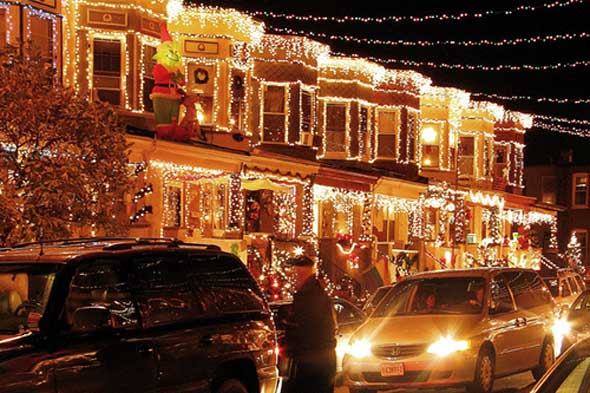
Traffic is jammed along 34th Street in Baltimore as revelers take in the street of lights. Photo: Cory Brown, Flickr
Continue reading “The Best Christmas Lights in America”
Pedestrians take to the streets; motorists learn to coexist
Author: Philip Langdon
New Urban News, December 2010
Britain is energetically designing streets that intermingle foot and vehicular traffic; the US follows ever so cautiously.
Maybe it’s a reflection of American car culture. Or maybe it’s a sign of how risk-averse the United States has become. Whatever the reason, the US is a long way from catching up to Europe in designing streets that allow the flexible, unchoreographed mixing of cars, trucks, buses, bicycles, and pedestrians.
…
Continue reading “Pedestrians take to the streets; motorists learn to coexist”
Tea Partiers See a Global Conspiracy in Local Planning Efforts

In the tea partiers’ dystopian vision, the increased density favored by planners to allow for better mass transit become compulsory “human habitation zones.” They warn of Americans being forcibly moved from their suburban dream homes into urban “hobbit homes” and required to give up their cars and instead—gasp!—take the bus to work. The enemies in this fight are hidden behind bland trade-association names like the American Planning Association or ICLEI (Local Governments for Sustainability).
Continue reading “Tea Partiers See a Global Conspiracy in Local Planning Efforts”
Baltimore Free Farm Sustainability Center!
[B’ Spokes: Just to note the project made its funding goal! Big thanks to the 124 people that made this happen.]
Continue reading “Baltimore Free Farm Sustainability Center!”
NYC thinks their ped signals are busted, what about ours?

Pictured a malfunctioning ped signal in Manhattan that has both Walk and Don’t Walk during the walk phase. I’ll take that over Maryland ped lights that show Don’t Walk during the walk phase.
For those of you who don’t know I have moved to Brooklyn, NY and I’ll note I discovered only one ped light call button so far and that was at the foot of the Brooklyn Bridge otherwise the ped signal comes on automatically. Clever idea huh?
Continue reading “NYC thinks their ped signals are busted, what about ours?”
Is U.S. Infrastructure Falling Dangerously Behind? The Pundits Discuss
A Fox news broadcast about the state of our highways and why high speed rail might be a good thing.
https://www.infrastructurist.com/2010/12/06/is-us-infrastructure-falling-dangerously-behind-the-pundits-discuss/