Bike Maryland January 2011 Newsletter

A Story of an “Accident” – A Time of Many “Crashes”

During this wondrous holiday season I feel the deep gratitude I have for life – for being able to use my body and mind and for being free. I’m also a holiday baby. I won’t tell you the exact date but it is within days of a big holiday – thus, the thought of life in December is personal.

I was in a dreadful accident approximately 18 months ago that involved me and a deer accidentally colliding on a beautiful rural road. As the New Year approaches and I reflect on the past year and a half I’m filled with gratitude for my health, family, friends, job, recovery and so much more. I will tell you just a bit of the story. I don’t remember any part of the accident so this story is pieced together by friends and strangers who told me what happened. I was riding with many of you on a five day bike tour in Virginia. It was the last day of the tour and I was bicycling down a long decent at about 30 mph. The road was narrow and a truck was traveling toward me. I was riding a few feet from the right side of the road where a ditch ran along side the road. Unexpectedly, a large doe jumped out from the ditch directly in front of me as the truck coming toward me was about to pass me. I’m very sad to know that I immediately hit the deer and broke its spine. The deer died from this injury. I was thrown to the other side of the road. I barely missed the truck and landed in the other lane on my face – I had serious head, neck, facial and other traumas. No one had done anything wrong – just an “accident” – bad timing with the deer. 

When a fellow Baltimore Bike Club member, who luckily is a seasoned nurse practitioner, arrived a minute later, I was face down and covered in blood. I’ve heard from many people that she helped me in many ways – she was loving, smart and compassionate. She lied down on the road next to me and put her arm around me and told me I would be just fine. She stayed with me until I was in the ambulance. It was later, in the hospital, that I was diagnosed with two neck fractures. Luckily, no one moved me. As I was coming out of the semi-conscious state, the doctor’s were stitching my lip back to its normal location on my face. The helmet I purchased the day before the bike tour saved my life. The straps were tight and it fit like a comfortable glove. Thankfully, the folks at my local bike shop assisted me as I sought a helmet that fit correctly.

When I was 14 years old my parents introduced me to bike club riding. They must have bribed me to get me to participate in the bike club experience as a teenager. But soon after the experience, I began to love biking. I felt free on a bike. For 30 years I’ve continued to love the bike.

While I’m on my bike I experience many things – really experience things like: wonder, freedom, the sky, changing of the seasons, my body, my breathing, laughter, pain, myself observing myself, concentration, the ground/dirt, smells, land, space, lack of energy, intense energy, deep feelings, hunger, my heart, my legs, sounds, quiet, wind….the terrain, sweating profusely, being freezing cold, being perfectly at ease, seeing disturbing things up close like dead animals smeared all over the pavement, seeing incredible wildlife – deer, fox, eagles, hawks, herons, frogs, bear, turtles, groundhogs… deepening relationships, time with friends, new friends, adventures, challenges, joy, easy gentle spinning, lungs bursting, love of life and the earth, beautiful landscapes, sunsets, trees, fields of wheat, woods, farms, communities, new places, family, gratitude for my dog, knowing what it is like to be chased by many dogs…. and so much more. And, I still have amazement that this object (the bike) is something I have the pleasure to enjoy – unlike so many others – I have the pleasure and freedom to enjoy it. A bike – a means of transportation; a racing machine; a piece of joy; a way to experience the world. I imagine that I will always be hooked.

So why this personal story? There have been many bicycling crashes and fatalities this year with automobiles and I hope that you will be grateful for your life, for your right to bike and that you will take an interest in increasing bicycle safety. The terrible and tragic crashes and fatalities are typically preventable. They are “crashes” — NOT “accidents” or unusual coincidences like my experience above. Crashes are very different from accidents. Crashes involve a collision that could have been avoided.  Dangerous activities, like distracted driving, are often avoided if the consequences of a certain action, i.e. intoxicated driving, are significant. If drunk driving laws didn’t exist, there would be many more tragic road fatalities. 

YOU can make a difference in decreasing crashes and fatalities. Crashes and fatalities are heart wrenching tragedies often consisting of a car hitting a bicyclist from behind; causing the injury or death of a father, husband, daughter, sister etc. while the person is bicycling with a friend, or to a job, or exercising, or relaxing on a lovely day. Any one of us could be a crash and fatality statistic. I never thought I would have the story above as part of my history.


Delegate Jon Cardin (in suit), Tammy Bensky (in black – widow of 2010 fatality victim Lawrence Bensky), Carol Silldorff (to Tammy’s immediate right), 75+ bicyclists ride to Annapolis to support pro-bike safety legislation.

Many of you knew someone this year that lost their life or was seriously injured while bicycling due to an automobile crash by a reckless driver. Horrifically, and unlike my experience, most of these bicyclists didn’t have a friend who got on the ground with them and told them they would be ok. Some were left as hit and run victims. The New Year is around the corner. Will you, as a bicyclist, friend or family member of a bicyclist, commit to these three tasks?

  1. Support Bike Maryland – click here to support Bike Maryland – we are your bicycle advocates.  Right now your support is being matched dollar for dollar.  
  2. Five minutes of your time is needed to perform this task that can decrease your (or your friends or loved ones) chances of injury or death. You do not need any sort of expertise to do this simple act that can save lives. Bike Maryland will, in the next few weeks, publish a list on the Bike Maryland website of pro-bike bills to support. These are bills that over time will make Maryland a safer place to bike. When this list is published, call your State Senator and/or Delegate. These people need to hear from you! You do not need to discuss the bill in depth. You will make a difference by saying , “Hello, my name is abc and I live in your district. It is very important to me, as one of your constituents, that you support xyz bill.”
  3. Send this newsletter to everyone you know – spread the word about Bike Maryland.

Thank you – Happy New Year – I wish you peace, love, freedom and safety – Carol Silldorff.  

Continue reading “Bike Maryland January 2011 Newsletter”

MTA to offer free public transit on New Year’s Eve

For the first time, the Maryland Transit Administration will offer free service on all local bus, Metro subway and light rail routes on New Year’s Eve this year.

The free service starts at 8 p.m. on Dec. 31 and runs until 2 a.m. on Jan. 1. It is part of Miller Light beer’s national Free Rides program, which is in its 23rd year. Miller Light is bringing the program to Baltimore for the first time. Locally, it is also sponsored by Bond Distributing Co. of Baltimore.

The free-ride service will be available for visitors to the annual Ports America New Year’s Eve Spectacular fireworks display at the Inner Harbor. Light Rail and Metro service will be extended until one hour after the fireworks, which is scheduled from 9 p.m. to 12:30 a.m.

For more information about the free-ride program, call 1-800-FREE-RIDES (1-800-373-3743), text RIDEMTA to 30364, or visit MillerLiteFreeRides.com or www.mtamaryland.gov.

Continue reading “MTA to offer free public transit on New Year’s Eve”

The advocacy process, bicyclists and the road safety agenda

Both DC and NYC cyclists have been experiencing a backlash from motorist to which Richard Layman has an excellent response here: https://urbanplacesandspaces.blogspot.com/2010/12/advocacy-process-bicyclists-and-road.html

I really recommend reading the whole thing but under the theory that some will not read the post till the end I’ll jump into the middle of his article:


But they will never be happy with a paradigm of balanced mobility (“complete streets”), because anything less than complete dominance of the mobility agenda by the automobile is seen as a significant loss of privilege and status.

An ideal and complete road safety agenda would include:

– recognition of the connection between higher operating speeds for motor vehicles and traffic fatalities, especially of pedestrians and bicyclists, and a re-engineering of road design and traffic enforcement to bring actual and desired operating speed of motor vehicle traffic into balance — REMEMBER THAT IN DC, MOST OF THE STREETS HAVE A 25 MPH POSTED SPEED LIMIT.

– recognition that motor vehicles, because of of their weights and speeds bear disproportionate responsibility for a safe road network

– recognition of how the rules of the road are written to favor motor vehicles and are often unfair to other users and therefore, traffic safety laws need to be rewritten to better balance the safety needs of all users, particularly those who are most vulnerable (pedestrians and bicyclists) (ALSO RECOGNIZE THAT IN DC AND OTHER CENTER CITIES, A SIGNIFICANT NUMBER OF HOUSEHOLD TRIPS ARE TAKEN ON FOOT OR ON BICYCLE AS WELL AS PUBLIC TRANSIT, AND LAWS IN SUCH PLACES SHOULD RECOGNIZE THIS.)

– enactment of Idaho Stop for bicyclists. This allows bicyclists to treat stop signs and red lights as yield signs WHEN THERE IS NO ONCOMING TRAFFIC, which specifically means stop when there is oncoming traffic — that means no weaving!

– driver responsibility for ped and bike crashes comparable to the Netherlands. This recognizes that motor vehicle operators, because their vehicles are significantly heavier and faster, much exercise a great deal of caution and responsibility when driving, unlike the passive system of motor vehicle safety in place in the U.S., which takes negligence and death for granted (see “Wrong Turn: How the fight to make America’s highways safer went off course” from the New Yorker).

– serious penalties for motor vehicle operators for causing injury and death

– insurance and registration systems for bicyclists

– better training for police officers wrt bicycling as traffic, including traffic investigation

– posting in real time traffic accident data
– and the implementation of a Pedsafe/Bikesafe accident investigation and response system for the resolution of structural-design issues contributing to accidents

– refresher tests upon drivers license renewal on ped and bike issues

– mandatory training/complete curriculum developed in K-12 at the early and late elementary levels, in middle school/junior high, and in high school on pedestrian and cycling safety, maintenance (this is something I recommended in the Western Baltimore County bike plan) — only by creating and delivering a complete pedestrian, bicyclist, and road safety curriculum throughout childhood and adolescence can we be assurred that we all know how to be safe, regardless of transportation mode.

– changes in the driver education curriculum to increase awareness of/safety pedestrians and bicyclists

– requirements on organizations operating heavy vehicle fleets so that their drivers are required to take and pass additional driver education with regard to operating heavy vehicles in areas with high pedestrian and/or bicycle traffic.

The problem that WABA faces is the classic one of the boundary spanner, where they have multiple stakeholder groups to satisfy, in this case at least four groups:

– elected officials who pass laws and who are lobbied by WABA
– appointed officials who enforce laws and also provide funds to WABA for technical training purposes
– members
– the general public, who the advocacy organization also seeks to influence.

Automobilists are quick to complain about loss of privilege and their seeming noticing of flagrant bicyclist road safety transgressions. They call and complain to both elected and appointed officials.

On the other hand, bicyclists rarely complain in a straightforward manner about flagrant road safety violations on the part of motor vehicle operators, especially speeding, failure to yield, failing to stop at stop signs, running red lights, reckless driving and road rage, verbal assault, etc.

WRT the above “master list” of a more complete and balanced road safety agenda, public officials aren’t in the position of being able to call for most of those provisions, because it challenges the dominant paradigm concerning automobility.

I know that when I was the bicycle and pedestrian planner in Baltimore County, I only felt comfortable mentioning four of those provisions (curriculum, heavy equipment operator training, changes in driver education and licensing), and as it was three were eliminated from the draft between the time I submitted the draft and the posted version. I needed advocates to help me push the envelope.

Advocacy organizations have the luxury and responsibility for laying out full and complete agendas so that the process of building and passing and implementing new paradigms can occur.

WABA, in a follow up entry, “Resolve, to set the stage for even stronger advocacy in 2011” claims that the responsible biking pledge is a necessary foundation for stronger advocacy in the new year.

I hope that is true and that we will see advocacy for a rebalancing of responsibility on those with the most power (motor vehicles) and greater protection for the most vulnerable, in our policies, laws, and actions in 2011 and beyond.

Continue reading “The advocacy process, bicyclists and the road safety agenda”

When a driver-pedestrian argument escalates to gunplay

By Dave Jamieson
Are you the kind of self-righteous pedestrian who stares down drivers who block the crosswalk? Have you ever called an aggressive driver a “douchebag” who needs to “slow the hell down”? Have you ever thrown your latest issue of the New Yorker at a car that came dangerously close to you within a designated crosswalk?
I’ll admit I’ve done all of the above. And it’s stories like this one that make me think I should probably relax:
According to Prince William County Police, there was an altercation last Wednesday between a mother-son shopping duo and a couple inside a car in the parking lot outside the Burlington Coat Factory in Potomac Mills Mall. The car, which had a woman behind the wheel and a man in the passenger seat, nearly hit the 15-year-old boy and his mother. Words were exchanged between the two parties. Then the man in the passenger seat pulled out a handgun and pointed it at the mother and son. Argument over.
The couple is wanted for “brandishing.” They are both described as white and somewhere between the ages of 50 and 55. The car was a circa-1995 black Honda Civic with visible damage to the passenger side of the hood.
Perhaps the dents are from the body of the last person who told them to watch where they’re going?
Continue reading “When a driver-pedestrian argument escalates to gunplay”

Advocate safer, robust, and efficient transportation for better cycling

by Invisible Hand

What should cyclists advocate?  As an avid cyclist who enjoys such discussions, it is a question that comes up in one form or another.  In many ways, the same discussion arises during conversations with non-cyclists who simply want to get around in a convenient manner, have safe neighborhoods, and enjoy their lives.  That is the direction that I want to take advocacy.  Or more generally, a lot of “us” — everyone in a neighborhood instead of simply cyclists — want safe, vibrant, and livable neighborhoods and as Charles Marohn writes,

When you can’t let your kids play in the yard, let alone ride their bike to the store, because you know the street is dangerous, then the engineering profession is not providing society any real value. It’s time to stand up and demand a change.  It’s time we demand that engineers build us Strong Towns.

The point is that instead of talking about what cyclists want, how great cycling is, or the many other benefits that it can give, we should recognize that a lot of what is good for strong neighborhoods is good for cyclists. 

My conclusion in a nutshell: slower road speeds are the easiest and most effective way to improve the cycling/pedestrian environment and a huge improvement for livable neighborhoods in general.  Underlying the idea is that a modest level of uncertainty is good since it requires drivers, cyclists and pedestrians to remain aware of their surroundings to successfully navigate the environment.  Instead of calling this bicycle or pedestrian advocacy, I think that we should push for safer, robust, and more efficient transportation network since we can make transportation safer, give people more acceptable options, as well as make driving trips shorter (make the same trip in less time).  We can make everyone better off regardless of their transportation choice.

Slower is safer for everyone

The claim that slower speeds are safer on local roads is probably accepted by just about everyone.  As one drives faster the distance covered before reacting and stopping increases; controlling a vehicle becomes more difficult; and damage increases in the event of a collision.  How much more dangerous is probably something that remains quite fuzzy for most people.  Given that an alert driver takes about 1.5 second to react and a few assumptions about the rate of deceleration we can determine the following:

Breaking Stopping Distances
MPH Reaction
Distance
Total
Distance
20 44 63
30 66 109
40 88 164
50 110 229

Relative to 20 mph, traveling 30 or 40 mph increases stopping distance by ~70% and 160%.  Clearly as one travels faster, the ability of an alert driver to slow their vehicle decreases at an increasing rate. Even a slightly distracted driver — say it takes three seconds to react doubling the distance in the table above — would significantly exacerbate the issue.  As expected, vehicle speed is highly correlated with pedestrian and cyclist injury/mortality.

image
From DOT HS 809 021 October 1999

A pedestrian hit by a vehicle traveling in the low 30s instead of low 20s has almost a three to fourfold increase in mortalityA statistic that is perhaps more surprising for many is that the risk to the driver is significant too

Injuries per 100 Occupants by Change in Speed (deltaV) at Impact
delta V Moderate Injury Serious Injury
mi/h AIS 2+ AIS 3+
1-10 4.5 1
11-20 10.6 2.6
21-30 29.2 11.1
31-40 53.4 27.9
Bowie and Waltz (1994)

 
Mortality for drivers also follows a similar pattern: velocity changes of 20, 30 , and 40 mph are estimated to have a 0.6, 3.2, and 10.1% fatality rate (Joksch, 1993).  Clearly, cyclists, pedestrians and drivers are all better off at moderate residential speeds in the event of a collision.  Perhaps more important is that the traffic calming literature — see the same FHWA synthesis — strongly supports that collisions are reduced as well.  A recent traffic calming success on Lawyers Road in Fairfax County demonstrates the concept.  Consequently, pushing for roads designed for slower velocities and greater user awareness, as opposed to roads built like freeways with lower speed limits, is likely to produce fewer and less serious collisions/crashes. 

A more robust transportation system

A transportation network that gives people several acceptable transportation options is more robust than one that emphasizes driving only and can benefit even those that typically drive.  This is most obvious during major events such as the recent snow storms (“Snowmageddon”) or “Tractor Man” where people were forced to choose alternatives due to their cars being trapped by snow or restrictions that made driving unreasonable.  More transportation options, however, are useful for far more mundane problems such as poverty — cars are expensive to own and maintain: greater than $5K annually for a Ford Focus — vehicle downtime, or as an alternative for a household second or third vehicle. 

Let me briefly emphasize that last point.  Parents often purchase (or let their teenagers use their vehicle) another car for a teenager because few alternatives exist and chauffeuring him/her around becomes a burden.  In short, teens are terrible drivers.  Giving parents alternatives to letting their teenager drive or greater leverage in limiting driving until a teenager demonstrates greater maturity and skill could literally save their life.  For instance, legislative changes that limit teenager driving have resulted in fewer fatal collisions.    

Naturally, there are people who would actively choose to cycle or walk more if they felt conditions were better.  As I demonstrated above, a strategy that lowers road speeds would make a given road safer and likely more acceptable.  Mind you, I believe virtually any road can be cycled on with a reasonable level of safety by applying a few rules and riding according to the rules of the road.  Based on my conversations with people of varying levels of interest in bicycling, however, when motorized traffic on a road crosses some threshold of volume and speed it is classified as too dangerous (or simply undesirable) regardless of the evidence.  Adopting a paradigm where slower but better flowing traffic becomes the norm clearly makes more roads accessible to average citizens.  

Yet typically one can simply look at a map in combination with some local knowledge to identify “high stress” areas or other obstruction that would limit cycling and walking for many even with some measure of traffic calming.  If these areas represent major connecting points in a local transportation grid, then addressing desirability via some smart engineering is probably worthwhile.  That is, if the cycling and pedestrian transportation network is meaningfully expanded with some thoughtful changes, then it should be seriously considered and pursued.   “Thoughtful” is the operative word here since careless application of bicycle treatments can create perverse situations for cyclists and other road users by increasing the risk of collision at with crossing traffic (intersections) which represents the greatest risk of collision to the cyclist.  While this is supported by observations in the U.S. as well as overseas, there are studies that find little correlation between facilities and collision risk but that facilities are also correlated with increased use and an overall improved safety that many attribute to safety in numbers.  Overall, my take on the literature is that it doubles my emphasis on the “thoughtful” adjective used earlier.  Over-engineering our roads can not only decrease safety directly, but facilities often remove driver/cyclist responsibility from actively thinking about their actions.  But in many cases, the engineering solution is the easiest way to connect sections of the transportation grid for many cyclists and pedestrians.  If one is looking to expand the acceptable cycling transportation grid through high stress areas, pick places with little or no crossing traffic, long ascents on roads with moderate to high traffic volumes, and so on.

More efficient and slower?

Clearly we all expect road diets and traffic calming to be safer however, their effect on vehicle capacity and travel duration is often minimal.

Under most annual average daily traffic conditions tested, road diets appeared to have minimal effects on vehicle capacity because left-turning vehicles were moved into a common two-way left-turn lane. (FHWA)

For instance, the Lawyers Road diet referenced earlier pulled back extreme speeds but only lowered average speed from 45 to 44 mph.  Moreover, distances are generally much shorter for local travel consequently the absolute change in travel duration will be small: a 5-mile trip without any stop lights driven at 30 versus 40 mph takes 10 and 7.5  minutes respectively.  Traffic signals clearly decrease the percentage difference between the two.  But we can actually slow traffic, decrease collisions, and improve travel times with a simple traffic device: the roundabout.

Many Washington DC locals shudder when they think about the high speed traffic circles that litter the area.  Modern roundabouts are not traffic circles nor rotaries!  Roundabouts have much more deflection, are much smaller than circles, and consequently have slower speeds.  Some of the benefits of modern roundabouts include:

  • Reduces injury accidents by 75 percent and fatal accidents by 90 percent.
  • Increases efficient traffic flow up to 50 percent.
  • Helps the environment by reducing carbon emissions by double digits.
  • Decreases fuel consumption by as much as 30 percent.
  • Costs less than traffic signals and does not require expensive equipment or maintenance.

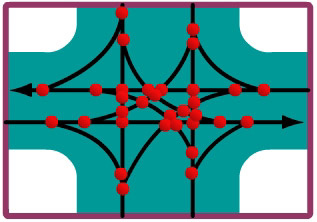
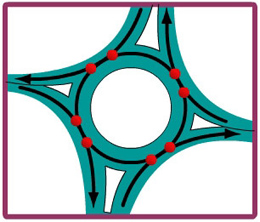
Roundabouts never have a “dead time” like traffic signals where no traffic is in the intersection.  Roundabouts avoid long vehicle waits during off hours.  By design, entering traffic yields to traffic already in the circle and pedestrians traveling on the outside.  Consequently, successfully navigating the roundabout requires that the driver pay attention instead of mindlessly zipping through a green light.  As demonstrated by the red dots, roundabouts have far fewer conflict points than a signalized intersection.

image
The standard signalized intersection has 32 vehicle-to-vehicle conflict points

image
The roundabout has 8 vehicle-to-vehicle conflict points.

Not all intersections are appropriate for roundabouts and the literature has mixed reviews for cyclists since some of the early designs put bike lanes in the “circle”.  Nonetheless, for the typical local trip, a few well placed roundabouts could easily reduce travel time to offset slower velocities and newer designs either encourage cyclists to behave as a vehicle or provide easy access to behave as a pedestrian

Conclusion

I know several cyclists that think fondly of European facilities.  While they look like a lot of fun and could work in some areas, even Copenhagen facilities show some warts and, to be frank, I have doubts that many would be willing to pay the price to have them.  Moreover, bike safety and ridership in many Netherlands cities likely experience a positive effect from strict liability and slow road speeds.  So the concept of building livable neighborhoods takes into account the European experience.   

Broadly speaking, here in the United States we spent a lot of energy and resources pursuing a strategy of safe crashing.  While seatbelts and other technological achievements are true advancements that help prevent injury and death in the car, we should also consider how people drive when they are in a protective cocoon and the effect on neighborhood livability.  Local streets should be for local travel which includes cycling and walking.  What this means is that for better neighborhoods we need to design our roads for slower travel that require greater driver attention.  Moreover, we need to stop building roads like freeways and simply slapping a 30 mph speed limit on the road.  We should consider innovative and efficient ways to enforce speed limits such as the speed camera lottery or ordinary automated cameras where engineering a slow road proves too costly for various reasons.

Thanks for reading!

Post Script

Just to be clear, I breezed through many details of the safety literature that might be important to particular individuals.  Moreover, I omitted many interesting studies and articles that could be related to various points discussed in the post.  My objective here is to give a broader outline but provide links that an interested individual could follow to obtain a foothold in the literature.  I’m also trying to reach a broader audience that might know little or only one side of the safety literature as well as a much broader community that could support pro-neighborhood policies that would find a more in depth discussion tedious.
Continue reading “Advocate safer, robust, and efficient transportation for better cycling”

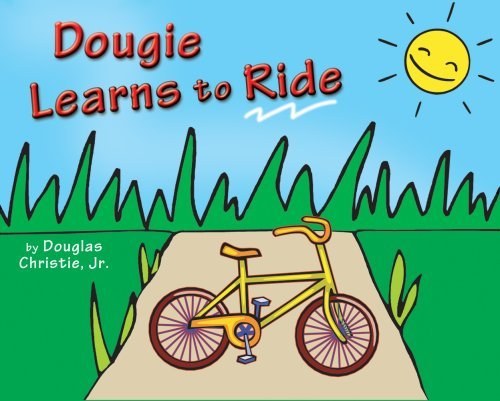
Dougie Learns to Ride by Douglas Christie, Jr. – review

[B’ Spokes: Note this is not an endorsement, just something I found.]


Learning to ride a bike can be a VERY BIG deal, and it may seem difficult at first, but don’t let it get you down. Practice makes perfect, as Dougie discovers in Dougie Learns to Ride. It’s a wonderful book that is sure to be a big hit with young kids who are taking the first steps to learning how to ride a bike. What’s more, the author is a kid, himself:  Douglas Christie, Jr., the eight-year-old son of the NBA star Douglas Christie (L.A Lakers 1993–2007). It is illustrated beautifully by Jupiter Images and Dotti Albertine, and makes a great gift at Christmas, or anytime.

Do you have a bike yet? Or are you hoping to get one, soon? If so, you can imagine the excitement and happiness that Dougie, the main character in Dougie Learns to Ride, feels when he gets his very first bike–and it’s even yellow, his favorite color! He wants to be able to ride it as soon as he gets it, but sometimes learning to ride a bike takes a little bit of trying, and practice. Sometimes it’s easier to learn if you have the help of your Dad, or Mom, or sister or brother, or a friend. Dougie’s Dad helps him in this book, and gives him encouragement, something we all can use when we’re learning something new.

Still, even with the help of a parent, you might find it hard to ride a bike when you first try. Just be like Dougie, and don’t give up, even if you might fall a couple of times in the beginning. As Dougie’s Dad tells him, “It’s not how many times you fall down that counts, it’s how many times you get back up.” Also remember to be safe when you ride, like Dougie, and always wear your helmet, knee pads, and elbow pads, so if you ever do fall, then you won’t get as badly hurt.

Riding a bike can be very fun. Dougie Learns to Ride by Douglas Christie, Jr., brings out the fun part of learning, as well as the hard part. And when you do finally learn to ride, you will feel proud and happy, just like Dougie does in this book. This is a great book for younger readers, and it’s a fun one for parents to read with their kids. If you have a boy or girl in your house who really wants to have a bike, or you are a boy or girl yourself who wants a bike and is maybe just learning to ride one, you should check this fantastic book out today!

Continue reading “Dougie Learns to Ride by Douglas Christie, Jr. – review”

Saturday farmers market in Waverly open New Year’s day


Jen Pahl, of Pahl’s Farm in western Baltimore County, sold trees that a friend raises in North Carolina and wreaths made by another friend in Harford County.

Pahl, 20, the sixth generation to work on the family farm, said she sold one tree to a man on a bicycle. They were able to tie the tree to the bike, but there wasn’t enough room for the rider.

“He had to walk it home,” she said.

Continue reading “Saturday farmers market in Waverly open New Year’s day”

The Car Culture’s Blind Spots

by Robert Sullivan

But the measured arguments are run down. So in quasi desperation, I will instead take a sarcastic approach, please forgive me, and agree, just for the heck of it, with the detractors of bike lanes.

On the argument that bike lanes should be eliminated given that they are not used during the winter, which I guess means no one noticed me biking around all this week, trying to save a little on the soon-to-be-increased subway fare: Oh, yes, by all means, take them based on this period of low usage, and then, using the same logic, let’s take out the BQE, because there are hardly any cars on it at 3 in the morning.

On the idea that mad bikers are the out to destroy everyone: We need to get those jerks off of bikes and put back in automobiles where they belong.

On the idea that bikes ultimately can’t coexist in a city with trucks and traffic, that restaurants and stores can’t get goods: Too true! Moreover, what are we doing allowing those concrete swaths in that area between where cars drive and where the buildings are? Sidewalks, I think they call them. People really slow things down. Can they be put underground, or some kind of special lanes?


Continue reading “The Car Culture’s Blind Spots”