

Recommended changes to the Drivers’ Handbook
[B’ Spokes: Just to give you a heads up this is what your Bicycle Advocacy groups have been up to. If there are any updates, I’ll post them here.]
Statement of Purpose
The Maryland Driver’s Handbook should clarify how automobile drivers interact with bicycles. Goal 4 of Maryland’s Twenty Year Bicycle and Pedestrian Access Master Plan states. “Develop education and encouragement programs that will increase levels of bicycling and walking and foster a pro-bicycle and pro-pedestrian ethic in individuals, private sector organizations, and all levels of government.” We strongly urge adopting the following language to clarify how drivers of automobiles should safely anticipate and interact with bicyclists.
The general public, including drivers, bicyclists, and police officers, use the Maryland Drivers’ Handbook as the basis for learning how to use our roadways. However, experience over the past decades has shown the Handbook to be out of date. For example, bicyclists have been told to ride as far right as practical, but that has given motorists the mistaken impression that they can then easily pass a bicyclist within the same lane which has resulted in an astounding two-thirds of all bicyclist fatalities happening in non-intersection areas. We believe that we must bring the Drivers’ Handbook up to date to clarify everyone’s expectations, educate all parties, and foster a more positive cycling and driving experience. Simply put, we must get all rightful roadway users on the same page.
Guiding Principles
• Clarification of Maryland’s “dueling handbooks.” We consider Safe Bicycling in Maryland to be the de facto bicyclists’ roadway handbook. Thus, when MVA’s Drivers’ Handbook sets forth a rule for cyclists, there must be a reference explaining how to obtain a more complete set rules and guidelines. Also, both the Drivers’ Handbook and Safe Bicycling in Maryland must clarify and reconcile any conflicts between them.
• Clear Identification of Bicycling Rules. The Drivers’ Handbook is generally intended for new drivers, so to the extent that the Handbook sets forth general rules specifically for cyclists, we urge MVA to clearly and separately identify those rules.
• Continued Communication. We hope to see continued involvement with the bicycling community and we very much appreciate MVA’s first draft and the respect it shows to bicyclists.
Signed:
| Carol Silldorff – Bike Maryland | Shane Farthing – Washington Area Bicycle Association |
| Jon Morrison – Montgomery Bicycle Advocates | Jack Guarneri – Bicycling Advocates of Howard County |
| Barry Childress – Baltimore Spokes | Baltimore Bicycling Club |
Our Recommendations: (Note the following has also been approved by MBPAC)
Markings for Bicyclists and Pedestrians
Bicycles share most of Maryland’s streets with motor vehicles without specific traffic signs or pavement markings. Some streets, mostly in urban areas, do have shared-use lane markings (see photo). These markings alert motorists that bicyclists may be on the road, indicate to bicyclists where to ride, and discourage bicycling in the wrong direction.

(Photo for example only; permission needed to reproduce.)
Some streets have pavement markings that show lanes specifically designated for the exclusive use of bicycles. Solid or broken white lines separate these bike lanes from motor vehicle travel lanes. You may see bike lanes marked with bike lane signs or by a combination of bicycle symbols and arrows. Where parallel parking is allowed, similar lines may separate the bicycle lanes from the parking lanes.
Pedestrians also use roads in areas without specific signs or pavement markings. By Maryland law, any intersection with a sidewalk has a crosswalk–whether it is marked or not. Marked crosswalks generally have two parallel, white, solid lines that define where pedestrians should cross the street. Some marked crosswalks also have lines between (or instead of) the two parallel lines. But most crosswalks in Maryland do not have pavement markings at all. (See photo of unmarked crosswalk). Drivers must stop for pedestrians in crosswalks whether they are marked or unmarked.
Sharing the Road with Bicyclists
Right-of-Way
Bicyclists are authorized users of the roadway. Bicyclists have the same rights-of-way and the same duty to obey all traffic signals as motorists. Violating a bicyclist’s right-of-way can result in a fine of $500 and 3 points on your driving record. Bicyclists are your family, friends and neighbors, so please share the road with care and consideration. Motorists must drive carefully near bicyclists: even a slight mistake can result in serious injury or even death.
Expect Bicyclists on the Road
Expect to find a bicyclist on all types of roads (except interstate highways and toll facilities), at all intersections and roundabouts, in all types of weather, and at all times of the day and night. Bicyclists may ride out in the travel lane for their own safety due to narrow roads, or to avoid obstacles or pavement hazards. On roads without shoulders, or with cars parked along the right side, often the safest place for a bicyclist to ride is in the center of the lane. In Maryland, a bicyclist may use the full lane even while traveling substantially below the speed of traffic if the lane is too narrow for a car to safely pass a bicycle within the lane (i.e. narrower than 14-15 feet). Before opening a car door, check for bicyclists who may be approaching from behind. Do not drive on a shoulder (to the right of the white ‘fog’ line) even to pass another vehicle.
Following a Bicyclist
As you approach a bicyclist, slow down. Avoid honking your horn. Bicyclists can usually hear an approaching vehicle and loud noises can startle bicyclists, causing a crash. Bicycles do not have turn signals so bicyclists use hand and arm signals to alert you of their intentions.
Do not follow a bicycle too closely. Remember that small holes, glass, and other hazards can be particularly dangerous to bicyclists. Bicycles can stop and maneuver quickly so a bicyclist may swerve or change speed to avoid a road hazard that a motorist cannot see.
Pass with Care — Give Bikes at Least 3 Feet
Pass a bicyclist as you would any slowly moving vehicle. Be prepared to slow down, wait until oncoming traffic is clear and then allow at least 3 feet of clearance between your car and the bicyclist when passing. The same 3-foot clearance applies if you are passing a bicyclist in a bike lane, on the shoulder, or in the same lane as your car. After passing a bicyclist, check your mirror to ensure that you have completely passed the bicycle with enough room before you move back to the right.
Use Caution at Intersections, Bridges and Driveways
Always assume that bicyclists are traveling straight through an intersection unless they signal otherwise, and yield to bicycles just as you would to any other vehicle. Bicyclists often ride on sidewalks and trails along highways, so look both ways before crossing a sidewalk or trail when turning into a driveway. A bicycle may come from an unexpected direction.
Never make a right turn from a through lane immediately after passing a bike on a shoulder or bike lane. Doing so is as dangerous as turning right from the left lane after passing a car on your right, so stay behind the bicycle. Try to avoid any chance that a bicycle will be to your right or in your right blind spot when you turn right. Before starting a right turn, move as far to the right as practicable within the bike lane, shoulder, or right turn lane.
Yield to bicycles as to any other vehicle proceeding straight. Do not turn left immediately in front of a bicycle. Experienced bicyclists often ride very fast (as fast as 35 mph!) and may be closer than you think. If you are passing a left-turning vehicle by moving right, first look closely for bicycles. Wherever a travel way narrows for a bridge, parked cars, or other obstructions on the right, be prepared for a bicyclist riding on the shoulder to merge left into the main traffic lane.
Driving at Night
If you see a dim reflective object at night do not assume that it is outside of the roadway. It could be a bicycle in the main travel lane. Bicyclists sometimes avoid shoulders at night when cars are not present because tree branches, potholes, debris, and even the edge of the pavement are difficult to see. Your headlights may provide enough light for the bicyclist to safely move into the shoulder for you to pass, but it takes longer at night. When approaching a bicycle, use your low beam headlights.
Watch for Children
Children on bicycles are sometimes unpredictable. Expect the unexpected and remember they are small in stature and may be hard to see. Young bicyclists are especially likely to make surprising changes in direction. Be aware of bicyclists entering the roadway from driveways or near parked cars. Strictly observe speed limits in school zones and in residential areas to allow time to see, and safely share the road with, young bicyclists.
Continue reading “Recommended changes to the Drivers’ Handbook”
Fred Barnes: Americans Mainly Want to Stay in Their Cars
And they are basically asking why we can’t change this:
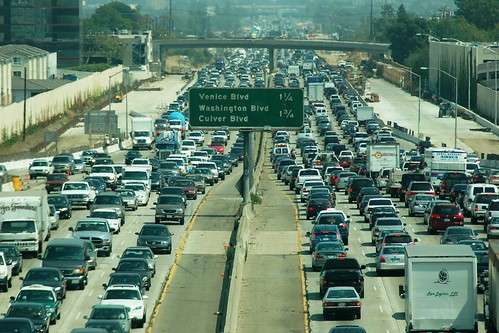 (by Atwater Village Newbie)
Into this:
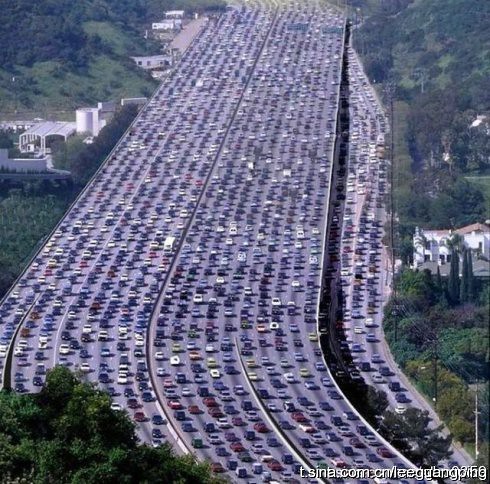 (copyright: Lee from t.sina.com.cn)
based on a tax that has not kept up with inflation nor has it kept up with improved fuel economy that puts in less money for the same wear and tear and the same demand for more space on the roads. (Not that it ever paid for all roads in full ever.)
This comment from from Streetsblog Capitol Hill by Ben Fried basically summaries the issues:
This is, basically, his entire argument: People just want to “stay in their cars.” We have zero interest in getting around any other way. According to Fred Barnes, we are perfectly content to drive and drive and drive, as long as we don’t have to put up with all the other people driving. If you believe that, then his cheerleading for highway construction makes a lot of sense.
If being inside our cars is what we’re really all about, by all means lets throw more money down the sinkhole of highway expansion. That will guarantee more quality time inside our cars. Then, a few years later, when we’re in our cars but not enjoying it so much because the new lanes are jammed with traffic again, we’ll repeat the whole expensive process.
But if we’d rather spend more time with our families and loved ones — or, you know, doing actual work instead of commuting — maybe we should try a different way of building our transportation system. According to public opinion research by Transportation for America, 57 percent of Americans would like to spend less time in their cars. Even with our highway-centric system, we’re already voting with our feet: These days, Americans are driving less and opting to walk, bike, and ride transit more than we were at the beginning of the decade.
Continue reading “Fred Barnes: Americans Mainly Want to Stay in Their Cars”
Montgomery making Conn. Ave. more like a freeway
This line from Greater Greater Washington by David Alpert caught my attention.
"In Montgomery County’s DOT and the office of the County Executive, however, no transportation idea less than 50 years old seems welcome."
Freeway like designs only make sense when bike/peds are prohibited I will also assert that freeway like designs on local streets is a major contributing factor to why people think bikes do not belong on the road. What ever happened to our #1 policy ratting and Complete Streets?
Isn’t Montgomery County the least concern about their percentage of fatalities that are bike/ped?
Continue reading “Montgomery making Conn. Ave. more like a freeway”
SHA to close part of Falls Road this weekend
[B’ Spokes: Cyclists might expect extra traffic on the side roads during this.]
*********************************************************************************************
from Getting There by Michael Dresser
The State Highway Administration will close a section of Fallls Road in Butler this weekend to repair pipes under the pavement.
The road wil be closed to all traffic between Butler Road and Black Rock Road between 8 p.m. Friday and 5 a.m. Monday. It will be closed to all but local traffic between a point south of Stringtown Road and to north of the Butler Volunteer Fire Department. At some points, motorists will not be able to cross Falls Road and will have to use the detours. Detours will be in place. If rain is expected, the work could be postponed until the following weekend.
Continue reading “SHA to close part of Falls Road this weekend”
Article explores bike-car-pedestrian relations
[B’ Spokes: More bike/ped/car relations from Michael Dresser. One thing I think that needs highlighting is the race to red lights. It amazes me how often road rage or aggressive driving ensues when cyclists dare to stop for red lights. It is human nature to avoid conflict so I am empathetic to cyclists that run red lights though I do encourage them to look for other ways to deal with this issue. It all boils down to education and what to expect from other road users and I am thankful to Michael for bringing more awareness on this issue.]
from Getting There by Michael Dresser
Reuters has an interesting article on the sometimes toxic relations among motorists, pedestrians and bicyclists. Felix Salmon writes from a New York bicyclist’s point of view, but he’s not at all sparing of his fellow bikers who trample all over the traffic laws. And most of his points are equally applicable in the streets of Baltimore.
The article is especially recommended to bicyclists who think they should be exempt from the traffic laws that govern sidewalk use and one-way streets. Salmon explains, clearly and from a bicyclists’ point of view, why this is dangerous folly.
Continue reading “Article explores bike-car-pedestrian relations”
Bicycle travel on the rise, statistics say
Bicycle travel continues to grow in North America, according to research and anecdotal evidence from tour operators and tourism promoters in the United States.
Bicycle travel is becoming an increasingly visible part of the adventure travel market, which, according to a recent study issued by the Adventure Travel Trade Association, generates $89 billion annually.
Here are some points:
…
Continue reading “Bicycle travel on the rise, statistics say”
The Mobbies
I think it would be really cool if a Baltimore biking blog won the Mobbies. So …
 Click here for Baltimore Spokes (us)
(You have to register/login with the Sun for your vote to count.)
Or for our second favorite:
Click here for Bike Baltimore (Nate’s unofficial blog)
Remember you can vote more then once and for more then one. (Bawhaaahaha.)
Cyclists Face Lack of Legal Protection in Crashes
— By Jen Phillips
Today is election day, but one candidate that won’t be on the ballot is Maryland candidate for Senate Natasha Pettigrew. Thirty-year-old Pettigrew, who represented the Green Party, was struck and killed by an SUV while biking on September 20. The driver of the Cadillac Escalade who hit Pettigrew said she thought she had hit a deer or a dog so she didn’t stop and continued driving for four miles until reaching her home. Upon parking the SUV, she saw Pettigrew’s bicycle lodged beneath it and called police. Pettigrew’s mother, Kenniss Henry, is running in her place but looks like Maryland is re-electing Democrat Barbara Mikulski.
The death of a promising young person is tragic, but at least charges for the driver are pending. (An eyewitness says she saw the SUV stop after striking Pettigrew, then take off with sparks and smoke trailing behind due to the bicycle stuck beneath the vehicle.) Often, charges aren’t filed in cases where bicyclists are killed by cars because it’s an accident. One could argue that’s what manslaughter charges are for, but of course traffic laws (and their execution) vary from state to state and city to city. Pettigrew’s mother has advocated stricter laws in Maryland, where if a driver hits a pedestrian or cyclist, they must be impaired, grossly negligent, or show intent to cause harm in order to be charged with a crime. Cases in other states show similar outcomes: in Florida this July, a Navy vet and executive was struck and killed by an SUV driven by a nurse, but no charges were filed because police considered it an accident. The same was true in a 2009 case involving the death of a Virginia bicyclist by an SUV. In 2008, there were 716 cyclists killed in crashes with motorized vehicles, making up 2% of all traffic fatalities.
A few weeks after Pettigrew’s death, a Maryland law was enacted that requires a 3 foot buffer zone between cars and bikes on roads, and require vehicles yield right-of-way to bicycles. But the fine for motorists who cause a crash that involves a bike is just $1000. "A loss of life is a loss of life," Henry told the Maryland Gazette. "We seriously need to look at how we balance these scales."
Continue reading “Cyclists Face Lack of Legal Protection in Crashes”
Could Restructuring the Gas Tax Fund the Transportation Bill?
This bit from Streetsblog Capitol Hill by Angie Schmitt caught my eye:
…
Sean Roche at Network blog Newton Streets and Sidewalks agrees with the impulse to restructure the gas tax, but says the proposal may not go far enough to bring fuel taxes in line with infrastructure spending:
Adoption of an ad valorem gas tax would be a step in the right direction. “Spending on road construction and maintenance grew almost exactly in line with the economy from 1994 to 2008 – a 102 percent increase.” As a consequence, “federal, state and local governments grew road spending faster than road revenues by borrowing more and by diverting general tax revenues to spend on roads.”
Ultimately, though, simply stemming the backward march of gas-tax revenue is not enough. We need to make up lost ground. We need to account for the impact of increased fuel economy. And, we need to capture more of the costs of driving from those who drive (or consume goods that have been shipped). One of the virtues of switching to an ad valorem gas tax, though, is that it has no immediate impact, but preps for the future.
It’s just math. Federal and state gas taxes are too low.
Continue reading “Could Restructuring the Gas Tax Fund the Transportation Bill?”