If you ride a bike, check your auto insurance

[B’Spokes : Note that I really can’t verify any of this and it’s from out of state but it might at least be a starting point.]


from Dave Moulton’s Bike Blog by Dave Moulton
If you ride a bike and own a car, and let’s face it most of us do, check your car insurance; that’s right your car insurance.

If you are hit by a car while on your bike and end up with $60,000 or more in medical bills, it will not help you if the driver at fault has only minimum legal coverage of say $25,000.

Worse yet he may have no insurance, or as is happening in more and more bicycle/car crashes, it is a hit and run. The driver leaves the scene and there is no one to make a claim against.

Most cyclists do not know that in most cases you can claim for expenses and compensation from your own insurance company, and if you are not at fault you are not penalized. However, this is only the case if you previously bought sufficient coverage on your own policy.

I was advised to do this a few years ago by an attorney friend of mine, and as a result I upped my underinsured and uninsured driver coverage to $250,000. It is advisable to carry at least $100,000 and up to $300,000. It may cost you $8.00 a month for the extra coverage, but the peace of mind it brings is worth it.

This advice was reiterated in a free book I just received called “The Utah Bicycle Accident Handbook.” As the title suggests it applies to the state of Utah, but much of the advice is good in most states.

The book also pointed out that I might consider Personal Injury Protection, or No Fault Coverage. This allows for my medical expenses to be covered immediately, instead of having to wait for the other party’s insurance to accept responsibility for the accident. If they do eventually accept responsibility my insurance company will seek reimbursement from the at fault insurer.

I had a serious bike accident a few years ago, and I was fortunate in that the person who caused the accident owned a business and had excellent auto insurance. There was also a witness who came forward, and I had an attorney who specialized in bicycle cases handle the claim.

I would advise anyone to do the same. An attorney will take a third of the final settlement, but they take no money up front, so it is in their interest to get the best settlement possible.

Insurance companies are in the business of paying out as little as possible, that is how they make a profit. In my case I would have had no idea what would have been a fair offer, or just how much they would have paid, but an experienced attorney has that knowledge and experience. 

The League of American Bicyclists has a list of attorneys who specialize in bicycle accidents 

Continue reading “If you ride a bike, check your auto insurance”

Environment Maryland endorses Gov. O’Malley

From Brad Heavner – Environment Maryland

I couldn’t stand by with Bob Ehrlich calling himself an environmentalist in this year’s campaign. I was there when he fought us on the renewable energy standard, Program Open Space, and many other environmental initiatives. We can’t forget.

A couple of those stories are in our new video. Please take a look and share it with your friends and family.

You can watch it here.

The video talks about Gov. Ehrlich’s lobbying efforts to kill legislation to reduce pollution from power plants. It also describes his attempt to sell land that was protected with taxpayer dollars to a developer to build luxury homes. The video was shot on the property involved in the controversial land deal in St. Mary’s County.

Ride Across America Report from Janeen “Noodle” McCrae

from Fat Cyclist by fatty

A Note from Fatty: You might have first gotten to know Janeen “Noodle” McCrae on this blog when I featured her 100 Miles of Nowhere video last year. Well, this year, she rode across the United States — helping Team Fatty raise thousands of dollars for LiveStrong along the way.

Noodle is, in short, an inspiration.

So when Noodle sent me a brief ride report along with photographs, I definitely wanted to pass them along. Enjoy!

Just a quick note to let you know that I finished my ride across these great United States on Wednesday (Oct. 13) at around 4.30pm. Hoping you can let peeps know of this news so that I may thank them for their support, followings, and random-showing-up-and-the-side-of-the-road antics. I actually have a lot to say about this trip, but I am currently struggling to pull my thoughts together into any kind of sensical ramble. It will come, just not today.

Here are 3 spur-of-the-head thoughts:

1. America is big. A lot of it is empty. I would like to thank all the stupid song writers in the world (mostly from the 80s) who buried their dumb lyrics deep in my head so that these songs would appear randomly in the silence and torture me for HOURS in these locations. Thanks in particular to Billy “You’ve got a nice white dress and a party on your confirmation” Joel, and Randy Newman for the Three Amigos theme (which I actually didn’t mind too much. I can really hold that note for a long time.)

fattysocks_colorado.jpg

2. America is beautiful. Even those empty parts. I would like to thank Mother Earth for shifting plates in her china cabinet to push mountains up in frighteningly wonderful messes, and flatten out the land in other parts like linen cloth on a table. There were days when landscape changed dramatically several times. Wow is a word that actually doesn’t sound corny and hollow when you see these things for the first time. People need to get out there and feast their eyes on this stuff, if they haven’t already.

wyoming_fatty.jpg

3. America is not full of axe murderers. Go figure?! I experienced moments of great kindness, which has reaffirmed my faith in humanity. For every jerk who yelled “Why don’t you just go kill yerself” out a car window, there were 20 who offered a meal or asked if I needed anything. Cheer up america. You’re not as full of suck as you are lead to believe. I’d like to thank everyone who wasn’t a jerk.

finish_sunset.jpg

And if you would indulge me this one personal note. I would like to thank you. I could have jumped on my bike and ridden across the USA and that would’ve been that and life would have gone on and whatever whatever so long and goodnight. But Team Fatty and raising money for LIVESTRONG became a key component of this trip for me. To the point where I sucked in some friends at Breakfast NY who made Precious (my bike) a brain and donated that brain and a website to help me raise money – refusing my lame attempts to pay for any of that stuff every time I half-heartedly offered.

finishastoria_1.jpg

Although my fundraising goal wasn’t huge, we reached the initial goal and so I upped the ante. Sure, I will fall short of that ambitious $21,310 goal, but I feel that the awareness my lovely tweeting bike raised for LIVESTRONG has served its own function.

For every email or tweet that I’ve gotten about how I’ve inspired some person to get on their bike or donate to the fight, I think about how it’s really just a knock-on effect from you. Your story was the initial hot coal under my seat to get off my arse and do something.

From you, to me, to … the next in line. I wonder who will inspire us next in this fight?

Ride on, Team Fatty!

Janeen “Noodle” McCrae

Continue reading “Ride Across America Report from Janeen “Noodle” McCrae”

Less crime noted in mixed-use neighborhoods

By Mark Ferenchik
THE COLUMBUS DISPATCH
Walkable communities that feature a mixture of houses and businesses often are promoted as the salvation of American cities.
Now, new research suggests that they also might deter violent crimes.
But that’s only once those neighborhoods have enough street activity and enough people to keep an eye on things, said Christopher Browning, an Ohio State University sociology professor.
That’s true in poorer areas as well as more well-to-do areas, he said.
"One of the assumptions is, you get a lot of people out in the street (and) that reduces crime," said Browning, whose research recently was published in the Journal of Research in Crime and Delinquency.
An area of Columbus that fits the bill is Clintonville on either side of N. High Street, from Oakland Park to Arcadia avenues. The area features a grocery store, a Starbucks and a number of street-front businesses, all surrounded by a densely populated neighborhood.
The rate of crime in the area is low.
Just adding a couple of new stores here or there, however, might actually boost violent crime for a time in some mixed-use neighborhoods, as crooks see a new opportunity, Browning said.
However, "Planners and developers should not be deterred if developing an area in the short-term increases crime," he said.
He said his study is one of the first to address the issue of violent crime and mixed-use neighborhoods.
Browning and his team of researchers studied 184 Columbus census tracts, looking at the numbers of houses and businesses in each, and examining rates of homicide, robbery and aggravated assault for three years.
His team merged the violent-crime and census data with detailed tax-parcel information that describes land uses.
The research somewhat counters work by Joanne Savage, an associate professor of justice and law at American University in Washington, D.C. She found that mixed-use developments might have higher levels of crime overall, particularly burglary and robbery, based on her review of a small number of studies.
Urban planners love mixed-use development, Savage said. So when she told a group of them that they should expect more crime in these areas, "They were shocked, shocked, shocked," she said.
Her findings suggest that cities should be careful when planning mixed-use neighborhoods and include such things as fewer alleys and more safe parking and transportation, as well as good lighting, surveillance cameras, security guards and police patrols.
This month, Columbus Mayor Michael B. Coleman announced that the city would install security cameras in Weinland Park and South Linden, on the Hilltop, and along Mount Vernon and Livingston avenues.
Diesha Condon, director of the Short North Business Association, said she’d like to see some of those cameras in her neighborhood, as well as more lights for pedestrians along N. High Street to the South Campus Gateway.
Until then, she’s happy that shop owners and residents work together through the Short North’s block watch.
"I personally preach to the business community to report everything to the police," she said.
On the city’s Near East Side, the Columbus Compact placed security cameras on buildings along E. Main Street to monitor criminal activity in the area and report it to police.
The nonprofit development group brought the Save-A-Lot supermarket to E. Main and is developing eight condominiums nearby with federal money in an attempt to revive a downtrodden part of the neighborhood.
Campus Partners, which built one of the area’s most publicized mixed-use developments in the South Gateway neighborhood near the OSU campus, said its security systems monitor activity in the area 24 hours a day.
"The goal was to balance the desire for people to feel safe without having the area feel like it was too heavily policed," said Doug Aschenbach, Campus Partners’ president.
Browning’s research, supported by a National Science Foundation grant, reviewed census and crime data compiled a decade ago. Despite the time gap, Browning said his research remains relevant because the characteristics of these neighborhoods and crime apply today.
Continue reading “Less crime noted in mixed-use neighborhoods”

Take the Lane: Sometimes, we could give up the lane

From twinriverscyclists

Driving your bike is a dance.

For the most part drivers are courteous. Courtesy demands thinking of one another. And it works both ways. We’ve all seen rude cyclists riding two and three abreast and refusing to give way.

That’s illegal but what about taking the lane? Usually the problem is the cyclist is too convinced of his own inferiority and tries to give way too much. It takes some courage to fill up a lane to prevent a motorist from passing on a blind corner.

On the other wheel, cyclists need to adjust to the road conditions even if it means giving way when you strictly speaking do not need to. For example, I often coast a bit to give that passing vehicle more room to pull back in before reaching that blind curve ahead. I can also speed up to get into the corner sooner controlling the lane so the passing motorist isn’t tempted to make that pass that might push me off the road should he enoucnter oncoming traffic.

In this way, I make a dance of my ride alternately leading and following but always remaining predictable.

Be sure to click through to the original newspaper story below.–Corrie


This column by Michael Dresser of the Baltimore Sun addresses an issue that a lot of cyclists and cycling advocates dance around but don’t directly address: pulling over to let motor vehicles pass.

I think we get so caught up in the mantra of “share the road” that we automatically think that sharing means “me first.”

via Take the Lane: Sometimes, we could give up the lane.

Continue reading “Take the Lane: Sometimes, we could give up the lane”

Here’s the problem…

[A snippet from Richard Layman’s article “In a world where automobility is prioritized, it can be difficult to recognize that automobility priority exists and is a factor in pedestrian deaths”]


Here’s the problem…

Most jurisdictions do not have a systematic process for evaluating each pedestrian and bicycle accident to determine if there are systematic design or other problems, and a program to address systemic failures.
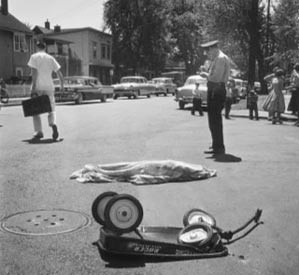
Child struck by car 1959 Pulitzer Prize winner
Child struck by car. 1959 Pulitzer Prize winner for photojournalism.

I know it doesn’t make sense, but that’s the way it is. Police departments handle the collection and maintenance of traffic accident data. Even though money is provided to police departments as part of the national highway safety program for traffic enforcement to reduce accidents (car on car, car on pedestrian, car on bicyclist, etc.), police departments don’t usually work very closely with planning and transportation departments to analyze the data, and they don’t usually have transportation engineers and planners on staff either.

This needs to change. We need to link the transportation engineers, planners, and police department personnel (officers and accident and crime analysts) in a systematic fashion to yield substantive improvements and reprioritize safety in ways that favor the most vulnerable (pedestrians and bicyclists are far more vulnerable to accidents compared to motor vehicles).

Continue reading “Here’s the problem…”

Want to walk to school? Laguna Beach says nope, not here

One problem noted in the article:
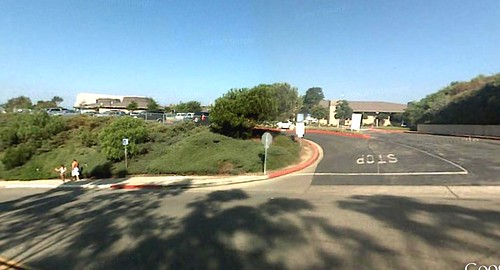
“Notice how the sidewalk actually stops at the school entrance, guaranteeing that any kid who dares to walk to school will find herself immediately in the path of motor vehicles. And that definitely would not be a good thing: parents’ traffic at Thurston, chauffering kids to and fro, has apparently gotten so heavy and unwieldy that the school has posted a flyer full of sternly worded cautionary rules and a complicated-looking traffic flow map,…”
image

And from a school official:
“However, in Laguna there are few sidewalks, winding roads with blind corners and a considerable distance for our students to travel and we cannot endorse walking or biking to school so much so that, at considerable cost (parents pay a portion), we provide busing for the elementary schools and middle school.’”

Hmm, so buses at considerable yearly cost from the education budget are an economical alternative to sidewalks and cycling considerations? Just another way of saving a few pennies in the transportation budget and make someone else pay for incomplete streets.

But if this is for the safety of our children … “But riding in a car isn’t exactly safe, either, given that each year some 250,000 children are injured in automobile accidents, including 2000 who die as a result. Motor vehicle accidents are the leading cause of death for children between ages two and 14.”

It does not sound like we are improving the safety of our children at all.
Continue reading “Want to walk to school? Laguna Beach says nope, not here”