Maryland Accident Lawyer Information Center

[B’ Spokes : I found the breakdown by jurisdiction and insurance company interesting as well as their blog. Personally I find the self promotion a bit over the top on the pages referenced but still they deserve credit for getting this information out there… now if just more lawyers would talk about what’s right and wrong with the system we might be able to do something about the wrong and be better prepared for what is right and this site is definitely a step in the right direction.]


from Maryland Injury Lawyer Blog

The primary purpose of this website is to provide information to both Maryland auto accident lawyers and to auto accident victims through our Auto Accident Victim Help Center and our critically acclaimed Auto Accident Lawyer Help Center, which is designed to assist the accident lawyer in Maryland in handling accident claims.

This website is considered by many to be the best accident website in the country for both victims and lawyers handling claims. For victims and potential clients, our Maryland accident lawyers provide the information you really need to help you best understand the process and how to maximize the money you receive as compensation: how Maryland accident claims work, their value, how to chose a lawyer, and the details of Maryland accident law and what that means for you.

….

Jurisdictional Analysis

Tips on Each Insurance Company

Continue reading “Maryland Accident Lawyer Information Center”

Making the main roads safer

Regarding the Oct. 13 article "Few common links in spate of pedestrian fatalities":
This article was correct that speeding cars are the biggest risk to pedestrians. But the assertion that there were "few common themes" in the six fatal pedestrian crashes that have occurred in the past month was off the mark. While the story focused on the demographics of the victims and the environmental conditions surrounding the crashes, it missed the biggest common factor: Four of the six crashes occurred on multi-lane, high-speed arterial roads.
Nationally, in fact, 56 percent of pedestrian fatalities occur on arterial roads such as Georgia Avenue in Montgomery County or Glebe Road in Arlington County. Arterial roads are especially risky for people on foot because they offer few, if any, pedestrian amenities such as sidewalks and crosswalks and because they encourage motorists to put the pedal to the metal.
Fortunately, communities across the country are beginning to transform those arterials into more pedestrian-friendly boulevards, complete with sidewalks, bicycle lanes and shade trees. But as these recent pedestrian deaths show, we still have a long way to go.
Michelle Ernst, New York
The writer is co-author of the Tri-State Transportation Campaign’s report "Dangerous by Design."
Continue reading “Making the main roads safer”

How Walkable Are the Streets Near Your Transit Stop?

from Streetsblog.net by Angie Schmitt

At individual transit sites, however, the usefulness of the database can depend on the location. As Network blog Walkable Dallas-Fort Worth explains, when you look closely, the areas within walking distance of a transit station don’t always match what appears in the database:

Each of these TOD zones requires specific attention to detail. This gets at a broader problem preventing TOD planning from becoming smarter, and that is the ubiquitous 1/2-mile walk circle.

As demonstrated by Walkable Dallas-Fort Worth, a half mile isn’t necessarily a walkable distance when the street pattern is accounted for.

The issue with the 1/2-mile circle, intended to simulate a 10-minute walk or a popularly accepted distance to travel by foot to transit stations is that not all 10-minute walks are the same. What is the road network like within that 1/2-mile generic circle? How many roads must be crossed? How direct is the route (yielding a more radial pattern emanating from a center of gravity or attractor – in this case the transit station)? Are there highways to be traversed? How long is the wait to cross at crosswalks, etc. etc.?

As you can see (image right), what actually constitutes an acceptable walking distance is FAR, FAR smaller than the 1/2-mile circle, because it takes a similar amount of time.

Maybe, with some tweaking, this can turn into another benefit of the database: highlighting all the places where re-configuring streets can increase the area served by transit.


Continue reading “How Walkable Are the Streets Near Your Transit Stop?”

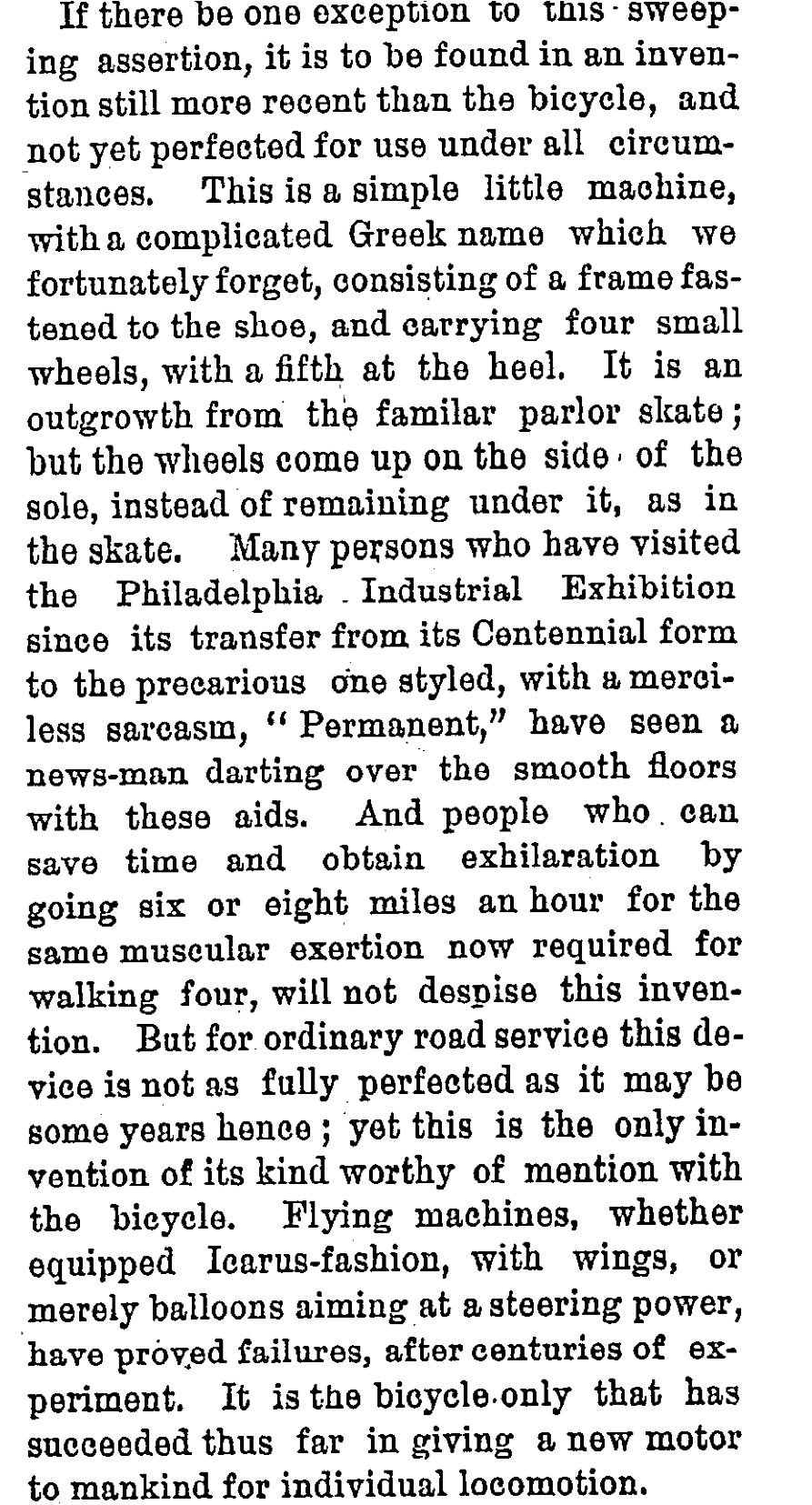
It is the bicycle only that has succeeded thus far in giving a new motor to mankind for individual locomotion

from How We Drive, the Blog of Tom Vanderbilt’s Traffic by Tom Vanderbilt

Reading an enthusiastic account of bicycling in New York City from this 1879 (!) article from the New York Times, I was curious about the reference to the sort of wonder skate referred to as a possible rival to the personal rapid transit offered by the bike. It almost sounds like a proto-roller blade. Anyone know what this is, have any references, etc.?

Continue reading “It is the bicycle only that has succeeded thus far in giving a new motor to mankind for individual locomotion”

Baltimore Tours- Bicycle

[B’ Spokes: I found this on Craig’s List and thought it was worth a mention here but I have no knowledge of the folks that run the tour.]
************************************************************
Enjoy a bicycle tour through Baltimore. Experience more than just the inner harbor and enjoy the character and the fun streets of Baltimore. Our tours go through, Little Italy, Fells Point, Harbor East, Inner Harbor, Federal Hill, Locust Point. and Fort McHenry. The cost is $5 per person and canned good donations for Bea Gaddy Family Center. There is a great need for food for the Thanksgiving dinner this year. You will need to provide your own bicycle or you can rent one from several sources in the city. For more information, including private tours, bicycle or walking. Also available are travel services for those visiting needing assistance with their travel to Baltimore. Contact for more information and services.

Touringbaltimore @ gmail.com
Continue reading “Baltimore Tours- Bicycle”

John Stechschulte


6. How did your Teach For America experience impact your subsequent endeavors?

After completing my two year teaching commitment, I had a few months off before I would start my current job. With all this time, and my newfound sense of possibility, I decided to bicycle from Baltimore to California. It was a journey I’d long dreamt of, but without my experience in the classroom, it probably would have never gone beyond the dream stage. I rode solo and unsupported; I carried about 50lbs of gear, camped most nights, and cooked most of my dinners and breakfasts on my camp stove. Often I would knock on doors and ask people if I could set up my tent in their backyard (I was only turned down once). Altogether, I rode 4,600 miles over about three months–I had 72 days of cycling, with a few rest days interspersed. I wore my Cornell jersey for about a third of those days (I only took three jerseys).

On my journey I bicycled through many cities–DC, Pittsburgh, Columbus, Xenia OH, Louisville KY, St. Francisville LA, Austin TX, El Paso TX, Phoenix AZ, and San Diego CA. Some were more bicycle friendly than others, but I was impressed in each by the efforts being made to encourage bicycling and improve infrastructure for cyclists. Since
just before I left on my bike ride, I’ve lived car-free in Baltimore. Two years ago I would’ve rated Baltimore as the least bicycle friendly city I’d ridden in. However, the city has made significant strides recently, and I’m excited to be involved in the effort to encourage active transportation.

Continue reading “John Stechschulte”

Driver Hits Cyclist in Utah Construction Zone

by Kenneth L. Christensen

KSL reported that a driver caused a Utah bicyclist versus car accident at one of Sandy’s busiest intersections October 21, 2010. Construction at the intersection at 10600 South and 1300 East has created chaos in the area. The roads are partially destroyed and there are construction crews everywhere. In addition, many of the lanes are very narrow. The incident occurred around 6:50 a.m., while it was still dark. A cyclist was headed west on 10600 South when the driver of a car coming in the opposite direction made a turn in front of the bicyclist. They collided, launching the cyclist five feet from the car. Investigators say the driver was concentrating on making a narrow turn and trying to avoid hitting another car. Nonetheless, according to Utah Bicycle Laws, the driver of the car would be liable for this accident as the bicyclist clearly had the right-of-way.

Many bicycle traffic accidents can be prevented if we simply keep a better lookout for pedestrians and cyclists. Though many people think that bicycling is especially dangerous, bicycling is actually generally safe. Cycling has lesser deaths per mile as compared to pedestrians and lesser fatality per hour as compared to passenger vehicle users.

The knowledge necessary for ensuring safety can be learned from the traffic code and from advice from other cyclists. Strength, bike handling skills, and experience are also important factors in bicycling. Before hitting the streets with your bike, be sure to get a free copy of our Utah Bicycle Accident Handbook. This book explains Utah bike laws and details what types of insurance every cyclist must have. This book is FREE at www.UtahAccidentBooks.com.

Continue reading “Driver Hits Cyclist in Utah Construction Zone”

1/3 of the story isn’t the full story: crossing guard pay and walk to school programs

[B’ Spokes: The short version of this might be how the heck do we get schools, planning, police, local government and state government all working together rather then just saying “This is not my problem to fix.”]


from Rebuilding Place in the Urban Space by Richard Layman

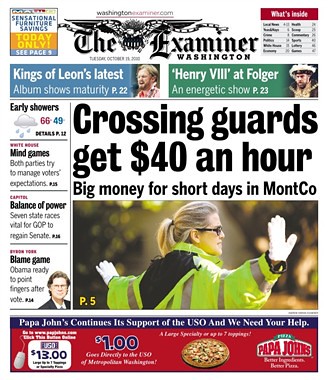
Crossing guard pay headline cover image, Washington Examiner, 10/19/2010
The Examiner writes a pretty narrow story today concerning school crossing guards, making it out as if the crossing guards are making a mint of money at the public expense. See “Being a Montgomery County crossing guard has its benefits – $40 per hour.”

It’s a surprisingly complicated issue.

In the last post, I discussed police departments and pedestrian and accident analysis, but I didn’t get into the details about some of my learnings about the issue. What I used to say was that “police officers aren’t planners, and that’s not their fault, but they do need our help.”

Because they don’t know they aren’t planners, without awareness of the need to bring planners and transportation engineers into the equation when it comes to accident analysis and countermeasure selection, that area of expertise tends to not be part of the analytical system and approach towards traffic safety improvement. (Of course, this is an area where guidance from the FHWA in terms of the national traffic safety program and how it could be restructured would be very helpful.)

There is a similar issue with crossing guards. The way it works, crossing guards are paid for and managed by police departments, not the local school system. (This should change, but that’s another issue too.) When the police department can’t fill the crossing guard position–which is usually the case in most places because the hourly wage is low and the hours are short so most jurisdictions never have enough crossing guards–they are forced to have the shift covered by sworn police officers. While this has some benefits, for the most part, it takes police officers away from other service duties.

So the Examiner article doesn’t discuss this, and how, by paying higher wages, Montgomery County is able to fill most of its crossing guard positions and they don’t have to use police officers for unfilled shifts.

That isn’t the case in Baltimore County.

At one of the planning advisory committee meetings, we were discussing walk to school efforts and how to expand the number of schools promoting and the number of students participating in walk to school efforts, and the police department representative present at the meeting interjected, and explained to us “the problem” from “their perspective,” not ours.

This is from the draft plan that I submitted, although the final text in the posted draft may differ slightly:

The plan advisory committee learned that one of the barriers to expanding walk to school efforts concerns the supply of available crossing guards. School crossing guards are managed by the Police Department, not by the School District. Funds to pay school crossing guards come from the Police Department budget. Because it is part-time work (10 hours/week) for relatively low wages, the Department has a difficult time keeping the 273 required positions filled. For each empty position, sworn police officers fill in, diverting officers from patrol and other duties. The Police Department ends up in the position of discouraging walk to school efforts, because it can’t meet current demand for crossing guards let alone additional demand generated by new walk to school efforts, which would mean that even more police officers are needed to cover school crossing guard functions.

(In Baltimore County, they pay under $15/hour.) The Police Department ends up in the position of discouraging walk to school efforts, because it can’t meet current demand for crossing guards let alone additional demand generated by new walk to school efforts, which would mean that even more police officers are needed to cover school crossing guard functions.

I am using the word “discourage” nicely. They actually tell principals to convert walk to school areas to school bus service zones, in order to reduce the demands on the sworn police officers.

This was the related recommendation in my draft (which was excised from the posted draft):

Address the issue of school crossing guard pay and other incentive programs that will strengthen retention of school crossing guards to reduce demands on other Police Department personnel for school crossing guard coverage. Ensure that when additional crossing guard positions are required, funding is provided to cover the increased cost.

We found this out because, unlike in most bicycle and pedestrian planning efforts, I reached out to the police department and got the traffic safety and traffic enforcement divisions to participate in our planning advisory committee. Plus the accident analysis section of the Crime Analysis section of the police department’s research division provided us data that we asked for with regard to pedestrian and bicycle accidents across the planning area (actually they provided it for the entire county, but I was tasked with a planning effort for only 1/2 of the urban area of the county, about 110 square miles). Some planning efforts get and analyze this information, many do not.

I am surprised that Baltimore County has demands for more crossing guards than Montgomery County (177 according to the Examiner article) and Fairfax County (64 according to the Examiner article). But it is a big school district (110,000 students), just as Montgomery County (130,000 students) and Fairfax County (175,000 students) are large, but Baltimore County is physically larger than either county (Baltimore County is about 640 square miles).

But I imagine that the Baltimore County Police Department wishes they could pay what Montgomery County is paying. They kept asking for more money to address the issue, but it kept getting denied, and they are always in the position of never having enough crossing guards, and constantly directing police officer details from other duties to serve as crossing guards.

The issue comes down to walking to school vs. being bused to school. Higher wages for crossing guards ensures the success of walk to school programs. Sure this comes at a cost. It means you don’t have to buy and operate as many school buses, find school bus drivers (another problem comparable to the problem of finding and retaining school crossing guards), or buy as much diesel fuel.

A new school bus costs about $75,000. Diesel fuel costs close to $3.00/gallon. For a variety of reasons, it makes more financial, health, and transportation sense to direct resources to walk to school programs rather than busing students to school.

In an odd way, the Examiner article, by not telling the whole story, is advocating for buying school buses and diesel fuel and for school bus drivers rather than crossing guards. It’s as if they are on the take from a school bus manufacturing company…

And it’s very disconcerting that Montgomery County Councilmember Marc Elrich accepts the narrative of the story as stated, rather than digging more deeply into the story. From the article:

Of the millions of dollars devoted to crossing guards, 45 percent of the funding is for group insurance plans.

“Wow, that’s incredible,” Councilman Marc Elrich, D-at large, said upon learning of the ratio. “If everything is on the table — as we have been saying with our budget problems — this certainly has to be in the discussion.”

Police say they hire the “most qualified” people for the positions, but current crossing guards admit that job placement is mostly tied to personal connections.

Yes, the how the people get the jobs issue needs to be addressed if it isn’t an open and fair process, but in most respects, the issue shouldn’t be how much people are paid. It’s either that or the school bus and police officer details. The amount of money spent wouldn’t necessarily be reduced, if anything, it would increase.

Resources:

Helping Johnny Walk to School (report)

National Center for Safe Routes to School

The Safe Routes to School National Partnership

– The State of Washington guide, School Walk and Bike Routes: A Guide for Planning and Improving Walk and Bike to School Options for Students

White House Task Force on Child Obesity

Continue reading “1/3 of the story isn’t the full story: crossing guard pay and walk to school programs”