American Lung Association study backs smart growth

from Streetsblog.net by Smart Growth Around America

Like many Americans, I grew up knowing only one type of community design — drivable suburbia. In my community, exercise wasn’t something that happened naturally over the course of the day. It required carving out designated time slots from a crowded schedule.

Frankly, that didn’t happen as often as it should.

Since that time, I’ve learned that cultivating a more active lifestyle doesn’t have to mean finding a 25th hour in the day. Moving to a walkable, mixed-use, smart growth community quite literally changed my life — with, as it turns out, more significant health benefits than I’d initially realized.

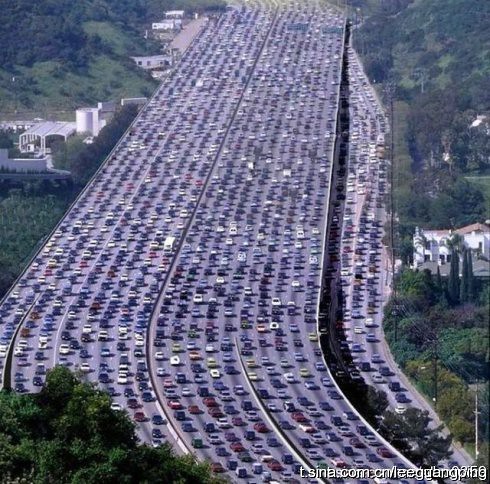
For example, in a new study, the American Lung Association in California has thrown its support behind that state’s plans for more smart growth communities because of the striking positive health implications.

“If doctors and other health experts designed our cities, they would look quite different than the sprawling communities we see today,” said Sonal R. Patel, M.D., American Lung Association in California Board Member and Director of White Memorial Pediatric Medical Groups Division of Allergy and Immunology in Los Angeles.

“Cities would provide more healthy choices, more opportunities for walking and biking, better access to transit, less congestion, more housing close to workplaces and more parks for kids and families to enjoy.”

Continue reading “American Lung Association study backs smart growth”

The Psychology of Road Rage: How Cars Transform Others Into Obstacles

from Streetsblog Capitol Hill by Angie Schmitt

What is it about being behind the wheel that can transform the most genial soccer mom into a seething mass of rage?

We can peek inside the head of an aggressive driver thanks to some timeless research from psychologist Leon James. In the late 1990s, James analyzed thousands of messages between drivers posted on internet discussion groups. He found that good-natured people often became intolerant and anti-social the moment they pull into traffic. Congressional testimony given by James, posted on Network blog Baltimore Spokes, explains the psychology of road rage and how automobiles serve to depersonalize others.

The car is not only an object of convenience, beauty, and status. It is also a cultural and psychological object, associated with the driver’s internal mental and emotional dynamics, our ego. Cars are an extension of the self, they are ego-laden objects that can be used both positively and negatively to get our own way on the road. The automobile offers us a means to exercise direct control over our environment. When we enter the car we use it as an outlet for regaining a sense of control. Automobiles are powerful, and obedient. They respond instantly and gratifyingly to our command, giving us a sense of well being that comes with achieving control over one’s environment.

What happens when someone thwarts our sense of freedom? For example, while driving along in a pack of vehicles, a car in the left lane suddenly darts into your lane just ahead of you. Your foot automatically lifts from the gas pedal and taps the brakes, just enough to maintain distance. At this point, aggressive drivers feel thwarted because they were forced to alter what they were doing. That driver forced you to lift your foot two inches. “What a moron. What an idiot.”

This research is no longer cutting edge (James gave the testimony in 1997), but has it been absorbed and applied? How many first-time drivers hit the road prepared to deal with the psychology of road rage?


[B’ Spokes: This bares repeating “but has it been absorbed and applied? How many first-time drivers hit the road prepared to deal with the psychology of road rage?”]
Continue reading “The Psychology of Road Rage: How Cars Transform Others Into Obstacles”

Wednesday Night Ride

On Wednesday, Sept. 22nd, the Wind Up Space on North Ave. is having a bike event https://www.baltimorespokes.org/article.php?story=20100915213435444

At the conclusion,approximately around 8:00 pm, I propose a short night ride around the City. Lights and helmets an absolute for a night ride. It may only be 10 miles or so, but it depends on who is interested. The area for the event is an up and coming region of the City known as Station North. It is not an upscale area, but I have been to many events at the Wind Up Space this year, and it’s been cool. Let’s see if there’s any interest. If anyone wants to see an area of the City at night, or if anyone is going to bike to the event and wants to be escorted home, that’s all perfectly acceptable……..thx………….Penny

https://www.meetup.com/Biking-in-Bmore/calendar/14827989/?a=socialmedia

Location
The Windup Space

12 W. North Ave
Baltimore, MD 21201
(410) 244-8855

How to find us
"Pretty much everyone knows me, but I will wear a white Tour De France hat"

Bike commuters unite!

Hi everybody,

Are you a local bike commuter looking for company on your commute into and out of downtown Baltimore City?

A few weeks ago I got assaulted again and have taken a break from riding in the city, but I don’t want to let this stop me from riding. I’d love to find some people to ride with. Please comment back or contact me if you’re interested. There’s safety in numbers.

In the last two years I used to ride in the mornings from Waverly/Charles Village (around 7:30am) via Guilford Ave and Lovegrove Alley from Penn Station. to Mt. Vernon. And similar route back In the evenings, about 5:15pm. Sometimes I’d take Charles St. or on really nice days, Falls Rd, via Wyman Park Dr. & Hopkins Campus, too.

Thanks!
Gerrit

PS: Fear not – I’m by no means an athlete, in top shape or hard to keep up with. Hahaha 🙂

Friends Mourn Football Player Killed In Crash

[B’ Spokes: If I am correctly deciphering where this happened, only one crosswalk with no zebra stripes, on a busy road. Exactly how is that best engineering for the needs of pedestrains as required by State law?]
***********************************************

Reporting Suzanne Collins
HARFORD COUNTY, Md. (WJZ) ―

Students at Fallston High School are devastated after a popular football player is killed crossing a busy Harford County road. Suzanne Collins reports two of the victim’s friends witnessed the fatal crash.

It’s been a very emotional day for dozens of teenagers who knew the 14-year-old and there are concerns about the dangers of that busy intersection.

A memorial was held Saturday at the Fallston Rec Center in memory of Joey D’Entremont. The 14-year-old freshman died Friday night crossing Route 24 north of the Bel Air Bypass.

All day friends comforted each other. They placed flowers, wrote sad notes and tried to cope with the death of a popular boy.

"He’ll never be forgotten at Fallston High. He was a good kid and #30 will live forever," said Jessica Siemasko.

Joey played linebacker on the JV football team. He also played piano, wrote music and was well known in Fallston and Bel Air. Saturday, his JV teammates met at the coach’s home.

"This is just a big shock to everybody. It’s hard to believe he’s gone," said teammate Michael Morgan.

"We’ve been at their house since 1 o’clock Saturday. We needed to bring the kids together. We had a youth minister there talking to the kids. They needed to be together today," said Karen Jersa.

State police say the preliminary investigation shows the 19-year-old boy who struck Joey had the right of way.

"We’re thinking the crosswalk was prohibiting any pedestrians from coming at the time of the incident because north and southbound traffic had a steady green light," said Sean Harris, Maryland State Police.

State police say the driver who struck the teenager probably could not see him when he was crossing the street because there was traffic stopped in the turn lane that blocked the view.

A business owner at the corner says he’s complained several times about the danger of the intersection to police.

On Saturday, the crossing signal on one side wasn’t working.

"What can happen in such a short moment of time just a block from your house–it’s scary," said Janine Meyer.

The tragedy has caused a roller coaster of emotions.

"One second I’m fine, completely fine and I can talk normally and act normally but I think I’m in denial. Another second, I’m sobbing," said Johanna Taylor.

State police say alcohol was not involved and speed was not a factor in the crash.

A memorial fund has been set up by the Fallston Rec Council.

Continue reading “Friends Mourn Football Player Killed In Crash”

Road Rage: A Culturally Acquired Habit

[B’ Spokes: Most cycling advocates look toward better roads, better laws, better enforcement, and better public education campaigns to improve conditions for cyclists but what if the real key was to get people not to get so upset when then have to use the brakes slightly… in other words learn how not to feed road rage. What impressed me about "Congressional Testimony on Aggressive Driving" Dr. Leon James is how drivers get upset by having to adjust their speed… it’s not just cyclists they are upset with, it’s the whole world. This behavior needs to be addressed and retrained! Anyway an excerpt from the paper:]
***************************************
Dr. Leon James
Professor of Psychology
University of Hawaii
1997
Road Rage: A Culturally Acquired Habit
Driving and habitual road rage have become virtually inseparable. Why? What causes aggressive driving and habitual road rage? And everybody points to the same factors: more cars—>more traffic—>more frustration—>more stress—>more anger—>more hostility—>more violence. More cars leads to more aggression on the roads, sort of like rats fighting in a crowded colony.
Given this logic the standard solutions are: more and better roads, better cars, better laws, better enforcement, and better public education campaigns. Even individual and group therapy. All of these approaches have been helpful, but in my opinion, they are not sufficient to contain and eliminate the epidemic of road rage.
The culture of road rage has deep roots. We inherit aggressive and dangerous driving patterns as children, watching our parents and other adults behind the wheel, and by watching and absorbing bad driving behaviors depicted in movies and television commercials.
I was astounded the first time I listened to drivers who had tape recorded their thoughts and feelings in traffic, speaking their thoughts aloud while driving, giving a sort of play-by-play of what it’s like inside the private world of the driver. This was the first time in the history of psychology that self-witnessing data became available through hundreds of drivers speaking and recording their thoughts in traffic. One feature that particularly amazed me was the pervasive negativity of their thoughts and feelings. In a kind of Jekyll and Hyde effect perfectly ordinary, friendly, good-hearted people tend to become extremely intolerant and anti-social as soon as they get behind the wheel. Behind the wheel their personality undergoes a rapid transformation, from polite and tolerant to inconsiderate, intolerant and emotionally unintelligent.
As a result of my studies, I’ve concluded that aggressive drivers need other behavioral modification techniques to manage their competitive impulses on the road. I refer to this set of emotional management techniques as "inner power tools" for smart driving.
It took several years of research for me to understand the psychological mechanism of emotionally impaired driving. The car is not only an object of convenience, beauty, and status. It is also a cultural and psychological object, associated with the driver’s internal mental and emotional dynamics, our ego. Cars are an extension of the self, they are ego-laden objects that can be used both positively and negatively to get our own way on the road. The automobile offers us a means to exercise direct control over our environment. When we enter the car we use it as an outlet for regaining a sense of control. Automobiles are powerful, and obedient. They respond instantly and gratifyingly to our command, giving us a sense of well being that comes with achieving control over one’s environment.
The pace of life has increased for the majority of the population. Many have commented on the general feeling of loss of control in their lives. And yet it is human and natural to seek a sense of control in our lives, we want to feel we’re getting somewhere, that we’re not wasting time, that we’re doing the right and just thing, that we’re free to pursue our own interest- unfettered.
What happens when someone thwarts our sense of freedom? For example, while driving along in a pack of vehicles, a car in the left lane suddenly darts into your lane just ahead of you. Your foot automatically lifts from the gas pedal and taps the brakes, just enough to maintain distance. At this point, aggressive drivers feel thwarted because they were forced to alter what they were doing. That driver forced you to lift your foot two inches. "What a moron. What an idiot." You feel an explosion of fury inside. It gets very hot. You might even begin to perspire. You grip the wheel harder. Now you’ve arrived at the decisive moment: you can let the emotion die out, or you can fan the flames with thoughts of indignation and retaliation. Aggressive drivers do not let the momentary emotional flare die down.
I discovered that many drivers I’ve worked with haven’t learned the emotional skills they need to handle such routine emergency situations. The violation of their sense of personal freedom instantly arouses negative emotions that escalate in sequence from frustration to hostility to hatred. The fact is that aggressive driving is a cultural norm because our culture condones the expression of hostility whenever we feel wronged.
Continue reading “Road Rage: A Culturally Acquired Habit”

Bicyclist FFY ‘10 3rd quarter Output

The Maryland Strategic Highway Safety Plan has aggressively set a plan for the State to follow. Survey outputs from Maryland Action Measure Tools document behavioral changes so that smaller more incremental outputs can monitor citizens’ knowledge, attitudes, and behaviors.
♦ When riding a bicycle, 38% of the respondents admitted to rarely or never wearing a bike helmet.
♦ Approximately one-half of the respondents indicated that their primary reason for bicycling was for exercise or recreational purposes.
When riding a bicycle, how often do you wear a helmet?
All of the time 30%
Most of the time 8%
Some of the time 9%
Rarely 13%
Never 40%
[Note that this does not add up to the "factoid" presented earlier.]
True or False: Bicyclists are considered legal roadway users and must follow the same rules as other motorists, including direction of travel
True 81%
False 8%
Don’t know/refused 11%
[This is is just sad.]
[Other survey "facts" are in the PDF after the fold.]
Continue reading “Bicyclist FFY ‘10 3rd quarter Output”