Boy, 10, robbed

Four teens assaulted a 10-year-old boy and stole his bicycle in Brooklyn Park on Thursday evening, county police said.

The boy was riding his bike in the 4000 block of Audrey Avenue around 6:20 p.m. when the teens shoved him off, knocking him to the ground.

They stole the bicycle – a gray Mongoose with gold pegs on the front tire and silver pegs on the back tire – and ran away.

They were last seen running across Doris Avenue.

The child was taken by ambulance to Harbor Hospital in Baltimore with minor injuries.

The teens are black, between 16 and 18 years old, and were all wearing black basketball shorts and white T-shirts.
**********************************************************************************************************************************
Young cyclist hurt

County rescue personnel received a call at 8:48 p.m. Friday for a seriously injured bicyclist on the BMX track at Severn-Danza Park in Severn.

Upon arrival, they found a 12-year-old male rider who had suffered serious but not life-threatening injuries, Rostek said.

Paramedics transported the boy by ambulance to Johns Hopkins Children’s Center in Baltimore.
Continue reading “Boy, 10, robbed”

Helpful Safety Resources for Bikes

image

By Kim

Wow, thank you for all of your comments on my Cycling and Traffic post.  I received a ton of helpful advice!  I thought that I would add it here so that everyone can benefit.

First of all, there is this brilliant essay from Eye on Annapolis, which was sent to me from Jen.  In the essay, Ann Brennan talks to drivers about why she does some of the things she does while she is out on the bike.  A great read for cyclists and non-cyclists alike.

Kitzzy sent me a few links that are specific to the Orlando area, but are still wonderful tips for everyone.  CommuteOrlando offers some tips about being a confident cyclist.  Cycling Savvy comes from the Florida Bicycle Association, and offers some tips about certain maneuvers you can make while on the road.

Kitzzy also sent the Bicycling Street Smarts manual, which includes a lot of helpful information, plus diagrams about riding in traffic, on streets, in darkness, etc.  I especially like the section on riding through traffic circles, which will be helpful if and when I get up the nerve to ride the Route 30 (Hampstead) Bypass, which is the closest Bike Route to my house.

My friend Misty sent me a link to Bicycle Safety.  This offers a lot of information that was in the Bicycling Street Smarts manual, but in a shorter version with catchier titles.  This site also offers a lot of statistics on how many bicycle accidents occur from different mistakes.  My takeaway is that around 33,000 people die in car crashes in the U.S. each year.  About 1 in 41 is a bicyclist.

After Kitzzy’s links that were local to Orlando, I decided to do my own research to see if Maryland or Baltimore had any bike information out there.  I found my county office of tourism offers some interesting bike tours of my local area.  This is interesting, and offers some routes I’d love to try, but doesn’t really go into safety at all.

Baltimore City offers some information on Bike Baltimore, but again, this is mostly maps and not really information about biking safely in Baltimore City.  The Maryland Department of Transportation offers similar services, with bike maps of the Bike Routes in the state of Maryland.

The best Maryland resource that I found was OneLessCar.org,   This includes events, news and information for Maryland cyclists, but their safety page didn’t include nearly the important information that was found in any of the links that anyone sent me.  It did, however, include a wonderful fact sheet on Bicycle Safety for Children.  There are some great tips on that one, so take a look at it if you are thinking of buying your child a bike.

The biggest thing that I’ve learned from reading up on all of these websites is that I should sit and memorize all of this before going out on the road.  Right now, I only interact with cars at trail crossings and in my own neighborhood.  I can begin practicing the safety lessons that I’ve learned in my neighborhood, but it will be a little while before I’ve learned enough to ride on roads outside of my neighborhood.  Right now, for example, I am still not quite confident enough to reach down and grab my water bottle while I’m riding.  If I can’t do that, then I’m not ready to ride on a bigger street just yet.

Image Credit: One Less Car.org
Continue reading “Helpful Safety Resources for Bikes”

6 Events You Don’t Want to Miss! Music, Swap, Rides etc.

One Less > Car

Get the Tour du Port Discounted Rate Until this Sunday August 29th. CLICK HERE TO REGISTER.  Order super cool custom socks, jerseys and wicking t-shirts now to pick up at the Tour!


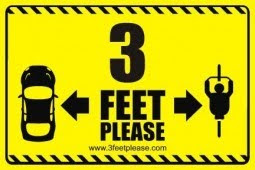
Join thousands of riders at Baltimore’s Canton Waterfront Park to kick off the 17th Annual Tour du Port! Routes to ride: 12, 26, 40, 50 (half century route) and 62 mile option. The Tour routes travel through many historic neighborhoods, waterfront areas and scenic parks. This fully supported Tour includes refreshments at rest stops, map, SAG support and a post-ride celebration at the Tour’s end with lunch supplied by WHOLE FOODS MARKET Harbor East and Mount Washington locations, and live music! Tour du Port is One Less Car’s annual fundraiser – all fees go directly to advancing the programs and advocacy efforts of One Less Car, a non-profit organization dedicated to walking, bicycling and mass transit alternatives. OLC worked to get the 3 foot rule and 5 additional pro-bike, pedestrian and alternative transportation bills passed in 2010!  You and your friends and family will have an unforgettable time! Click here to register and to view the new custom jersey, t-shirt and really cool socks available.


Tonight, August 27th, Critical Mass rides from the Washington Monument in Mt. Vernon at 7pm. Helmets Please!


Tomorrow, August 28th, Free Bike Swap

Swap at The Hexagon from 12 to 5pm.  Featuring demonstrations by Baltimore Bike Works, Twenty20 Cycling and Velocipede.  Discuss the politics of biking with members of Red Emmas Cafe and Books Co-Op. Buy, sell and swap your used parts and bikes – there are no vendor fees and no entrance fees.


Monday, August 30th, Bike Bill Work Session and Vote

The Baltimore City Council’s Community Development Subcommittee will hold a work session & vote on three bike-related bills!

  • 09-0175R Baltimore Police Department – Police and Cyclists
  • 09-0430 Transit and Traffic – Bike Lanes
  • 09-0431 City Streets – Bike-Safe Grates

The work and voting sessions are open to the public.  Location – 4th Floor City Council Chambers in City Hall, Baltimore.


September 8th, MUSIC EVENT – Ben Sollee’s Ditch The Van Tour!

An evening you will not forget! Hosted by One Less Car, doors open 7:30pm, 8:30 performance, 2640 (a cooperative events venue located at 2640 Saint Paul Street, Baltimore). Sollee takes on his largest challenge yet as the Ditch the Van Tour 2010, is a transcontinental endeavor not reliant on the traditional modes of touring. Four regional tours, in which all touring members ride without the use of support vehicles, are linked together. The Ditch the Van Tour is about much more than going car-free though. Sure, it’s a reaction to the massive carbon footprint that many tours leave behind (particularly the fleet of 53′ trucks required to haul an elaborate U2 stage) and an awareness-raising project for the nation’s elaborate series of Adventure Cycling-advocated bike highways and communities where bike infrastructure is lacking. However, Ben also sees the bike tour as an opportunity to acquaint himself with a myriad of towns and communities across our nation – a “beautiful limitation” he calls it – that can only present itself when you slow down the pace of life by traveling by bike rather than bus or plane, as Ben tells National Geographic in a recent interview. “I’ll sum up (Ben Sollee’s) performance in one word: astounding.” “Sollee plays the cello like it’s more than just an orchestral instrument. He plays it like a rock star!” Learn more here. $10 fee. 


September 30 and October 1st – Cities For Cycling/One Less Car Fall Bicycle Forum in Baltimore

One Less Car has partnered with the Baltimore Department of Transportation/Bike Baltimore to host the National Association of City Transportation Officials Cities for Cycling (C4C) summit. The September 30th event is an important step toward a smart, clean and green commuter friendly Baltimore. Traditionally, the One Less Car Fall Forum is held prior to the start of the Maryland General Assembly session to bring together leadership, advocacy groups and the general public to discuss city, county and state bicycle advocacy and program opportunities. The September 30th Thursday Evening Forum will be interactive, educational, FREE, and open to the general public. It will include an array of bicycle infrastructure, advocacy initiatives and programs that have been successful in other cities with a Q&A session at the end. Friday, October 1st will include meeting opportunities followed by a bicycle tour of recently improved Baltimore bike facilities. Times and locations to be posted soon. Check out the OLC event calender for updates and additional events.


Get Involved or Subscribe

Maryland Attorney General Upholds Right to Video Traffic Stops

Maryland attorney general rules that state police were wrong to charge motorist with felony for recording his traffic stop.
Making a recording of a police traffic stop is not a crime in the opinion of Maryland’s attorney general. In a ruling issued last month from the state’s top law enforcement office, Chief Counsel Robert N. McDonald found the legal grounds weak for felony wiretapping charges of the type brought against a motorcyclist who posted a video of himself being arrested on YouTube. Maryland State Police had taken advantage of ambiguity in the law to prosecute Anthony Graber, 25 for the April 13 recording.
"No appellate decision in Maryland specifically addresses the application of that law to recording of police activity," McDonald wrote in his opinion.
Graber had been stopped for speeding on Interstate 95. While driving an unmarked car in plain clothes, Maryland State Trooper Joseph David Uhler cut off Graber as he brought his motorcycle to a stop. Uhler then jumped out of his car, gun drawn, commanding, "Get off the motorcycle" before identifying himself. Graber had a camera on his helmet that recorded the entire incident, which he later posted on YouTube (https://www.youtube.com/watch?v=BHjjF55M8JQ ). The sight of Uhler wielding his weapon in public over a traffic infraction drew a storm of criticism. Uhler responded by ordering his colleagues to raid Graber’s residence and confiscate all of his computer equipment as evidence of wiretapping. By filing charges that could send Graber to prison for sixteen years, the state police wanted to send a clear message to anyone who might consider documenting police misconduct in the future.
Under the interpretation of the state police and prosecutors, a police officer has an expectation of privacy while working on public streets. Ordinary citizens on those same streets, however, have no such expectation and are subjected to constant monitoring by the state’s red light cameras, speed cameras and recently expanded automated license plate recognition systems. The attorney general’s office examined the question of whether the conversation in a traffic stop constituted an "oral conversation" that is "intercepted" under the wiretap act if a citizen records the arrest. After considering a related attorney general ruling from 2000, McDonald ruled that there is no difference between a police officer and a citizen as far as the statute is concerned.
"The reasoning of that excerpt, which suggested that a police officer would not face prosecution or liability under the act for recording an arrest or traffic stop in a public place, would apply equally well to a private person involved in the same incident," McDonald wrote.
Several other states, with the exception of Massachusetts, have developed case law that clearly allows the recording of police traffic stops. The attorney general’s ruling did not directly consider the details of the Graber case, but it concluded that the most likely outcome should it come to trial would be acquittal.
"A court could hold that a police stop of an individual necessarily is not a ‘private conversation’ and therefore does not involve an oral communication covered by the state wiretap act," McDonald ruled. "This conclusion would be consistent with the suggestion made in the 2000 opinion and with the holdings of the courts in most other states construing state eavesdropping statutes. Given the language of the Maryland statutes, this seems the most likely outcome in the case of a detention or arrest."
Continue reading “Maryland Attorney General Upholds Right to Video Traffic Stops”

Why do some kids in Baltimore and D.C. take such joy in beating up cyclists?

By Dave Jamieson

Last night I had a few beers with a buddy who lives in Baltimore. This friend is an avid cyclist who does just about everything with his road bike, whether it’s commuting to the train station, going grocery shopping, or escaping the city limits on the weekends. But lately even the shortest rides around his neighborhood have come with a bit of anxiety. Apparently, a lot of cyclists in his part of town have been getting beaten up by groups of teenagers.

On Saturday the Baltimore Sun reported on the rash of assaults, muggings, and bike-jackings in Charles Village. Three arrests had been made in connection with two robberies before another cyclist was jumped and his bike stolen last Wednesday. "The attacks — which include several instances of harassment and rock-throwing, many that were not reported to police — generated discussion on Facebook among bike commuters and the city’s pedestrian planner, Nate Evans," the Sun reported.

My buddy asked me a question in earnest last night: Which do I think would be easier to use while biking — a can of Mace, or one of those retractable (and illegal) batons?

To people who ride in D.C., the situation in Baltimore must seem pretty familiar, especially the bit about the rock throwing. A few years back the City Paper ran a couple of articles about a spate of random assaults directed at cyclists and pedestrians in Columbia Heights and the U Street corridor. As Ryan Grim reported, rocks and bricks were raining down from Garfield Terrace onto cyclists who were trying to brave the bike lane along 11th Street above U. And as I reported, kids fresh out of Garnet Patterson Middle School in the afternoon were taking aim at cyclists and pedestrians.

I remember stopping to talk to a Garnet student who had trained a rock on me, unprovoked, while I was biking on V Street NW. The boy, who was among a large group, had been suspended before for rock-throwing with his friends. He explained to me that they often pulled cyclists off their bikes just to get a chase going. In other words, it was mostly about having fun. When I asked what kind of people they did this to, he looked me up and down, smiled broadly, and pointed right at me. If I recall correctly, I was wearing a Social Distortion t-shirt and an oversized blue bike helmet, looking every bit the gentrifying 20-something dork.

The recent incidents in Baltimore seem to be more about thievery than anything else; the kids have been, above all, after the bicycles. But the rock-throwing and harassment at play certainly suggest an undercurrent of joy to the whole thing. Honestly, I don’t really get it. But I do know this: When I’m riding my bike and I see a group of a dozen kids on the side of the road looking especially bored, I’ll often cruise over to the other side of the street. And I won’t feel guilty about it. [And I’ll note making a u-turn and finding another route is also equally viable.]

Continue reading “Why do some kids in Baltimore and D.C. take such joy in beating up cyclists?”

Cycling: Help needed to spur bicycle service on trains

By Larry Walsh – Pittsburgh Gazette
My first experience with roll-on/roll-off train service occurred in the late 1990s on the Western Maryland Scenic Railroad which runs from Cumberland to Frostburg, a 16-mile trip.
I had pedaled a steel Bianchi mountain bike on alternate sides of the railroad tracks from Frostburg to Cumberland. It was a bumpy ride, thanks to all the ballast. What is now a smooth ride on a crushed limestone surface trail was years away.
When I arrived in Cumberland, I had breakfast at the All Aboard Café in the renovated red brick railway station, rode around Cumberland for a few hours and caught the 11:30 train back to Frostburg.
After buying my ticket, I rolled the bike over to the baggage car and lifted it up from the platform to John Jeppi, the conductor. I used bungee cords to secure it to the interior of the car. When we got to Frostburg, Jeppi rolled it over to the door and handed it down. No muss, no fuss.
The Allegheny Trail Alliance and the Trail Town Program have asked Amtrak officials to approve roll-on/roll-off service along the railroad’s Capitol route from Pittsburgh to Washington, D.C. And they would like all members of the bicycling community to help make that request a reality.
Roll-on/roll-off service allows cyclists to transport their bikes on and off the train without turning the handlebars sideways, taking the pedals off and putting them in boxes.
The alliance also has asked Amtrak to include roll-on/roll-off service to trail towns it does not currently service.
To accomplish those goals, they are asking cyclists to write letters to Joseph H. Boardman, president and chief executive officer of Amtrak, National Railroad Passenger Corp., 60 Massachusetts Ave., NE, Washington, D.C., 20002. The railroad prefers hard copies rather than e-mails.
They also ask that copies of those letters be sent to Ray LaHood, secretary of the U.S. Department of Transportation, 1200 New Jersey Ave., SE, Washington, D.C., 20590; and to the alliance at PO Box 501, Latrobe, Pa., 15650 or admin@atatrail.org.
Time is of the essence.
If enough cyclists write enough letters as soon as possible — and now would be a good time to do so — roll-on/roll-off service along the Capitol Limited could be in place by next spring.
It might be possible, for example, to ride the train from Pittsburgh to Connellsville, bike 90 miles to Cumberland, Md., along the Great Allegheny Passage and catch the train back to Pittsburgh. The Capitol Limited stops in those towns.
Rockwood, about halfway between Connellsville and Cumberland, has asked Amtrak to approve a stop in their bike-friendly southern Somerset County town. If approved, the stop would serve bicyclists in the spring, summer and fall and snow sports enthusiasts during the winter.
Hidden Valley and Seven Springs, which maintain miles of mountain-bike trails, are only 15 miles away. And each resort has expressed interest in providing roundtrip shuttle-bus service to Rockwood if it becomes an Amtrak stop.
Depending on snow conditions, cross-country skiers and snowshoers arriving by Amtrak could stay overnight in Rockwood and ski or shoe on the passage. If there is not enough snow, they could go to the resorts and/or nearby state parks such as Laurel Ridge and Kooser.
If you would like some suggestions about what to include in your letter, go to https://www.GAPtrail.org.
For more information about the Western Maryland Scenic Railroad, go to https://www.wmsr.com or call 1-800-872-4650.
Although there was no bike fee on my first roll-on/roll-off trip, the railroad now charges $5. Advance reservations are encouraged. The railroad now transports up to 60 bikes a day.
You might want to include that information in your letters.
Continue reading “Cycling: Help needed to spur bicycle service on trains”

Tour dem veggies: An East Baltimore bicycle garden tour review

By Davelove

starting the ride from Duncan St Miracle Garden

starting the ride from Duncan St Miracle Garden

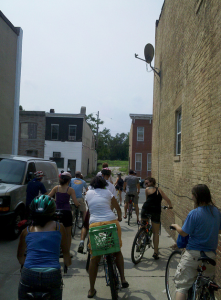
Fueled by cherry tomatoes and lemonade, three-dozen bikers (this blogger included) hit the pavement last Saturday afternoon for a seven-mile tour of seven great community gardens in East Baltimore. We started the ride at the 22-year old Duncan Street Miracle Garden, a one-acre fruit and vegetable haven. Along the ride I was searching for secretes to a successful community garden, but it turns out there are no hard-and-fast rules; gardens are themselves heirloom varieties, each unique and charming.

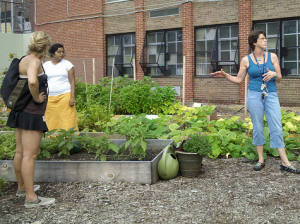
Some community gardens had neatly arranged raised-beds, such as Montessori gardens beds built from old book shelves, or the checkerboard pattern beds of the Homestead Harvest garden. Montpelier Orchards, the newest garden on the tour, had a neatly mowed lawn between rows of trellised young raspberries plants and a small olive tree dwarfed by a tall garden gate with arbor. Others took a wild and free-form approach with natural reseeding tomatoes and sunflowers, making every step a delicious adventure.

Montessori School Garden

Montessori School Garden; raised beds made from old bookcase

I had always believed Robert Frost’s line “good fences make good neighbors,” that is until I learned that many community gardens benefit from the opposite philosophy. Participation Park steward Scott Berzofsky said “the fact that there is no fence was important from the beginning… we wanted to have a commons.” Brentwood Gardens also lacks a fence, and encourages neighbors to glean on a regular basis. Cucumbers were free for the taking; just one example of the “gift economy” at work.

Several gardens gave animals a prominent role, such as the chickens and bees at the Montessori School garden. Apparently playing with chickens during recess is a favorite activity. Brentwood is preparing for chickens this summer by building a coop and purchasing permits from Baltimore City. For more on chickens in Baltimore see my previous post. Brentwood also raised goldfish in modified rain barrels to eat mosquitoes. I’ve never heard of this use, though I didn’t get a single bite while standing next to the barrel in ankle deep grass.

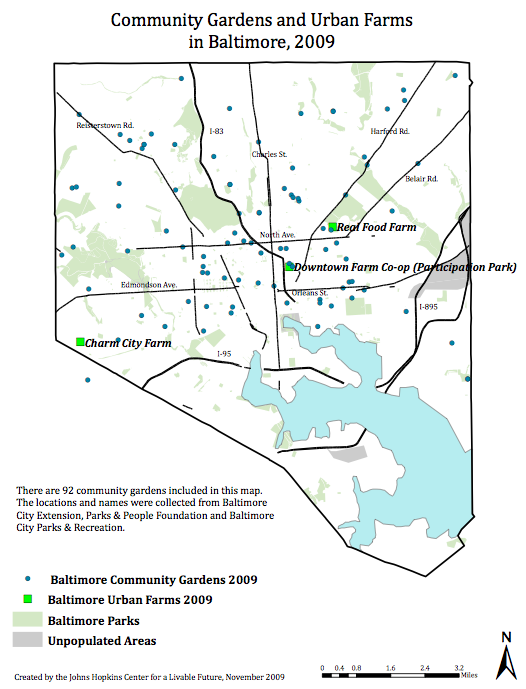
Our last stop was Real Food Farm, where three hoop houses sit peacefully in a grassy field in Clifton Park.Head farmer, Tyler Brown, gave an impassioned pitch for urban commercial farming that grabbed the crowds’ attention.Leaving the farm hungry and tired, the bikers headed back to the Duncan Street garden for a great spread of food donated by leading Baltimore restaurants, live music, and lively conversations with new acquaintances and old friends.

sunflowers at Participation Park Garden

sunflowers at Participation Park Garden

Gardens in the tour:

  • Duncan Street Miracle Garden :: 1800 North Duncan Street
  • Participation Park :: 1100 Forest Street
  • The Montessori School Garden :: 1600 Guilford Avenue
  • Brentwood Garden :: 1700 N. Brentwood Avenue
  • Homestead Harvest :: 632 Homestead Street
  • Montpelier Orchard :: 918 Montpelier Road
  • Real Food Farm :: 2706 St Lo Drive

Congratulations Parks and People, the Community Greening Resource Network, and any other volunteers for turning a hot, muggy Saturday into a memorable event!

– Dave Love

CLF generated map of Baltimore community gardens


Continue reading “Tour dem veggies: An East Baltimore bicycle garden tour review”

Anne Arundel County and Howard County crime report

ASSAULTS

ROUTE 175 AND DISNEY RD., 10:46 p.m. Aug. 13. A male teenager was shot by a projectile while riding his bike. The projectile came from a dark four-door vehicle occupied by two males. The bicyclist rode home, realized his head was bleeding and was taken to a hospital.

ROBBERIES

OLD SOLOMONS ISLAND RD. AND FOREST DR., 4:30 p.m. Aug. 15. A bicyclist was hit with a piece of wood and robbed by two people. The bicycle, groceries and cash were taken. The bicyclist was treated at a hospital.

THEFTS/BREAK-INS

BROACH CT., 600 block, 8:50 p.m. Aug. 13. A group of juveniles entered a residence’s back yard and took a bicycle from a porch. A resident went to investigate, and the juveniles fled with the bicycle.

Continue reading “Anne Arundel County and Howard County crime report”

Phys Ed: Does Music Make You Exercise Harder?

By GRETCHEN REYNOLDS
For a study published last year, British researchers asked 12 healthy male college students to ride stationary bicycles while listening to music that, as the researchers primly wrote, “reflected current popular taste among the undergraduate population.” Each of the six songs chosen differed somewhat in tempo from the others.
The volunteers were told to ride the bicycles at a pace that they comfortably could maintain for 30 minutes. Then each rode in three separate trials, wearing headphones tuned to their preferred volume. Each had his heart rate, power output, pedal cadence, enjoyment of the music and feelings of how hard the riding felt monitored throughout each session. During one of the rides, the six songs ran at their normal tempos. During the other rides, the tempo of the tracks was slowed by 10 percent or increased by 10 percent. The riders were not informed about the tempo manipulations.
But their riding changed significantly in response. When the tempo slowed, so did their pedaling and their entire affect. Their heart rates fell. Their mileage dropped. They reported that they didn’t like the music much. On the other hand, when the tempo of the songs was upped 10 percent, the men covered more miles in the same period of time, produced more power with each pedal stroke and increased their pedal cadences. Their heart rates rose. They reported enjoying the music — the same music — about 36 percent more than when it was slowed. But, paradoxically, they did not find the workout easier. Their sense of how hard they were working rose 2.4 percent. The up-tempo music didn’t mask the discomfort of the exercise. But it seemed to motivate them to push themselves. As the researchers wrote, when “the music was played faster, the participants chose to accept, and even prefer, a greater degree of effort.”

[but there is more]
Continue reading “Phys Ed: Does Music Make You Exercise Harder?”