
America Bikes is a coalition of leaders from the bicycle community advocating for positive outcomes for bicycling and walking in federal transportation.
The Next Mile is our latest project – an online database of what the next bicycle and walking projects should be according to government officials and advocates from around the country.
We asked a simple question, "What are the next five bicycling and walking projects that you want built?" Check out what they said.
[B’ Spokes: Hopefully folks in Maryland will be responding soon.]
Continue reading “America’s To Do List of Bicycle and Pedestrian Projects”
L.A.’s Newly Biking Mayor Still Doesn’t Get It
from Streetsblog.net by Biking in LA
…
His Honor may have written — and Tweeted — that bikes belong on L.A. streets and he’ll be back on a bike as soon as he’s able. But according to the Daily Breeze, Villaraigosa insists that the cab driver shouldn’t face charges.
“He was very concerned when he realized it was me,” the mayor said. “He was careless, but that’s not illegal. He certainly didn’t do this on purpose.”
That’s where the Mayor is wrong — and where he’s done a huge disservice to everyone else on the roads, especially his new friends in the cycling community.
Because what the driver did was illegal. He pulled away from the curb without making sure the bike lane he was parked next to was clear. And as a result, caused a cyclist to be injured.
It’s called failure to yield. And it is against the law.
Continue reading “L.A.’s Newly Biking Mayor Still Doesn’t Get It”
Something to bike to

Officer Charged after Allegedly Striking Brooklyn Biker Last Month
Juliet Papa Reports
Officer Louis Ramos is charged with reckless driving, reckless assault and leaving the scene of an accident — all misdemeanors.
Sources say Ramos and his partner — riding in a police radio vehicle — struck 61-year-old Yu Tong Chan at the corner of Jay and Sands streets in Dumbo.
Chan suffered a broken nose and facial cuts in the June 14th incident.
The officers allegedly got out of the vehicle, offered Chan a tissue and drove off without calling for aid.
Continue reading “Officer Charged after Allegedly Striking Brooklyn Biker Last Month”
Inspiration for our ped safety program [video]
Imagine if: Police announced that they spent only 1/3 of their anti-crime grant while the crime rate increased
[By way of analogy this is how the police might respond to funding issues if they had the same mentality as MDOT.] The Police department is proud to announce that do to its initiatives it has managed to make money from a Federal grant go further. “By requiring neighborhoods to pay for half the cost of additional patrols we have managed to get more patrols in wealthy neighborhoods where crime is typically low.” said W. T. Funk. “And we are proud to report that the grant money only goes to support the most expensive form of police work, after all if it’s cheep and cost effective why would you need a grant to pay for it?” [But if the goal is to reduce crime shouldn’t the most cost effective be supported where it is needed most?]
When asked about the increase in the crime rate and the seemingly ineffectiveness of the program the Police were quick to point out projects that were done in Baltimore City. But were not those funded by a different program then the one run by your office? we asked. “Well yes, but that is not the point, the point is programs like this can be effective. ” [This is alluding to the fact that the State takes credit for Federal Funded Earmarked projects, in short, if you want funding for a bike/ped project talk to Senator Ben Cardin and forget MDOT.] Mr. Funk also noted that over the next 5 years they will be spending more on police enforcement by adding an additional 115 State Highway Patrol Officers. When asked what effect this will have on local crime Mr. Funk responded “Probably not much but it does show we are committed to reducing crime by spending money at the State level.”
When asked what will happen to the other 2/3 of the grant not yet spent, Mr. Funk said that most likely the reaming unspent funds will have to go back to the Federal government, “It’s not our fault that the neighborhoods are not willing to spend the money to take advantage of the grant.” But you are requiring the highest neighborhood match in the nation. “Yes and we are quite proud of that fact.” retorted Mr. Funk “By doing this we making this funding go further. After all, wouldn’t you rather see expensive stuff being built irregardless of effectiveness over cost effective projects that have a proven history of showing results?”
The way MDOT handles Federal Transportation Enhancement funds is vastly different then typically done in other states. Typically these funds are used at the local level to enhance the existing transportation infrastructure. By going above and beyond Federal policy requirements MDOT has twisted enhancement into big stand alone (capital) projects separate and apart from the existing transportation infrastructure. In a recent article Missed Opportunity what is not pointed out that the landscape panels along Road Island Ave, as well as the medians could be reduced to accommodate a bike lane. This is more expensive then just paint alone but cheaper then trails but to date no such solutions are in the funding mix, in fact the State has in several occasions in the name of bike/ped “improvements” removed bikable shoulders (Strathmore Ave (Bethesda,) Belle Grove Rd and Bestgate Rd) to create deplorable biking conditions almost identical to Road Island Ave. So by making things worst for cyclists the State is claiming they are doing things for us just because they spent money and totally ignored results.
While MDOT’s 2010 Annual Attainment Report (pg 17) Fully admits they have not reached targets of reducing bike/ped injuries and fatalities (maybe next year.) In fact not much has changed in 7 years since adopting some of the “best policies” in the Nation but without funding going to a diverse and practical application of strategies nothing has changed and nothing will change.
Keep in mind that MDOT only controls 5,148 miles of roadway while the counties control 21,160 miles and municipalities control 4,678 miles of roadway, so does it really make sense to say only State roads can receive funding for on-road bike accommodations? (While MDOT does not say that point blank it is only State roads that get bike/ped funding for on-road improvements per their long range report. Not to mention Transportation Enhancement spending (only for trails per State rules but not per the Feds) for the next six years is near equal to what we have in the bank this year without anyone paying a 50% match which would leave us with 5 more years of funding to do more then what is currently on the books. And we are supposed to be impressed with the States position on funding?) The roads that have the highest potential of economically accommodating cyclists are a mix of State and local roads and funding should be available to all per policy laid down by Federal law. In response to Shortchanges in Md. commitment to pedestrians Neil Pedersen penned this letter, which in my opinion does not justify the States policies especially in light that the amount of bikeable roads have not increased, bike/ped injuries and fatalities have not decreased. Even more depressing is how we rank Nationally:


And from the 2010 Benchmarking report:
High to Low Ranking of:
Per Capita Funding to Bike/Ped, Maryland 45
Bicycle Safety, Maryland 36
Pedestrian Safety, Maryland 35
Cycling to Work, Maryland 46
Lastly look at the brown area on the right of unspent Transportation Enhancement funds for Maryland:

We have gotten some talk on improving the Recreational Trail program, let’s see if we can get the same thing going with the Transportation Enhancement program. If you would like to see Baltimore County’s Bike Master Plans really take off by allowing both on-road and off-road bike accommodations to be funded through Federal aid then write Jon Cardin jon.cardin@house.state.md.us
How fast is your bus? WMATA maps bus speeds
This would be cool for Baltimore as well. Greater Greater Washington has this recolored “thumbnail” that shows the bus speeds from green (fastest) through cyan to dark blue (slowest) because the original color choices were bad.

The sad bit for me is the average speed of the buses, which I’ll redefine as walking, casual bike riding, intermediate bike riding and bike racing speeds. I believe that if alternate transportation was better thought out and supported, biking and walking could (mostly) take over having to have slow bus routes, leaving more buses to be faster and more of a competition for fast convenient travel.
Or stated a bit differently, if you are in decent shape getting around DC (and most likely Baltimore as well) is faster by bike then by bus, and I find that rather sad.
Continue reading “How fast is your bus? WMATA maps bus speeds”
Swanson Civil Case Settled in January
Kate Ryan at WTOP has another good story, this one about the Swanson anniversary and includes the news that there was a civil trial in January. The parties settled, though they don’t say how much for.
[Her mom, Ruth] Rowan says three experts in the civil trial,
which was settled in January, agreed that Swanson was hit by the truck,
not the other way around.
“If someone is in my blind spot, and I pull into their lane and hit
them, it’s my fault,” she says.
Rowan insists that her daughter was not at fault in the crash that
killed her, but the Metropolitan police investigation concluded Swanson
was the one who actually struck the trash truck on the passenger’s side
door.
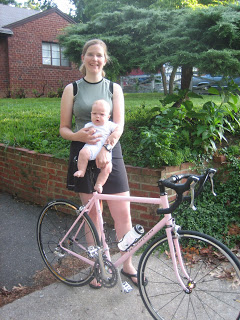
Elizabeth Kiker, VP League of American Bicyclists, Car-lite Profile
…
Do you have a favorite car-free/car-lite story? (Something that really makes you smile or could possibly encourage others to use a bike instead of a car for transportation?)
“I have so many! Some are from when I went out of my way to ride … like riding to Baltimore to meet friends for lunch (50 miles each way) or riding 10 miles out of the way to meet a colleague and show him how easy it was to ride to work. I do love every commute in the summer—I always try to stop and offer help to cyclists in need. Last week I saw a guy pushing a bike and offered him a tube or air. He said no thanks, that he was close to his hotel, and I rode on. The next day, at the same place (almost) I saw another guy pushing a bike. I stopped to help and he said, “Didn’t I talk to you yesterday?” It was the same guy! He was a tourist in town and had been low on air the previous day and then had a blow-out the next day. Both days he declined my offer of help, but it was fun to chat.”
What are three pieces of advice you would give to someone starting/ considering commuting by bike?
- “You can do it!”
- “Have someone show you a good way to get to work by bicycle — it most likely won’t be the way you drive. “
- “Don’t worry about all the gear — just ride the bike you have and use a backpack, and then buy stuff later.”
…
Continue reading “Elizabeth Kiker, VP League of American Bicyclists, Car-lite Profile”
Fast cars = the need to give blood

Is this a subtle way of suggesting motorists should slow down?