Yes, You Can Move the Needle on Public Support for a Gas Tax Hike

by

gas_tax_graphic.jpgPublic support for increasing the federal gas tax rises if revenues will be spent to combat global warming. Graphic: Mineta Transportation Institute

Last week, USA Today reported rather gleefully that the U.S. gas tax has never been lower. Having remained unchanged at 18.4 cents per gallon since 1993, American drivers are now paying half as much in inflation-adjusted gas taxes, per 1,000 miles driven, as they did in 1975. We can pretty much forget about investing in new and expanded transit systems — or even just holding up our bridges — as long as this is the case.

USA Today also cited a recent national survey by the Mineta Transportation Institute, which pegged public support for a 10-cent gas tax increase at a paltry 23 percent. Thanks to a post from Streetsblog Network member TrailBlog, penned by Steve Schweigerdt of the Rails to Trails Conservancy, we have a more complete — and interesting — picture of what this survey actually revealed. Schweigert reports from a recent panel discussion about the survey:

A couple key points from the survey were that:

  • Linking transportation tax to environmental benefits will increase support, specifically if the tax helps address global warming.
  • Support for gas taxes can be significantly increased with good program design.

The panelists portrayed the gas tax increase as a needed short-term fix, but a restructuring of transportation financing is necessary for long-term investment in the system. William Millar [of the American Public Transit Association] reminded the audience that we shouldn’t assume that the way things are can never change. We spent the last 60 years building the system we have, he said, and we can spend the next 60 building a better system.

You can download the survey results here. Of particular note: Support for the 10-cent gas tax hike rose to 42 percent if the revenue would be spent to reduce global warming. The survey also gauged public opinion on a mileage tax, finding that support increased from 21 percent to 33 percent if the rate would vary according to the fuel efficiency of the vehicle.

Tellingly, Americans seem more willing to tax everything they purchase than to pay for transportation infrastructure by taxing driving: A half-cent national sales tax enjoyed the highest support of all the options given, at 43 percent.

But the big takeaway from the Mineta survey is that a national gas tax hike gains support if you make a strong case for how the revenue will be spent. Should some national political figure come along and deliver a compelling public message that we need to raise the gas tax to invest in cleaner, more efficient transportation, move us away from oil addiction, and keep our existing infrastructure from falling apart, who knows, maybe you could break the 50 percent threshold.

Of course, seeing as how most Americans mistakenly already think the gas tax goes up regularly, and gas prices have fluctuated within a 24-cent range in just the last three months, you could also reach the conclusion espoused in this classic Infrastructurist post: Just raise the g-dd-mned gas tax already.

Continue reading “Yes, You Can Move the Needle on Public Support for a Gas Tax Hike”

The Return of the Bicycle

By Lester R. Brown
The bicycle has many attractions as a form of personal transportation. It alleviates congestion, lowers air pollution, reduces obesity, increases physical fitness, does not emit climate-disrupting carbon dioxide, and is priced within the reach of the billions of people who cannot afford a car. Bicycles increase mobility while reducing congestion and the area of land paved over. Six bicycles can typically fit into the road space used by one car. For parking, the advantage is even greater, with 20 bicycles occupying the space required to park a car.
Few methods of reducing carbon emissions are as effective as substituting a bicycle for a car on short trips. A bicycle is a marvel of engineering efficiency, one where an investment in 22 pounds of metal and rubber boosts the efficiency of individual mobility by a factor of three. On my bike I estimate that I get easily 7 miles per potato. An automobile, which requires at least a ton of material to transport one person, is extraordinarily inefficient by comparison.
The bicycle is not only a flexible means of transportation; it is ideal in restoring a balance between caloric intake and expenditure. Regular exercise of the sort provided by cycling to work reduces cardiovascular disease, osteoporosis, and arthritis, and it strengthens the immune system.
World bicycle production, averaging 94 million per year from 1990 to 2002, climbed to 130 million in 2007, far outstripping automobile production of 70 million. Bicycle sales in some markets are surging as governments devise a myriad of incentives to encourage bicycle use. For example, in 2009 the Italian government began a hefty incentive program to encourage the purchase of bicycles or electric bikes in order to improve urban air quality and reduce the number of cars on the road. The direct payments will cover up to 30 percent of the cost of the bicycle.
(more)
Continue reading “The Return of the Bicycle”

PSA: How To Bike Commute On A 100+ Degree Day

by

I was going to post about my 4th of July road trip with the LHT but that’ll wait until tomorrow. It was already 92 degrees when I biked in this morning and I think that warrants a public service announcement.

image

I think the most common question people have when they learn I commute by bike everyday is, “Do you have a shower at work?”. It doesn’t matter if we’re talking summer heat or winter freeze, most people think that having a shower at work is the only way bike commuting can work. It dawned on my this morning while pushing through the heat that not having a shower in the office is stopping a lot of people from even considering the bike as a way to get to work.

I don’t want a shower at work, it would make the process of biking to work longer and more tedious. Taking a shower is an important element of bike commuting in the summer heat but take it before the ride, not after. The best way I’ve found to manage the DC summer is to take a shower right before I leave the house.

If you are a burning hot when you get to work and take a quick shower odds are you’ll start sweating again the second you step out to dry yourself off. Your sweat isn’t what cools you down, it’s that sweat evaporating that does the trick so when you get to work all sweaty find a fan, a big ass fan.

image

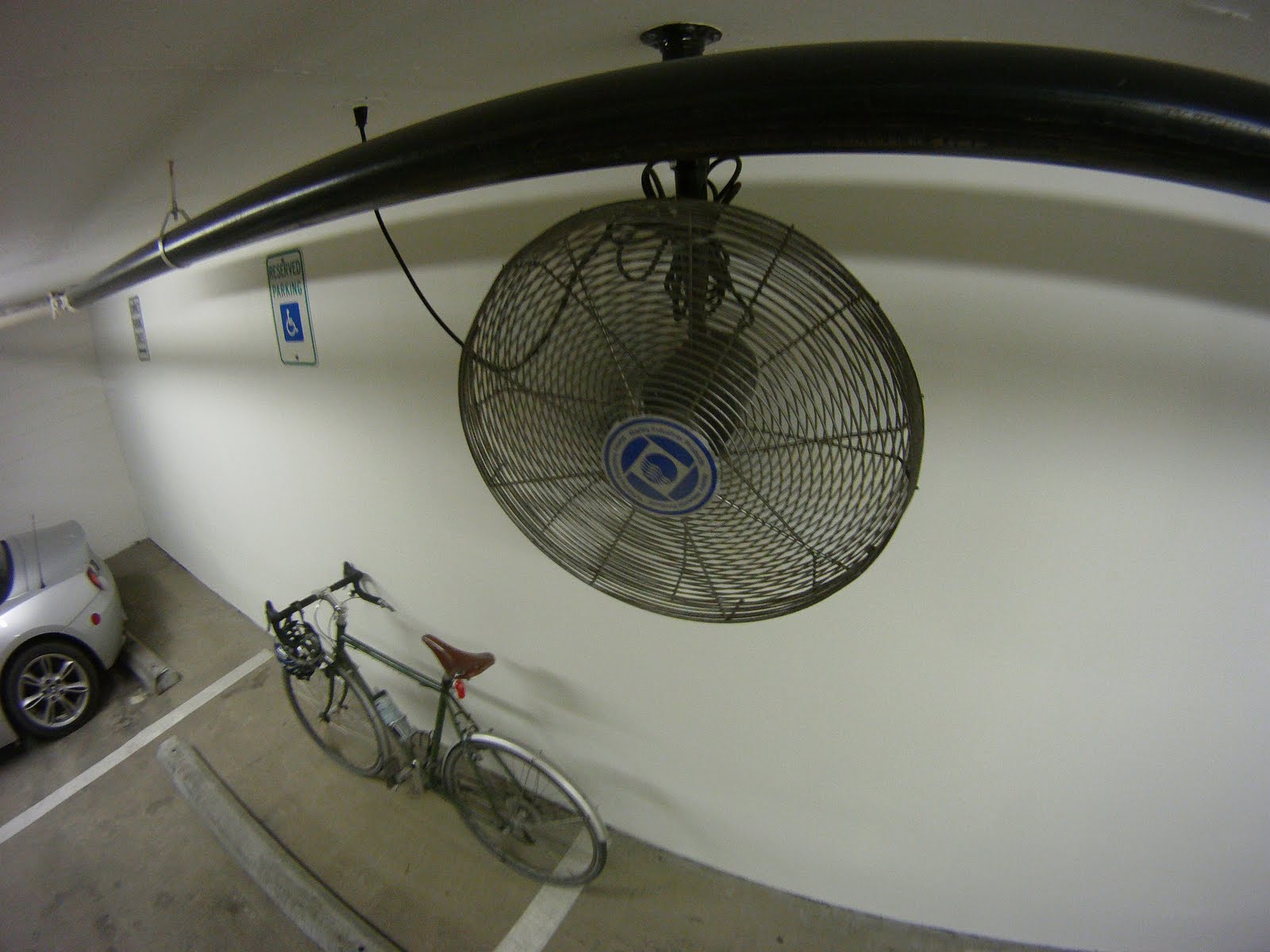
This BAF circulates the air in the parking garage under my building. It’s never on but I can plug it in when I need it. Three minutes in front of this with my shirt held open cools me down enough to enter the building. If  I’m still hot after changing in the bathroom I head to my desk where i have a stick of deodorant and a small fan waiting. After about 10 minutes I have to turn the fan off because I get too cold. If you can’t find a BAF try two small ones at your desk, you’ll be surprised at how effective they are.

All that an no shower! It’s a quick process and because I took a shower right before leaving the house I’m relatively clean.  

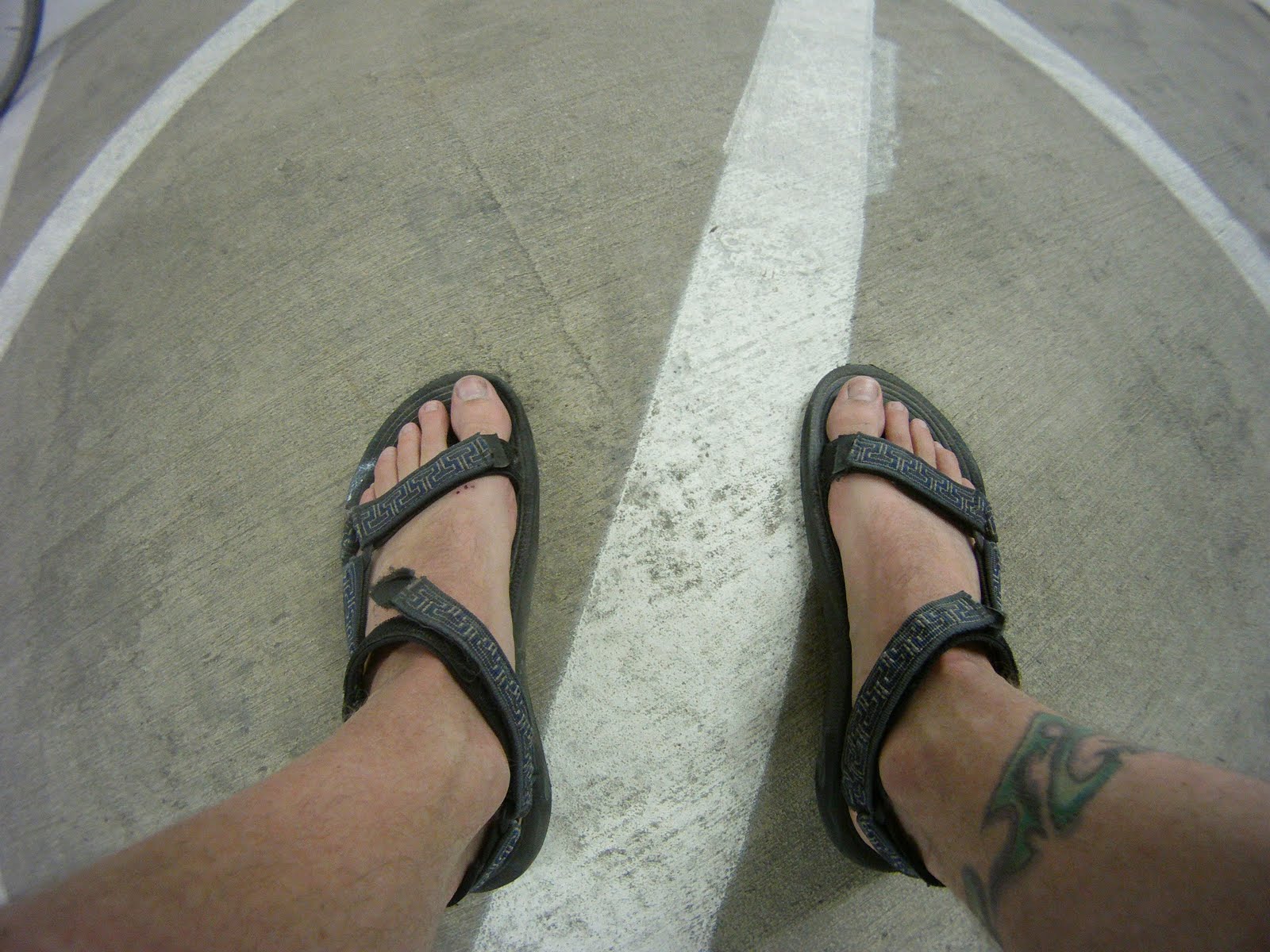
Another way to beat the heat is to wear sandals on your ride. Last fall I switched to platform pedals on the LHT (yeah you know me). In the winter I wear my boots, in the summer I’ve started wearing my Tevas. They’re not ideal for long rides but they are fine for a commute and they keep my feet nice and cool.

image

Now I know that everybody’s physiology is different, some of us are sweaty pigs that stink like a barnyard after a ride. Just give it a try, modify your routine until it works for you. Asking your coworkers to let you know if you smell of barnyard isn’t a bad idea either.

Got a good hot weather commuting technique? Please share it with the rest of the class.

Continue reading “PSA: How To Bike Commute On A 100+ Degree Day”

Calvert County Police Bar Patrol on Bikes?

DISORDERLY: Dep. J. Norton arrested Dorothy Irene Emerson, 41 of Chesapeake Beach and charged her with disorderly after she refused to leave the parking lot outside the Crooked I Bar in North Beach on July 5 at 12:51 a.m. She became disorderly and pushed over a bicycle belonging to the Calvert County Sheriff’s Office, causing $400 in damage. She was charged with disorderly conduct, failure to obey a lawful order and malicious destruction of property.
Continue reading “Calvert County Police Bar Patrol on Bikes?”

The Freedom to Not Drive

by Ben Fried

Automakers have been equating cars to “the national theme of freedom” for the better part of a century, so I think advocates for sustainable transportation and livable streets are well-served by flipping that argument on its head, as Carlson suggests. It’s not a tortured line of reasoning by any means. Generations of car-centric planning have, after all, yoked Americans to a transportation system that constrains the most basic elements of our lives — our time, our health, our finances, our ability to socialize with friends and neighbors.
In addition to liberating people from hellish commutes, as Carlson describes, reducing car-dependence means freedom from spending more and more of our household budgets on transportation; freedom from sedentary lifestyles that are contributing to skyrocketing rates of obesity and diabetes; freedom from worrying about the safety of walking or biking. Freedom, eventually, from having to extract and use oil in ways that pose catastrophic risks to the environment.

Continue reading “The Freedom to Not Drive”

NYC Children Die from Injuries at Half the National Rate

June 29, 2010 – Children in New York City die from injuries at half the national rate, according to a new report from the Health Department. From 2001 to 2008, the city recorded 4.2 injury deaths each year for every 100,000 children between 1 and 12 years old. The national rate was 8.9 deaths per 100,000 children. The city’s advantage stems mainly from a lower risk of transportation-related fatalities. Children die in traffic accidents in New York City at less than one third the national rate, due to New Yorkers’ high reliance on public transportation. …
Continue reading “NYC Children Die from Injuries at Half the National Rate”

Gas taxes give us a break at the pump

By Dennis Cauchon, USA TODAY

When drivers hit the road in large numbers for the Fourth of July holiday, they will have something extra to celebrate — the lowest gasoline taxes since the early days of the automobile.

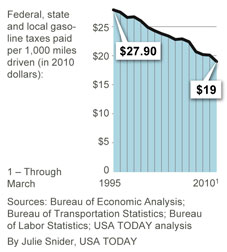
Holiday drivers will pay less than ever at the pump for upkeep of the nation’s roads — just $19 in gas taxes for every 1,000 miles driven, a USA TODAY analysis finds. That’s a new low in inflation-adjusted dollars, half what drivers paid in 1975.

Another measure of the trend: Americans spent just 46 cents on gas taxes for every $100 of income in the first quarter of 2010. That’s the lowest rate since the government began keeping track in 1929. By comparison, Americans spent $1.18 in 1970 on gas taxes out of every $100 earned.

Although the federal gas tax — 18.4 cents per gallon — hasn’t changed since 1993, tax collections are down because today’s vehicles go farther on a gallon of gas, cutting tax collections while increasing wear and tear on highways. Inflation since 1993 has eroded the value of the tax to maintain roads.

“The gas tax isn’t going to work as the user fee to finance the highway system in the 21st century,” says Robert Poole, transportation policy director at the free-market Reason Foundation.


image
Continue reading “Gas taxes give us a break at the pump”

Independence Day on the Gunpowder Trail

by
Bent Lorentzen
(c)1994, 2010, Bent Lorentzen & Baltimore Sun – All Rights Reserved

Thousands of Baltimoreans escaped the city heat to enjoy a different kind of Independence Day. Built up over an old railroad bed, the Northern Central Railroad Trail offers the cyclist and hiker easy access to one of Maryland’s most historic and pristine state parks. I asked many who walked, cycled or live along the trail what being here on the Fourth meant to them.
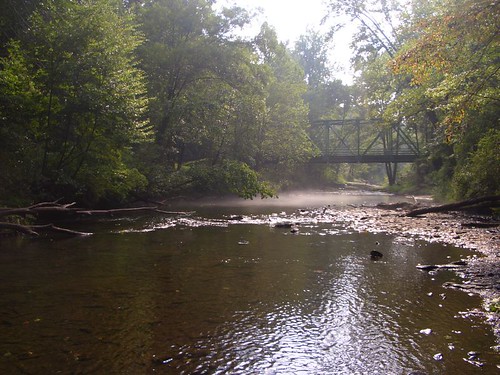


Gunpowder River, looking up to RR trail of park

It is curious to know that though construction impacts heavily locally, on the trail you are completely insulated from this. You can almost see the Native Americans who walked and traded along the misty river for thousands of years, or Maryland’s freedom fighters as they campaigned here to gain independence, or sadly, to hear the whistle of Lincoln’s final train ride, as his body was returned to Illinois. He’d taken this same train ride to deliver his address in Gettysburg.

The trail begins in Ashland, and on Sunday morning, the Fourth, mist from the Loch Raven Reservoir and the Gunpowder River hung heavy in the air. Bicycling into Sparks, shafts of sunlight have begun to pierce the green canopy and mist. Passing Glencoe, once a resort village for Baltimore’s affluent (circa 1880), the ivy shrouded rocks silently tell the story of those who carved out this railroad.

Emerging from a dark, misty overhang of trees, I came upon a startling view from a bridge. Below spread a farmfield of parked cars.

“It started as a wedding party,” said Richard Hyatt, who had walked up from below, “and has evolved into an annual gig. They call it ‘Kool-Aid.’ I came last night with a friend from D.C. and partied all night long, listening to a neat group, the Oxymorons, on an outdoor grandstand. We all brought along some food for the homeless. Part of the admission fee, I guess, goes to the homeless too. I guess that’s how the Fourth and this park relates to me.”

I cycled down to an ancient stone house, barn and several hundred people sleeping in a tent village or out in the open around a smoldering campfire. “Come back later this afternoon and talk with ‘Stan’,” someone suggested.

https://media-files.gather.com/images/d696/d430/d746/d224/d96/f3/full.jpg
Sergeant Dave Davis, chief park ranger, ministering to Annie, the dog hit by careless driver

Cycling north, I entered the Monkton Train Station, now the park’s headquarters and museum. While there, Sergeant Dave Davis, chief park ranger, rushed to help a dog hit by a motorist. With thick but tender hands, he gently scooped up the paralyzed dog and set it in his truck to take it to the vet.

“Annie,” the dog, was doing okay at the vet’s, I was told later.

“That’s the Fourth to me,” said the ranger later while arranging several flags along his station. “I’ve had to dispatch deer who’ve been hit by cars, and it’s sad, so to be able to help an animal into recovery makes my day. Come on by later… we’ll be having watermelon. And there’s a nature walk at eleven.”

John Welling, a Towson State University student interning as the Station attendant, said, “I love this park especially on the Fourth. It’s like a part of me now. I love telling people how this area used to bustle with the railroad traffic from the Calvert Street Station in Baltimore to the Sunburg and Harrisburg area of Pennsylvania….”

https://media-files.gather.com/images/d693/d430/d746/d224/d96/f3/full.jpg
Sands & Wantz family, by Monkton Train (ranger) Station

A two-family group descended on the station in bicycles with training wheels and high-tech ATBs. James Sands, father of three, said, “Coming here for the Fourth was a convenient thing to do for the whole family without argument–” His young daughter shuffled uncomfortably. “Well,” he admitted, “almost everyone.”

Judith Wantz, mother of three girls, said, “It’s a nice family trail. My husband is going all the way to Pennsylvania. We’ll be picnicking half way there sometime. Whenever they,” and she gave her brood a nod, “get tired.”

“Mom!” cried out little Melissa Wantz.

“Oh yes,” said Judith. “Tell the man what your job is.”

“I push,” she said matter-of-factly.

“Push?” I asked.

Smiling her mother said, “She means, she helps her daddy along by pushing him.”

“How old are you?” I asked.

She slowly unfurled four fingers.

Traveling north again and passing the crumbling relics to the old gunpowder-related industry, I come behind a beautiful Arabian mare.

https://media-files.gather.com/images/d695/d430/d746/d224/d96/f3/full.jpg
Barbara Marcus with Mellodi

States Barbara Marcus of White Hall as we stopped: “For me to ride Mellodi–that’s two Ls and an i–on this trail on the Fourth is a part of my every day life as an artist. I come here not only to work out and exercise my horse, but also to find painting inspirations. There’s something about the early morning lighting here… haunting shafts of light…”

I was now following the smaller, Little Falls River, which empties into the Gunpowder. In White Hall, rose a landscaped rock where Old Glory hung limp in the late morning heat.

https://media-files.gather.com/images/d700/d430/d746/d224/d96/f3/full.jpg
Gene Stiffler

Gene Stiffler, the property’s owner, squinted his eyes, then said, “Well, I usually work on the Fourth–“

“He means, around the house or on the grounds,” said his camera-shy sister.

“Err, yup. –Haven’t decided what I’ll do today. Kind’a early yet. Might look for some seasonal music and play it for the
folk on the trail… Can’t find too much of that patriotic stuff, though–“

“That’s because you like Bluegrass…” said his sister.

“How long have you lived here?” I asked.

“Been around here since , oh, 1964. The house here was built in 1898.”

“Do you like being so close to the trail?” I asked.

“It has its advantages and disadvantages,” he said. “It’s convenient for my bicycling and you meet the nicest people. But some people trespass, or their dogs run loose in my yard. I’d like for the DNR to definitely enforce some of the leash laws on the trail.” He smiled reflectively: “But there’s no rowdy people to speak of on the trail. It’s just that late at night… bikers talking to each other kind’a spook the night quiet.”

“Sunday mornings, too,” complained his sister.

“Yup. Sunday mornings is a nice time for quiet. But I’m glad the trail is here, especially on the Fourth, so I can show off my garden and flag.”

The trail was now busy with cyclists, joggers and picnickers. Just south of Parkton, Little Falls cascades into a large pool from an overlook with picnic tables.

https://media-files.gather.com/images/d728/d430/d746/d224/d96/f3/full.jpg
Beetree Run beaver colony

Parkton once served as the northernmost point of the Baltimore commuter line. About a half mile north of Parkton, the trail leaves the Little Falls River and follows Beetree Run, a prime trout fishing stream. It also boasts an active beaver colony. The nearby Bently Springs once served as a health resort. Here also, blackberries and raspberries hang heavy.

The trail begins to ascend more steeply. To the seasoned cyclist, this slope feels absolutely flat. To a child who has been cycling for ten miles, it might be murder.

Freeland is the last outpost before the Mason-Dixie line. Crossing Freeland Road, I asked a pair of brightly attired cyclists how far I was from Pennsylvania.

“A little over a mile,” said the one in orange and black spandex.

“And it’s all uphill,” said the lady in red.

“But it feels great coming down,” said the other.

I found it a relaxing climb, with ever more dairy farms coming into view among gently rolling hills.

At the state line the trail instantly changed into a horrible bed of rocks for a hundred yards, then into complete disarray, and seemed to disappear into the local farming scene.

Back in Freedom I stopped at the FLOWER CAFE, on the west bank of the Beetree. Vera Simmons, proprietor, said, “For the sake of thirsty hikers and bicyclists, the Fourth for me means we’re open…

“We came to this area twelve years ago,” she continued, “to be a part of something more peaceful than what we had before. Now I feel I’m a permanent fixture of the trail.”

Sitting beneath the shade listening to the stream, a forty-something couple dismounted and sat beside me. “Well,” said Philip Gillum, “we’re here on the trail for the Fourth because…” he paused.

Bonnie Dunn, smiled as she said, “It’s because we weren’t invited anywhere…”

“We do it every Sunday,” he said.

“Too bad it doesn’t keep going in Pennsylvania,” she reflected.

“Yeah,” he said. “I hear it’s because the farmers up there have been farming the railroad property for so long now that they don’t want to part with it.”

https://media-files.gather.com/images/d692/d430/d746/d224/d96/f3/full.jpg
Accident scene in Parkton, after arrival of ambulance

Southbound, I come upon a cycling accident in Parkton. A woman bleeding from the head was surrounded by cyclists.

A young girl approached and said, “That’s my mommy over there.”

“The one who got hit?” I asked.

“She didn’t get hit!” she said like I was supposed to know absolutely everything. “She ran into that pole… Anyways, that’s not my mommy. My mom’s helping the girl. My mommy is a doctor.”

“Do you like being here on the Fourth?” I asked her.

“Yeah… but now my mommy’s working.”

Back in Monkton, Sergeant Davis motioned me over to a flag-adorned table full of cold, sliced watermelon. “Dig in,” he said heartily. “It’s free.”

Suddenly, he sprang up and lectured a cyclist who failed to walk his bike across Monkton Road. After the warning had sunk in, he said, “Want some melon?”

I returned to the Kool-Aid fest along the Gunpowder to interview the landowner. Sporting a distinguished salt-and-pepper beard, Stan Dorman explained: “This all started as a wedding anniversary eight years ago in D.C. Somehow it grew–“

Tim McGuinnis of D.C., continued: “We’re all friends of friends of family. Last year there was two hundred–“

“And this year,” said Stan, “it grew to five hundred.”

“That’s too many,” reflected Tim.

Stan nodded in agreement but said, “But you know, when these people leave here, the farm is spotless. These are a remarkably responsible group of people. And we want to keep it that way. We had many kegs of beer, lots of good partying. There’s a river over there where we tube, and the live music… We didn’t have one brawl.”

“It’s not open to the public,” explained Tim.

“So don’t reveal our location, please,” stated Stan.

“What’s this I hear about helping the homeless?” I asked.

“Together with the groom, I’m in charge of the donations thing,” said Tim. “We decided to have lots of fun while also helping our fellow man. The food will go to the Capitol or Baltimore food bank.”

“That’s the Fourth for us,” said Stan. Proudly, he pointed to his home. “That was built in 1857… I’ve been here for seventeen years, and enjoy my proximity to the Trail.”

Southbound, near Phoenix, I come upon a young couple with a child sitting in the water who were gently talking. The scene was ever so peaceful…  ever so Biblical.

Thus I left the trail and headed for the hustle and bustle of the hot city with a warm feeling about America stirring in my heart.

https://media-files.gather.com/images/d727/d430/d746/d224/d96/f3/full.jpg
Danish writer, cultural anthropologist, Bent Lorentzen, exploring America’s backwoods society by bicycle many years ago

Continue reading “Independence Day on the Gunpowder Trail”