‘Zero-tolerance’ policy to be evaluated

Police will evaluate the weekend’s "zero-tolerance" trial policy on speed before deciding to extend it or apply it again.

All drivers caught travelling more than 4km/h over the posted permanent speed limit were to be ticketed over Queen’s Birthday weekend, which saw only one death on the roads – the lowest road toll for a holiday weekend in over 50 years.

"One death on the road is one death too many but it’s a hell of a lot better than 10 so that’s a good thing."

Ms Rose said drivers took up the challenge and self-policed their own speed, which was the aim of the blitz.

"We don’t want to catch people, we want people to choose to do the right thing. On this weekend we have had a lot of people making some really good choices."

Continue reading “‘Zero-tolerance’ policy to be evaluated”

Baltimore area bike trails: Patapsco Valley State Park is a challenge

[B’ Spokes: Note there is flat paved trails in the park as well, something for every one.]
*******************************************************************
Via Washington Post:
Detailed maps available at: The Avalon area visitor center close to the park entrance near South Street and Route 1.
Mountain biking is not for the faint of heart, and that’s exactly why serious mountain bikers love it. Rocketing down hills, bouncing over rocks and roots, and splashing through streams all have a certain danger — and therefore thrill.
Trails in Patapsco Valley State Park deliver on that thrill. Park in the lot on River Road near the swinging bridge. The blue-blazed trail head for the Cascade Falls trail is across from the bridge.
The trail is so steep and rocky that you must walk your bike the 0.1 mile to where it meets the orange-blazed Ridge Trail. Cascade Falls is an incredibly popular trail and for good reason: There are lovely views of waterfalls coming down the mountain. Get to the park as early as you can to have this picturesque scene to yourself.
The ride really begins on the appropriately named Ridge Trail. It is extremely rocky and hilly, and it will challenge even experienced riders. After a mile you get to the Connector Trail, which will take you to the yellow-blazed Morning Choice Trail, which is considerably smoother and flatter than Ridge and Cascade Falls. There are still some challenging hills, but for the most part you can slow down and enjoy the bright green spring foliage.
After about another mile, you will see the familiar blue blazes of Cascade Falls. This last mile is a favorite of mountain bikers because it is not so difficult as Ridge, but more challenging than Morning Choice. The loop brings you back to the parking lot.
Before leaving, be sure to take a walk on the swinging bridge. If you’re lucky, that wobbly feeling will come only from the bridge — not from your legs.
Continue reading “Baltimore area bike trails: Patapsco Valley State Park is a challenge”

Baltimore Spokes on the net

Occasionally I like to see who sending traffic to the site and return the favor.

BentRiderOnline.com linked to our coverage of helmet cams and has added the following information:

In light of MD state police ignoring the constitution, and spying on citizens with no cause to do so. ACLU has decided to represent the plaintiff.

Investigativevoice.com


Adventure Cycling has named Baltimore Spokes “This Week’s Favorite Blogs”, cool! A person once asked me why I liked biking so much and I said because there is so much to see, and her response; “Like what?” Which brings up this famous quote:

Thanks to the Interstate Highway System, it is now possible to travel from coast to coast without seeing anything. – Charles Kuralt

An adventure of a life time is just a bike ride away.

How Cul-de-Sacs Are Killing Your Community

from INFRASTRUCTURIST by Melissa Lafsky

cul-de-sacs

The Harvard Business Review has a piece this month on research by Lawrence Frank, Bombardier Chair in Sustainable Transportation at the University of British Columbia, on the effects of cul-de-sacs in neighborhoods in King County, Washington. He found that residents in areas with the most interconnected streets travel 26% fewer miles by automobile than those in areas with many cul-de-sacs. Meanwhile, recent studies by Frank and others show that the higher a neighborhood’s overall walkability, the greater the amount of walking and biking— which means a drop in per capita air pollution, fuel use, and body mass index.

The theory behind cul-de-sacs was that they lessened traffic, since they change the primary function of local streets — rather than offering a way to get anywhere, now they simply provide access to private residences. The problem is that this design inherently encourages car use, even for the shortest trips. It also limits the growth of communities and transportation options. Consider the above maps of one-kilometer walks in two different Seattle suburbs — the first, in Woodinville, is all cul-de-sacs that result in a disconnected jumble of streets with no walking or bike paths, while the second, in Ballard, offers an interconnected network of streets that provide easy access to shopping, parks, and other destinations. The argument that cul-de-sacs increase safety because they limit traffic is also misguided — the more empty and desolate a suburban (and often affluent) street is, the more likely crime is to occur. Also, it’s much harder for emergency vehicles to reach these homes if they’re sequestered in the belly of a web of disconnected dead-ends.

As more and more direct evidence piles up that these dead-end developments are doing no one any good, the cul-de-sac tides are beginning to change: Last year, the Virginia legislature passed a law limiting cul-de-sacs in future developments. And if other states see the benefits for VA –  more efficient streets that are cheaper to maintain, as well as other savings from not having to widen arterial roads that otherwise were overburdened by cul-de-sacs — perhaps they’ll follow suit.

Image: Urban Design 4 Health

Continue reading “How Cul-de-Sacs Are Killing Your Community”

Dependence on foreign oil

from TYWKIWDBI by Minnesotastan
* In 1974 with 36.1% of oil from foreign sources, President Richard Nixon said, “At the end of this decade, in the year 1980, the United States will not be dependent on any other country for the energy we need.”
* In 1975 with 36.1% of oil from foreign sources, President Gerald Ford said, “We must reduce oil imports by one million barrels per day by the end of this year and by two million barrels per day by the end of 1977.”
* In 1979 with 40.5% of oil from foreign sources, President Jimmy Carter said, “Beginning this moment, this nation will never use more foreign oil than we did in 1977 – never.”
* In 1981 with 43.6% of oil from foreign sources, President Ronald Reagan said, “While conservation is worthy in itself, the best answer is to try to make us independent of outside sources to the greatest extent possible for our energy.”
* In 1992 with 47.2% of oil from foreign sources, President George Bush said, “When our administration developed our national energy strategy, three principles guided our policy: reducing our dependence on foreign oil…”
* In 1995 with 49.8% of oil from foreign sources, President Bill Clinton said, “The nation’s growing reliance on imports of oil…threatens the nation’s security…[we] will continue efforts to…enhance domestic energy production.”
* In 2006 with 65.5% of oil from foreign sources, President George W. Bush said, “Breakthroughs…will help us reach another great goal: to replace more than 75 percent of our oil imports from the Middle East by 2025.”
* In 2009 with 66.2% of oil from foreign sources, President Barack Obama said, “It will be the policy of my administration to reverse our dependence on foreign oil while building a new energy economy that will create millions of jobs.”
Continue reading “Dependence on foreign oil”

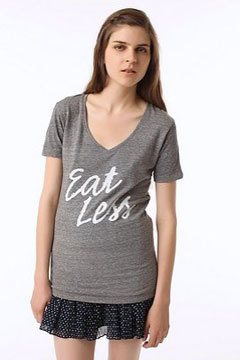
T-Shirt Says to “Eat Less”, I say "Bike More"

from Jay Parkinson + MD + MPH = a doctor in NYC

image

T-Shirt Says to “Eat Less”

So Urbane Outfitters pulled this T-shirt from their stores due to cries from anorexia groups that it sends the wrong message. So let’s look at the numbers:

Prevalence of Anorexia = 1%

Prevalence of Obesity = 35%

Americans eat, on average, 3,790 calories a day. That’s nearly double what we should eat. Know how many calories you should eat. [Note what an active person needs to eat, personally I think they need another column for really active people who average 20+ mile bike rides daily. ;)]

I think it’s safe to assume that the US could stand to “eat less.” In fact, obesity kills more people than smoking. It’s a message the vast majority of us need to implement in our lives. Because remember, the kids today are expected to live a shorter, lower quality life than their parents. And that’s not due to anorexia.

UPDATE: So any time I mention anything on my blog about eating less/obesity, it tends to irk many people. A few people have commented saying “No, the US doesn’t need to eat less, we need to eat healthier.” So here’s the deal. If one person eats 5,000 calories of fast food a day vs. another person who eats 5,000 calories of food from Whole Foods, both will be obese. It’s simple physics. First, ensure you are taking in just the right amount of calories per day. Then, ensure those calories come from healthy, fresh, and whole foods.

I don’t support this t-shirt, but I do support the conversation it brings up. We need to have a real dialogue about this issue of obesity. Our culture doesn’t want to talk about it for fear of offending 35% of the population. But the real issue is, it’s killing 35% of the population. Ignoring the issue won’t help us progress and solve this epidemic. So what does the conversation look like? We desperately need to change our culture and understand that obesity is bad for you, bad for our economy, and bad for the environment. 

UPDATE 2: Why did I post this?

Continue reading “T-Shirt Says to “Eat Less”, I say "Bike More"”

Survey: More support road rules

By Larry Copeland, USA TODAY
Americans strongly support public policies to reduce highway deaths, including some measures that many elected officials consider too restrictive, such as alcohol ignition interlocks and traffic enforcement cameras, a new national survey finds.
The Center for Excellence in Rural Safety at the University of Minnesota found that most Americans support ignition interlocks for those convicted of drunken driving and automated speed enforcement using cameras and radar. Respondents also support sobriety checkpoints, mandatory motorcycle helmet laws, phased-in privileges for new drivers and laws enabling police to ticket drivers solely for not wearing seat belts.

Continue reading “Survey: More support road rules”

Volunteers Wanted

Are you interested in volunteering in a community garden or urban farm? How about a city park or a trail? Would you like to help out with educational or sports programs? There is a perfect opportunity waiting for you with the Parks & People Foundation or with one of our many partners! To find out more, contact us at community.greening@parksandpeople.org or call 410-448-5663 ext. 128.

Commuting 101 : Don’t Have a Shower?

by Bike Shop Girl

One large complaint or worry for beginner bike commuters is the lack of showering, or showing up sweaty to work.  This is a valid worry and shouldn’t be overlooked as your employer, co-worker or client may not appreciate the “biker look.”

Top tips if you don’t have a shower at work

Photo Credit : Fritz
  • Wear wicking clothing. I actually avoid wearing padded shorts in the morning as it creates a “funk” that you can’t avoid.  If my commute is shorter in distance I find a comfortable saddle and wear a stretchy, breathable pair of shorts.  Either a jersey, or tech-t on top, comfortable shoes or maybe my cycling shoes for longer distances.
  • Action Wipes.  No joke, go buy them.  I’m not paid or bribed to say this (I have to say that by law,) but Action Wipes are in all my saddle bags and in my desk at work.  A quick “pocket shower” with Action Wipes and re-installation of deodorant and I’m fresh!
  • Bring extra clothes.  Don’t worry about working up a sweat as you can use your Action Wipes to clean up and then put on all new clean clothes. Also, I am talking to put on a whole new outfit from top to bottom, putting on clean clothes and dirty socks doesn’t give you the same “fresh” feeling.
  • If you may need it, keep a spare at work.  This means everything you can’t do without, because we are talking about clothes currently I will mention those but recommend extra tubes/lube/tools at work too.
  • If all else fails, start stinking in very important meetings and maybe they will install a shower at your work place.

Continue reading “Commuting 101 : Don’t Have a Shower?”

BikePed Beacon — June 2010

image


June 2010 

IN THIS ISSUE
OPEN FOR PUBLIC REVIEW

IMAGINE 2060
SCHOOL STUDY
STREET SMART

IN THE NEWS

NEXT ISSUE

A Regional Bike and Pedestrian Newsflash


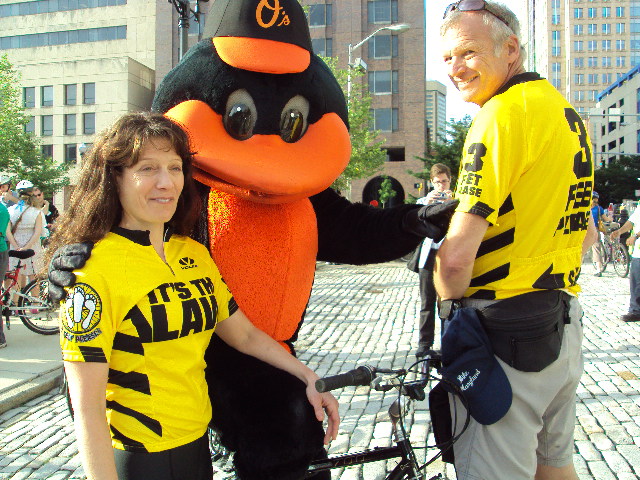
Success!Bike to Work Day (3 feet)

 
Thank you to the 1,320+ riders who came out for Bike to Work Day 2010! 
 
Regional rallies were well attended and enjoyed by over a thousand bicyclists.  Rideshare coordinators, convoy leaders and bike mentors around the region deserve a big congratulations.  Thank you to regional sponsors; MASN, PNC, Pricepoint and RoadID and all the great local sponsors.  A follow-up survey will be sent in a week.
 
Green Zone folding bike prize winners were in Baltimore City, Annapolis and Harford County.  Better World Club membership winners were from APG and Bel Air rallies.  Panera, a loaf of bread a month for a year, winner was from Howard County.  One lucky winner got an October 3rd Tour duPort registration free and three winners are headed to Tour Dem Parks on Sunday June 13th.
 
Don’t forget to become a fan of the facebook page and upload your photos from Bike to Work Day! 
  
Stephanie Yanovitz
BikePed Beacon Editor

Continue reading “BikePed Beacon — June 2010”