
A police officer walks by destroyed bicycles in Rougemont, Quebec, south of the Montreal area Friday, May 14, 2010. Six triathletes on their way by bike to a training weekend at the Université de Sherbrooke were struck by a pick-up truck in the village of Rougemont.
Photograph by: John Kenney, The Gazette
Continue reading “3 cyclists killed, 3 injured in Rougemont”
Transit is in crisis: tell Congress to act!
[B’ Spokes: Across the nation there is a mode shift from cars to mass transit (even bikes) but it seems the funding emphases is the exact opposite, lets take even more money from other things and give it to cars.]
*******************************************************************
Transit agencies across the country are facing budget problems. While transit ridership is stronger than ever, entire routes are at risk, workers are being laid off, and fares are going up. The problem goes beyond local budgets and politics: it’s a crisis of national proportions.
Send a letter to your representatives by using the form below. You can share a link to our transit funding crisis map and call for Congress to act quickly to save transit.
Continue reading “Transit is in crisis: tell Congress to act!”
Vote for Rails-to-Trails
by
American Express is donating a combined $1,000,000 divided among five charities from unique categories. One charity in the running is Rails-to-Trails. Rails-to-Trails has played a key role in the development of several local, region and national trails; including the Capital Crescent Trail and Metropolitan Branch Trail. Right now they are trailing the National Trust for Historic Preservation (another good cause) by a scant margin. If you would like to support Rails-to-Trails and help them secure an extra $200,000 you can vote at takepart.com.
Bike and Roll Used Bikes Sale
by washcycle
It’s this Sunday, May 16th 10am-4pm.
Spring Bike Sale
SUNDAY, MAY 16TH 10 – 4PM
PURCHASE A 2009 RENTAL BIKES FOR AT LEAST 50% OFF!
RECEIVE A CARD GOOD FOR 10% DISCOUNT ON SERVICE & RETAIL
AT OUR NEW LOCATION AT UNION STATION WITH BIKE PURCHASE
CASH ONLY. ALL SALES FINAL.
12th St NW between Pennsylvania and Constitution Ave
Rear plaza of the Old Post Office Pavilion
• 202-842-BIKE (2453) • www.bikethesites.com •
Also for sale:
24” kids bikes for $160
20” kids bikes for $120
20” & 24” trailer tandems for $100
Sale price $220
Retail price $440
You save $220
2009 TREK 7100
Sale price $100 Retail price $320
You save $220
2009 TREK Classic Cruiser
BALTIMORE BIKE MAP
by Nate
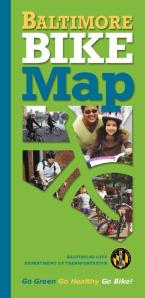 After years of demand and years in the making, the first Baltimore Bike Map is here! This map shows the city’s bike infrastructure (both existing and soon to be completed) as well as routes commonly used by cyclists. The flip side is packed with information on safe cycling techniques, securing your bike and using your bike with transit.
Free maps are available from Baltimore Department of Transportation (410-396-6856) and pdfs will be available soon on the Bike Baltimore website (www.baltimorecity.gov/bike)
Within the coming weeks, we’ll have this map on its own Google Maps page where the public will be able to comment: where do you ride, where are bike improvements needed, etc.
Big Thanks go out to
Victor Miranda for all the cartographics!
Paula Simon at Highmeadow Design for the overall design and artwork!
Toole Design Group for the proofing and odds & ends!
Bike Infrastructure Where You Live
by Sarah Goodyear
 This path on New York’s Randall’s Island gives cyclists plenty of space. (Photo: Bicycles Only)
Get ready for another Streetsblog Network slide show.
This time, in honor of National Bike Month, we’re looking for pictures of bicycle infrastructure that you love. Lanes, trails, paths, signs, signals, parking, you name it — we want to see the best examples from all over the country.
We know there’s a lot of innovative stuff being built out there, and we’re counting on you to show us something we haven’t seen before, or just something that you’re particularly fond of.
You can send me JPEGs at sarah [at] streetsblog [dot] org, or tag your photos “streetsblog infrastructure” in Flickr. Please include caption information and let us know how you’d like to be credited. Get your photos to us by the afternoon of Friday, May 21.
To see a couple of examples of past user-generated slide shows, check out this one of work bikes, or this one of space hogs (those would be cars).
The Fallacy of Speed and Emergency Response
[B’ Spokes: note that sometimes emergency response time is used to to keep residential neighborhoods car centric and bike unfriendly.]
by Tom Vanderbilt
One of the oft-cited complaints about any sort of traffic calming treatment (speed bumps, narrowing streets, etc. etc.) is ‘what about emergency response?’ This has become something of a knee-jerk response, and it’s said with such seeming authority that it seems impolite, at the very least, to question it, even if it means we allow our local streets to become a source of daily unpleasantness and danger to accommodate what are statistically very rare needs (and there has been some good work on so-called “emergency response friendly” traffic calming).
After all, what individual, when questioned, wouldn’t intuitively want to be whisked to the hospital as fast as possible, or have fire crews sent racing to their house with minimal delay? I began thinking differently on this topic after meeting Nadine Levick at a traffic conference last fall. Over lunch, Nadine, a tireless crusader on a subject outside of most people’s purview, noted to me, according to one survey, riding in an ambulance, per mile, was one of the most dangerous things a person can do. And not simply because of, as you might imagine, clueless drivers not noticing an ambulance blazing through an intersection — but often because of unsafe actions by drivers themselves, as well as alarmingly substandard ambulance design (ambulances are not regulated by NHTSA for the crash protection of the occupants in the back; she’s got loads of horrific slides of the “boxes” having flown off the vehicle in a crash, and I’d urge you to otherwise delve into the site). The underlying sense I got from her was that of a sort of macho heroic undertone to emergency response, albeit shot through with the best of intentions, to get to or from the emergency with greatest possible haste — damn the consequences.
In any case, I thought of this again today thanks to an excellent article at Slate, by two medical personnel, that points out something that Levick was getting it: Despite the notion we may have that lives are at stake and a delay of a few minutes will be the crucial difference (isn’t it better for the speeding up to happen at the hospital end, or to work on better preventative and monitoring measures?), it turns out, as the authors note, “not to be backed up by good science’; and, what’s more, as they note, the risks taken in fast transport (to those outside the vehicle as well) may exceed whatever medical benefits are gained.
Continue reading “The Fallacy of Speed and Emergency Response”
The Great Bicycle Tour of the C&O Canal
Date: Saturday July 10, 2010 to Tuesday July 13, 2010
Location: Boonsboro, MD
Type of Event: Touring
The Great Bicycle Tour of the C&O Canal (TGBT) will be held Saturday, July 10 through Tuesday, July 13. Nearly 80 riders have already registered for San Mar’s July 10-13 ride along the length of the 186-mile C&O Canal—beginning in Cumberland, MD and ending in Georgetown, District of Columbia. Ride capacity is 150.
The ride is fully supported. Riders, their bikes and gear are transported from San Mar Children’s Home in Boonsboro to Cumberland for the start of the ride through the country’s longest National Park. Four days later they will be transported from the end of the ride in Georgetown back to San Mar.
In between, riders are treated to one of the premier rides in the East with overnight stops in Hancock, Williamsport, and Frederick. Community groups, including the Cumberland Rotary Club, and Lions Clubs from Hancock, Hagerstown and Boonsboro help along the way. Members of the groups provide rest and lunch stops for the riders.
The Cumberland Valley Cycling Club is a ride sponsor, as are Best Buy, which provides a support truck and driver and Wheelbase Bike Shop, Frederick, which sends mechanics along to help throughout the entire tour, and Hagerstown Ford.
Continue reading “The Great Bicycle Tour of the C&O Canal”
The Great Bicyclist Responsibility Debate Continues
by Sarah Goodyear
Today on the Streetsblog Network, Boston Biker takes issue with a recent column in the Boston Globe Sunday Magazine about how people on bicycles need to “earn” respect on the road. In the view of the Globe’s Doug Most, it’s essentially the responsibility of bicyclists to stay out of the way of motor vehicles and to ride with the assumption that they’re invisible.
Here’s what Boston Biker writes about the Globe’s piece:
The subheading of the article is, “After a fatal crash, they want more respect on the road. They need to earn it.” (“They” meaning cyclists.) If everyone is breaking the law why do cyclists need to “earn” respect? Why don’t car drivers and pedestrians have to “earn”
respect?…[T]hat is not how our legal system works. Everyone has the full protection of the law at all times. You don’t lose that protection because you didn’t wear your helmet, you also don’t lose that protection if other people making the same transportation choice you are break the law. Car drivers don’t lose protection and respect because some of them don’t wear seat belts and run red lights, neither do cyclists.
Too often in the mainstream media, cyclists are assumed to be at fault in any conflict between modes. Even when a person on a bike is following all the rules and is hit and killed by a car, frequently the implication in news coverage is that the bicycle rider was somehow “asking for it,” simply because he or she was daring to ride a bike. And riding a bike shouldn’t be something you need to dare to do.
There’s nothing wrong with defensive riding. And there’s no question that many people on bicycles break the law in dangerous ways. But as bicycle use increases around the country, there is a real need for balanced discussion of the ways that pedestrians, bicyclists and drivers interact in traffic. That means recognizing that all road users should respect each other. It’s all well and good for bicyclists to see themselves as ambassadors (that’s how I personally choose to ride). But they should be allowed to be just people, as well, like the members of any minority.
Related: Ditching the Car for 40 Days has a rundown of all the scary ways drivers pass bicyclists on the road.
…
Continue reading “The Great Bicyclist Responsibility Debate Continues”
Family member of bicycle crash victim responds
by Michael Dresser
My Getting There column last Monday in the print edition of The Sun, concerning the need to respect the rights of bicyclists on the road, received one of the strongest responses since the column began.
Many were from motorists who vigorously disagreed and who essentially pointted to bicyclists as miscreants who needllessly clog the roadways. But other, more favorable responses came from bicyclists and from the family members of bicyclists who were killed in collisions with motor vehicles.
Here’s one email, from Fran Leonard of Elkridge, that I though was worth passing on:
Thank you for your article ‘Sharing the road with bicycles is hardly a hardship’. My children’s father/step father was struck and KILLED by a driver of a four wheeled vehicle on May 4th, 2006 and died the next day. He was KILLED by someone who has never been caught or punished for this CRIME. SHAME on the people who feel riding a bike is inferior to them driving a car, van, truck or whatever other thing it is they drive. They have no respect for others much less themselves or else they would be more considerate. They are bigoted, self righteous people who think only of themselves. Our grandchildren will never know the love and compassion he had for his family and others. He never hurt anyone and he surely didn’t deserve to die that way. The person/persons who ran him down had to have known they hit someone or something didn’t even stop, if they had he may still be alive today. It doesn’t matter why bicyclist ride on bikes, whether it’s to go to work, out of need, pleasure or a Lance Armstrong wantabe. They deserve to be on the road as much as anyone else.
Continue reading “Family member of bicycle crash victim responds”