Safe Passage Needed for Pedestrians & Cyclists

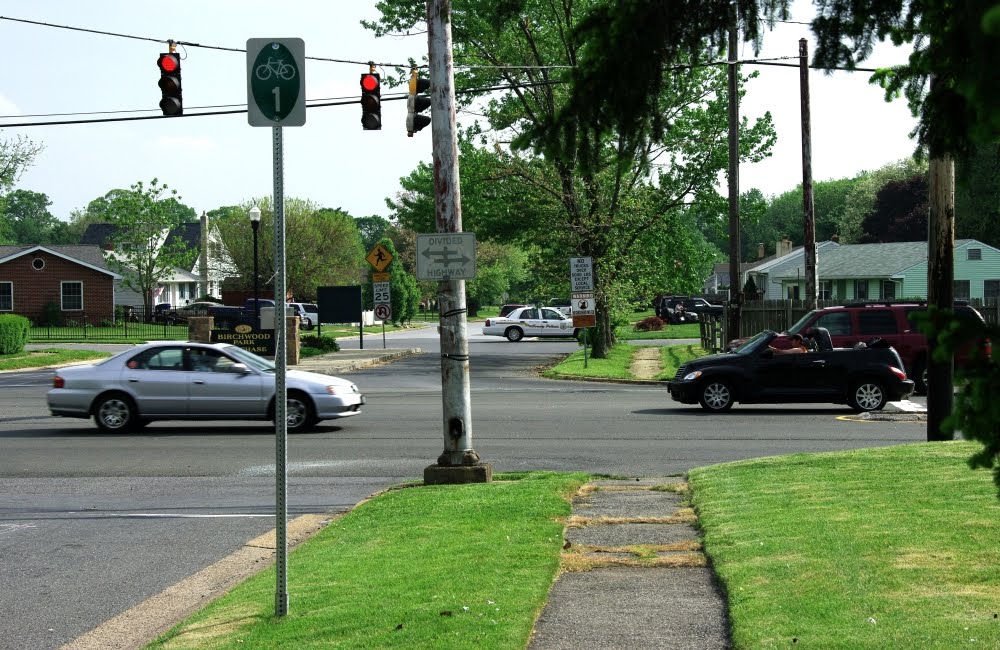
The intersection at 273 and Brownleaf Road in Newark, Delaware is a dangerous intersection for pedestrians and bicyclists.  A bicycle is not able to trip the traffic sensor, nor is there a pedestrian crosswalk and signal to allow safe passage on this major Newark arterial road.  This is particularly troubling to many cyclists since Brownleaf Road is part of the official Delaware bike route.

image
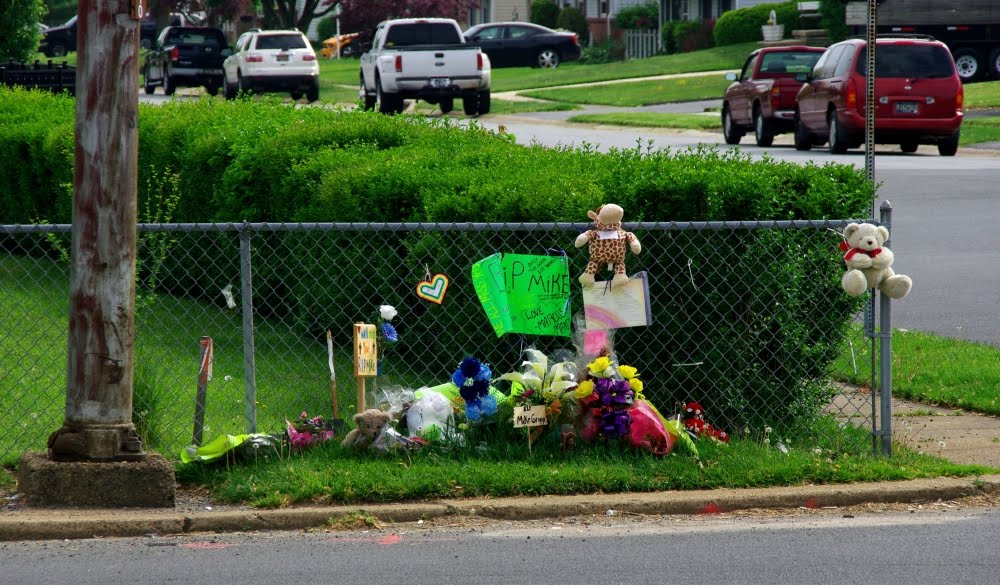
Less than a month ago, a pedestrian, sixteen year old Michael Gropp, was killed at this intersection by a speeding car that ran a red light.
image
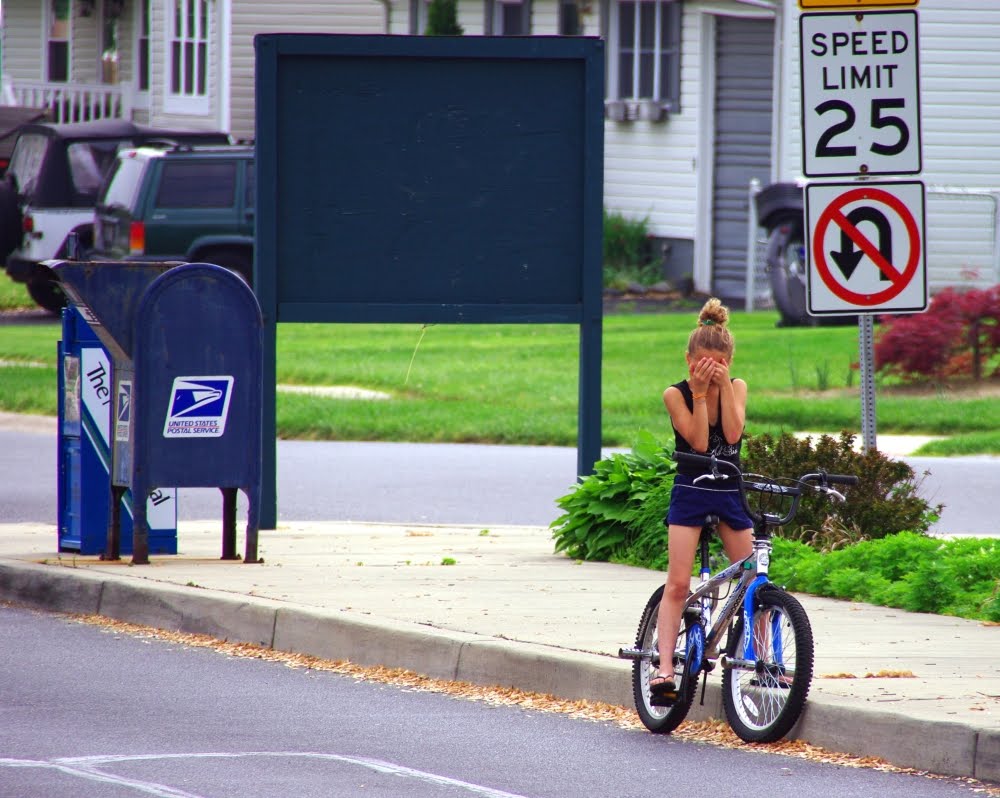
Today, on a Sunday afternoon, a little girl waits in frustration and the 85 degree heat for a car to come along to trip the traffic signal.  She waits in vain for quite some time.
image

Continue reading “Safe Passage Needed for Pedestrians & Cyclists”

Penn Ave. Bike Lanes: AAA is crushing us

In a couple of stories about the new Pennsylvania Ave NW bike lanes that are opening this week one thing is clear: AAA is kicking our asses. Seriously, how are they able to get in several unsubstantiated, anti-bike facility quotes while neither Fox nor News8 even interviews WABA? The Fox article is like an advocacy piece for them.

Two new bicycle lanes have opened up on Pennsylvania Avenue this
weekend. However, AAA claims adding more lanes could make D.C. traffic
worse than it already is. AAA is also concerned about a plan to add bike
lanes to four other major streets.

I’d like AAA to produce at least one study showing a negative link between bike lanes and congestion. I don’t think there is one. I’ve looked. There is a study out of New York that shows that “the only way to prevent crippling congestion, is for more people to
walk, bike, and take public transportation.” Other cities are turning to bike lanes to actually END congestion.

The auto agency believes
those lanes will take away lanes used by cars

So AAA is OK with bike lanes as long as they don’t take away lanes used
by cars. Prepare to be disappointed AAA. 

as well as increase
gridlock.

Maybe this is the writer’s fault – and not AAA’s – but gridlock is absolutely not caused by bicyclists. It’s caused by scofflaw drivers who move into the intersection even though they can’t clear it; and left immobile,  blocking cross-traffic when the light changes. I’ve never seen a cyclist doing this. If gridlock is the problem, cracking down on scofflaw drivers is the solution.

AAA is urging anyone concerned to take part in the public
comment period which ends on May 15.

And then they presented another opinion…no wait, they didn’t. They just added

To publicly comment or leave
feedback on this issue, CLICK
HERE
.

Yes, by all means, please do. 

The News 8 story was longer, but no better.

While some drivers didn’t mind, others were driven crazy by it.

“It’s bad enough with the cabs running you over and you can’t hardly
cross the street!” said Sandra Powell.

Northeast’s Sandra Powell works at the National Archives in downtown
D.C. She says her commute typically takes just under an hour, but she’s
worried her commute time will double because of the bike lanes.

Powell stated, “The people of Washington D.C. should not have to go
through this!”

The only explanation for Powell’s nonsensical responses is that she was literally driven crazy by this. Double her commute time? That seems excessive. She also fails to note that even if there is a negative impact on traffic for some people of Washington, DC, there might be a positive impact on others. 

AAA got in some more choice quotes

“As opposed to doing open heart surgery to open the clogged arteries and
traffic arterials in the city, you clog them even more,” said Townsend. 

I’m not following this analogy. What is sticking to the sides of roads to “clog” them? It isn’t bikes. When traffic is clogged, cyclists are either filtering past cars or choosing not to.

Townsend emphasizes that only 2.5 percent of residents bike to work. 

Which is why we need more bike lanes to encourage more people to bike.

Townsend stated, “They’re taking so much from so many to give to so
few.”

Is he talking about how we subsidize driving? I agree, it’s wrong to take from the majority who don’t drive and give it to the minority that do.

Gabe Klein defended the policy

Klein said, “We’re not gonna cram bike lanes or a cycle track onto a
street that’s already overpopulated with automobiles.”

That might be exactly where we need bike lanes and cycle tracks.

The Examiner joined the pile-on with an anti-bike lane opinion piece in response to Ray LaHood’s defense of bike lanes

I ride the bus to work in D.C. every day, and I’d just like to make an
observation about our bicycle lanes. I usually ride down Georgia Avenue,
which flows well at rush hour right up until you cross Florida Avenue. 
That’s where you lose a lane of traffic to — you guessed it — a bicycle
lane.

Ummm, no. They did not take out a lane of traffic to add those bike lanes (on what is really 7th street). They used the door zone of the parking lane to make those. 

Mind you, it’s entirely possible that people bike in that lane
sometimes, but I’ve never seen it happen.

Ummm, he’s not paying attention. I’ve ridden this road at rush hour and it is a packed with cyclists. I waited at the light once with six other cyclists (and we weren’t riding together or anything). 

What I have seen is the other rush-hour result of the bicycle lane:
Dozens of vehicles idling in the bottle-neck behind too-short traffic
lights and left-turners.

It sounds like the problem is the light cycle and left turns, not bike lanes.

The same can be said for the one-way section of
9th Street downtown from I to E Street, where a dedicated bus and bike
lane (usually empty) contributes to massive, box-blocking backups among
cars headed for the National Mall and the 9th Street Tunnel.

I’m looking to the judges for a ruling on this one…and it’s total BS. Drivers completely ignore these restrictions so if traffic backs up, that isn’t the cause.  Besides, they’re bus/bike lanes. You’re on a bus. Don’t you want those lanes to be empty? As for box-blocking, see my comments on gridlock above.

I would love to see a study of how many extra car-minutes of idling
these largely unused bike paths create.

They’re not bike paths, they don’t cause congestion and the see above for the answer.

Continue reading “Penn Ave. Bike Lanes: AAA is crushing us”

Commentary: Keep Drilling, Stop Driving, Use Oil Wisely


No one can say when the gushing river of oil will stop. But as we watch and ponder this sorry state of affairs, environmentalists will demand loudly that Obama retract his earlier proposal to loosen offshore drilling policy. Perhaps they are right, but like other Americans, most of those same people will likely keep on driving. So I take this moment to urge environmentalists to reflect upon their relationship between oil and driving. We need oil and are lucky as a civilization to be endowed with oil, but most people are squandering this precious resource by driving. We need to use oil more wisely.

Continue reading “Commentary: Keep Drilling, Stop Driving, Use Oil Wisely”

Looking but Not Seeing

from Bikeleague.org Blog by Darren

The bottom line is that drivers talking on cell phones may look at you but not see you. Here’s chilling section of the paper:
Inattention Blindness – Vision is the most important sense we use for safe driving. It’s the source of the majority of information when driving. Yet, drivers using hands-free and handheld cell phones have a tendency to “look at” but not “see” objects. Estimates indicate drivers using cell phones look at but fail to see up to 50 percent of the information in their driving environment. Cognitive distraction contributes to a withdrawal of attention from the visual scene, where all the information the driver sees is not processed. This may be due to…how our brains compensate for receiving too much information by not sending some visual information to the working memory. When this happens, drivers are not aware of the filtered information and cannot act on it.

Continue reading “Looking but Not Seeing”

Sharing the road with bicycles is hardly a hardship

Nobody’s time is so important they can’t look out for the little guy
By Michael Dresser, The Baltimore Sun

There are many dreadful burdens in this cruel life we lead: disease, heartbreak, war, taxes and death. But despite all the anguished cries from drivers who balk at the slightest delay, sharing the roads with bicyclists just doesn’t rank in the same class.

You wouldn’t know that from some of the reactions on the Getting There blog to a recent item about a bill that establishes a buffer between motor vehicles and bicycles. The way some people carry on, you’d think they’d been sentenced to drive at bike speed in perpetuity.

The law that passed the General Assembly is simple enough. It tells the folks in cars and trucks and those testosterone-fueled Dodge Rams to allow 3 feet of distance between their vehicles and the bicyclists they are passing. It’s something drivers should be doing already.

Now the police aren’t going to be out on the streets with magic electronic rulers ticketing folks who come within 2 feet, 11 inches of a bicycle for a nanosecond. But it does give them a statute to rely on if they see some road-raging lunatic buzzing a bicyclist by a few inches. Chances are, most of the tickets under this law will be written after a driver actually clips a bicyclist. Right now, unless the police can show actual intent to injure, there’s not a lot they can do in such cases.

Mostly the law serves to educate. It sets a standard that can be taught in driver’s ed classes. It gives parents a clear-cut rule to pass on to their teens with learners’ permits.

But for some folks, any concession to the safety of bicyclists is a surrender to the forces of two-wheeled evil. Here are a few of the reactions:

I live in a scenic rural area, where cycling groups take weekend fun rides EVERY weekend. The roads have no shoulders and no turn lanes. There are no easy detours — when I run across a bunch of Lance Armstrong wannabes going 25 in a 40 or 50 mph zone, I can’t just ‘turn at the next corner and go around’ them. That will take me a mile or more out of my way.

And there’s this:

I use these roads to go to the grocery store, the doctor’s office, my parents’ house, the hardware store, you name it. I don’t appreciate the packs of city dwellers who drive out here, park their cars, and clog up my neighborhood thoroughfares. I can’t tell you how many times I have been driving at the posted speed and come around a blind corner, only to almost hit a cyclist going less than half the posted speed in the middle of the lane.

And another:

Shame on the State legislature for bowing down to another special interest group. … Bicyclists pay no highway taxes, and should therefore have no more special privileges than pedestrians.

When a bicyclist hears or sees a vehicle approaching, he should pull far off the shoulder to not [impede] traffic. Bicyclists caught in the traffic lanes should be fined.

My reaction: Cry me a river.

It has been more than five years since I last took a bicycle onto a Maryland road, so by now I am firmly in the majority of folks who get around mostly by engine-driven vehicles. But the experience of trying to share the road with speeding drivers tends to stay with you.

For decades now I’ve driven the back roads of Maryland, occasionally coming upon groups of bicyclists pedaling furiously but poking along by gas-driven standards. And at times, on curvy two-lane roads, their presence has actually forced me to slow down — sometimes for more than a minute or two — until the road straightened out and I could pass.

And guess what? There was no permanent damage. Never was an appointment missed or a destination denied. The world kept spinning on its axis.

Here’s a flash for the internal combustion crowd: Bicyclists, even the Lance wannabes who live somewhere else, have a right to be on all roads except for a few high-speed highways. They do not impede traffic; they are an integral part of traffic. It has been thus since the dawn of the auto age. Should bicyclists stay to the right and use the shoulders when they can? Absolutely. But there are times when they have to use the travel lanes and the rest of us just have to learn to share.

Bicyclists may not pay gas taxes, but they pay sales tax on their bikes. The government hits them up in most of the ways it hits up others. Their bikes cause no pollution and almost zero wear to the road system. They don’t require widened highways or significant traffic law enforcement.

They don’t seem to demand much except that other drivers honor their right to safe roads. Even when they ask for a bike path, they’re happy to share it with hikers.

So what harm are they doing?

The rules of the road boil down to an essential principle: The big should look out for the little guy even when the little guy is in the wrong. The tractor-trailer truck driver should defer to the guy in the SUV; the SUV driver should let the woman in the small car merge; the motorist should look out for motorcyclists and bicyclists, who should in turn refrain from running over pedestrians.

Maybe the local clergy could find a sermon topic in this clash between motorized and human-propelled cultures.

How would Jesus drive? Would he buzz bicyclists or counsel us that blessed are the meek of vehicle?

Would the Buddha rage at delay or find good karma in driving gently?

Would Muhammad spur us to vehicular jihad or remind us that Allah prizes mercy over wrath.

Can’t we at least agree that Moses and the authors of the Talmud would tell us to stop kvetching and obey the law already?

With Gov. Martin O’Malley planning to sign the bill, the 3-foot law will take effect Oct. 1. There’s no reason under Heaven to wait until then to comply.
Continue reading “Sharing the road with bicycles is hardly a hardship”

If an oil rich place wants to create more walkable communities, what’s our excuse?

The Abu Dhabi Urban Planning Council (UPC) in February released the Urban Street Design Manual, a 172-page guidebook that outlines design standards to create more walkable communities in Abu Dhabi, the largest and most oil-rich of the seven members of the United Arab Emirates. With its population expected to double to at least three million people by 2030, Abu Dhabi recognizes a need to prepare for a sustainable future, with a focus on transport and urban planning solutions.

Continue reading “If an oil rich place wants to create more walkable communities, what’s our excuse?”

Thoughts on waiting for the bus in the rain

I’ve only hated one thing more than the MTA, and really wishes I didn’t have to rely on these rude, lying pieces of garbage to get to work on time.

If a bus passes my stop 10 minutes early, I shouldn’t have to wait on hold for 15 minutes to be told that "they’re not reporting anything wrong with the 8:15 bus" and that the "bus should be there any minute." Seriously getting my day off to a rotten start sitting on a damp wooden bench waiting for the next bus to come in a half-hour leaving me to wallow in my fury.

– Overheard

Analysis of Google’s Bike-There Feature: Part I

from Streetsblog.net by Utility Cycling

Behind the Scenes — How Google’s Bike Maps Work
The push to get Google to incorporate bike directions into Google Maps has been going strong for quite some time now, but Google reports that adding such directions presented quite the engineering challenge. Google uses a few key features to develop the algorithm that generates a bike route, using the already-existing network of streets in their mapping system, which are summarized below.
1. Bike Trails – These show in dark green when you generate a Bike-There map. Google worked directly with the Rails-to-Trails Conservancy to find as many trails to incorporate as possible. The algorithm is weighted to send cyclists on trails as much as possible, as long as it doesn’t send them too far out of the way.
2. Bike Lanes – Google has information about dedicated bike lanes for 150 U.S. cities, which they used to build into the algorithm. Bike lanes appear on a Bike-There map in bright green, and they are also weighted as a priority in the algorithm.
3. Recommended Routes – These are routes from cities that have information about other good roads for cycling, which may not have an official bike lane. These roads are indicated by a dashed green line in the Bike-There map.
4. Uphill Slopes – In order to avoid hills (because, according to Google, nobody likes riding up hills… though I beg to differ…), Google developed a model that takes into account power (exerted by the cyclist), the slope of the road, wind-resistance, and speed. If the model shows that a given route requires an inordinate amount of exertion (aka too much power required) and will be too slow for time efficiency, Google will send you on an alternate route that avoids the climb. I could not find out what Google defines as “too slow” or “unreasonable degree of exertion”.
5. Downhill slopes – The model will also help cyclists avoid roads with too much downhill or descending, which can be tiring or disconcerting due to the unnecessary amount of braking required.
6. Busy roads – In order to keep cyclists off busy roads, the algorithm basically uses the inverse of the Drive-There algorithm in order to avoid arterials and freeways.
7. Intersections – Lastly, the algorithm avoids busy intersections with heavy traffic (car) and long waits.

Review of Google’s Bike-There Features

Continue reading “Analysis of Google’s Bike-There Feature: Part I”

GPD tracks percent of cars yielding to pedestrians

image
Photo credit: Doug Finger/The Gainesville Sun

Gainesville’s campaign to get drivers to yield for pedestrians is apparently showing results. Signs placed in several locations around town show that more than half of the drivers in the city now yield to pedestrians.


Yielding on Yield
from How We Drive, the Blog of Tom Vanderbilt’s Traffic by Tom Vanderbilt

In New Jersey, you now have to come to a complete stop, rather than simply “yield,” when pedestrians are in the crosswalk.

Why?

New Jersey has one of the highest rates of pedestrian fatalities in the country, with 27 [FARS says 22.9 for NJ] percent of auto fatalities in 2008 involving pedestrians, almost twice the national rate [MD is “only” 19.6% 🙁 I will note our rate per capita is 2.06 vs NJ @ 1.55], according to the National Highway Traffic Safety Administration.

Must be all those jaywalking pedestrians, no? Not quite. Rather drivers, and this will surprise no readers of this blog, seemed to show a shocking disregard — or complete lack of knowledge — of the actual law.

Last year, Cherry Hill police set up crosswalk stings, in which officers, in some cases pushing baby strollers, would step out into a crosswalk as cars approached. Over six days, officers handed out 249 tickets and arrested one man who became irate when cited by police, Rann said.

“People would just drive right around the carriage,” he said. “It’s a matter of handing out more tickets. It gets the word out, and people start to comply.”

Another dispatch notes:

A potentially controversial part of the law says that if a driver hits a pedestrian in a crosswalk, the presumption of fault lies with the driver for not taking “due care” for the safety of the pedestrian.

What’s controversial to my mind in this case is presuming fault on anyone but the driver.

Continue reading “GPD tracks percent of cars yielding to pedestrians”