
from Streetsblog Capitol Hill by Elana Schor
…
The CDC brief, quietly released late last month, offers seven recommendations aimed at making public health a greater priority for transportation policymakers:
* Pass road safety laws, such as those requiring child safety harnesses and prohibiting texting behind the wheel;
* Increase funding for air quality improvement projects and clean diesel projects that limit vehicle emissions;
* Encourage more transit-oriented development and transit expansion;
* Require streetscapes to be designed for bicyclists and pedestrians as well as drivers, the principle known as "complete streets";
* Support local planning and zoning rules that promote mixed-use construction in denser neighborhoods;
* Revamp road design practices to minimize auto speeds and increase pedestrian and bicyclist safety;
* Increase data collection and research about the transportation-health relationship
In addition, the CDC outlines the grim consequences that can be expected from the nation’s transportation status quo:
* Physical activity and active transportation have declined compared to previous generations. The lack of physical activity is a major contributor to the steady rise in rates of obesity, diabetes, heart disease, stroke and other chronic health conditions in the United States.
* Motor vehicle crashes continue to be the leading cause of injury-related death for many age groups. Pedestrians and bicyclists are at an even greater risk of death from crashes than those who travel by motor vehicles.
* Many Americans view walking and bicycling within their communities as unsafe because of traffic and the lack of sidewalks, crosswalks, and bicycle facilities.
* Although using public transportation has historically been safer than highway travel in light duty vehicles, highway travel has grown more quickly than other modes of travel.
* A lack of efficient alternatives to automobile travel disproportionately affects vulnerable populations such as the poor, the elderly, people who have disabilities and children by limiting access to jobs, health care, social interaction, and healthy foods.
* Although motor vehicle emissions have decreased significantly over the past three decades, air pollution from motor vehicles continues to contribute to the degradation of our environment and adverse respiratory and cardiovascular health effects.
* Transportation accounts for approximately one-third of all U.S. greenhouse gas emissions contributing to climate change.
Continue reading “Centers for Disease Control: Transportation Reform is Health Reform”
Kids’ solutions to air pollution
By Ann Posegate
When it comes to inspiring solutions to air pollution, we adults could learn a thing or two from kids.
Clean Air Partners, a regional nonprofit partnership that advocates and educates for cleaner air in the D.C.-Baltimore area, recently announced the winners of its annual student poster contest. According to Rebecca Davis, education program manager for the partnership, “the purpose of the poster contest was to educate students about the solution to air pollution and climate change by integrating science and art,” in addition to celebrating the 40th anniversary of Earth Day.
Through their artwork, students displayed their understanding of the human-atmosphere interaction and highlighted individual actions that all of us can take in our daily lives to reduce air pollution in the region.
Over 300 posters were submitted, but two stood out the most…
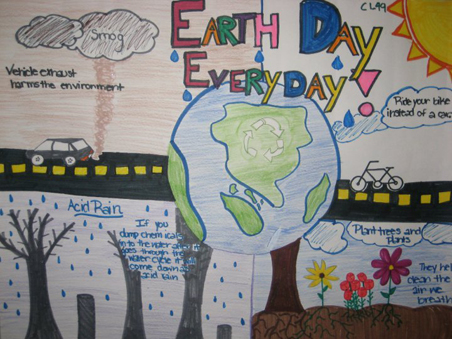
Poster by Katie Moser.
Katie Moser, a sixth-grader in Anne Arundel County in Maryland, made the winning poster for the grades 4-6 category. Her poster, “Earth Day Every Day,” features bicycle-riding as a solution to vehicle exhaust that causes smog, and planting trees and plants as a solution to acid rain. She explains that acid rain comes from chemicals that travel through the water cycle and rain down during precipitation.
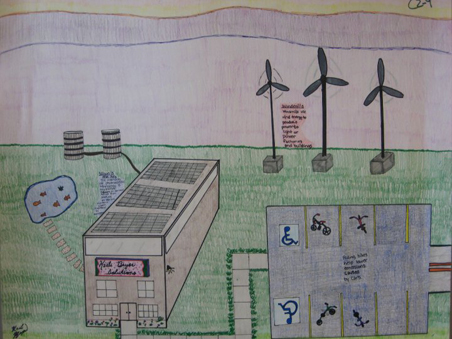
Poster by Kaili Bryer.
Kaili Bryer, a seventh-grader in St. Mary’s County in Maryland, created the winning poster for the grades 7-8 category. Kaili’s solutions come from the “Kaili Bryer Solutions” factory. She describes how windmills and “photovoltaic technology” (aka solar panels) create power and light for buildings. She also advocates riding bikes to reduce car emissions (notice the bicycles parked in the parking lot).
Congratulations to Katie, Kaili and all the student artists for completing the On the Air curriculum and doing your share to help clean the air.
Globe online poll: What’s the biggest menace on the road?
At the time of writing it’s:
Cars 42% 7096 votes
Bicycles 24% 4020 votes
Pedestrians 5% 810 votes
Tractor-trailers 23% 3972 votes
Motorbikes 6% 1023 votes
Continue reading “Globe online poll: What’s the biggest menace on the road?”
May Critical Mass
Come celebrate biking! Join us for May’s Critical Mass!
Friday, May 28th. 7:00 pm. Washington Monument.
Bring yourself.
Bring your bike.
Bring a friend.
Check out the new website!
Speed cameras are nothing more than a “revenue grab” on unlawful and unsafe drivers
Well at least that’s what Sykesville feels while the No. 1 complaint received by Police Chief John Williams is motorists speeding on quiet streets. But with a force of only seven officers, he said, there is no way to enforce traffic laws with radar guns alone.
Continue reading “Speed cameras are nothing more than a “revenue grab” on unlawful and unsafe drivers”
Action Alert: Accidents Involving Pedestrians Rise In Balt. Co.
[B’ Spokes: This article makes my blood boil, too many pedestrians and cyclists are "at fault" because the road was designed only for cars and dangerous for everyone else. Part two what’s the point of having laws to protect cyclists rights to the road if police never learn them or even bother to read the law as they pertain to cyclists? After the fold is the email address of Baltimore County Police.]
************************************************************************************
By Suzanne Collins
BALTIMORE COUNTY, Md. (WJZ) …
…
Pedestrian accidents, especially fatal ones, are way up in Baltimore County.
They involve bicyclists, joggers, and people on foot.
From 2006 through 2008 an average of 15 people were killed [per year.] Last year that rose to 19.
In the first four months of this year already eight have died. If that rate continues, there could be 24 deaths before year’s end.
"What we’re finding is, of those accidents involving a pedestrian, that generally the pedestrian is at fault," said James Johnson, Chief Baltimore Co. Police.
The police report shows the truck driver in Tuesday’s crash may not be at fault.
Police say the bicyclist wasn’t wearing a helmet [as the law allows,] and they believe he was riding in the middle of the car lane [***as the law recommends.***] They also say the driver probably had a blind spot when he came over the hill [as if the hill makes the cyclists at fault.]
A group promoting bicycling says its riders observe traffic rules, but drivers need to know of a new law.
"Drivers need to know to give cyclists three feet when passing, which is a safe passing distance," said Carol Silldorff, One Car Less.
And if it’s a narrow road, Silldorff still says drivers should be accountable.
"You wait, just like if you were passing a child," she said.
Because of the rising number of fatals, county police have been out giving warnings to pedestrians who violate traffic laws. They will kick off an education campaign soon.
"Certainly both the pedestrian and the motor vehicle operator have responsibility here. Obviously a pedestrian has responsibility to obey traffic laws not cross in areas that are dangerous," said Johnson.
In two bike fatalities so far this year and several serious injuries, they were riding outside the beltway mostly on rural roads without sidewalks.
The county also is working to engineer its roadways to accommodate both forms of transportation.
Continue reading “Action Alert: Accidents Involving Pedestrians Rise In Balt. Co.”
5 down and 132 to go with manslaughter charges
[B’ Spokes: Let’s hope this is a sign that unsafe drivers who kill people will be strongly discouraged by the state. In 2008 there were 138 Alcohol-impaired driving crashes that resulted in at least one death and that is just the tip of the iceberg of all the reckless and negligent driving out there. ]
*********************************************************************************
By Sharahn D. Boykin
SALISBURY — A Dover man criminally charged in a fatal crash that killed two people reflects the growing number of drivers charged with vehicular homicide in Wicomico County, according to the State’s Attorney’s Office.
…
Stephens is one of about five drivers charged with vehicular manslaughter within the last 18 months, according to the State’s Attorney’s Office.
…
Continue reading “5 down and 132 to go with manslaughter charges”
Got What It Takes To Be America’s Worst Driver?
The latest in reality shows: Grand prize for each show’s winner: a bicycle, a bus pass, and—perhaps most importantly—to see their car totaled. The non-winners (the safer drivers) get new cars.
Continue reading “Got What It Takes To Be America’s Worst Driver?”
MTA Tests Cameras to Deter Illegal Use of Bus Lanes
by Matthew Schuerman
NEW YORK, NY April 27, 2010 —New York City Transit will try out mobile video cameras in a move that may eventually lead to ticketing more drivers who illegally use bus-only lanes. Over the next 10 months the agency will test the cameras by mounting them on the front of two buses on the Bx12 line in the Bronx.
The Bx12 is the city’s first Select Bus Service route, a special limited-stop route that uses various innovations to reduce travel time by 20 percent. Steve Plochochi, a transit official, says drivers who use bus lanes slow down buses, "because as cars and taxis move in and out of the lane, that interrupts our flow of traffic."
State law doesn’t allow buses to use mobile cameras to crack down on drivers. A bill was introduced to change that. In the meantime, the pilot project won’t use the information to ticket drivers.
Instead, the trial period will test software to distinguish between cars traveling in the bus lane, which is illegal, and those merely making a quick stop or a right turn, which is legal.
Continue reading “MTA Tests Cameras to Deter Illegal Use of Bus Lanes”
Free! Bike Movie Night at Windup Space, May 11, 2010
Bmore Fixed will host a FREE screening of the 80’s BMX classic Rad!
We will also be holding a silent auction that will benefit Ride for the Feast, a 140 mile charity ride for Moveable Feast Baltimore.
Tuesday, May 11th at 6PM
The Windup Space
12 W North Avenue, Baltimore, MD 21211
Plenty of bike parking out front!
Continue reading “Free! Bike Movie Night at Windup Space, May 11, 2010”