Tree Baltimore/Bike Baltimore – THIS SATURDAY

Come out and make Baltimore
greener, while being green!   We’re delivering trees by bike trailer!


Event starts 9AM at
Walter P
Carter Elementary School
– 820 E. 43rd St


If you can make it, please contact Nate Evans or Anne
Draddy


imageNate Evans

Bike & Pedestrian Planner

Baltimore City Department of Transportation

417 E.
Fayette St
, Rm. 555

Baltimore,
MD 21202

443.984.4094

www.baltimorecity.gov/bike

BikePed Beacon — April 2010

image


April 2010 

IN THIS ISSUE

IMAGINE 2060

BIKE TO WORK DAY!
TAX BENEFITS
IN THE NEWS

NEXT ISSUE

A Regional Bike and Pedestrian Newsflash


REMINDER!
 Bike to Work Day
May 21, 2010Bike to Work Day Logo

Registration for Bike to Work Day opened earliier this month and already 400 people have registered! Outreach continues across the region with postcards and posters (contact us if you’d like to help distribute). 
 
May is Clean Commute Month and National Bike Month. Celebrate by showing others how great it is to commute by bike or just ride for fun. With more of us out there enjoying the great riding weather, we may even be able to inspire others and surpass last years Bike to Work Day registration numbers!
 
The March edition of the BikePed Beacon reached over 1,000 readers like you, but we’d love to grow or list even further. 
 
Please encourage someone new to sign up to receive the e-newsletter, get Bike to Work Day facebook updates to share, and register to ride on Bike to Work Day.  Chances are if you find a co-worker to ride with, you are more likely to ride. 
 
Thank you for all that you do to commute by bicycle.  
 
Stephanie Yanovitz
BikePed Beacon Editor

CAN YOU IMAGINE 2060?
Contribute your ideas to help make this region and our communities great places to live and work — for you, your children, and your children’s children.

imagine 2060Citizens and organizations from all around the Baltimore region are invited to take part in a groundbreaking series of public workshops to imagine the future of transportation.

Workshop participants will have an opportunity to share their values and ideas about how future transportation initiatives can make the region a better place to live. Later public workshops will deal more specifically with the planning process to achieve this vision.

Attend one of these upcoming workshops!


Monday, April 26, 6 – 8 p.m.
Pascal Senior Center
125 Dorsey Road, Glen Burnie, MD 21061

Wednesday, April 28, 6 – 8 p.m.
Westminster Senior Center
125 Stoner Ave., Westminster, MD 21157

Thursday, April 29, 6 – 8 p.m.
Planning Board Meeting Room
105 West Chesapeake Ave., Towson, MD 21204

Monday, May 3, 6 – 8 p.m.
State Center, Building 4
201 W. Preston Street – Atrium, Baltimore, MD 21201

Tuesday, May 4, 7 – 9 p.m.
Howard Community College, Duncan Hall – Kittleman Room
10901 Little Patuxent Parkway, Columbia, MD 21044

Tuesday, May 11, 6 – 8 p.m.
County Administrative Building, 2nd Floor Conference Room
220 South Main Street, Bel Air, MD 21014

Registration begins 30 minutes prior to each workshop.  Additional details about transit access and driving directions, links to join the imagine 2060 e-mail list or the Facebook and Twitter online communities, and how to RSVP for an upcoming public workshop can be found by visiting the link below.


BIKE TO WORK DAY!
Registration open and more rally details.   
 
Bike-to-Work DayThe 13th Annual Bike to Work Day (B2WD), hosted by the members of the Baltimore Metropolitan Council (BMC), will be held on Friday, May 21, 2010.  
 
Regional rally site coordinators are busy making arragements for bicyclists to party. At the rally site, riders will receive a free t-shirt, bicycle resources, and a Bicycle Commuter Guide for Employees and Employers, as well as be entered to win prizes (including a folding bike).
 
If you are interested in being a sponsor for B2WD please contact BMC’s Stephanie Yanovitz at syanovitz@baltometro.org.  

 
You don’t have to wait until Bike to Work Day to start commuting by bike, transit, carpool, or walking! Information and help is always available on the B2WD web site. 
 

TAX BENEFITS


The Bicycle Commuter Act  

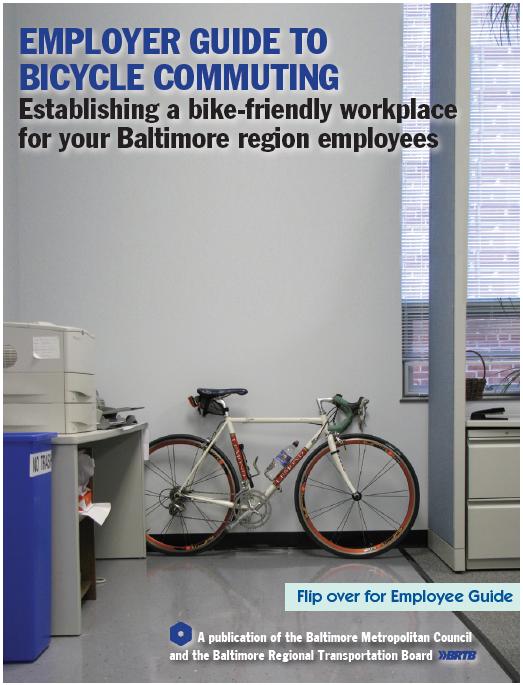
Employer Cover
 
Since January 2009 a tax benefit for bicyclists has been available.  If you ride your bike for a substantial portion of your commute, accept only the benefit for bicycling (not transit too), and use the fringe benefit for your bicycle then you can qualify.  
 
Talk to your human resources department and your employer.  Biking to work can improve productivity, build employee morale and reduce health care costs and monthly parking expenses.   

Your office can start by appointing a Bike to Work Day coordinator and providing incentives and challenges for bicyclists.  Ride as a group on Bike to Work Day.


>> Employee Tax Benefit


BIKE FRIENDLY BUSINESSES

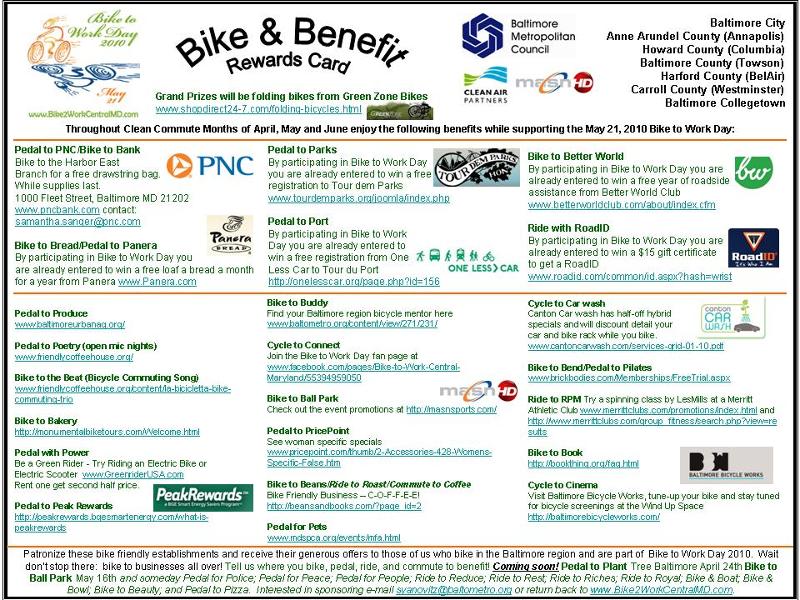
Print out the Bike and Benefit Card!


Bike and Benefit CardBike to Work Day 2010 Bike and Benefit Rewards Card


Share information on Bike Friendly Businesses with your favorite attractions.  Help build a benefit reward card to promote bicycling and businesses in your neighborhood.
 

>>Become a Bicycle Friendly Business    


In The News, Events, and Other Useful Links


EVENTS


IN THE NEXT ISSUE
 May’s BikePed Beacon will focus on Safe Routes to School and Street Smart Pedestrian and Bicyclist safety.  With the good weather, longer daylight hours, and the end of the school year approaching our streets are used even more by the most vulnerable users.
 Send your stories and article ideas to syanovitz@baltometro.org.


BMC Logo             
              Stephanie Yanovitz
             Senior Transportation Planner
              410-732-0500 x1055

              syanovitz@baltometro.org

 
Join Our Mailing List
Get Bike to Work Day Updates On Facebook!Follow B'more Involved on Twitter!
 

ACT Sends Questionnaire to Planning Board Chair Candidates

[Baltimore Spokes: which I will highlight 3 of the 6 questions:]
3) Do you support the current growth policy which ties development to the movement of motor vehicles, or would you replace the "PAMR" and "LATR" tests with a growth policy that gives transit, pedestrian, and bicycle travel equal weight with automobiles?
4) Are minimum parking requirements, which make transit riders, pedestrians, and bicyclists pay for parking they don’t use and thereby subsidize drivers, wise policy in places with good transit service?
5) The Parks Department’s current policy is to clear snow only from roadways used by motor vehicles and not from roadways used exclusively by bicycles and pedestrians, even when the roadway used by bicycles and pedestrians carries far more people. Will you reverse this policy?
Continue reading “ACT Sends Questionnaire to Planning Board Chair Candidates”

BoltBus responds to St Paul bike lane issue

By cyclosity:

Reader Jed wrote in to let us[cyclosity] know about an update to the St Paul street bike lane / BoltBus parking situation. If you’ve ridden in the new lane, you might have encountered some large charter buses intruding into, or outright blocking the lane.

Their response is interesting to read for perspective, and is probably the best you could ask for short of “we will cease operations until we can stop blocking the bike lane” (I don’t think anyone wants that. BoltBus is probably the best way to get between New York and Baltimore, and I think there is a way Baltimore City can provide a good home for BoltBus and a safe lane for Baltimore cyclists. Oddly BoltBus did not reply to my email and those of a few others. No idea why Jed got the special treatment.

Thanks for your email.  We have been addressing this issue with Nate Evans of the Baltimore City Department of Transportation.  There wasn’t a bike lane on St. Paul prior to the recent street resurfacing project.  Unfortunately, the taxi cabs staging in this area have made it difficult for us to pull on bus in completely parallel to the curb and that’s why sometimes the rear of our buses protrudes into the bicycle lane.  We have asked the city for guidance on this issue and have recommended possibly moving the cabs stand back 10 more feet to alleviate this issue.  We have also addressed this with our drivers operating from this location and our customer service staff to ensure that we don’t block the cycling lane while our vehicle is there.   Hopefully you’ll see some improvement on this situation shortly.  We are trying our best not to block this lane, however a 45 foot bus is not the easiest thing to maneuver in the limited space that the city has given us here.

I’ve only seen a few buses in the lane myself – but the times that I did, it definitely seemed like the taxis (or private vehicles) were not really blocking the bus standing zone, and the driver probably had the extra 20 feet needed to park flush to the curb.

[B’ Spokes: Has anyone thought about putting bike lanes on the left> side of the street on one way streets? It avoids problems like this and door zone bike lanes and it is in our tool kit for our bike master plan.]

Continue reading “BoltBus responds to St Paul bike lane issue”

In Dallas, a Community Transforms a Street [video]

With about a thousand bucks and some elbow grease, neighborhood residents transformed a rundown city block for two days, creating a vibrant streetscape — a truly complete street. They painted a cycle track, opened a pop-up café in an empty storefront, put up some outdoor seating and calmed traffic. It’s a brilliant example of how, with a minimal amount of money and a full commitment from the community, places can be transformed quite literally overnight, revealing a wealth of untapped economic and social potential.
Continue reading “In Dallas, a Community Transforms a Street “

Input sought on safer bicycle, walking paths in western county

Planner says he would like to see residents make walking, bicycling a ‘way of life’

Baltimore County officials are asking for the public’s input on how to make the county more friendly for cyclists and pedestrians.

The county wants to make biking and walking easier and safer while using those activities as another way to moderate automobile use, according to Richard Layman, a county planner.

People walk a mile in 15 to 20 minutes and can bike a mile in just five or six minutes, Layman said.

“Since 28 percent of household trips are 1 mile or less and 50 percent are 3 miles or less, you can see how a goodly chunk of car trips (can be eliminated),” he said.

The county’s Office of Planning will hold a public input meeting April 27 at the Catonsville Library to hear about residents’ biking and walking experiences and how to improve them.

Continue reading “Input sought on safer bicycle, walking paths in western county”

3 Feet Wide and Rising

By Michael Byrne – City Paper

What One Less Car does is amazing–and can’t be overstated–but it is largely focused on state issues, and as One Less Car Executive Director Carol Silldorff notes, "I’m a one-person staff." While there is an expectation among many riders in Baltimore that Evans is the be-all end-all of making Baltimore a better place, he is quick to say, "I can do so much, but I can’t do everything." Evans mentions the Mayor’s Bicycle Advisory Committee, a close-knit group of City Hall insiders that makes recommendations to city government. However, "the group is still within the city government," Evans says. "They can only do so much." He then hesitates slightly and adds, "They don’t want to step on any toes."

What Baltimore cyclists need is someone stepping on toes, fighting constantly at City Hall.

It can’t be emphasized enough: Advocacy is inextricably linked to everything that goes into making a city a safe and comfortable place to ride a bike. "Advocacy capacity" is one of six indicators that the Benchmarking Report uses to determine the bike- and walkability of a city. The advocacy force in Baltimore City for cyclists and pedestrians is minimal, ranking in the bottom third of U.S. cities, according to the Alliance for Biking and Walking’s report–despite an actual cycling and pedestrian share in the top third.

The lack of independent local bike advocacy isn’t about money, Evans says. "Look at our two biggest, closest cities, Philadelphia and Washington," he says. "In size and population, we’re pretty similar. [Washington,] D.C. has a phenomenal bike infrastructure and part of the reason is that they have Washington Area Bike Association. In Philadelphia, they have Bicycle Coalition of Greater Philadelphia. These groups have thousands of members."

In short, the advocacy gap in Baltimore gapes. There are many interested parties in Baltimore’s bicycling landscape: the bike repair collective Velocipede, the loose-knit boosters of the North Baltimore Bike Brigade, the Baltimore Bicycling Club, the growing number of bike shops in the city. But none appear to be in the position to take on the load of full-time advocacy. "My feeling is that [the businesses and organizations] are also understaffed," Silldorff adds.

Continue reading “3 Feet Wide and Rising”

Plastered

>>>[B’ Spokes: As I have noted elsewhere that Maryland has a very high pedestrian fatality rate and I will note here that the latest FARS data shows 34% of our pedestrian fatalities involve some level of alcohol. That’s way too high. This story along with the Snow hill fatality outcome is very depressing.]

JOSEPH F. VALLARIO JR., chairman of the House Judiciary Comittee in Maryland and a defense attorney by profession, has made a career of making problems go away for drunk drivers — both in the courthouse and in the legislature. He proved it once again in the recently ended legislative session in Annapolis by killing a measure that has proven effective elsewhere in preventing drunk drivers from operating vehicles. As a result, Maryland missed an opportunity to diminish the carnage on its roads, and the General Assembly blew a chance to rehabilitate its reputation as a haven of good-old-boy lawmakers in bed with special interests such as the alcohol industry.

Mr. Vallario killed a bill that would have allowed convicted drunk drivers to start their cars only after after blowing into the mouthpiece of devices installed on their dashboards that determine whether they are sober. The devices, called ignition interlocks, are simple and effective. In New Mexico and Arizona, where they are required for those guilty of driving with a blood alcohol content of .08 or above — a 180-pound man who’s downed more than four beers in a hour, for instance — they’ve helped cut the number of liquor-related accidents and deaths. The bill was passed without dissent by the state Senate and backed by Mothers Against Drunk Driving, the state police, Gov. Martin O’Malley, and, quite probably, a majority of the members of Mr. Vallario’s committee.

Continue reading “Plastered”

A Department Bulletin to Help Officers Understand Cyclist Safety and Lane Use

The following text was created for the Orlando Police Department Bulletin. This was an initiative by Officer Bill Edgar, a member of our officer advisory panel. If you would like to duplicate it for distribution in your department, please contact us and we will send you the text and illustrations.

(Page 1)

It may not look right because you don’t see it very often, but this is legal and it’s the safest position for a bicycle driver

But don’t cyclists have to ride as far right as practicable?

316.2065(5)(a)(3) states that a cyclist does NOT have to stay right: “When reasonably necessary to avoid any condition, including, but not limited to, a fixed or moving object, parked or moving vehicle, bicycle, pedestrian, animal, surface hazard, or substandard-width lane, that makes it unsafe to continue along the right-hand curb or edge. For the purposes of this subsection, a “substandard-width lane” is a lane that is too narrow for a bicycle and another vehicle to travel safely side by side within the lane.”

FDOT has determined that 14ft is the minimum width which allows most motor vehicles to pass cyclists within the travel lane. (See second page for diagram.)

The lane pictured above is 13ft wide. Most of the lanes in Orlando are 10-12ft wide. Bicycle drivers are not required to keep right, and are encouraged, for their safety, to occupy enough lane that motorists recognize they must change lanes to pass. By riding this way, cyclists can avoid road hazards, operate more predictably, encourage overtaking motorists to pass safely and discourage common motorist mistakes that result in crashes.

Continue reading “A Department Bulletin to Help Officers Understand Cyclist Safety and Lane Use”