By —Andrew Beaujon
Last Sept. 10, Legba Carrefour left the house at 5 a.m. in a borrowed truck filled with 22 junk bikes he and friends had spray-painted white. He strewed them all over Dupont Circle, where 12 days earlier, a “ghost bike” memorial to Alice Swanson, a cyclist killed at 20th and R streets on July 8, 2008, had been removed by the city. By 11 a.m., 16 bikes remained; a week later there were two piles of tangled frames and forks that looked less like a memorial and more like a memento mori. Carrefour was nowhere to be found. “I was going to do more with them,” says Carrefour, “but the G-20 hit in Pittsburgh.” The self-described “D.C. native, cyclist, and anarchist” says he was busy with protests there when the ghost bikes turned into ghost rubbish, but he notes that his bike project “was not supposed to be permanent.…to a certain extent the idea was to have the city come down to rip them off.” Carrefour says his project was as much a public space protest (“I’m European by birth….Like, in Vienna [Austria] where I’m from, people vandalize 1,000-year-old statues on a regular basis”) as a memorial to Swanson, whom he never met. Carrefour says he plans more protests involving bicycles, though “the thing with the bikes,” he says, “depends on me getting a job.”
Continue reading “Best Guerrilla Activist Legba Carrefour”
Introducing the new Frederick Bicycle Coalition


Another opinion that Street Smarts campaign is focusing on the wrong parties
"I don’t really have any problem with enforcement actions against unsafe behavior on anyone’s part. However, I’m not really a fan of this program, as it combines arbitrary enforcement, a focus on the wrong parties, and I suspect that it is mostly ineffective at actually improving safety."
Continue reading “Another opinion that Street Smarts campaign is focusing on the wrong parties”
Summer is around the courner are you prepared to pay more for gas?
Last year gas was $1.96. …. Think about it.
Continue reading “Summer is around the courner are you prepared to pay more for gas?”
Future of Transportation National Survey (2010)

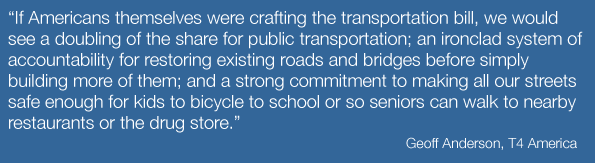
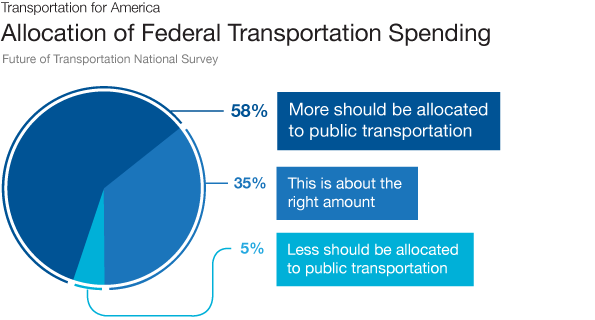
Yet Maryland continues on its trend to cut Mass transit.
Continue reading “Future of Transportation National Survey (2010)”
The most injurious to happiness is commuting
by Jonah Lehrer
David Brooks, summarizing the current state of happiness research:
The daily activity most injurious to happiness is commuting. According to one study, being married produces a psychic gain equivalent to more than $100,000 a year.
In other words, the best way to make yourself happy is to have a short commute and get married. I’m afraid science can’t tell us very much about marriage so let’s talk about commuting. A few years ago, the Swiss economists Bruno Frey and Alois Stutzer announced the discovery of a new human foible, which they called “the commuters paradox”. They found that, when people are choosing where to live, they consistently underestimate the pain of a long commute. This leads people to mistakenly believe that the big house in the exurbs will make them happier, even though it might force them to drive an additional hour to work.
Of course, as Brooks notes, that time in traffic is torture, and the big house isn’t worth it. According to the calculations of Frey and Stutzer, a person with a one-hour commute has to earn 40 percent more money to be as satisfied with life as someone who walks to the office. Another study, led by Daniel Kahneman and the economist Alan Krueger, surveyed nine hundred working women in Texas and found that commuting was, by far, the least pleasurable part of their day.
Why is traffic so unpleasant? One reason is that it’s a painful ritual we never get used to – the flow of traffic is inherently unpredictable. As a result, we don’t habituate to the suffering of rush hour. (Ironically, if traffic was always bad, and not just usually bad, it would be easier to deal with. So the commutes that really kill us are those rare days when the highways are clear.) As the Harvard psychologist Daniel Gilbert notes, “Driving in traffic is a different kind of hell every day.”
But if commuting is so awful, then why are our commutes getting so much longer? (More than 3.5 million Americans spend more than three hours each day traveling to and from work.) In my book, I cite the speculative hypothesis of Ap Dijksterhuis, a psychologist at Radboud University in the Netherlands, who argues that long-distance commuters are victims of a “weighting mistake,” a classic decision-making error in which we lose sight of the important variables:
Consider two housing options: a three bedroom apartment that is located in the middle of a city, with a ten minute commute time, or a five bedroom McMansion on the urban outskirts, with a forty-five minute commute. “People will think about this trade-off for a long time,” Dijksterhuis says. “And most them will eventually choose the large house. After all, a third bathroom or extra bedroom is very important for when grandma and grandpa come over for Christmas, whereas driving two hours each day is really not that bad.” What’s interesting, Dijksterhuis says, is that the more time people spend deliberating, the more important that extra space becomes. They’ll imagine all sorts of scenarios (a big birthday party, Thanksgiving dinner, another child) that will turn the suburban house into an absolute necessity. The pain of a lengthy commute, meanwhile, will seem less and less significant, at least when compared to the allure of an extra bathroom. But, as Dijksterhuis points out, that reasoning process is exactly backwards: “The additional bathroom is a completely superfluous asset for at least 362 or 363 days each year, whereas a long commute does become a burden after a while.”
The same thing happens when we go car shopping. We tend to become fixated on quantifiable variables like horsepower (they’re so easy to compare), while discounting factors, such as the cost of maintenance or the comfort of the seats, that will play a much more significant role in our satisfaction with the car over time. I’m always surprised when people brag about variables like torque or the speed with which the car can rocket from 0-60 mph. Who cares? I’d much rather spend 30 minutes testing out the front seat.
Update: Matthew Yglesias argues that the misery of commuting should lead to congestion pricing. I agree.
Continue reading “The most injurious to happiness is commuting”
It’s Official: Robert “Highways are environmentally friendly but bikeways are not” Ehrlich plans to rematch O’Malley
While I will give former Governor credit for pushing through MD’s portion of the Great Allegheny Passage (https://www.atatrail.org/) But his choice for Secretary of Transportation (Robert Flanagan) resulted in the most draconian period for cyclists in this state in recent years. Flanagan wielded MDOT’s policy of accommodating cyclists where "practical and feasible" as a carte blanche rule for violating state law that the needs of cyclists MUST be considered in ALL transportation projects. Under Flanagan’s tenure Government employees where threaten to support the state’s position on the ICC trail or be fired. Flanagan in testimony before the legislature bragged about coming in under budget $40 million for years in a row while denying cycling accommodations as "too expensive" that would be only a small fraction of that amount. I will strongly assert any government agency that comes in under budget by that large of an amount is not performing its duties to the citizens of this state.
I feel that it is my duty to inform all those who support cycling that during Ehrlich’s administration the most absurd and laughable assertion ever that a bike trail is not environmentally friendly while a multi-lane highway full of single occupancy vehicles is environmentally friendly. We have made progress in undermining Ehrlich ‘s anti-ICC trail and a change back to that administrations could jeopardize that progress.
Beware of "iPod zombies," warns the AAA Mid-Atlantic.
The iPod zombies are cyclists, pedestrians and motorists who have on portable music devices with headphones or earbuds while attempting to cross streets or drive — in essence becoming oblivious to the rest of the world, said AAA Mid-Atlantic spokeswoman Christine Delise.
"It’s very dangerous because the headphones block out sound, and you can’t hear if there’s an ambulance behind you trying to get through or horns blowing to alert you to danger," she said.
Pedestrians, runners and bicyclists risk death or injury because the devices often make them inattentive to traffic and road conditions.
The automobile advocacy group pointed to several recent instances: A 14-year-old Baltimore County girl was killed by a train as she crossed the track while wearing her headphones in January; a 23-year-old Pennsylvania woman on a bicycle was killed last summer as she crossed an intersection while wearing headphones in Ocean City; a 51-year-old Washington, D.C., woman was struck and killed March 6 by a tractor-trailer as she crossed against the light while wearing headphones.
With the weather warming, more people will be out for walks, jogs and bike rides, Delise said. That increases the chances for accidents.
AAA urges people to either leave their devices at home or keep the volume down low enough so that they can still hear traffic, particularly at intersections, Delise said.
Continue reading “Beware of "iPod zombies," warns the AAA Mid-Atlantic.”
Hearing 4/6 1 PM SB 624 in the House ROW in crosswalks and removal of mandatory shoulder use
This bill passed the Senate (47-0) and is now being heard in the House. Come down to testify or just to show support.
Continue reading “Hearing 4/6 1 PM SB 624 in the House ROW in crosswalks and removal of mandatory shoulder use”
Cycling Provides a Break for Some With Parkinson’s
Underneath all the practical reasons for cycling there is almost a magical quality that transforms the mind and spirit as evident in this article:
…
“I said, ‘This cannot be,’ ” Dr. Bloem, a professor of neurology and medical director of the hospital’s Parkinson’s Center, recalled in a telephone interview. “This man has end-stage Parkinson’s disease. He is unable to walk.”
But the man was eager to demonstrate, so Dr. Bloem took him outside where a nurse’s bike was parked.
“We helped him mount the bike, gave him a little push, and he was gone,” Dr. Bloem said. He rode, even making a U-turn, and was in perfect control, all his Parkinson’s symptoms gone.
Yet the moment the man got off the bike, his symptoms returned. He froze immediately, unable to take a step.
Dr. Bloem made a video and photos of the man trying to walk and then riding his bike. The photos appear in the April 1 issue of The New England Journal of Medicine.
After seeing that man, Dr. Bloem asked 20 other severely affected patients about riding a bike. It turned out that all could do it, though it is not clear why.
…
Continue reading “Cycling Provides a Break for Some With Parkinson’s”