People can’t smoke. Cars can.

image

image
The essay is titled The Sacred Car and is in the book Upside Down – A Primer for the Looking-Glass World.

Human rights pale beside the rights of machines. In more and more cities, especially in the giant metropolises of the South, people have been banned. Automobiles usurp human space, poison the air, and frequently murder the interlopers who invade their conquered territory – and no one lifts a finger to stop them. Is there a difference between violence that kills by car and that which kills by knife or bullet?


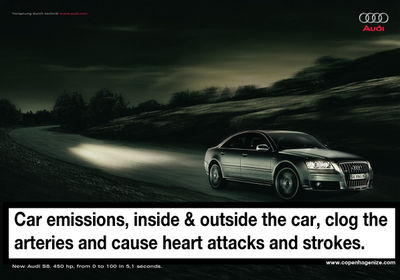
I saw a cigarette ad in a magazine with the required public health warning: ‘Tobacco smoke contains carbon monoxide.’ But the same magazine has several car ads and not one of them warned that car exhaust, nearly always invisible, contains much more carbon monoxide. People can’t smoke. Cars can.
Continue reading “People can’t smoke. Cars can.”

House Safe passing bill hearing 2/16 at 1:00 p.m.

HOUSE BILL 461 Vehicle Laws – Bicycles, EPAMDs, and Motor Scooters – Rules of the Road

Synopsis:

Requiring that a driver of a vehicle, when overtaking a bicycle, an Electric Personal Assistive Mobility Device (EPAMD), or a motor scooter, pass safely at a specified distance, except under specified circumstances; requiring a driver of a vehicle to yield the right-of- way to a person who is riding a bicycle, an EPAMD, or a motor scooter in a bike lane or shoulder under specified circumstances; etc.

Senate version passed (43-0)
Continue reading “House Safe passing bill hearing 2/16 at 1:00 p.m.”

Rant: Baltimore’s Green Building Loop Hole? Parking lots!


Anyone building or renovating a 10,000 sf building must conform to the City’s green building and energy requirements. However, anyone demolishing and constructing a parking lot is not subject to the regulations. It appears that the regulations are encouraging demolition of existing buildings and replacing them with cheap, non-environmentally friendly parking lots. 

If we are to encourage sustainable, environmentally-friendly development, we must include at-grade parking in the green legislation. 

It is in the City’s interest that underutilized buildings and parking lots find their way to become inhabited, revenue producing buildings. The Tower Building (a former landmark building located at Baltimore and Guilford) and the McCormick Spice building (the baseline Marty Milspaugh used for the planning of the Inner Harbor) sites remain at-grade parking to this day after decades of waiting for the right time for development. 

 
A parking lot can be designed to contribute to the environmental quality and energy efficiency of the city. An environmental parking lot might include: pervious paving; internal landscaping; bioretention; bicycle parking; solar recharging for alternative vehicles; assigned parking for alternative vehicles; solar panels to power the lighting; green roofs to treat rainwater prior to its converging with the oil and particulates on the paving reducing the need for underground treatment, and green canopies to reduce the heat island effect and create bio habitats.

If you agree, please add your comment to this blog to be forwarded to City Councilman Jim Kraft.

Continue reading “Rant: Baltimore’s Green Building Loop Hole? Parking lots!”

Proteus Bikes on Route 1

This is a fabulous, cozy bike shop that really caters to the commuter cyclist. They have a cat who lives in the shop and weekly potlucks for the local community. Jill is dedicated to College Park and was a huge part of the success of the NIH commuter cycle club. Check the shop up for a chance to really be a part of our College Park community and honest advice on a great bike. For a link to the shop website, just check our links on the right. https://proteusbicycles.com/

Continue reading “Proteus Bikes on Route 1”

Stop, Swap and Save Bicycle Swap and Consumer Expo

Sunday, February 14. 9 a.m.-2 p.m.

Booths selling used bike parts, people looking to swap bikes, industry reps, and shops and vendors offering seminars, tutorials, remaindered parts, and other bike items.

image

With more bicyclists on the road and a 3-foot passing law wending its way–again–through the state legislature, there is hope bicycling safety might enter public consciousness. Lately, we noticed bicycle safety posters on city buses, ironically enough, as bus drivers, along with their commercial counterparts, make for a frightening city bike ride. No matter, we continue to pedal to work and around town. We’ll have to drive to Westminster, however, to meet fellow biking enthusiasts at the annual bike expo, which is to cyclists what Carlisle is to automotive enthusiasts: booth after booth of folks selling used parts, looking to swap rides, industry reps, and shops and vendors offering seminars, tutorials, remaindered parts, and stuff, lots of stuff. If you’ve thought of buying a bike, improving on what you have, learning about the sport, or want to just walk around and chat with fellow bike nuts, this is the place to be.

Tim Hill

Continue reading “Stop, Swap and Save Bicycle Swap and Consumer Expo”

Secretary LaHood Issues Recall of the American Motorist

“DoT Secretary Ray La Hood has recalled the entire surface transportation fleet to replace an endemic factory defect: dangerous loose nuts have been installed behind the steering wheels of more than half of our cars…”

Too far out to be true? Much has been said lately about the recall of all those Toyotas due to defects in brake algorithms and sticky accelerators. But from what I have read in multiple sources (here is one), there have been about 19 deaths over a decade cause by Toyota’s faulty throttles. Not sure how many have been killed by the brakes, but I suspect similar low numbers.

Meanwhile, what about the real “factory defects” in our vehicle fleet? We have killed roughly 400,000 people in traffic crashes over the last decade and according to the FHWA: “Depending on the source, driver error is cited as the cause of 45 to 75 percent of roadway crashes and as a contributing factor in the majority of crashes (Hankey, et al, 1999).”

Out of all those deaths, the defective gas pedal can explain perhaps %0.005. Driver error? 45-75%. Who are we kidding?

While roads and cars have acquired numerous safety features over the last quarter century (divided highways, better pavement, numerous safety improvements on vehicles including better body design, brakes, tires, lights, and air bags), we see two big problems. One, that motorists increasingly take safety for granted and engage in high-risk behavior such as driver distraction. Secondly, all these improvements have done little to protect non-motorists such as bicyclists and pedestrians.

DoT Secretary Ray LaHood has been quoted as calling Toyota “safety deaf” over the accelerator issue. But looking at the FHWA report, don’t you think its about time that the Secretary of Transportation looked at the cause of the lion’s share of traffic crashes and demanded a recall of that most imperfect of designs, the American motorist, to repair his or her safety defects?

Continue reading “Secretary LaHood Issues Recall of the American Motorist”

Senate wants drivers to move over for cyclists

by Julie Bykowicz

The Maryland Senate this morning unanimously approved a measure requiring drivers to give bicycles, scooters and other personal transportation devices, such as Segways, at least three feet of space when possible.

Drivers now are required to exercise “due care” when passing cyclists, but the Senate wants to get specific on what exactly that means. A House of Delegates committee is scheduled to hear the proposal next week.

Also included in the measure is a directive that drivers are to yield right-of-way at intersections when a cyclist is in a designated bike lane or lawfully riding on the shoulder.

Violating these new provisions would be a misdemeanor with a maximum fine of $500.

The Baltimore City Paper pointed out in a recent commentary on its news blog that the measures come too late for cyclist Jack Yates, who was killed last summer at the intersection of Maryland and Lafayette avenues in Baltimore. From Michael Byrne’s entry:

He was riding to the right of the right lane of Maryland as a truck passed him, also in the right lane. That is, both vehicles were smooshed into the right lane as the truck instigated a right turn onto Lafayette. The accident that resulted is a classic “right hook,” one of the most dreaded occurrences in urban bicycling—and one of the most common.

Maryland lawmakers are also considering several “move over” measures that would require drivers to pull away from emergency vehicles that are stopped on shoulders to investigate traffic accidents or infractions.

Continue reading “Senate wants drivers to move over for cyclists”

From a mobility to an accessibility orientation

image

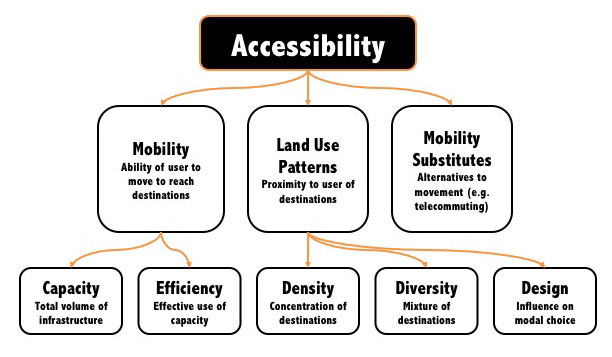
If mobility is “The ability to travel where you want when you want”

Then success is measured in terms of vehicle miles traveled – the more movement, the better.

But is having to drive further to work and further to shop really a desirable strategy? And is having congested roads proof of success in getting more people mobile?

If the car is indeed the ultimate in mobility why then is a common response to “Hey do you want to go see such and such?” “Nah, too much traffic and parking is a pain.” For an example there is evolution of the movie industry, theaters are losing to video rental places and video rental is losing to Red Box and other methods that require little to no travel time.

So this hints that the solution in getting people to what they want when they want it is like in the Dune novels in order to travel further we need to fold space to get our destinations closer to where we are. So modern mobility is stressing less miles traveled and looking at land use patterns. And I will assert that the indicator of getting land use right is when cycling is more common place as when distances required to do what we want when we want are within easy biking distances then true mobility has been archived.
Continue reading “From a mobility to an accessibility orientation”

Mandatory Use of Ignition Interlock System Program

While trying to skim what’s going on this legislative system I ran across HB 515 and I have to wounder what was going on:

Altering the Motor Vehicle Administration’s authority to establish an Ignition Interlock System Program to require the Administration to establish the Program; requiring rather than authorizing the Administration to establish a protocol for the Program by specified regulations; providing that individuals who are convicted of, or granted probation for, specified alcohol- or drug-related driving offenses must participate in the Program; etc.

Were the courts ordering a Ignition Interlock System and MVA not following through?
Continue reading “Mandatory Use of Ignition Interlock System Program”