
Los Angeles residents living near freeways experience a hardening of the arteries that leads to heart disease and strokes at twice the rate of those who live farther away, a study has found.
Continue reading “Study finds traffic pollution can speed hardening of arteries”
The Economic Potential of Portland’s New Bike Plan
*** Portland’s entire 300 mile network of bikeways cost about the same as 1 mile of urban freeway. ***
Yep, supporting cycling is expensive. Ya, right.
Continue reading “The Economic Potential of Portland’s New Bike Plan”
Benefit/Cost of bike/ped improvements–over 10X return on investment
From the People Powered Movement list:
Hi all,
I have mentioned this before but with the announcement of the federal TIGER grants coming tomorrow it’s on my mind again.
We often talk about how valuable and important bicycle and pedestrian infrastructure is, how it makes communities more liveable, improves community health, reduces air pollution and congestion, etc etc etc.
However, we rarely are able to put specific dollar figures to those benefits.
For the Kansas City metro area’s TIGER application–which included a request for federal funds for a comprehensive bicycle & pedestrian program for Kansas City–we were able to do that.
The results blew me away. Over a twenty year time frame:
– an investment of about $30 million (initial cost plus maintenance)
– in a comprehensive bicycle & pedestrian program (5Es)
– will have benefits of over $353 million
And that is using conservative figures that only capture part of the benefit.
So let me say that again: a comprehensive, 5Es bicycle & pedestrian program has more than a ***10 TIMES RETURN ON INVESTMENT***.
The TIGER application the KC metro area submitted included several other types of projects–transit, highway, rail, etc. None of the others even come close to this kind of rate of return. For instance:
Transit project has a benefit/cost ratio of about 2
Freeway interchange has benefit/cost ratio of about 4
Freight RR corridor reconstruction/update has benefit/cost ratio of about 5
Continue reading “Benefit/Cost of bike/ped improvements–over 10X return on investment”
Clearing bus stops in Silver Spring
Hans Riemer, who will be announcing his candidacy for Montgomery County Council later this month, helped to organize a bus stop dig out in Silver Spring on Saturday.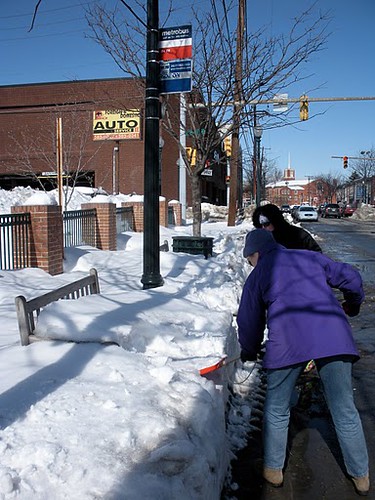
Bus stop before. Tina Slater and Kathy Jentz, clearing out the stop on Fenton near Thayer, downtown Silver Spring. (Tina is with Action Committee for Transit, and Kathy is the publisher of Washington Gardener Magazine.)
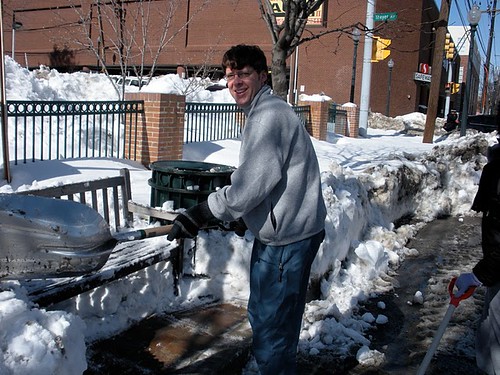
Bus stop after. Hans Riemer clearing out a bus stop on Fenton near Thayer, downtown Silver Spring. Subsequent bus riders stood in the clearing, with bags placed on the bench.
Continue reading “Clearing bus stops in Silver Spring”
Congress supports cars not paying for road improvements
Congress isn’t likely to approve raising gas taxes to pay for road improvements, U.S. Transportation Secretary Ray LaHood said Friday.
"It’s very hard on elected officials to go back to their districts and tell people — under these economic conditions — that they are going to raise a gas tax," LaHood said.
*************************************************
I’ll mention one alternate tax idea would be to switch from so much per gallon to a percent of the cost of gas. That way the tax has some hope of keeping up with inflation and in the short run gas prices can be set to be the same as they are now.
Continue reading “Congress supports cars not paying for road improvements”
White House: Transit Inflation Outstripping Private Transportation
by Elana Schor
The White House’s annual economic report, in addition to its endorsement of inter-city rail and transit spending, also sheds more light on transit inflation, which is often reported anecdotally in the many cities struggling with fare hikes but rarely put in statistical terms by economists.
 (Photo: UPI)
In the appendices of its report, the president’s Council on Economic Advisers estimated the overall U.S. consumer price index (CPI) at 214.537 in 2009, with the period of 1982-1984 signifying the 100 level. In general, then, prices for major goods have more than doubled over the past two-and-a-half decades.
The changes in price for what Americans pay for food (218.249 in 2009) and housing, including utilities (217.057), have kept pace with the overall CPI, according to the White House. But in the specific category of transportation, the difference was notable — private transportation, a category that includes new or used vehicles and motor fuel, had a CPI of 174.762 in 2009, while transit’s CPI hit 236.348 last year.
To be sure, transit costs were not the most out-off-control expense singled out by the White House. Inflation for medical care reached 375.613 in 2009, and the cost of shelter, not including utilities, was 249.354 last year.
Still, the palpable disparity between the costs of private and public modes of transportation is a trend that should be catching the attention of policymakers on both ends of Pennsylvania Avenue.
By Baltimore Spokes
I’ve bloged about how the costs of cars are being supplemented by our tax dollars and this report hints that cars are getting more of a supplement then mass transit but a resent video by Transportation For America introduced something not often talked about starting at 0:59: U.S. military actions in oil rich nations to “protect” the resources we so desperately need.
Which got me thinking if that works to keep the cost of using a car down why not use the same mentality to keep the cost of mass transit down? Surly there is some un-American terrorist country where we could get cheaper buses and trains from, like lets say Canada. Talk about being un-American, despite being a part of the same continent they refuse to accept the American life, parts even speak French! It does not get much more un-American then that.
OK, I am being very tongue and cheek but still I have to question why is there so much emphases on keeping single occupancy vehicles cheep when there is no way we can keep up with the demands for new roads that over use of the single occupancy vehicles require? We need to stress appropriate transportation and if efforts are made to keep gas cheep, then the benefits should largely go to commercial interests that truly need to use the roadways and the single occupancy vehicle should be the last to benefit, at least until we can keep up with the demand for new roadways.
Continue reading “White House: Transit Inflation Outstripping Private Transportation”
The monetary benefits of bicycle infrastructure
By Posted by melancholic optimist
A commenter on my last post mentioned that I wasn’t very specific about the monetary benefits of implementing the Portland Bicycle Plan, that is, of adding bicycle infrastructure and making it more attractive to ride bicycles (or walk) rather than drive. I started writing a comment in reply, but figured that would make a pretty good post all on its own, so here it goes.
There are a lot of potential benefits – firstly, much of the reason our roads are in bad shape, is that we have so many cars driving on them so often. If we can get more people riding bikes and walking more often, the roads will last considerably longer, as bicycle tires and feet do exponentially less damage to the roads. I think about this a lot, as many of the sidewalks in Portland are still there from as early as 1909, and are still serviceable. Busy road surfaces however, have to be repaved every few years in order to remain smooth, due to the volume of automobiles driving on them.
What many cities in Europe have found out, is that pedestrians and cyclists are better shoppers than those who arrive in automobiles. They are more able to stop on a whim, browse casually, and for those who don’t own a car, the fact that they aren’t spending loads on owning and operating an automobile all the time means they potentially have more money to spend. Many major shopping districts in European cities are car-free, and they thrive.
Active citizens are healthier citizens, and more productive citizens, and the city, as well as companies, pay money to support healthcare costs for the citizens of a city. An active lifestyle is one of the best preventative medicines, and countries in Europe have done studies that show the monetary benefits of having their workforce healthy and productive due to being regularly active are massive.
Traffic. We spend hours and hours sitting in our cars, wasting fuel, wasting time, polluting the air. Our streets simply cannot handle the volume of traffic we currently have, and we are expecting growth. Not only can we not afford to tear up our neighborhoods to build bigger roads (from a community point of view), we can much more easily afford to add bicycle infrastructure to our existing roads than build more roads. Portland’s entire 300 mile network of bikeways cost about the same as 1 mile of urban freeway. Granted, some of the stuff in the Portland Bicycle Plan is more expensive that what we have done so far, but it is still miniscule compared to the cost of building and maintaing automobile-only roads.
There is no shortage of news and information on this, and I’m sure a google search will provide many more specifics, studies and discussions on the topic. Here is a study from the European Cycling Federation to start (https://www.ecf.com/3379_1), and I know Mikael at Copenhagenize has also posted a number of times about this.
Obviously, people are still going to drive. I’m still going to drive, sometimes. However, currently 80% of trips in the U.S. are by single-occupancy automobile, and about 40% of all trips are 2 miles or under. The more people we can encourage to not drive when they don’t really need to, the better, in so many ways. Not just better for the "cyclists", but better for the city, better for the citizens, better for the businesses, better for the people who improve their health and save themselves money.
Continue reading “The monetary benefits of bicycle infrastructure”
RAND report suggests scrapping gas taxes in favor of per-mile levy
By Jon Schmitz
Congress should get rid of fuel taxes and move toward a system that charges road users for the miles they travel, a leading national research organization said Wednesday.
A report by the RAND Corp. explored several different mechanisms for switching to a vehicle-miles-traveled fee, ranging from having motorists self-report their odometer readings to sophisticated onboard devices that track where and how far a driver goes.
A growing body of transportation experts, including two commissions established by Congress, has concluded that the per-gallon gasoline taxes that currently fund the lion’s share of highway budgets are obsolete and inadequate.
The 18.4-cent federal gas tax hasn’t been increased since 1993, and the advent of more fuel-efficient and alternative-fuel vehicles has further eroded that revenue source, causing the federal Highway Trust Fund to become insolvent.
"Failure to raise fuel taxes in recent years to keep pace with inflation and improved fuel economy has created significant transportation funding shortfalls at the federal and state levels," said Paul Sorensen, lead author of the RAND report.
"The prospect of more fuel-efficient conventional vehicles and alternative-fuel vehicles in the coming decades – though clearly beneficial in terms of the environment and energy security – threatens to make funding challenges worse. Shifting from fuel taxes to mileage-based road use fees would help to overcome this problem, and there are several promising options for implementing such a shift."
Since 1980, the total number of vehicle miles traveled in the United States has doubled but fuel consumption has increased only 50 percent, RAND reported. Charging by miles driven would place the burden for maintaining roads and bridges on those who use them most.
…
Continue reading “RAND report suggests scrapping gas taxes in favor of per-mile levy”
Entitlement
Douglas Preston has been taking heat for his surprisingly acid comment in the New York Times vis a vis e-book pricing:
“The sense of entitlement of the American consumer is absolutely astonishing,” said Douglas Preston, whose novel “Impact” reached as high as No. 4 on The New York Times’s hardcover fiction best-seller list earlier this month. “It’s the Wal-Mart mentality, which in my view is very unhealthy for our country. It’s this notion of not wanting to pay the real price of something.”
I won’t get into Wal-Mart or e-book pricing, but reading it I couldn’t help think of another form of American consumer: The driver. Just try floating the idea of a federal gas tax hike, simply to keep up with inflation (and, more ambitiously, to cover the actual costs of driving).
Continue reading “Entitlement”
DC Cyclocross in the snow
Wile this video may not exactly encourage you to go out and ride in the snow but at least I hope it shows that cycling can be fun even in the snow.
2010 Snow-Cx-Opocalypse from Brian Butts on Vimeo.