
[Note: There are many technical errors in this report but none the less this is how some people think.]
By Zack Colman
Black 2001 Saturn SC2. That’s the car I drive — and if you’re a bicyclist on the road but not in a bike path and you see my car, I hope you’re wearing a helmet, because I might run you over.
Maybe not intentionally.
But you see, with all these things I can do in my car nowadays, such as choose a different song on my iPod, send a text message while driving or fall asleep at the wheel because I had to wake up for a worthless 8 a.m. biology lab, I might not notice you.
And, considering you are where you should not be, I might hit you.
The simple fact of the matter is, MSU has so kindly provided sidewalks for people on foot and Rollerblades, and MSU’s ordinance should be revised to require bicyclists be there too. The university has outlined bike paths on certain roads, but bicyclists can’t just create imaginary bike paths like they do.
I cannot drive my car on the sidewalk, so why must you ride your bicycle where I drive?
Continue reading “Bicyclists need to stay on sidewalk”
Giving Lessons in Traffic Safety at Middle Schools
…
Increased traffic around schools has vexed other major cities, too. Nationwide, roughly 21 percent of morning traffic is generated by parents driving children to school, said Raquel Rivas, a spokeswoman for Safe Routes to School, a national organization formed to encourage walking and bicycling to school.
Traffic patterns around schools in Los Angeles have become clogged and often dangerous because of a large growth in student enrollment and an increase in the number of parents who ferry their children to and from school out of fear for their safety, Mr. Hopwood said. Especially in high-crime areas, parents are reluctant to let their children walk.
“It’s getting worse and worse each year,” said Brad Smith, an environmental health and safety officer at the school district, “because so many parents feel that they need to drop their kids at the front entrance of the school because they are concerned about harm.”
…
The city attorney, Rocky Delgadillo, is also pressing the Police Department to enhance enforcement of traffic laws around schools. “It’s a small investment with a big return,” said Mr. Delgadillo’s spokesman, Nick Velasquez. “Making do with less in tough times.”
A school bus driver, Michelle Coleman, says middle schools are her biggest nightmare. “The parents park right here where the buses need to be,” Ms. Coleman said the other day outside Florence Nightingale, northeast of downtown Los Angeles.
Luz Bunacaba conceded that she was part of the problem. But with bus fare of $5 a day and the distance too far for her 15-year-old son to walk, Ms. Bunacaba parks in the bus lane. “I have to,” she said, “it’s the only way.”
Part of the problem is that schools lack enough crosswalks, so students cross in the middle of the block, Mr. Hopwood said.
“We have sidewalks that are too thin,” he said. “At one high school, there are over 5,000 students on the sidewalks, and they get impatient with one another. We have lots of parents double parking. There is just not enough room, and there have been lots of incidents of students getting hit.”
…
Continue reading “Giving Lessons in Traffic Safety at Middle Schools”
Pollution link with birth weight
Traffic pollution was identified as a significant problem
Exposure to traffic pollution could affect the development of babies in the womb, US researchers have warned.
They found the higher a mother’s level of exposure in early and late pregnancy, the more likely it was that the baby would not grow properly.
…
[Baltimore Spokes: Note that being in a car you are exposed to more traffic pollution then if you are riding your bike in traffic.]
Continue reading “Pollution link with birth weight”
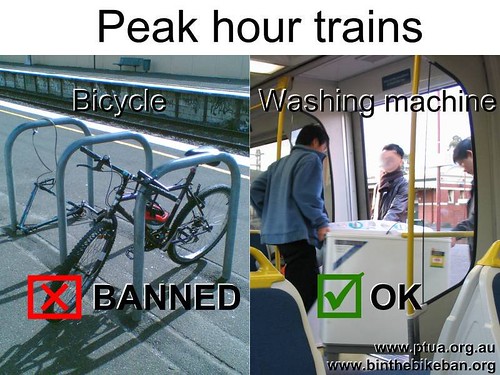
Peak hour trains
SHA Share the Road – 3 Feet wihen Passing Bus Safety Campaign

To All:
I was very pleasantly surprised to see SHA’s Bike Safety Ad on the back
of a MTA bus in Baltimore this afternoon. I followed the bus and snapped
the attached photo of the ad. Last year the 3 Foot passing legislation
failed like it did this year but SHA promised to encourage motorists to
pass bicyclists by a minimum of 3 feet in an educational campaign
instead.
This is to thank SHA and MTA staff responsible for creating the campaign
and getting them up on buses where the ad is right in the face of
drivers riding behind the bus. While some folks will remain disappointed
that the legislation didn’t pass there should be some consolation that
this safety campaign will probably reach more motorists than a change in
the law will.
Have a great weekend!
Michael Jackson – Maryland Director of Bicycle and Pedestrian Access
I melt the ice with a thermonuclear device
Words from a song I like from a group I can’t remember at the moment but very descriptive of my recent activities. I filed a compliant with the Open Meetings Law Compliance Board against Maryland Bicycle and Pedestrian Advisory Committee. And after review it looks like we will be getting some significant changes! We should be getting better notice and opportunities on providing public input on policies that effect cyclists. And we should be getting timely information what the group has been up to like Talbot County bike maps, Trail Towns initiative along the C&O. Updates on the Full and complete ICC Hiker Biker trail and if cyclists can use shoulders of the ICC bridges rather then 5 miles of circuitous detours. Updates on the Hatem Bridge and why the State needs two fast roads a mile apart and no bicycle and pedestrian access in the area.
It is sad that I had to resort to this measure to get timely news that you would be interested in reading about, as the group does a lot of good work but under the old system news that is 4-6 months old ain’t news.
BIKE ROMP

The Clean & Green team is planning a fun bike tour around Hampden and the surrounding green areas. We will make a pit stop at Baltimore Bicycle Works for refreshments and a tour around the newest, closest bike shop to Hampden. The Bike tour is scheduled for May 2 from 10 am until noon.
Continue reading “BIKE ROMP”
WEB EXTRA: A WHO’S WHO OF BALTIMORE GREEN GROUPS
From the Urbanite:
Say what? Under CLIMATE/ENERGY/TRANSIT
Baltimore Spokes: This website/ discussion forum provides an endless stream of bike/ transit/ climate-related news and commentary.
Cool beans!
Continue reading “WEB EXTRA: A WHO’S WHO OF BALTIMORE GREEN GROUPS”
Bikes in Urbanite magazine
Urbanite magazine is looking to set up a spirited, sassy, tit-for-tat
between an avid biker and an opinionated driver for an upcoming issue
on transportation. We’re looking to have some fun, not get nasty. The
tit and tat don’t have to be long — think of a 500- to 800-word
essay, just a pithy story and some thoughts on navigating Baltimore’s
roadways on your chosen set of wheels. Know anyone who could write
such a tit or tat? Maybe you know a rabid biker whose spouse or
significant other thinks he/ she is crazy? If so, send me an e-mail.
We’ll talk. (Disclaimer: There’s no money in this. Just a chance to
have some fun and get your name in the magazine.)
Thanks,
Greg
Continue reading “Bikes in Urbanite magazine”
Running red lights is a problem
…
Well, according to field research conducted by the city of Portland, there are indeed a lot of scofflaws blowing through stop signs around town.
We’re talking about commuters who apparently have a total disregard for safety and the law, coming to a full stop at intersections only 22 percent of the time.
See! It’s those dang bicyclists with their neon-colored jackets, self-righteous attitudes and ripped calves, right? Right!? Actually, no. Those were automobile drivers.
"The law says a complete cessation of motion is required," said Greg Raisman, traffic safety specialist for the Portland Bureau of Transportation. "I think a lot of the time, people think they stop. But they were watching the wheels."
"They" were the Bureau of Transportation’s data-collection team, which camped out at various stop-signed intersections in 2006 and 2007. The monitors recorded a "full stop" whenever the wheels on a car, bike, minivan, truck or any other vehicle came to a complete halt, even for just a second.
Although automobile drivers weren’t as dismissive of stop signs as cyclists, who stopped just 7 percent of the time, you’d think the study might erase some of the nasty stereotypes that they have of bike riders.
Don’t count on it, said Randy Blazak, a Portland State University sociologist.
…
Continue reading “Running red lights is a problem”