Grassroots Bike Series – Saturday, April 25

image
The Grassroots Bike Series is a series of bicycle races, once a month, taking place throughout the Baltimore area. While these are “races,” everyone is invited, regardless of speed or competitive nature. The goal of the GBS is to provide a time for us, the Baltimore area cycling community, to come together and have some fun in an otherwise hectic bike city.

Each month a new location will be chosen, and a course will be determined beforehand. I will do my best to keep the course varied each month, in terrain as well as style. One month may be all pavement, the next all grass, the next a mix of pavement, grass, gravel, mud, etc. You get the idea. The style of race may also change from month to month. We may be racing for laps, for time, or mix it up with unconventional race styles, such as a tag-team race. Each race will, however, be a reasonably small (a mile or so) closed loop with a number of laps, so as not to send anyone too far away or all across the city. Before each race I will post a page describing the location and time of the race, as well as what to expect you will be riding on and any other special instructions you should know before showing up.

You can race on any bike you want; track, mountain, bmx, cyclocross, hybrid, tandem, recumbent, unicycle, etc. It’s all good. As said above, I will note what type of terrain each race will be held on.

Each race will gather at a specific time. Before the race begins, i will lead everyone in a few leisurely laps around the course, so everyone understands clearly what the course is. I will do my best to bring signs, cones, tape, or other devices for particularly confusing sections, but in general the expectation will be to remember where you are going.
Continue reading “Grassroots Bike Series – Saturday, April 25”
Main Sponsor Pulls Plug – Help Save Ride to Boston!!

[Note this is in Bike Baltimore because this ride will be coming through here.]
image
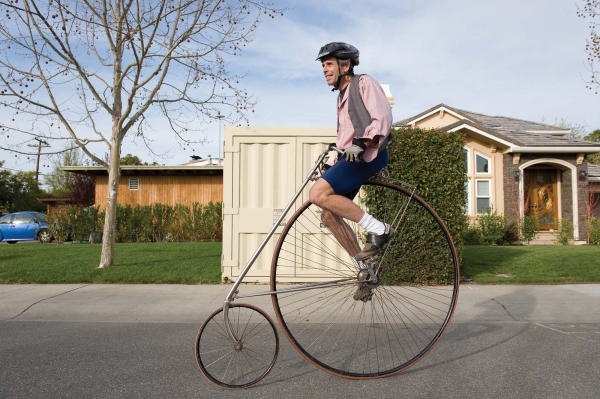
Last week, and, in hindsight I could feel it coming for months because their business was off the mark, the Main Sponsor for my ride pulled the plug. The quarterly payment that I got from them for web work and soon the advertising exposure they would have gotten for helping the two most photographed vehicles in the world get from one coast to the other, fell victim to bad economic times. It was this money that I had planned on using to get me out of the gate come May 3.

Nor can I feel at all mad at them. When the orders were not coming in, they had to figure out some way to keep themselves fed. Nor do I know what more I could have done. I moved forward in good faith finishing my book, learning this backwards HiWheel so I could pedal the mountains, and even though we barely broke even, holding fund raisers so we could maybe actualize some of the bigger dreams I had for this ride.

Instead of using this month of April trying to add a few sponsors so I could buy some needed supplies in addition to the motor home I had planned to rent to blog and stay in touch with Mayor’s office from, sag my ride and get the Busycle back to Boston, I am finding myself starting from scratch. Besides dollars, I also lost my sponsor’s office support, so I will have to build two crews in three weeks time – one for the road and one for here at home.

Do I crawl in a hole and throw the last six years away? Or do I look for new ways to make all of this real? I suspect that those of you who have read my book, “Awake Again”, know the answer. I was up against a lot tougher odds in rebuilding my broken body, mind and the world I had created then. So, just as I got better from my setback by listening for God’s voice, I am doing the same thing now. And it does seem that a Bigger Power is saying that I need to come before my community of friends for help. Here is how:
Continue reading “Main Sponsor Pulls Plug – Help Save Ride to Boston!!”

Bicycles, Rolling Stops, and the Idaho Stop

Ever wounder why pedestrians are not required to come to a complete stop at stop signs? Shouldn’t they be required to sit down just like a cyclists is required to put a foot down at stop signs? And what about cars? If stopping means the complete cessation of movement shouldn’t they be required to turn off their motors because any conservation of momentum that would allow a fast start is bad?

If these things sound ridiculous so is requiring a cyclists to put there foot down, see the link and video for a good presentation.
Continue reading “Bicycles, Rolling Stops, and the Idaho Stop”

Woman gets probation in death of teen at bus stop

A judge has sentenced a 60-year-old North Carolina woman to three years of probation for passing a stopped school bus and striking a 16-year-old boy, killing him.
The News & Record of Greensboro reported Judy Stilwell pleaded guilty Tuesday in Rockingham County. Her six- to eight-month jail sentence was suspended as long as she completes probation. Her driver’s license was suspended for a year and she was ordered to pay a $1,000 fine.
Prosecutors say Stilwell had a clean record in January before passing the school bus which had its lights on and stop sign out on state Highway 770. She struck Nicholas Adkins as he crossed the street.
Stilwell cried in court and her attorney called the incident a lapse in attention.
Continue reading “Woman gets probation in death of teen at bus stop”

Drivers catch green lights ‘wave’

Local councils can adopt "green wave" systems of sensors, where vehicles at or just below the speed limit trigger a succession of green lights.
Environmental and motoring groups say carbon emissions will be reduced.
Previously the Department for Transport (DfT) had discouraged the systems which reduce fuel use, resulting in less tax being paid to the Treasury.
But now, rather than seeing green wave systems as a "cost" to the public purse, the DfT views them as a "benefit".
‘Easy target’
The RAC’s motoring strategist Adrian Tink said: "Green waves is a common sense win-win initiative that will actually help motorists as they go about their daily lives as well as reduce carbon emissions.
"It’s used very successfully in other countries and it would be great to see motorists up and down the UK benefit from its widespread introduction.
Continue reading “Drivers catch green lights ‘wave’”

Lane control public policy

Posted by: John Forester on Chainguard
Date: Tue Apr 14, 2009 9:58 am ((PDT))

The issue regarding control of lanes by cyclists, precisely stated, is:

1: Cyclists should have the same legal right of lane control as other
drivers of vehicles. This can be called the slow vehicle law case.
or

2: Cyclists should be assumed to have no right to control lanes, but
must always act to allow the easiest overtaking by any potential faster
traffic, unless failure to control the lane is dangerous. This can be
called the Far To the Right law case.

That’s the issue.

2.1: The FTR case has been public policy for decades, and it has been
supported by three arguments:

2.1.1: Cyclists are not capable of obeying the normal rules of the road,
and therefore are endangered if they don’t stay at the edge of the
roadway. This is an assertion based on the notion that cyclists are
young children, who are assumed to be safe only if they stay at the edge
of the roadway. Both parts are false. Most roadway cyclists are not
young children, but are sufficiently old to obey the normal rules of the
road. Furthermore, roadway cycling safety requires that cyclists often
operate away from the edge of the roadway, so that those who do not know
how to do this safely are endangered. Cyclists need to be trained to
operate properly.

2.1.2: Having cyclists operate at the edge of the roadway keeps them
safe from fast traffic. This argument assumes that fast motorists will
always leave sufficient room at the edge of the roadway to accommodate
bicycle traffic, which is false, and it exonerates motorists who are so
careless that they drive right into slower vehicles, which is seriously
unlawful behavior.

2.1.3: Having cyclists operate at the edge of the roadway, despite the
exceptions for safety, will produce less delay to motorists than
allowing cyclists to operate as drivers of vehicles. This argument is
very weak. The only condition in which the cyclist’s lateral position on
the roadway might be changed to allow a motorist, who has no other safe
choice than to stay behind the cyclist, to safely overtake, is if the
cyclist is using a lane that is wider than standard. If the lane is
standard-width or narrow, which is the typical case, the cyclist can do
nothing to make safe overtaking possible within that lane. Only if the
cyclist is operating in a wide outside lane, might there be adequate
width for safe overtaking. Only in the limited case when there is
adequate width in the outside lane for safe overtaking, does the FTR law
require that the cyclist stay far right to facilitate overtaking by
faster traffic. That is all the advantage that the FTR law can provide.

2.2: The FTR case has been public policy for decades, and it has
produced the following ill effects:

2.2.1: The public belief that staying at the edge of the roadway is both
necessary and sufficient for cyclist safety persuades cyclists that they
should not leave the edge of the roadway and, therefore, would not
benefit from better knowledge and skill in operating according to the
rules of the road.

2.2.2: Motorists believe that there is always room for cyclists to move
aside safely, simply because the FTR law says that there is.

2.2.3:Some motorists believe that the FTR law expresses the right of
motorists to always travel faster than bicycles, that bicycle traffic is
prohibited from slowing down motor traffic.
Continue reading “Lane control public policy”

Federal/State Matching Requirements

[I have been struggling with the problems associated with the State requiring a 50% match in local funds for bike/ped projects note the the Feds allow for a 5% local share!]
In general, the Federal share of the costs of transportation projects is 80 percent with a 20 percent State or local match. However, there are a number of exceptions to this rule.
* Bicycle-related Transit Enhancement Activities are 95 percent Federally funded.
* Hazard elimination projects are 90 percent Federally funded. Bicycle-related transit projects (other than Transit Enhancement Activities) may be up to 90 percent Federally funded.
* Individual Transportation Enhancement Activity projects under the STP can have a match higher or lower than 80 percent. However, the overall Federal share of each State’s Transportation Enhancement Program must be 80 percent.
Also in Title 23: Highways:
Federally aided bicycle and pedestrian projects implemented within urbanized areas **must** be included in the transportation improvement program/annual (or biennial) element unless excluded by agreement between the State and the metropolitan planning organization.
Continue reading “Federal/State Matching Requirements”

Bicycling related bills that passed

SB 98 Use of Text Messaging Device While Driving – Prohibition – Passed Senate (43-4), House (133-2)
SB 219 Violations by Drivers Under the Age of 18 Years – Driver’s License Suspensions – Passed (with amendments) Senate (44-0), House (133-0)
SB 262 Repeated Drunk and Drugged Driving Offenses – Suspension of License – Passed (with amendments) Senate (44-0), House (137-0)
SB 277 Speed Monitoring Systems – Statewide Authorization and Use in Highway Work Zones – Passed Senate (27-20), House (94-41)
Continue reading “Bicycling related bills that passed”

The cost of free parking

By Todd Litman –
There are a lot of good reasons for cities to charge for public parking. It is more efficient and equitable. Urban parking facilities are a valuable resource, costing $10,000 to $50,000 to construct, with a typically annual value of $1,000 to $2,000 in land, construction and operating costs. Many vehicles are worth less than the parking spaces they occupy; underpricing parking forces people who own fewer than average vehicles to subsidize their neighbors who own more than average vehicles. Currently, most parking is provided free, financed through development costs and municipal governments, and therefore borne through mortgages, rents and taxes. Charging motorists directly of using urban parking facilities typically reduces automobile trips by about 20%; in other words, about 20% of parking facility costs, traffic congestion, accidents, energy consumption and pollution emissions results from the common practice of paying for parking indirectly rather than directly.
Continue reading “The cost of free parking”