BIKERS AND HIKERS “ROAR” FOR KENNEDY KRIEGER INSTITUTE

Annual
Event to Raise Funds for Autism Research
image

BALTIMORE,
MD –
This year, families
throughout the region will once again come together to “ROAR”
for the millions of children with autism who cannot. Celebrating its
5
th
anniversary, Kennedy Krieger Institute’s annual fundraiser
ROAR
for Autism
will be held on
Saturday, April 25 at
Oregon Ridge Park.
Following a successful 2008 fundraiser that featured over 1,000
participants, once again teams of families and friends will
participate in the activity-filled event that helps raise critically
needed funds for autism research. Autism, a complex, life-altering,
developmental disorder, affects 1 in every 150 children.

ROAR
for Autism
will feature events
and activities for every member of the family including challenging
50- and 25- mile rides, a 10-mile ride for recreational bikers, a
5-mile ride designed for beginner cyclists, and a kid’s youth
fun ride. For those who prefer to stay off the road and in the
woods, hiking trails at Oregon Ridge will be open with guides
available to lead tours. In addition to the hiking and biking
activities, there will also be a family fun festival including face
painting, children’s entertainment, and the popular Wegman’s
Wellness Village featuring healthy food for all families including
those with children on special autism diets.

With
last year marking the successful introduction of the online team
fundraising component, participants can once again go online to
register, join a fundraising team, and to build a personal
fundraising page to raise money from supporters. Additionally,
“Snore for ROAR” is an option again this year for those
individuals who can’t quite get out of bed that early but want
to make their voice heard and “ROAR” for autism research.
For more information about ROAR, or to register, visit
www.ROAR.kennedykrieger.org
or call 443-923-7300.

All
cyclists and hikers can register either solo or as a team. Rest
stops and bike repair services will be available along the bike
routes.

Continue reading “BIKERS AND HIKERS “ROAR” FOR KENNEDY KRIEGER INSTITUTE”

Buffer zone a good idea for cyclists, even the irksome ones

By Michael Dresser | Getting There, Baltimore Sun March 16, 2009

Bicyclists are obnoxious.

On any sunny spring day, you’ll find them infesting the country roads surrounding Baltimore looking freakishly fit in their Spandex outfits and dweeby helmets. You just know they’re a bunch of smug, greener-than-thou elitists whose greatest joy – apart from forcing motorists to crawl along at 10 mph while they drift toward the middle of the road – is to lecture you about your carbon footprint.

So I can sympathize with those members of an Annapolis House subcommittee who would really prefer to kill Del. Jon S. Cardin’s bill to establish a 3-foot buffer zone for bicyclists when cars are passing them. It would be galling to hand a victory to those irksome people – half of whom don’t seem to think the rules of the road apply to them. Why reward their bad behavior?

Because it’s a good bill. And it’s needed.

House Bill 496, along with the companion Senate measure that received preliminary approval last week, would write into Maryland law an evolving national standard that has been adopted in at least 20 states. It won’t cost the state money. The State Highway Administration and AAA have endorsed it. Nobody testified against it when it came up for a hearing. It could save a life or two.

Nevertheless, Cardin told me Friday, the bill’s prospects are hanging by a thread in the House subcommittee. The Baltimore County Democrat said it isn’t being lobbied to death, but it has touched a nerve of resentment among some legislators.

They’ve seen the way some bicyclists behave. They’ve seen them scoot through red lights where vehicles are stopped. They see them flagrantly going the wrong way on one-way streets. They see them riding side by side and taking up a whole lane of a two-lane road, oblivious to the vehicle traffic stacking up behind them. Why would anyone possibly want to pass a law on behalf of those people?

Because it’s the right thing to do.

Whatever the rights and wrongs of who does what to whom on the roads, the mismatch in weight and vulnerability between motor vehicles and bicycles is extreme. And the law protects the vulnerable, even when the vulnerable get on our nerves.

And, hard as it is to accept, there are many law-abiding, courteous bicyclists who would never dream of lecturing you about your vehicular decisions. These bicyclists tell me the law is urgently needed.

Take Adam Berg, a 35-year-old recycling business owner from Stevenson, who said he does his best to stay close to the white line on the right of the road. But that doesn’t stop some drivers from passing him as closely as possible – sometimes deliberately.

"They still buzz you. It happens all the time," he said.

Berg said that the wind forces generated when a vehicle – particularly a truck – passes too closely alternately push a bicycle away and then pull it back toward the vehicle. He said that he hasn’t been blown over but that he’s come close to being dragged into the side of a passing truck.

One concern that always comes up in writing traffic laws is how they will be enforced. It’s definitely an issue with the subcommittee chair, Del. James E. Malone of Baltimore County. And rightly so.

It’s true there’s no way to measure exactly the distance between every bicycle and every passing car, but this law would certainly be just as enforceable as the current statute on tailgating. We leave such judgment calls to police officers. Why not with vehicles passing bicycles? You’re not going to see many officers writing tickets for vehicles passing 2 feet, 11 inches from bicycles. But many judges would give weight to an officer’s estimate that a vehicle passed within a foot of a bicyclist.

And sadly, there are cases where there is actual contact – often with a protruding side-view mirror. It won’t hurt the car much, but the damage to the bicyclist can be serious. For the motorist in such a case, a ticket for violating the buffer zone would be both deserved and provable.

Even if there aren’t a ton of convictions for buffer-zone offenses, many bicyclists believe there is value in simply making it The Law.

"It helps to educate," said Paul DeSantis, a 35-year-old bicyclist from Freeland in northern Baltimore County. Once the law is on the books, he said, the rule will find its way into driver’s ed classes. Maybe even the driver’s license exam. There’s value in that.

If subcommittee members are still having trouble getting their heads around the notion of voting for a pro-bicyclist bill, it might help to put a face on a person it might protect.

Delegates, imagine your best friend has a young adult son or daughter who is enjoying a glorious day pedaling through the scenic valleys outside Baltimore. That bicyclist is obeying the law, staying as far right as possible. But the driver coming up from behind at 50 mph is in a hurry, feeling stressed and in a bad mood.

Consider the worst – and how you’d explain a "No" vote to your friend.

Besides Malone, the bill’s fate lies in the hands of Dels. Saqib Ali, Alfred C. Carr Jr., Barbara Frush, Cheryl Glenn, Anne Healey, H. Wayne Norman, Andrew Serafini, Dana M. Stein and Paul Stull. If someone you love is one of those obnoxious bicyclists, you might want to let them know how you feel.
Continue reading “Buffer zone a good idea for cyclists, even the irksome ones”

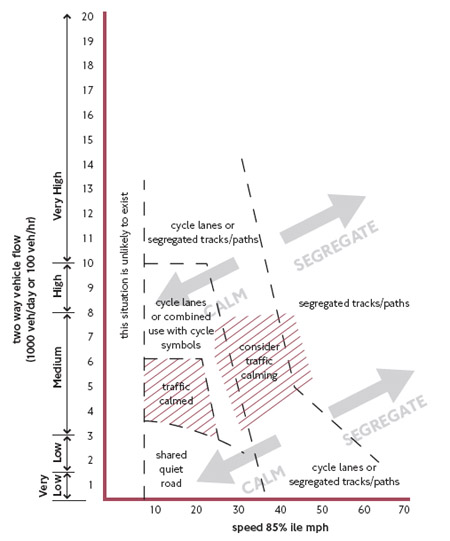
London’s Cycling Design Standards: A Model for NYC or here?

As New York City begins fulfilling its commitment to build 200 miles of new bicycle lanes over the next three years, the question will increasingly arise: What kind of bike lane should go where? Currently, DOT seems not to have any set of guidelines to answer that question. So, take a look at how the City of London does it.

Transportation Alternatives’ bike program director Noah Budnick pointed me to the London Cycling Design Standards book. It is a remarkable document and, perhaps, a great model for New York City to follow.

The chart below can be found in Chapter 4, page 62. With vehicle volume on one axis and speed on the other, it establishes a general set of rules for when a street should have a physically-separated, “segregated” bike lane versus when bikes should mix with “calmed” motor vehicle traffic. Note that London has long-since stopped debating whether or not physically-separated bike lanes are a good and necessary thing.

bike_lane_chart.jpg

Continue reading “London’s Cycling Design Standards: A Model for NYC or here?”

Auto Bailout? Nothing new!

by Peter Saint James
Is bailing out auto manufacturers really such a new and radical idea? Or should we perhaps consider carmakers wards of the state already?
Many people believe that gas taxes and other auto-generated revenue pick up the bills for roads and other auto-related expenses. Nothing could be further from the truth. Some researchers conclude that if gas taxes really paid for what many people think they pay for, pump prices would probably be somewhere around $25 per gallon.
If you paid that much for gas, you would probably eliminate a lot of trips you make now. Wouldn’t you realize they aren’t cost effective? For example, you would probably refuse to pay so much to drive a couple of miles just to get a bag or two of groceries, wouldn’t you? Wouldn’t everyone do things in better, easier, cheaper ways? How would this change the way our cities look and feel?
Driving really does cost that much. Driving is not cost effective. You pay those expenses through taxes and other means and only because you don’t know you’re paying them and have to pay them to keep from going to jail. If you did know and had a choice, you’d probably stop. You’re not that stupid, are you? You’d probably see it’s not worth it, wouldn’t you? Is that why the costs are hidden so well?
So how much do autos cost? What are the real figures? Does anyone know for sure?
We can figure out impossible numbers like how many molecules exist in the universe, how many stars in Andromeda Galaxy, and other enormous numbers, but we can’t seem to get a handle on auto expenses. Many researchers, including me, have tried. A whole government agency was set up just to get that number. Everyone comes up with different totals. Even the same person comes up with different numbers on different attempts. Many argue that their figures are right, but in reality everyone has points to be taken into consideration. Transportation is so divorced from reality, so alien from sound economic and accounting principles, that getting exact figures remains nearly impossible.
Here are just a few of the complex, controversial problems.
Gas taxes don’t fully pay road building and maintenance expenses. Most road money comes out of general funds. That’s easy. We can find most of that money.
But what about other government activities and agencies? Gas taxes don’t fund them, but autos obviously inflict some or all of their costs. Most police agencies don’t get much from gas taxes if anything at all. Yet don’t most of them regulate traffic, search for stolen cars, and so on? About half of fire department calls are to cars, not houses or businesses. That’s auto expense, isn’t it?
And look at bigger agencies. EPA deals with pollution. Cars cause significant pollution. What portion of EPA budget should be considered auto expense?
Continue reading “Auto Bailout? Nothing new!”

Prince George’s County Bill Threatens Trail Easements

LETTERS NEEDED TO OPPOSE ANTI-TRAIL EASEMENT BILL


A bill to severely restrict trail easements is on the Prince
George’s County Council’s Planning, Zoning, and Economic Development Committee
agenda for next Wednesday, March 18. The bill (CB-10-2009,
see attached file),
introduced by Tony Knotts, would keep trail
easements from being created on “individually residentially zoned
lots” and place severe restrictions on building trails on existing
easements. Restrictions would include having the trail open to the public only
between 9 am and 4 pm, gating the trail when it is not open to the public, and
having M-NCPPC Park Police man security posts every 1,000 feet.


Trail easements are frequently established as a condition
for the approval of new subdivisions, and they are an important way to expand
our future trail system. We need to inform the County Council that the
easements are an important element of the County’s overall policy for improving
bicycle and pedestrian access.


The March 18 committee meeting (see attached agenda) will be
at 10 am, Room 2027, County Administration
Building. Committee meeting are open to the public, but usually there is no
public comment period. If the committee goes along with the bill, there will be
a  public hearing later and then the vote by the entire council. Before
next Wednesday’s committee meeting, we need to have people e-mail,
write or phone committee members asking them to oppose this bill and any other
attempts to deny the public use of public trail easements.

Continue reading “Prince George’s County Bill Threatens Trail Easements”

The Wild Bunch (NYC)


Though bikers are hated, pedestrian deaths and injuries on Ninth Avenue in Chelsea immediately declined in the area of the physically separated bike lane, as reported on streetsblog.org, news blog of the Livable Streets Initiative, which advocates creating sustainable cities. In December, Community Board 4 voted in favor of creating a bike lane on Eighth Avenue between 14th and 23rd Streets.

The Brooklyn Bridge is an important front in the bike publicity war; it is a place where bikes are losing. The essential conflict can be grossly caricatured like this: Guys dressed as if they are in the Pyrenees stage of the Tour de France try to set speed records as Italian tourists linger in the middle of the bridge to get a photo of their cousin, Paolo, backed by the Empire State Building.
Bikers won’t stop, fearing they will lose a few tenths of a second off their times; and tourists from former Soviet republics confuse the phrase “Get out of the bike lane, you jerk” with “Enjoy your stay.”

Continue reading “The Wild Bunch (NYC)”

HB 1197 (removal of manitory shoulder use and righ of way in crosswalks)

The Legislative Priorities Update developed for the Bicycle Symposium did not include information on HB 1197 due to the late nature of the filing. I submitted testimony for One Less Car, the Baltimore Bicycle Club and 1000 Friends of Maryland.

Some good news, Senator Raskin called me earlier tonight to inform me that SB 428, the three-foot bicycle safety rule, came out of Judicial Proceedings favorably with all but one Senator voting in favor of the bill! Thank you Eric, Jim H. and Greg for joining with me to testify on the bill.

Carol Silldorff, M.P.A.
Executive Director
One Less Car
Continue reading “HB 1197 (removal of manitory shoulder use and righ of way in crosswalks)”