
By JANE E. BRODY
…
These are a few of the hundreds of deaths and tens of thousands of injuries suffered by cyclists each year from crashes with motor vehicles. Most of these accidents could be prevented if cyclists and drivers would learn to “share the road,” as a nationwide campaign urges.
…
There is some good news. Thanks to the proliferation of designated bike paths and the growing use of helmets, deaths among bicyclists have declined to around 600 a year from about 800. Still, 600 is 600 too many, as are the approximately 46,000 annual injuries that cyclists suffer in crashes with motor vehicles.
Drivers are not always at fault. One study attributed 60 percent of bicycle-motor vehicle accidents to the drivers and 17 percent to cyclists. But another study of crashes involving children on bikes found that 80 percent of those accidents were the fault of the bicyclists.
Learning to share the road safely is especially important in light of efforts to reduce the nation’s energy needs and greenhouse gases and to increase energy expenditure by overweight Americans. More and more people are riding their bikes to work or for exercise, and cities are frantically trying to keep up by building bike paths on or alongside of roadways.
In New York City, the number of cyclists has doubled in the last 20 years, far outpacing the city’s population growth. Prompted by organizations like Transportation Alternatives, the city has created hundreds of bike paths on or near city streets.
If You’re the Driver
Keep in mind that a bicycle is a vehicle and that a person riding one has the same rights as a driver of any other vehicle. Bicycles are legally entitled to use most roads, though they must ride on the shoulder when the speed limit exceeds 50 miles per hour.
Remember, too, that bicycles are hard to see and, unlike drivers, cyclists are unprotected by seat belts, air bags and steel cages.
When approaching a cyclist, slow down. When passing, clear the bike by at least three feet (five feet if you are driving a truck). Check your rearview mirror and be sure you can see the cyclist clearly before moving back into the lane.
Do not blow your horn behind cyclists. It can frighten riders and cause them to swerve.
Don’t follow closely behind a bicycle, which may have to stop or maneuver suddenly to avoid a road hazard that could cause the cyclist to fall.
Be especially wary around young cyclists, including those on sidewalks, who may cross intersections or dart into the road from a driveway or midblock without looking.
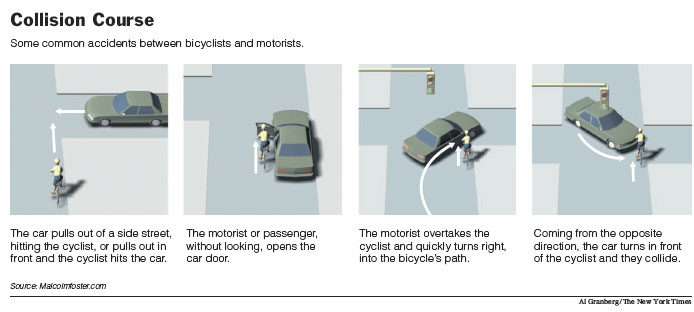
Most serious crashes occur at intersections. When turning right, signal well ahead of time, turn from the middle of the intersection rather than across the bike path, and make sure no bike is on your right before you turn. Do not pass a cyclist if you will be turning right immediately after.
In bad weather, give cyclists a wider berth, just as you would do for other drivers.
When waiting to turn left or to proceed from a stop sign, yield to a bicycle that has the right of way. More than half of collisions occur when cyclists and drivers are on perpendicular paths, and three-fourths of these accidents result from a failure to yield the right of way.
Before opening your car door, check your mirror to be sure no bike is approaching. A passenger on the driver’s side should open the door just enough to turn around to see if the path is clear.
Like it or not, bicyclists have the right to “take the lane” under certain conditions:
- When overtaking a vehicle moving in the same direction.
- When getting ready to turn left.
- When a lane is too narrow to share with a car or truck.
- When there are unsafe conditions on the road like double-parked vehicles, animals, pedestrians and potholes.
If You’re the Cyclist
Continue reading “Cars and Bikes Can Mix, When the Rules of the Road Are Clear”
