
"Curbing emissions from cars depends on a three-legged stool: improved vehicle efficiency, cleaner fuels, and a reduction in driving," said lead author Reid Ewing, Research Professor at the National Center for Smart Growth, University of Maryland. "The research shows that one of the best ways to reduce vehicle travel is to build places where people can accomplish more with less driving."
Depending on several factors, from mix of land uses to pedestrian-friendly design, compact development reduces driving from 20 to 40 percent, and more in some instances, according to the forthcoming book Growing Cooler: The Evidence on Urban Development and Climate Change. Typically, Americans living in compact urban neighborhoods where cars are not the only transportation option drive a third fewer miles than those in automobile-oriented suburbs, the researchers found.
————————————————————————————-
The Three-Legged Stool Needed to Reduce CO2 from Automobiles
Transportation CO2 reduction can be viewed as a three-legged stool, with one leg related to vehicle fuel efficiency, a second to the carbon content of the fuel itself, and a third to the amount of driving or vehicle miles traveled (VMT). Energy and climate policy initiatives at the federal and state levels have pinned their hopes almost exclusively on shoring up the first two legs of the stool, through the development of more efficient vehicles (such as hybrid cars) and lower-carbon fuels (such as biodiesel fuel). Yet a stool cannot stand on only two legs.
As the research compiled in this publication makes clear, technological improvement in vehicles and fuels are likely to be offset by continuing, robust growth in VMT. Since 1980, the number of miles Americans drive has grown three times faster than the U.S. population, and almost twice as fast as vehicle registrations (see Figure 0-1). Average automobile commute times in metropolitan areas have risen steadily over the decades, and many Americans now spend more time commuting than they do vacationing.
…
This raises some questions, which this report addresses. Why do we drive so much? Why is the total distance we drive growing so rapidly? And what can be done to alter this trend in a manner that is effective, fair, and economically acceptable?
The growth in driving is due in large part to urban development, or what some refer to as the built environment. Americans drive so much because we have given ourselves little alternative. For 60 years, we have built homes ever farther from workplaces, created schools that are inaccessible except by motor vehicle, and isolated other destinations
Continue reading “Growing Cooler: The Evidence on Urban Development and Climate Change”
Bush Admin Wants to Rob Transit to Pay for Highways
More of this is good???
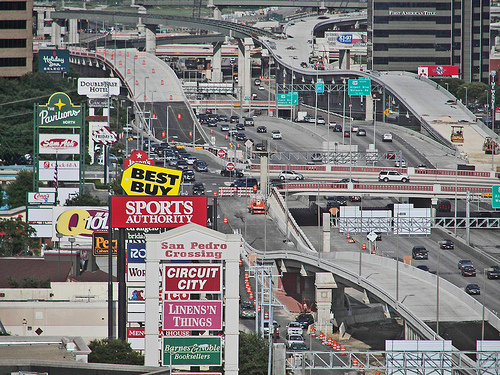
It proposes to shore up the Highway Account of the federal Highway Trust Fund (HTF) by
Continue reading “Bush Admin Wants to Rob Transit to Pay for Highways”
Condoning speeding may imperil others
Letters to the Editor (Sun)
Michael Dresser’s article "Up to speed" (Feb. 3) exposes the great variation in speed enforcement among Maryland jurisdictions.
In counties such as Montgomery County, police often write speeding tickets that cite speeds of one to nine miles over the posted limit when drivers were going far faster.
Why give them a mere slap on the wrist?
Cpl. Jimmy Robinson, a police spokesman, explained: "We are very proud of the caliber of the citizens" of Montgomery County. He deems it unfair to penalize such drivers with a three-point citation and a fine of hundreds of dollars.
Fair to the speeding drivers? How about to the other citizens of Montgomery County, whose lives are jeopardized by speeders? Is this policy fair to them?
Speeding is a major cause of crashes, especially fatal crashes. Speed increases the likelihood of a crash because a driver has less time to react.
In a crash, higher speed increases the severity of injuries and the chance of fatalities.
I hope counties that make a practice of trivializing speed infractions will begin to consider the rights of other road-users, who deserve protection.
Continue reading “Condoning speeding may imperil others”
TREK recalls girls bicycles due to frame failure
WASHINGTON, D.C. – The U.S. Consumer Product Safety Commission, in cooperation with the firm named below, today announced a voluntary recall of the following consumer product. Consumers should stop using recalled products immediately unless otherwise instructed.
Name of Product: Trek MT220 Girls Bicycles
Hazard: The bicycle’s frame can break during use, causing the rider to lose control and suffer injuries.
Incidents/Injuries: Trek has received 13 reports of frames breaking, including four minor injuries.
Description: This recall involves Trek girls’ bicycles model MT220 and model years 2005 (light metallic blue), 2006 (metallic silver and metallic purple or pink and pearl white), and 2007 (pink and white pearl or metallic purple). The model name is printed on the frame of the bicycle. Model year 2008 bicycles re not included in this recall.
Sold at: Authorized Trek dealers nationwide from April 2004 through June 2007 for about $300.
Remedy: Consumers should take the recalled bicycle away from children immediately and return it to a Trek dealer for a free replacement MT220 girl’s bicycle or a $100 discount on a different size Trek bicycle.
Consumer Contact: For additional information, consumers can contact Trek at (800) 373-4594 between 8 a.m. and 5:30 p.m. CT Monday through Friday and between 9 a.m. and 5 p.m. CT Saturday, or visit the firm’s Web site at www.trekbikes.com
Continue reading “TREK recalls girls bicycles due to frame failure”
40mph residential speed limit strictly enforced
The constitutional right to drive like an a55 irregardless of the potential harm to others as long as you have insurance has hit home, the street where you live.
The right to exceed the speed limit, if there is such a right, might make some sense on interstate highways and expressways but it has no place on public streets used by cyclists and walkers, yet police districts are saying that they will not ticket anyone that is going less then 15mph over the speed limit no mater where, expressway or residential street.
This 15mph speed difference when applied to a 25mph residential road turns the likelihood of a pedestrian or cyclists surviving a crash with a motor vehicle from favorable outcome to a very likely unfavorable outcome. This apparently is acceptable because it is "just an accident" when someone purposefully depresses the accelerator and drives too fast for conditions or the posted speed limit.
After our presentation at the Bicycle Symposium (https://www.baltimorespokes.org/article.php?story=20080205223929495 ) we are getting feedback from people who are inquiring about speed limit enforcement in their neighborhood and getting very disappointing answers.
Maryland is in the top ten highest ratio of bicycle and pedestrian traffic fatalities, in Baltimore City 39% of traffic fatalities involve a cyclists or pedestrian. Studies have shown when you enforce traffic laws, crime also goes down. Addressing two major issues with one simple action? Nah, too simple, not sexy enough, we need to reinvent the wheel. Sorry but no, enforcing the law, works, period.
‘Speeding’ bicyclists anger homeowners
Hmmm, cyclists too fast for residential streets and too slow for the 6 lane Boulevard.
Continue reading “‘Speeding’ bicyclists anger homeowners”
Photos – Bike Symposium
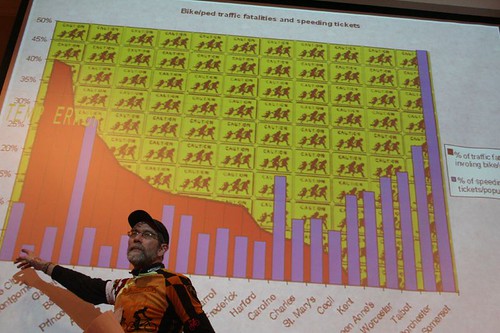
Photo credit: Doug Retzler
Continue reading “Photos – Bike Symposium”
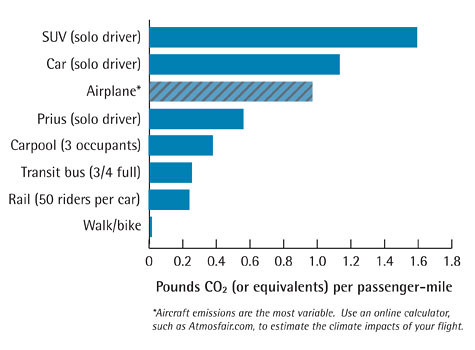
Pounds of Carbon per passenger mile
MD Bike/Ped Crash analysis of 2006 MHSO crash data
This and so much more

Continue reading “MD Bike/Ped Crash analysis of 2006 MHSO crash data”
Bike lane laws in the news
This article has an interesting animated graphic that shows vehicular behavior right turning across a bike lane as required by two different states.
Continue reading “Bike lane laws in the news”