
A question came up on where to dispose of Hazardous waste and the only convenient option I have found is Baltimore County
Continue reading “Recycling in Maryland”
Baltimore to Philadelphia
East Coast Greenway has their route on Google!
Continue reading “Baltimore to Philadelphia”
Getting behind bicycle safety
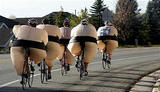 A 20-mile Halloween ride by sumo bicyclists had motorists looking twice. Ken Webster, David Winnie, Kelley Hansen, Lance Anderson, Curt Doman and Elliott Smith put on inflatable sumo suits and helmets
Continue reading “Getting behind bicycle safety”
Bicycle Trails and Bridges Are Nice, But Changing Attitudes Would Be Better
PEMCO Insurance Northwest Poll Finds Tensions Between Cyclists, Drivers
SEATTLE, Nov. 6 /PRNewswire/ — The greater Seattle region has a ways to go before becoming one of the country’s great bicycling cities, according to the results of the 2007 PEMCO Insurance Northwest Poll. And, the poll shows, some of the biggest challenges are not funding bike trails or signage, but changing attitudes and creating a spirit of sharing the road between cyclists and drivers.
…
"There’s still a lot of misunderstanding between riders and motorists," said Osterberg. "Many times that misunderstanding fuels some dangerous encounters, like the road rage incident in Fremont a few days ago." In that incident, a motorist frustrated with a cyclist’s use of a lane allegedly followed and harassed the cyclist with his vehicle. The poll shows why such a scenario can occur: only one out of every five Washingtonians (20 percent) believes that it is legal for bicyclists to ride two abreast, taking up an entire lane of traffic.
Two of the most important aspects of bicyclists’ legal rights are the right to take an entire lane, and to ride two-abreast in a lane.
"Drivers often get frustrated by that, but it’s the law, and it’s there to provide a margin of safety for the rider," Osterberg said.
…
Continue reading “Bicycle Trails and Bridges Are Nice, But Changing Attitudes Would Be Better”
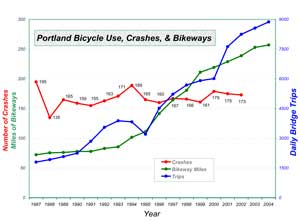
Portland Tips, Graphs and Stats
A bank is just like a bike?
A bank is doing a promotional comparing itself to a bike.
Continue reading “A bank is just like a bike?”
Adventure Cycling Unveils Three New Eastern Bicycle Routes
Bicycling in the East just got a whole lot better. The Adventure Cycling Association, America
Continue reading “Adventure Cycling Unveils Three New Eastern Bicycle Routes”
Bike map makes commuting safer
By Larry Walsh
Pittsburgh Post-Gazette
Saturday, October 20, 2007
Riding from one Pittsburgh neighborhood to another can be challenging, even to those that are contiguous.
To make it easier — and a bit safer — Bike Pittsburgh, the Heinz Endowments and DeepLocal have teamed up to produce a new bike map of the city, the first in 15 years.
…
As a result, cyclists tend to ride the larger, arterial roads where they have to share the road with speeding motorists.
The new map, as much as possible, takes them away from all that by introducing them to alternative routes via back streets that "are quite pleasant," said Scott Bricker, executive director of Bike Pittsburgh.
"Our goal is to make it simple for people to choose a bicycle to transport themselves," Bricker said.
But not all low-traffic routes are ideal alternatives for bicyclists, said Eric Boerer, Bike Pittsburgh’s membership director. Some low-traffic routes are quite steep and others don’t always connect neighborhoods.
"Our hills and bridges give Pittsburgh its unique identity and beautiful views, but it also makes bike travel between neighborhoods intimidating, especially if you don’t know the milder side streets and how they connect to one another," Boerer said.
Bricker and Boerer said the new map contains graphic-style illustrations depicting safe commuting techniques, as well as the locations of major hills, landmarks and trails.
They said it also identifies and marks unavoidable stretches of road that are hazardous.
In conjunction with Bike Pittsburgh’s mission to establish Pittsburgh "as a city that is increasingly safe, accessible and friendly to bicycle transportation," the map also provides information on who to contact to lobby for safer streets.
The new map was created by Bike Pittsburgh and funded by the Heinz Endowments.
Continue reading “Bike map makes commuting safer”
Being overtaken by a thousand points of darkness
What are you doing taking unnecessary space on the roadway?
– From a person with 7 empty seats to a cyclist.
I
Continue reading “Being overtaken by a thousand points of darkness”
Alert – MTA violates state law
[Senator Gladden’s response]
Q: What part of a bus is allowed to be broken and go without repair, adversely affecting a segment of the ridership population?
A: The bike rack.
All 180 bike racks have been destroyed by MTA drivers and there have been ZERO effort for repair or replacement. MTA drivers have been destroying bus bike racks at a rate close to one a week and no one in MTA thought this is a problem to be dealt with by repair or replacement. It really gets my goat when we fight for a bike facility then it gets taken away, there really should be a law against this
Continue reading “Alert – MTA violates state law”