
(A) Aren’t Cars Great??
"Cars are great! Fast! Convenient! Sexy! Freedom!"
Well, no, no, and no again.
First, cars aren’t anywhere near as fast or convenient as they seem. Speed is, of course, the distance you go, divided by the time it takes. Problem is, the "time it takes" to get somewhere by car is not just the time spent driving. You also spend time
Continue reading “Get a Car or Get a Life!”
World Carfree Day on September 22
 Carbusters Magazine first called for a World Carfree Day on September 22, 2000. Today Sept. 22 is celebrated in 1,500 cities in 40 countries with carfree festivals, bicycle demonstrations, street closures and permanent changes to make cities more environmentally and socially sustainable. Each year in late September, streets are closed to cars and opened to children
Continue reading “World Carfree Day on September 22”
She Got Bike!
 Pre-registration for She Got Bike! ends next Tuesday (9/26). This is your
last chance to get the very cool, pink, chainring-design event t-shirt for
FREE. Don’t miss out on the biggest celebration of women’s cycling in the
Mid-Atlantic – or the free shirt. Great rides, interesting lectures and
lots of prizes — for only $14!
Trek will also be at the event at 7am doing bike fittings for attendees on
their line of WSD bikes – so if you’ve always wanted to take a Madone for a
spin, this is your chance!
Register at https://www.active.com/event_detail.cfm?event_id=1331289. More
info at www.bbcracing.org.
Cyclists for the Bay
 (I think this is a great concept
Continue reading “Cyclists for the Bay”
Some Things To Think about
|
| Cycling can help the environment |
|
PJ is biking to Brazil to pass the Climate Stewardship Act

 Yes, PJ (Paul Park) is embarking on a bicycle journey from the Mount Rainier (MD) Bike Coop all the way through Central America, across the north coast of South America to the city of Natal in northeastern Brazil. PJ is raising funds and collecting signatures to pass groundbreaking global warming legislation in Congress–the McCain-Lieberman Climate Stewardship and Innovation Act. see www.undoit.org
PJ will embark on the journey Sunday, Sept. 17th at 9:30am towards Fredericksburg via Mount Vernon. I invite you to join me on the beautiful ride to Mount Vernon! Meet at the Mount Rainier bike coop (behind city hall and library in alley) Sunday, Sept. 17th at 9:30am.
Follow PJ on his journey at www.biketobrazil.blogspot.com.
DC’s Triathlon Becomes Duathlon
DCist.com is reporting that DC’s first Triathlon is going to become a Duathlon. Their permit for swimming in the Potomac was denied. Read more about it at https://www.dcist.com/archives/2006/09/13/triathlon_becom.php
Bicyclists winning a war of lanes in San Francisco
By Daniel B. Wood | Staff writer of The Christian Science Monitor
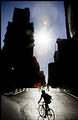 SAN FRANCISCO
Continue reading “Bicyclists winning a war of lanes in San Francisco”
Maryland Local takes biking to the extreme
Anapolis Capital has a story about Mr. Sweeney, 70, of Bay Ridge, who has just completed a trip from Montana through Canada and up to Alaska ending in Anchorage with a group of about a dozen other cyclists. He trained for the trip on the Baltimore & Annapolis Trail by lugging 50 pounds of sand with him
Read more at https://www.hometownannapolis.com/cgi-bin/read/2006/08_13-53/LIF
Wearing a helmet puts cyclists at risk, suggests research
 Drivers pass closer when overtaking cyclists wearing helmets than when overtaking bare-headed cyclists, increasing the risk of a collision, the research has found.
Dr Ian Walker, a traffic psychologist from the University of Bath in the UK, used a bicycle fitted with a computer and an ultrasonic distance sensor to record data from over 2,500 overtaking motorists in Salisbury and Bristol.
Dr Walker, who was struck by a bus and a truck in the course of the experiment, spent half the time wearing a cycle helmet and half the time bare-headed. He was wearing the helmet both times he was struck.
Continue reading “Wearing a helmet puts cyclists at risk, suggests research”