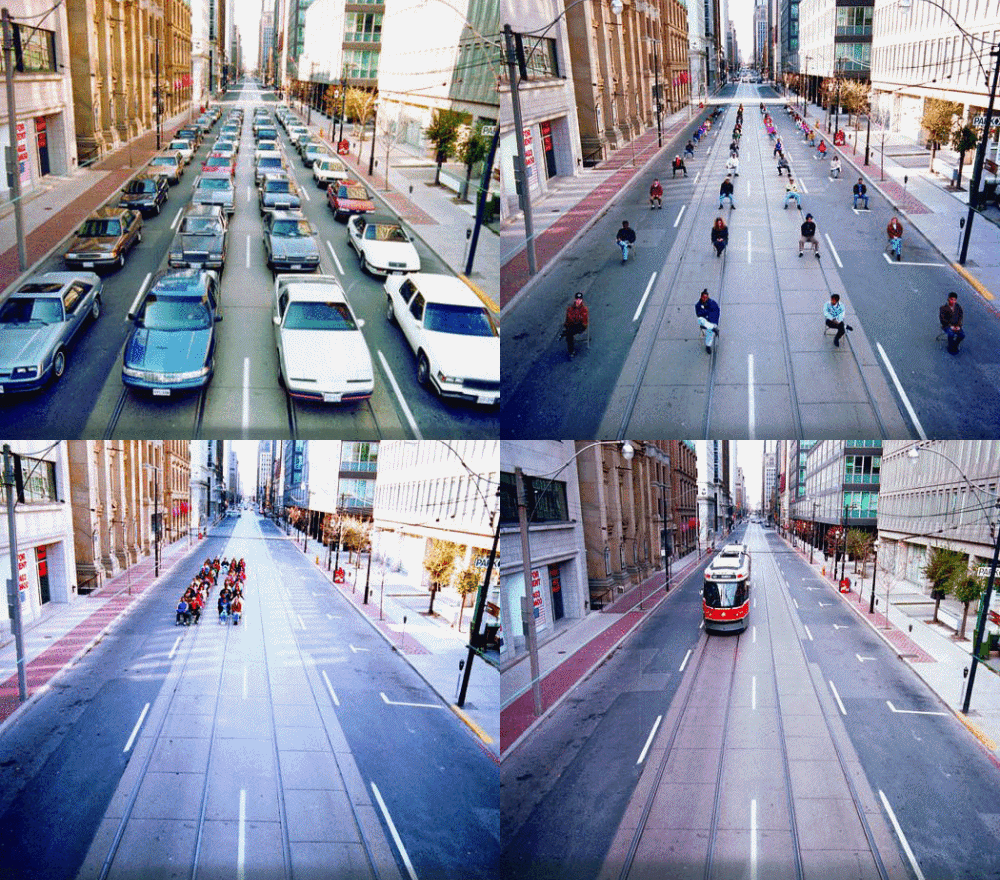
Arrogant cyclists? No, they’re following the rules.

By Alan Solot, Arizona Daily Star

“Arrogant bicyclists feel they own the road” is a common lament of motorists. Since El Tour de Tucson is on Saturday, I think it’s a good time for this discussion.

To state the most important point: All road users — motorists, cyclists, pedestrians — must comply with the law, and use the road safely.

Many motorists seem to believe (I may be incorrect in saying this) that cyclists’ use of the road is not as important as motorists’ use. But, the law doesn’t provide that any road user’s reason for being on the road is more important than others’, unless it’s a police car, fire truck or ambulance responding to an emergency. Cyclists and motorists have equal right to use the road; that right has nothing to do with why they are using the road.

https://tucson.com/news/opinion/column/guest/arrogant-cyclists-no-they-re-following-the-rules/article_722bd26d-4447-5f3b-badc-76fe2296cfe8.html

BOB MIONSKE ON THE 3-FOOT LAW

[Bob Mionske responds to these and other comments:]

My question: If, on a rural 2-lane road, an officer gives a motorist a citation for part of the vehicle crossing the double yellow in order to grant the cyclist room, assuming there was clearly sufficient room to do so without peril from an oncoming vehicle, what is the likeliest scenario in a courtroom if the motorist decides to contest this citation?

It would seem intuitive that the decision to mark a road double yellow as opposed to a broken yellow is based on engineering decisions contemplating cars passing other cars at high speed. Might the court agree and, if so, could the fact that a car is passing a cyclist, rather than a motorist, be a mitigating factor in the court’s decision, and could this be a reasonable defense by a motorist charged with a violation of 21460?

https://www.bicyclelaw.com/blog/index.cfm/2014/11/5/Bob-Mionske-on-the-3Foot-Law

LIVING LONGER BY SAFER DRIVING, LESS SMOKING, & LESS DRINKING

by Mark Plotz
-> This article could have been titled: "Gains in Life Expectancy Slowed by Obesity, Shootings, and Overdoses." A working paper from the National Bureau of Economic Research examined preventable deaths for the period 1960-2010 and its conclusion is troubling: the longevity gained from our public health wins (safer cars, less smoking, less drinking) has been nearly cancelled out by the public health battles we are losing (obesity, shootings, and drug overdoses). The wins have given us an additional 1.82 years of good health; the losses have erased 1.77 years, leaving not much net gain. The study uses ‘quality-adjusted life expectancy’ as it is a more accurate measurement of years spent in good health. Read the working paper at https://bit.ly/1Ae7KDc or the summary at https://on.wsj.com/1sdkykg.
The decline in motor vehicle death rates is impressive, dropping from 20 per 100k in population (1960) to a little over 10 deaths per 100k (2010). The authors present the counterfactual scenario, which projects death rates if we had done nothing–freezing seat belt use, impaired driving, and vehicle safety at 1960 levels–and continued to drive at our current rate: we reach 78 deaths per 100k population by 2008 before the plunge in VMT brings deaths back down to 65 per 100k in 2010. The lesson seems to be it is remarkable what we can accomplish when government, the private sector, and the public agree on a public health threat and decide to act.
The trend is going the wrong way in Houston, where the voters told the City to turn off red light cameras in 2010. The result: more crashes–a lot more (https://bit.ly/1uqzPVc).
from CenterLines, the e-newsletter of the National Center for Bicycling & Walking.
**********************************************************
B’ Spokes: I want to emphasize: "The lesson seems to be it is remarkable what we can accomplish when government, the private sector, and the public agree on a public health threat and decide to act."

A 40-mph electric recumbent tricycle that changes your commute forever

By Ezra Dyer, Yahoo Auto

The 422 Alpha has some impressive stats. With a 2.1-kWh lithium-polymer battery, it can cover 100 miles at 20 mph. A recharge takes only two hours. And the price? Well, it’s not cheap: $11,995. But nice bicycles are expensive, and this is really an exotic bike. I guess the way to think of it is not as a $12,000 bike, but as a $12,000 piece of transportation that’s also gym equipment and tech-geek lust object. Outrider also makes a less powerful, all-terrain version called the Horizon, which starts at $8,545. That one was funded through Kickstarter and sold out its first production run.

https://autos.yahoo.com/blogs/motoramic/a-40-mph-electric-recumbent-tricycle-that-changes-your-commute-forever-222311127.html

Interim Executive Director Greg Hinchliffe

Via BikeMore

Bikemore is naming Greg Hinchliffe the Interim Executive Director of Bikemore. Greg is a Baltimore City resident, recently retired Captain at American Airlines, and has been a lifetime advocate for bicycle infrastructure improvement in Baltimore City.

He is a member of the Maryland Bicycle Pedestrian Advisory Committee, is the State Chair of the East Coast Greenway Alliance, a member of the Gwynns Falls Trail Council, the former Chair of the Mayor’s Bicycle Advisory Committee, and he helped organize Tour du Port for the past 12 years.

“Having worked with Greg for many years on bike issues both large and small, I’m encouraged with the direction Bikemore is taking. Greg not only has a solid vision for what a truly bikeable Baltimore can be, but knows how to make it a reality. I look forward to working with him in his new role at Bikemore.”  – Nate Evans, Bike Maryland

Greg will continue Bikemore’s daily advocacy work while we launch a national search for a new permanent Executive Director.

If you know of anyone passionate about bicycles with a demonstrated track record of advocacy and fundraising success, please let us know. Bikemore will publish a formal announcement and job description for that position soon.
 

Thank You to Chris Merriam

From initially sparking the idea of a Baltimore-focused bicycle advocacy organization at evening meetings with a small group of dedicated volunteers, Chris Merriam grew Bikemore into a professional advocacy organization that–while still in its infancy–has moved the needle significantly on projects in Baltimore City, and recently expanded into Baltimore County with progress on the I-70 trail connections and the opening of Towson bicycle facilities.

While Chris is stepping down as Executive Director, we look forward to his continued involvement in the organizational mission, vision, and strategy as a founding member.
 

Jed Weeks
President, Bikemore

https://us4.campaign-archive2.com/?u=9ae12933a17d8c1c4a22924d6&id=8d609fb28a&e=83fc0acd76

4 Maryland Counties in the top 30 with Highest Transit Share increases

Per the Federal Highway Administration Office of Planning, Environment and Realty the Top 30 Counties with Highest Transit Share increases between the Year of 2000 and 2007-2009 (Journey to Work Trips) include 4 Maryland counties and here they are with their ranking:

2 Prince George’s County, Maryland
7 Charles County, Maryland
12 Montgomery County, Maryland
23 Howard County, Maryland

https://www.fhwa.dot.gov/planning/census_issues/ctpp/data_products/2000_2007-2009_2010-2012_commute_shares/transitshare.cfm

B’ Spokes: And I’ll note that there are similar analyses for biking and walking but no Maryland county made that list (no surprise there)
Continue reading “4 Maryland Counties in the top 30 with Highest Transit Share increases”

Why motorists get so angry at cyclists — a psychologist’s theory

By Susan Perry, MINN POST
A study issued earlier this year found that motor vehicle drivers and cyclists are equally responsible for car-bike collisions in Minneapolis. But, as comments to media reports of that study demonstrate, the finger pointing continues, with bicyclists blaming aggressive drivers for most collisions and drivers blaming “inconsiderate and stupid” cyclists.
The anger from motorists toward cyclists seems especially raw. So I read with interest British psychologist Tom Stafford’s latest Neurohacks column for BBC Future in which he offers his theory for “why cyclists enrage car drivers.”

https://www.minnpost.com/second-opinion/2013/02/why-motorists-get-so-angry-cyclists-psychologists-theory

BIKE PARKING OVERTAKES AUTO PARKING IN SOME PLACES

-> According to a July 9th Mobility Lab article, "… Interestingly, Arlington gives as much attention to bike parking as it does auto parking. As bike ridership numbers rise in D.C. (and nationally), so does the demand for bike parking. The county currently requires developers of site-plan buildings to construct one bike parking space per 2.5 residential units. John Durham, transportation demand management planner for Arlington County Commuter Services (ACCS), believes that number may be too low because 50 percent of all households in the county own at least one bicycle.
"Not only are quality bicycle-parking facilities an effective way to encourage and influence bicycle-ridership numbers, but they also are a more efficient use of land and maximize resources. One automobile parking space can accommodate 10 bikes, according to Durham.
"Mounting research suggests that bike facilities pay off economically to business owners. In D.C., businesses located near Capital Bikeshare stations appear to benefit economically. Similarly, protected bike lanes in New York City have been shown to increase retail sales by 49 percent. Just as Arlington County is focused on moving people instead of cars, some businesses are recognizing that cars don’t buy things, people do. Particularly in areas of density with scarce parking generally, it can make sense to provide bike parking as a complement to (or replacement for) car parking. The goal is to maximize foot traffic…"
Source: https://bit.ly/W9kXuR
from CenterLines, the e-newsletter of the National Center for Bicycling & Walking.

Survey Request: Biking to Campus; Jumping the Hurdles

Via Bike Maryland

From the research team at Morgan State University:

You are invited to participate in a survey of students, faculty, and staff in colleges and universities in the Baltimore Metropolitan Area. This survey is conducted by a research team from Morgan State University. The objective of the survey is to identify barriers of bike-to-campus. Your responses will help us to understand your concerns on biking, and find desirable policies to overcome hurdles and improve rate of biking. Completing the survey would take about 10-15 minutes. This survey is completely voluntary. There is no risk associated with your participation. Your responses will be anonymous and confidential.

https://goo.gl/forms/1IbkAPQEEa

More info: https://www.bikemaryland.org/survey-request-biking-to-campus-jumping-the-hurdles/