
[Baltimore Spokes: Note how are cars paying for roads is the tax system is "irrevocably broken"?]
ALBUQUERQUE, N.M. (AP) — Researchers are looking for 1,500 drivers in six cities, including Albuquerque, to test an on-board computer system that taxes motorists based on miles driven rather than fuel taxes paid at the pump.
That mileage-based tax is being considered by the University of Iowa Public Policy Center in a $16.5 million study for the U.S. Department of Transportation to determine whether it’s a viable option for paying for surface transportation, including roads and railroads, in the future.
The gas tax over the long term "is irrevocably broken and something is going to have to be done," said Jon Kuhl, a University of Iowa professor of electrical and computer engineering and principle investigator on the study.
…
Continue reading “Drivers asked to test alternative to fuel tax”
Public Transit Loses to Polluters in Climate Bill Subsidies
As Senate lawmakers launch new efforts to curb the nation’s greenhouse gas emissions, some key members have joined local transportation officials and environmentalists to ask a seemingly relevant question: Where’s the commitment to public transit?
…
“Transportation accounts for nearly one-third of our emissions, and yet it does not appear to be on Congress’s radar screen as one third of the solution,” Sen. Robert Menendez (D-N.J.), chairman of the Senate Banking Committee’s subpanel on transportation, said during a hearing on the topic Tuesday. A failure to provide more funding for clean transit, Menendez added, would represent a failure to tackle climate change adequately.
…
Michael Replogle, founder of the Institute for Transportation and Development Policy, told lawmakers Tuesday that, even as cars have become more efficient and fuels cleaner in recent decades, greenhouse gas emissions related to transportation have grown steadily over the same span.
“Our current policy framework guiding the development of surface transportation infrastructure in the U.S. is not designed to take into account [greenhouse gas] emissions,” Replogle said.
…
Ignoring mass transit solutions, according to many experts, is an oversight that could vastly limit the emission-reducing capabilities of whatever proposal eventually comes out of Boxer’s committee.
Continue reading “Public Transit Loses to Polluters in Climate Bill Subsidies”
Crash costs per mile of roadway – MD in top ten worst

…Still, without an alternative to driving in highly developed areas, simply repairing roads isn’t enough.
Continue reading “Crash costs per mile of roadway – MD in top ten worst”
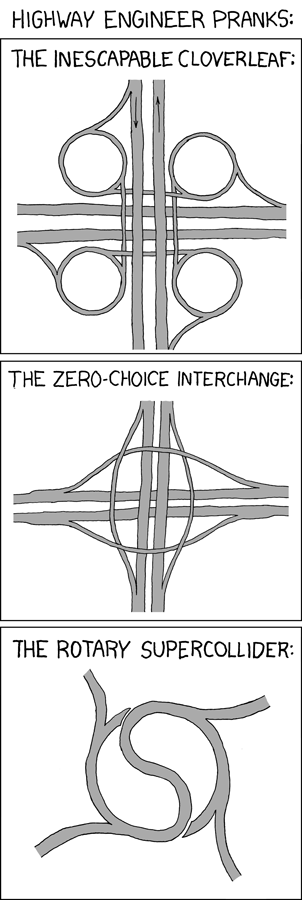
I am always looking for creative road ideas ;)
Red Emma’s
Greetings comrades & supporters!
We’ve got some sweet events coming up at Red Emma’s and 2640 these next few weeks, plus some great new books in at the store! And even more exciting – it seems that we now have more daytime parking available in front of Red Emma’s – the spots that used to be off limits until 6PM on the west side of St. Paul St. can now be used from 9AM-4PM. So it’s that much easier to visit us for lunch if you’re driving. And of course it’s still really easy to visit us by bike – we’ve even got a lock here you can use on our huge custom anchor-chain bike rack if you’ve forgotten your own. So don’t delay, and plan a visit any day of the week … or check out one of these fantastic events!
Continue reading “Red Emma’s”
Maryland Department of the Environment mentions bicycling in their July newsletter
Air Quality Action in Maryland
… On Air Quality Action Days, MDE recommends we all take steps such as:
* Limit driving. Montgomery and Prince George’s Counties offer free bus service on Ozone Action Days. Commuters can car-pool, walk, or bike to work.
…
https://www.mde.state.md.us/ResearchCenter/Publications/General/eMDE/vol3no11/airquality_action.asp
Another Route to Work: Bike to Work Day 2009
This May, MDE Secretary Shari T. Wilson and MDE staff participated in a record-setting Bike to Work Day.
…
https://www.mde.state.md.us/ResearchCenter/Publications/General/eMDE/vol3no11/bike2work.asp
Continue reading “Maryland Department of the Environment mentions bicycling in their July newsletter”
One Less Car Event Planning Meeting
Thursday July 9, 2009 6:30PM – Your Invited
One Less Car Event Planning
Meeting

Meeting
Are you interested in volunteering? One Less Car (OLC) is a non-profit organization and we need
your help. We want to meet you! Discussion will center
on Tour du Port coordination with review of the event checklist. The Tour du Port is Baltimore’s Premier Bicycling Event
and One Less Car’s Annual Fundraiser. The event takes place October
4th and 2000 registrants are expected. If you have an interest
in volunteering, OLC can find a task
to suit you! Are you a social marketing expert? The
development of a face book page and twitter are two of our
priorities. Do you have experience or interest in supporting OLC with
any of these tasks: event logistics, food set up, sponsorship,
advertising, flyer distribution, registration, rest stops, music coordination,
grant writing, fundraising, marketing, writing, community outreach, program
development, administrative tasks and more? Please sign up to help the day of the Tour du Port!
Date: July 9th, 2009
Thursday
Time: 6:30PM
Location:
The Marion I. & Henry J. Knott Foundation; 3904 Hickory Avenue, Baltimore,
Maryland 21211 Click for
directions.
Food: Pizza and
drinks
Please RSVP to chantelnjackson@gmail.com or let her
know that you are interested in
volunteering but unable to attend the meeting.
Most importantly, please visit
the OLC website (www.onelesscar.org) and click the header “contact”. Take a minute to complete this form and we will
update you on events and volunteer opportunities.
4 Cases Of How Tearing Down A Highway Can Relieve Traffic Jams
…
One example is reducing traffic congestion by eliminating roads. Though our transportation planners still operate from the orthodoxy that the best way to untangle traffic is to build more roads, doing so actually proves counterproductive in some cases. There is even a mathematical theorem to explain why: “The Braess Paradox” (which sounds rather like a Robert Ludlum title) established that the addition of extra capacity to a road network often results in increased congestion and longer travel times. The reason has to do with the complex effects of individual drivers all trying to optimize their routes. The Braess paradox is not just an arcane bit of theory either – it plays frequently in real world situation.
Likewise, there is the phenomenon of induced demand – or the “if you build it, they will come” effect. In short, fancy new roads encourage people to drive more miles, as well as seeding new sprawl-style development that shifts new users onto them.
Of course, improving congestion is not the main reason why a city would want to knock down a poorly planned highway–the reasons for that are plentiful, and might include improving citizen health, restoring the local environment, and energizing the regional economy. More efficient traffic flow is just a wonderful side benefit.
Sound dubious? Here are several examples of how three cities (and their drivers) have fared better after highways that should never have been built in the first place were taken down.
CASE 1: Seoul, South Korea – Cheonggycheon highway
CASE 2: Portland, Oregon – Harbor Drive
CASE 3: San Francisco – Embarcadero Freeway
CASE 4: San Francisco – Central Freeway
Continue reading “4 Cases Of How Tearing Down A Highway Can Relieve Traffic Jams”
Loudoun bikers stop sign charges dismissed; Landau successfully represents “MS-8″ Lovettsville cyclists in Leesburg Traffic Cour
This morning Doug Landau represented 2 of the bikers who were ticketed for rolling through a stop sign in Loudoun County. But the details of their ride are turning heads all over Virginia, as reported in prior posts.
On Sunday June 11th, a total of eight cyclists were stopped for this offense (Virginia Code 46.2-821) during the MS ride, by a police officer whose car was parked a full 300 feet away, with orange cones near the 7-11 “rest stop.” As the cyclists approached the stop signs, located on an open, rural road, they slowed down, looked both ways, saw no traffic and continued on their route around the “squircle” (a squared off traffic circle with 4 stop signs and a sidewalk running through the center). Rather than follow some of the cyclists through the middle of the square, these experienced bicycle riders thought going around the “squircle” would be safer. The police officer, who the cyclists thought was waving on participants in the Multiple Sclerosis charity ride, then proceeded to ticket them for not coming to a complete stop. No warning. Just a citation for a moving violation, with 4 points and a large fine as well!
Continue reading “Loudoun bikers stop sign charges dismissed; Landau successfully represents “MS-8″ Lovettsville cyclists in Leesburg Traffic Cour”
Betraying the Planet
New York Times Op-Ed Columnist PAUL KRUGMAN
…
But if you watched the debate on Friday, you didn’t see people who’ve thought hard about a crucial issue, and are trying to do the right thing. What you saw, instead, were people who show no sign of being interested in the truth. They don’t like the political and policy implications of climate change, so they’ve decided not to believe in it — and they’ll grab any argument, no matter how disreputable, that feeds their denial.
Indeed, if there was a defining moment in Friday’s debate, it was the declaration by Representative Paul Broun of Georgia that climate change is nothing but a “hoax” that has been “perpetrated out of the scientific community.” I’d call this a crazy conspiracy theory, but doing so would actually be unfair to crazy conspiracy theorists. After all, to believe that global warming is a hoax you have to believe in a vast cabal consisting of thousands of scientists — a cabal so powerful that it has managed to create false records on everything from global temperatures to Arctic sea ice.
Yet Mr. Broun’s declaration was met with applause.
Given this contempt for hard science, I’m almost reluctant to mention the deniers’ dishonesty on matters economic. But in addition to rejecting climate science, the opponents of the climate bill made a point of misrepresenting the results of studies of the bill’s economic impact, which all suggest that the cost will be relatively low.
Still, is it fair to call climate denial a form of treason? Isn’t it politics as usual?
Yes, it is — and that’s why it’s unforgivable.
Continue reading “Betraying the Planet”