
Now that the "Cash for Clunkers" program has ended you maybe wondering what else you can do to help the environment with that old clunker. Your old car can help support One Less Car’s mission of improving the quality of life by supporting alternate transportation and it’s tax deductible!
Continue reading “Create a better Maryland with clunkers program”
One Less Car acts to support the Complete Streets Act
Dear Senator Cardin:
I am writing to you to encourage you to cosponsor S. 584, the Complete Streets Act of 2009. As the Executive Director of One Less Car, a Maryland non-profit organization with over 12,000 members, I strongly believe in the importance of providing a wide variety of transportation options. At One Less Car, we are working to make Maryland an example of the economic and social good that comes from a society where everyone regardless of age, physical condition or economic background has the opportunity to bike, walk or use mass transit to get where they need to go. The Complete Streets Act is an important first step in making that happen.
I strongly encourage urge you to co-sponsor the Complete Streets Act and support complete streets throughout the development of the next transportation authorization bill. This important piece of legislation would ensure that future transportation investments made by state Departments of Transportation (DOT) and Metropolitan Planning Organizations (MPO) create appropriate and safe transportation facilities for all those using the road motorists, transit vehicles and riders, bicyclists, and pedestrians of all ages and abilities.
As you may know, the Complete Streets Act of 2009 is based on existing successful state and local policies. The bill directs state DOTs and MPOs to adopt such policies and apply them to upcoming transportation projects receiving federal funds. The resulting policies will be flexible and cost effective, with a process that clarifies appropriate situations in which a street would be exempted from being covered under the policy, including issues of prohibitive costs. Streets designed for all users are safer, can ease congestion, are less costly in the long run, and spur economic development. Complete streets also make important contributions towards alleviating the serious national challenges of energy security, climate change and obesity. Complete streets promote clean air, reduce greenhouse gas emissions, and help children and adults get more physical activity by providing safe, convenient alternatives to driving.
Continue reading “One Less Car acts to support the Complete Streets Act”
No Impact Man

|
Colin Beavan — celebrated green blogger, author, subject of the No Impact Man documentary, T.A. Board member, and all-around good guy — spent a year living with zero net environmental impact in the heart of Manhattan. His family of three lived without creating trash, using electricity or traveling on anything but a bicycle or scooter. They discovered that living simply was not only better for the environment but also created a much higher quality of living.
His book detailing the journey goes on sale September 1 and a documentary about the project opens in theaters nationwide September 11. For listings go to NoImpactMandoc.com.
If you’d like to try living like Colin and his family, you can. The No Impact Project is challenging people to try and live with no impact for one-week. They’ll put participants on a team and guide them through the steps day-by-day. They promise that you’ll discover for yourself that less really is more. Sign up at NoImpactProject.org.
From Chaos to Compliance
[I so want to do something like this here.]

|
|
The NYPD likes to brag that they issued 1.2 million traffic tickets last year. That’s not much considering that drivers run 1.2 million red lights each day. |
In New York City, the phrase “traffic law” often seems a misnomer for the rules of the road. More often, those “laws” appear to be suggestions, recommendations or afterthoughts.
To test this assumption, T.A., with the help of dozens of volunteers, set out to quantify just how often New York City’s traffic laws are broken. We sent out scores of observers to a few big intersections and recorded nearly 40 hours of traffic data. In doing so, T.A. was able to demonstrate a simple method for understanding the pervasiveness of traffic violations that the City could easily adopt.
The results, published in the new study titled From Chaos to Compliance (PDF), are hardly surprising, but still, they paint a shocking portrait of New York City streets:
- Traffic law violations occurred approximately three times every minute per intersection — 157 times an hour.
- Drivers failed to yield the right of way 24 times an hour.
- Drivers disregarded traffic controls, including traffic signals, signs and roadway markings, approximately two times every minute — over 100 times an hour.
- Over 38 hours of surveying, no summonses were issued for moving violations in the survey areas.
- 57% of pedestrians believed they were endangered by traffic while navigating the survey areas.
- 43% of pedestrians actually avoid an area or intersection in their neighborhood because they feel endangered by lawless driving.
The report suggests that a lack of deterrence facilitates this type of behavior and calls on the Mayor and the New York City Police Department to approach this problem scientifically, by deploying personnel where they’re needed most, adopting the study’s methodology and applying it to gauge compliance, deploying traffic cameras to monitor conformity with speed and traffic-signal laws and enabling citizen-reported violations through 311.
Had the NYPD been enforcing the violations observed in the study, the City stood to make a minimum of $478,645 in fines. Considering the budget woes of New York City, the fact that thorough enforcement at just four locations for only 38 hours could yield nearly half a million dollars in benefits, makes a better approach to enforcement both a financial and safety necessity.
As of press time, neither the Mayor nor Police Commissioner Kelly has acted on these suggestions, but if they want to make traffic laws into more than suggestions, they’ve got a good place to start.
As Bike Lanes Proliferate, So Do Disputes
In blistering August heat and sopping city humidity, Councilman Alan J. Gerson held a rally on the busy corner of Mott and Grand Streets in Chinatown at noon on Friday to oppose a bike lane. Mr. Gerson, his collar wilting in the heat, told the sweat-drenched crowd, which included a fair share of helmet-wearing cycling advocates, that while he supported bike lanes in general, he objected to the way this particular lane was put into place.
“It’s not whether or not there should be a bike lane,” he said, “but where.”
…
Others voiced concern that reckless cyclists were putting pedestrians, especially the elderly, at risk. Those concerns have not been backed up by studies by the city’s Transportation Department, which found that total traffic accidents along the lane decreased 29 percent, despite a significant increase in the number of bicycles.
“The Grand Street bike lane provides critical protection for the nearly 1,000 bicyclists who use it daily and also for motorists and pedestrians along the corridor,” Seth Solomonow, a department spokesman, said in a statement.
Continue reading “As Bike Lanes Proliferate, So Do Disputes”
Divide and Conquer, by Rail and Trail
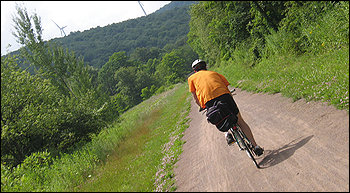
By Christine H. O’Toole – Special to The Washington Post
On the right: a deep, Swiss-style farm valley encircled by high peaks. On the left: sheer rock. Overhead: a sulfurous storm cloud. Behind us: the nearest town, six miles back. Up ahead: the gloomy entrance of the Big Savage tunnel. As we pedaled our way toward the Eastern Continental Divide from Maryland to Pennsylvania, there was only one choice: onward
Call it the trail cyclist’s Tour de Chance. Jim and I had never biked this section of the Great Allegheny Passage, a laid-back rural path that climbs gently northwest through the Allegheny Mountains from Cumberland, Md. After cresting the divide (Chesapeake watershed to the east, Mississippi to the west) it dips into Pennsylvania’s Somerset County. If we’d waited for a sunny stretch during this summer’s soggy weather, we might never have made it. But luck was with us — mostly.
Continue reading “Divide and Conquer, by Rail and Trail”
They Are Building Bicycle Superhighways in Copenhagen
This could be Baltimore:

Continue reading “They Are Building Bicycle Superhighways in Copenhagen”
The truth about ‘Cash for Clunkers’
By Jeff Jacoby – Boston Globe
Q: CONGRESSMAN, was “Cash for Clunkers’’ a success?
….
A: I have to go, but let me say this: If Cash for Clunkers were as dubious as you suggest, it wouldn’t have had so many takers.
Q: Oh, for heaven’s sake, congressman: If you give away money, won’t people always line up to take it?
Continue reading “The truth about ‘Cash for Clunkers’”
Tour du Port 2009

[If you like this site and would love to see more done for cyclists in Maryland then please help out in some way, volunteer, register for the ride or donate to One Less Car.]
Tour du Port – October 4th 2009 – Baltimore’s Premier Bicycle Event. Join thousands of riders at Baltimore’s Canton Waterfront Park to kick off the 16th Annual Tour du Port! Routes range from a 12 mile ride to a new half Century, 50 mile ride! The Tour route travels through many historic neighborhoods, waterfront areas and parks. This fully supported Tour includes lunch, refreshments at rest stops, map, SAG and a post-ride celebration at the Tour’s end. Tour is One Less Car’s annual fundraiser – all fees go directly to advancing the programs and advocacy efforts of One Less Car, a non-profit organization dedicated to walking, bicycling and mass transit in Maryland.
More info here: https://onelesscar.org/page.php?id=156
An eye on potholes and crime
There are a lot of obstacles that Nate Evans considers when he designates a bicycle route.
Baltimore’s bicycle pedestrian planner – yes, this is his official title – accounts for potholes, the quality of pavement and how fast cars travel on a particular street. (He calls Northern Parkway a "speedway" that should be avoided by the pedaling crowd.)
But there’s another factor that has to be part of the bicycle-loving mayor’s Bike Baltimore campaign to mark cycling routes throughout the city.
Crime.
Evans, who works for the city’s Department of Transportation, has been quietly recording crimes against bicyclists. He incorporates the information into routes he’s mapping, to advise two-wheel commuters on the most efficient way to get from places like Park Heights to downtown without getting beaten, mugged or pelted with rocks.
Based on his statistics, which he acknowledges are incomplete, he advises, for example, that bicyclists leaving Johns Hopkins Hospital avoid most east-side streets and instead pedal south to Highlandtown and head west.
From Northwest Baltimore, he recommends using Eutaw Street instead of the quicker Druid Hill Avenue to get downtown.
"It’s out of their way, but they’ll get there a lot safer," Evans said.
The idea came from Mayor Sheila Dixon, an avid cyclist who often invites residents and commuters on rides, after a guest told of being shot with a BB gun while riding on Calhoun Street in West Baltimore.
Continue reading “An eye on potholes and crime”