
Jeff’s POV

[A comment on Streets Blog:]

I grew up in Baltimore and have lived in NYC for two years, and thus feel inclined to comment on my observations.

Baltimore ranks number 6 in the nation for car-free households, with 35.89% car-free. The public transportation in Baltimore is so bad that when I visit my friends or family for the weekend (all of whom live within the central urban core), I have to bring my bike down with me (and of course spend no less than three hours throughout the course of the weekend explaining to my parents why I am politely turning down their friendly offer to borrow an automobile – "So what if you’re drinking? You only need to drive a few miles!"). I’m sorry, did I say Public Transportation? I meant to say Poverty Transportation. Allow me to explain.

From the same country that brought you intensified class divisions based on access to health care and education comes a way to keep poor people poor through transportation! The bus system (and random rail lines that are rarely useful) is not meant to be a comfortable and convenient way to get around town. It is meant to serve as a bare minimum to allow those who cannot afford a car to get around town. After all, if only poor people are using the system, and poor people have little to no political clout, then where is the incentive to invest public money for improving the system? Obviously it’s more important for suburbanites to pay less taxes, therefore enabling them to purchase more flat-screen televisions. So in other words, in order to have comparable access to employment and education opportunities to the privileged class, one must purchase an automobile.

Yes, that’s right: People who can barely afford to feed and clothe their children are required to purchase a multi-thousand dollar product from a private vendor, and then spend hundreds of dollars per month insuring and maintaining said product. A family starts to get back on their feet financially? Oops! Timing belt broke! That will be $1000, please! In other words, the cycle of poverty continues. Economically disadvantaged individuals cannot participate in mainstream society by purchasing a $89 Metro Card as they can in more functional cities (further subsidized based on need) once a month, enabling them to use the rest of their income to feed and clothe their children, and pursue educational opportunities in order to climb out of poverty. In New York, automobile culture hurts our quality of life. In places like Baltimore, automobile culture flat-out ruins lives.

Continue reading “Jeff’s POV”

Car free

The figure given for each city is the percentage of households that do not own a car.

1. New York City, New York 55.7%
2. Newark, New Jersey 44.17%
3. Jersey City, New Jersey 40.67%
4. Washington, D.C. 36.93%
5. Hartford, Connecticut 36.14%
6. Baltimore, Maryland 35.89%
Continue reading “Car free”

We have congestion and we want more cars to make it worse?

Bumper-to-bumper traffic is America’s collective nightmare, and like the movie Groundhog Day it repeats on a daily basis.

Yet over 100 million automobile commuters each day feel like they have little option. “We put so much of our national wealth and our identity into the whole motoring thing,” says James Howard Kunstler, author of Geography of Nowhere, “that we can’t imagine doing something different.”

Anthony Downs, author of Stuck in Traffic has identified four reasons for America’s congestion problem, also applicable to most European and Asian economies: first, most of us work during the same hours of the day; second, the country’s economic success has allowed households to buy multiple cars; third, there are more people now than when most roadways were conceived; fourth, more cars means more accidents which means more delays. [Note: cyclists are not the problem here, its too many cars.]

In other words, this problem isn’t going anywhere. So the Daily Beast set out to figure out the worst of the worst.

#21, Baltimore Beltway, surrounds Baltimore
Weekly hours of bottleneck congestion: 152
Worst bottleneck: Southbound, I 70/Exit 16
Length of worst bottleneck: .46 mi
Weekly hours of congestion on worst bottleneck: 13
Speed of worst bottleneck when congested: 24.3 mph

[If my math is right going from 60mph down to 24.3mph for .46 of a mile is a delay of 40 seconds for the individual. OMG How can people live with such conditions? :p Anyway if you want to avoid the frustration… bike, it’s fun, good for you and it makes it easier on those that drive. It’s a win win solution.]
Continue reading “We have congestion and we want more cars to make it worse?”

Cycling in Baltimore (the little green card)

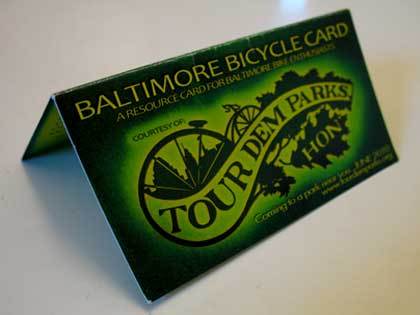
Avid cyclists and aspiring city bike riders are recommended to keep their eyes peeled for this handy little green wallet card containing a wealth of information about bicycling in Baltimore.  The card has been distributed to area businesses and organizations.

The Resource Card For Baltimore Bike Enthusiasts has been created courtesy of Tour Dem Parks, a major fund raising event focused on supporting groups and organizations dedicated to improving Baltimore’s park system.

Below is an sample of some of the information contained in the card:

Baltimore Bicycle Organizations & Information

Baltimore Bike Club
Baltimore Spokes
Charm City Cycling
One Less Car
Velocipede

Baltimore Bicycle Shops

Baltimore Bike Works
Joe’s Bike Shop
Light Street Cycles

Continue reading “Cycling in Baltimore (the little green card)”

The City of Laurel Gets Tough on Cyclists Riding on Public Parking Lots? WTF?

"It is unlawful for any person to ride any bicycle, moped, motor vehicle or play vehicle, on any public parking lot and public sidewalks in the City of Laurel, except those areas designated (none current and when approved, by sign designation)"
Oh and lose that "Recreational Vehicle" title some people believe it or not use their bike as transportation just like a car.
Continue reading “The City of Laurel Gets Tough on Cyclists Riding on Public Parking Lots? WTF?”

The Thirteenth Annual Maryland Smart Transportation and Bicycle Symposium Agenda

image


One
Less Car Presents the 13
th
Annual
Smart Transportation and Bicycle Symposium


February 3rd, 2010 President’s
Conference Center East, Miller Senate Bldg., Annapolis

The 2010 13th Annual One Less Car Smart Transportation and Bicycling Symposium in Annapolis will be a little different this year! The Symposium will be more inclusive covering many bicycle and pedestrian topics, as well as, presentations on smart commuting/alternative transportation initiatives.

Attendees will learn about the link that exists between our reliance on the automobile, climate change, public health concerns, land use planning, alternative transportation opportunities, livable communities and more.

This Annual Symposium is an outstanding opportunity for people to meet and share information with advocates, planners, state and local officials, and community leaders who want more bike lanes, better sidewalks, more trails, a statewide Complete Streets policy and access to a variety of modes of efficient transportation for everyone. The Symposium is the perfect setting to inform our state Delegates and Senators that Maryland communities need smart commuting opportunities and safe bicycle and pedestrian access to be fully sustainable and livable.

This free event includes educational exhibits and presentations throughout the day! A continental breakfast and pizza lunch will be provided.

* Please RSVP by contacting Carol Silldorff.
* To have an exhibitor table, obtain sponsorship information or to volunteer contact: Carol Silldorff.
https://onelesscar.org/page.php?id=157


Draft
Agenda:

Continue reading “The Thirteenth Annual Maryland Smart Transportation and Bicycle Symposium Agenda”

Obama Quietly Gets Federal Agencies Involved in Transport Planning

by

When President Obama signed an executive order in October requiring federal agencies to craft strategies for reducing their greenhouse gas emissions, he described the mandate as Washington “lead[ing] by example” on the pollution-reduction front.

Obama_bike.jpg(Photo: AP)

And that’s true — but the order also includes language telling federal agencies to get involved in integrating local transportation planning, with a particular focus on selecting sites for government facilities

that are pedestrian-friendly, near existing employment centers, and
accessible to public transit, and emphasize existing central cities
and, in rural communities, existing or planned town centers;

The overall goal for government agencies, as Obama’s order put it, should be to “strengthen the vitality and livability of the communities in which federal facilities are located.” Given that more than 2,200 communities host federally owned or leased property, that edict could unleash a lot of local energy for transit and pedestrian improvements.

Continue reading “Obama Quietly Gets Federal Agencies Involved in Transport Planning”

Oprah’s distracted driving show, online pledge provide huge public service

by

It is fitting that The Oprah Winfrey Show chose the Martin Luther King Day of Service to air its program on distracted driving. Spreading awareness about this deadly epidemic is a huge contribution to the safety of millions of Americans.

Oprah Winfrey: "This show could save your life."
For that public service, I enthusiastically thank Oprah.

And I encourage everyone who didn’t see the show to visit Oprah’s website where you can watch segments of the show, read the transcript, and SIGN THE PLEDGE

Oprah’s online pledge draws a line in the sand that says, “NO! We will not do this anymore.”

I signed it. So have tens of thousands of others. Now we need you to sign it. And then we need you to get your friends and your family members to sign it. And then
we need them to get their friends and family members to sign it. That’s
how it works, folks, moving out one expanding circle at a time.

Undistracted driving versus distracted driving
From Oprah’s website. In the top half of the image above we see all of the information necessary to navigate the intersection safely. In the bottom half we see what the distracted driver sees. Notice this driver’s attention blindness literally blocks out the pedestrians, the stop sign, the bicyclist, and the crossing guard.

One of the most compelling of those is an extended video, “After the Show,” of survivors telling their painful stories of loss due to distracted driving.

Now, over and over during the show, the word “preventable” comes up. Every single one of these tragic losses was preventable. Preventable just by people keeping their hands on the wheel and their minds on the road.

So, please, while we’re all thinking about service, let’s do what we can to end this epidemic. Visit www.distraction.gov to learn more about what we’re doing and what you can do.

Then one day we will look back and say, “Yes. We kicked that deadly habit.” And when that day comes, we will have all sorts of heroes to thank. Among others, we’ll thank Jennifer Smith. We’ll thank Shelley Forney. We’ll thank Reggie Shaw.

And we’ll thank Oprah Winfrey.

Continue reading “Oprah’s distracted driving show, online pledge provide huge public service”