Secretary LaHood Issues Recall of the American Motorist

“DoT Secretary Ray La Hood has recalled the entire surface transportation fleet to replace an endemic factory defect: dangerous loose nuts have been installed behind the steering wheels of more than half of our cars…”

Too far out to be true? Much has been said lately about the recall of all those Toyotas due to defects in brake algorithms and sticky accelerators. But from what I have read in multiple sources (here is one), there have been about 19 deaths over a decade cause by Toyota’s faulty throttles. Not sure how many have been killed by the brakes, but I suspect similar low numbers.

Meanwhile, what about the real “factory defects” in our vehicle fleet? We have killed roughly 400,000 people in traffic crashes over the last decade and according to the FHWA: “Depending on the source, driver error is cited as the cause of 45 to 75 percent of roadway crashes and as a contributing factor in the majority of crashes (Hankey, et al, 1999).”

Out of all those deaths, the defective gas pedal can explain perhaps %0.005. Driver error? 45-75%. Who are we kidding?

While roads and cars have acquired numerous safety features over the last quarter century (divided highways, better pavement, numerous safety improvements on vehicles including better body design, brakes, tires, lights, and air bags), we see two big problems. One, that motorists increasingly take safety for granted and engage in high-risk behavior such as driver distraction. Secondly, all these improvements have done little to protect non-motorists such as bicyclists and pedestrians.

DoT Secretary Ray LaHood has been quoted as calling Toyota “safety deaf” over the accelerator issue. But looking at the FHWA report, don’t you think its about time that the Secretary of Transportation looked at the cause of the lion’s share of traffic crashes and demanded a recall of that most imperfect of designs, the American motorist, to repair his or her safety defects?

Continue reading “Secretary LaHood Issues Recall of the American Motorist”
Senate wants drivers to move over for cyclists

by Julie Bykowicz

The Maryland Senate this morning unanimously approved a measure requiring drivers to give bicycles, scooters and other personal transportation devices, such as Segways, at least three feet of space when possible.

Drivers now are required to exercise “due care” when passing cyclists, but the Senate wants to get specific on what exactly that means. A House of Delegates committee is scheduled to hear the proposal next week.

Also included in the measure is a directive that drivers are to yield right-of-way at intersections when a cyclist is in a designated bike lane or lawfully riding on the shoulder.

Violating these new provisions would be a misdemeanor with a maximum fine of $500.

The Baltimore City Paper pointed out in a recent commentary on its news blog that the measures come too late for cyclist Jack Yates, who was killed last summer at the intersection of Maryland and Lafayette avenues in Baltimore. From Michael Byrne’s entry:

He was riding to the right of the right lane of Maryland as a truck passed him, also in the right lane. That is, both vehicles were smooshed into the right lane as the truck instigated a right turn onto Lafayette. The accident that resulted is a classic “right hook,” one of the most dreaded occurrences in urban bicycling—and one of the most common.

Maryland lawmakers are also considering several “move over” measures that would require drivers to pull away from emergency vehicles that are stopped on shoulders to investigate traffic accidents or infractions.

Continue reading “Senate wants drivers to move over for cyclists”

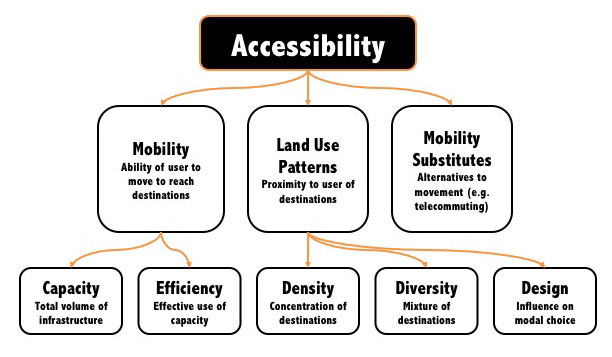
From a mobility to an accessibility orientation

image

If mobility is “The ability to travel where you want when you want”

Then success is measured in terms of vehicle miles traveled – the more movement, the better.

But is having to drive further to work and further to shop really a desirable strategy? And is having congested roads proof of success in getting more people mobile?

If the car is indeed the ultimate in mobility why then is a common response to “Hey do you want to go see such and such?” “Nah, too much traffic and parking is a pain.” For an example there is evolution of the movie industry, theaters are losing to video rental places and video rental is losing to Red Box and other methods that require little to no travel time.

So this hints that the solution in getting people to what they want when they want it is like in the Dune novels in order to travel further we need to fold space to get our destinations closer to where we are. So modern mobility is stressing less miles traveled and looking at land use patterns. And I will assert that the indicator of getting land use right is when cycling is more common place as when distances required to do what we want when we want are within easy biking distances then true mobility has been archived.
Continue reading “From a mobility to an accessibility orientation”

Mandatory Use of Ignition Interlock System Program

While trying to skim what’s going on this legislative system I ran across HB 515 and I have to wounder what was going on:

Altering the Motor Vehicle Administration’s authority to establish an Ignition Interlock System Program to require the Administration to establish the Program; requiring rather than authorizing the Administration to establish a protocol for the Program by specified regulations; providing that individuals who are convicted of, or granted probation for, specified alcohol- or drug-related driving offenses must participate in the Program; etc.

Were the courts ordering a Ignition Interlock System and MVA not following through?
Continue reading “Mandatory Use of Ignition Interlock System Program”

Tired of business not shoveling there sidewalks? Here’s an interesting idea:

Like most Washingtonians, I’m sick of trudging over the snow. I’m especially tired of walking over increasingly icy sidewalks that should have been shoveled by the adjacent property owners. It is, after all, required by law that all sidewalks be cleared within eight hours of final snowfall.
But rather than complain, shame them in a listserv they’ll never read, demand government assistance, or report them to the government, some Tenleytowners are going to just clear the snow for the public good. In doing so, we will make the area safer for residents and name the businesses that failed in their legal and civic responsibility.
Jon Bender and I are organizing the First Tenleytown Volunteer Snow Removal Battalion. At 4 pm this afternoon 3 pm tomorrow, we will go forth from the Tenleytown Metro entrance to destroy the slush piles. We will clear paths through sidewalks swamped by plowed snow, unusable bus stops, several elderly residents, and even a few frontages untouched by those responsible for them.
To prevent any businesses from taking advantage of our labor, we will post "You’re Welcome" posters on the windows of miscreants and publish names and photographs of them online. I hope that residents will participate in a brief boycott of listed organizations.
Continue reading “Tired of business not shoveling there sidewalks? Here’s an interesting idea:”

Garrett Trails Helps Government ‘Get It’

As a supporter of Garrett Trails This is great news!!! I sit in on the board meetings and know first hand how valuable this trail system and some help can be for Garrett County and Deep Creek Lake. Dont forget Taste of Garrett May 17, 2010.
This article is from the CUMBERLAND TIMES
Mountain Marylanders back governor’s plan for state trail network
Kevin Spradlin
CUMBERLAND — The mountain side of Maryland and those living closer to metropolitan centers can at least agree on one thing — there is value when investing in local trail systems.
With many legislative initiatives, there often is a split on what is good for one part of the state and what is good for Mountain Maryland.
This time, “I think the two sides do agree,” said Bill Atkinson on Friday, two days after Gov. Martin O’Malley announced the state’s first Maryland Trails: A Greener Way To Go plan.
The development of the plan was spearheaded by the state Department of Transportation. It focuses on a long-term projection of how a seamless trail network throughout the state can increase commuter options. Atkinson works for the Maryland Department of Planning and is a local representative for the Pennsylvania-based Trail Towns Program. He also is appointed as an advisory member to the Garrett Trails organization by the Garrett County commissioners.
Atkinson said the annual PACE reception in Annapolis about a week ago, where both Garrett Trails and the Allegany County-based Mountain Maryland Trails organization collaborated on a booth to showcase their positive economic impact, was “the first time we really joined forces.”
“We received a lot of interest at PACE with the combined booth,” said Mike Dreisbach, Mountain Maryland Trails president. “It looks like MMT and Garrett Trails can help the governor add about another 200 miles to make it 1,000 miles in Maryland.”
Atkinson, an avid bicyclist, said people already are using portions of the 20.47-mile Great Allegheny Passage in Allegany County as a commuting option on good-weather days. The gradual decline from Frostburg east to Cumberland provides an easy ride to work, he said.
“We found that to be one of those sidebars to the trail experience,” Atkinson said. “It’s easy to get to work that way. It’s recreation, it’s transportation and it’s economic development.”
State officials appear eager to agree.
“Working together, we can create a great transportation trails network that takes residents to where they need to go by bicycle or foot without ever having to get into their cars,” said Transportation Secretary Beverley Swaim-Staley in a news release.
Continue reading “Garrett Trails Helps Government ‘Get It’”

Bike the Tred Avon Circle, Maryland, USA

Three charming towns, one small ferry, and an afternoon full of greenery and water views make for a great day of bike riding and exploration.
Bike enthusiasts can find all the enjoyment of country riding, water views, historic towns, and opportunities for good food and exploration all within a 90-minute drive of Washington, D.C. The flat terrain of the Tred Avon Circle bike ride appeals to both experienced and inexperienced riders on this 35-mile route near the Chesapeake Bay in Maryland that’s perfect for an outing with friends or family.

Continue reading “Bike the Tred Avon Circle, Maryland, USA”

Right to use crosswalks and roadway even if shoulder is present – Hearing 2/25 at 1:00 p.m.

SENATE BILL 624 Vehicle Laws – Bicycles and Motor Scooters – Rules of the Road

Synopsis:

Authorizing a person operating a bicycle to ride the bicycle in or through a crosswalk in specified locations under specified circumstances; requiring a vehicle to yield the right-of-way under specified circumstances to a bicycle that is in a crosswalk; authorizing, under specified circumstances, a person who is operating a bicycle or motor scooter to use the roadway even if a shoulder is present; etc.
Continue reading “Right to use crosswalks and roadway even if shoulder is present – Hearing 2/25 at 1:00 p.m.”

NJ’s ‘Bicycle Bandit’ Pleads Guilty To 8 Bank Jobs

CAMDEN, N.J. (AP) ― A man police dubbed the “Bicycle Bandit” has admitted committing eight bank robberies in southern New Jersey and Delaware.

Forty-eight-year-old Brian Layton of East Greenwich Township pleaded guilty Tuesday before U.S. District Judge Jerome Simandle in Camden.

Layton was arrested Sept. 25 while trying to flee from a New Jersey state trooper on the Garden State Parkway.

[Which brings this unrelated video to mind.]

Continue reading “NJ’s ‘Bicycle Bandit’ Pleads Guilty To 8 Bank Jobs”