The authors also noted the significance of a documented link between dense residential development and public health in a city known more for its grinding traffic jams and struggling transit:
The Atlanta region is relatively skewed in terms of walkability, with a low proportion of survey participants actually walking and limited variation in urban form. While this presented some difficulty, the large sample size and oversampling of residents of walkable neighborhoods allowed for reasonable estimates of association. The fact that these results emerged in the auto-oriented Atlanta region is an indication that relationships are robust; associations are expected to be stronger in regions with higher overall variations in walkability and/or transit access.
Continue reading “Study: Even in Car-Centric Atlanta, Transport Reform is Health Reform”
Pedestrian Safety after Snow
By Nancy Floreen
Although we are getting back to normal in many ways, visibility is still limited by large snow banks, and many sidewalks are still hidden under mounds of snow. Please continue to be very careful when driving and walking. Here are some more safety tips to keep in mind.
For drivers:
• Slow down and obey the posted speed limit.
• Stop for pedestrians at crosswalks and intersections- it’s the law.
• Don’t block crosswalks when stopping at intersections.
• Take extra care around schools, playgrounds, and neighborhoods.
• Always look out for pedestrians, especially before turning at a green light or making a "right turn on red."
• Obey signs, signals and markings–and never run red lights.
• Be careful when passing stopped vehicles. They might be stopping for pedestrians.
• Share the road. It is your responsibility to look out for others.
For pedestrians:
• If you must walk in the street, face traffic so you can see the vehicles coming toward you.
• Stay visible after dark and in bad weather with reflectors or retroreflective clothing. • Cross the street at marked crosswalks and intersections whenever possible.
• Stop and look every time before crossing streets, even when you have the right-of-way, and especially at intersections with “right turn on red.”
• Before crossing, look left, right, then left again, and over your shoulder for turning vehicles. • Begin crossing the street on “Walk” signals – never on a solid or flashing “Don’t Walk.”
Oakland Mills Shovel Brigade
We need more volunteer shovelers and our reps setting an example does not hurt.
by Ken Ulman
Bridging The GAP
From Cycle Jerk:
Urban Velo bounced this article from Newsweek today about one of the last remaining speed bumps in the completion of the historic C&O / GAP trail connection from DC to Pittsburgh.

The douche bags over at Sandcastle Waterpark, “refused to allow the trail to proceed through their property, even threatening riders with arrest who pedal their bike through their parking lot that features a double yellow line for car traffic, forcing riders to take what amounts to a highway around their property and thwarting what would otherwise be the longest continuous city to city trail in the United States”.
These shitbirds are missing a golden marketing opportunity to have legions of active outdoorsy types riding and walking right passed their front door for free. Perhaps they just need some bad press to put this issue in perspective, so please forward this along.
Study finds traffic pollution can speed hardening of arteries
Los Angeles residents living near freeways experience a hardening of the arteries that leads to heart disease and strokes at twice the rate of those who live farther away, a study has found.
Continue reading “Study finds traffic pollution can speed hardening of arteries”
The Economic Potential of Portland’s New Bike Plan
*** Portland’s entire 300 mile network of bikeways cost about the same as 1 mile of urban freeway. ***
Yep, supporting cycling is expensive. Ya, right.
Continue reading “The Economic Potential of Portland’s New Bike Plan”
Benefit/Cost of bike/ped improvements–over 10X return on investment
From the People Powered Movement list:
Hi all,
I have mentioned this before but with the announcement of the federal TIGER grants coming tomorrow it’s on my mind again.
We often talk about how valuable and important bicycle and pedestrian infrastructure is, how it makes communities more liveable, improves community health, reduces air pollution and congestion, etc etc etc.
However, we rarely are able to put specific dollar figures to those benefits.
For the Kansas City metro area’s TIGER application–which included a request for federal funds for a comprehensive bicycle & pedestrian program for Kansas City–we were able to do that.
The results blew me away. Over a twenty year time frame:
– an investment of about $30 million (initial cost plus maintenance)
– in a comprehensive bicycle & pedestrian program (5Es)
– will have benefits of over $353 million
And that is using conservative figures that only capture part of the benefit.
So let me say that again: a comprehensive, 5Es bicycle & pedestrian program has more than a ***10 TIMES RETURN ON INVESTMENT***.
The TIGER application the KC metro area submitted included several other types of projects–transit, highway, rail, etc. None of the others even come close to this kind of rate of return. For instance:
Transit project has a benefit/cost ratio of about 2
Freeway interchange has benefit/cost ratio of about 4
Freight RR corridor reconstruction/update has benefit/cost ratio of about 5
Continue reading “Benefit/Cost of bike/ped improvements–over 10X return on investment”
Clearing bus stops in Silver Spring
Hans Riemer, who will be announcing his candidacy for Montgomery County Council later this month, helped to organize a bus stop dig out in Silver Spring on Saturday.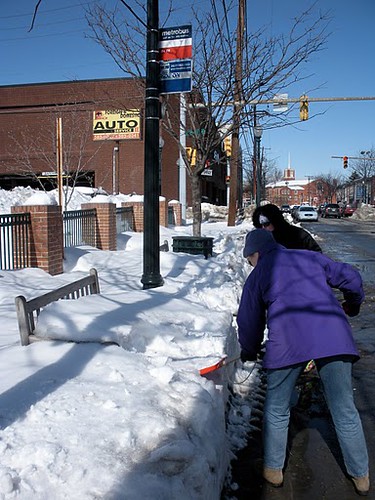
Bus stop before. Tina Slater and Kathy Jentz, clearing out the stop on Fenton near Thayer, downtown Silver Spring. (Tina is with Action Committee for Transit, and Kathy is the publisher of Washington Gardener Magazine.)
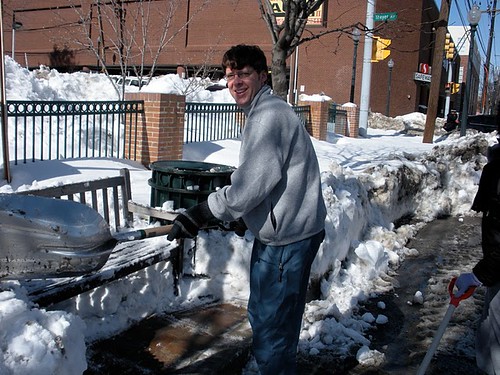
Bus stop after. Hans Riemer clearing out a bus stop on Fenton near Thayer, downtown Silver Spring. Subsequent bus riders stood in the clearing, with bags placed on the bench.
Continue reading “Clearing bus stops in Silver Spring”
Congress supports cars not paying for road improvements
Congress isn’t likely to approve raising gas taxes to pay for road improvements, U.S. Transportation Secretary Ray LaHood said Friday.
"It’s very hard on elected officials to go back to their districts and tell people — under these economic conditions — that they are going to raise a gas tax," LaHood said.
*************************************************
I’ll mention one alternate tax idea would be to switch from so much per gallon to a percent of the cost of gas. That way the tax has some hope of keeping up with inflation and in the short run gas prices can be set to be the same as they are now.
Continue reading “Congress supports cars not paying for road improvements”
White House: Transit Inflation Outstripping Private Transportation
by Elana Schor
The White House’s annual economic report, in addition to its endorsement of inter-city rail and transit spending, also sheds more light on transit inflation, which is often reported anecdotally in the many cities struggling with fare hikes but rarely put in statistical terms by economists.
 (Photo: UPI)
In the appendices of its report, the president’s Council on Economic Advisers estimated the overall U.S. consumer price index (CPI) at 214.537 in 2009, with the period of 1982-1984 signifying the 100 level. In general, then, prices for major goods have more than doubled over the past two-and-a-half decades.
The changes in price for what Americans pay for food (218.249 in 2009) and housing, including utilities (217.057), have kept pace with the overall CPI, according to the White House. But in the specific category of transportation, the difference was notable — private transportation, a category that includes new or used vehicles and motor fuel, had a CPI of 174.762 in 2009, while transit’s CPI hit 236.348 last year.
To be sure, transit costs were not the most out-off-control expense singled out by the White House. Inflation for medical care reached 375.613 in 2009, and the cost of shelter, not including utilities, was 249.354 last year.
Still, the palpable disparity between the costs of private and public modes of transportation is a trend that should be catching the attention of policymakers on both ends of Pennsylvania Avenue.
By Baltimore Spokes
I’ve bloged about how the costs of cars are being supplemented by our tax dollars and this report hints that cars are getting more of a supplement then mass transit but a resent video by Transportation For America introduced something not often talked about starting at 0:59: U.S. military actions in oil rich nations to “protect” the resources we so desperately need.
Which got me thinking if that works to keep the cost of using a car down why not use the same mentality to keep the cost of mass transit down? Surly there is some un-American terrorist country where we could get cheaper buses and trains from, like lets say Canada. Talk about being un-American, despite being a part of the same continent they refuse to accept the American life, parts even speak French! It does not get much more un-American then that.
OK, I am being very tongue and cheek but still I have to question why is there so much emphases on keeping single occupancy vehicles cheep when there is no way we can keep up with the demands for new roads that over use of the single occupancy vehicles require? We need to stress appropriate transportation and if efforts are made to keep gas cheep, then the benefits should largely go to commercial interests that truly need to use the roadways and the single occupancy vehicle should be the last to benefit, at least until we can keep up with the demand for new roadways.
Continue reading “White House: Transit Inflation Outstripping Private Transportation”