Editorial: When it comes to family biking, size matters

Posted by Jonathan Maus (Publisher/Editor)
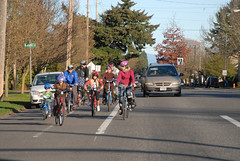
Family biking-8

An impromptu group family ride led
to realizations about the size and quality
of our bikeways.
(Photos © J. Maus)

A few weekends ago my girls and I, and several other families, planned to attend a local event. Since it was a sunny day, the location of the event was fairly close, and we all tend to bike frequently anyways, it turned into an impromptu group ride. There were kids (youngest was age 7) riding bikes on their own, kids in tag-alongs, and adults with various types of family cargo bikes. There were about 13 of us in all.

While I enjoyed the company of friends and the pleasant ride, being the bike geek that I am, I also couldn’t help from noticing a few other things.

The first thing I noticed is that a group of families riding together really catches people’s attention. In Portland, 10-15 people riding a bike is no big deal (especially during the morning and evening rush hours), but when there are little kids in the mix, people really take notice.

I kept thinking how cool it was that this wasn’t an organized ride, it just so happened that we all decided to ride our bikes to the same place (I hope someday seeing a bunch of families on bikes doesn’t draw so many stares).
Family biking-2

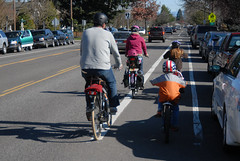
Standard bike lanes can be a tight
squeeze when riding with kids.

It also struck me how inadequate standard bike lanes are when riding with kids. Why? At just four or five feet wide, it’s nearly impossible to ride next to a small child — which, as a father of a 7-year old who is just learning to mix with traffic, is something I feel compelled to do. With parked cars on one side and traffic going 35 mph on the other, there was sort of an evolutionary magnet pulling me alongside my daughter as if to create a little cocoon of safety around her (see photo at right).

Continue reading “Editorial: When it comes to family biking, size matters”

When did it become the responsibility of the federal DOT to build sidewalks?

by

[Sen Kit Bond (R-MO)] only dug in his heels, arguing that Americans had shown their
eagerness to use roads and bridges but would not embrace rail or
walkable infrastructure. “When did it become the responsibility of the
federal DOT to
build sidewalks?”

From streetsblog

LaHood then reminded him Congress set up dedicated funding for pedestrian improvements nearly 20 years ago.

Continue reading “When did it become the responsibility of the federal DOT to build sidewalks?”

ACT Act Introduced, Alliance Announces Virtual Lobby Day!

By Nadege Dubuisson on March 03, 2010

Representative Earl Blumenauer(OR) just introduced the Active Community Transportation Act, H.R.4722, on March 2nd 2010. This groundbreaking bill creates a competitive grant program with $2 Billion to help communities build bicycling and walking networks. For the first time, communities would be able to compete for multi-year funding to build active transportation systems, just as they do for transit and road infrastructure.

“Too often we take for granted the value of being able to bike and walk to work,” said Blumenauer. “It’s unfortunate that many communities don’t have the infrastructure in place to make active and healthy forms of transportation more accessible. The ACT transportation grants will make it easier for people to get out of their vehicles and onto sidewalks or bikes, boosting both heart rates and community vitality.”

In conjunction with the National Bike Summit the Alliance is asking that you call your representative next Thursday, March 11th at the same time that over 700 Summit participants will have in-person meetings in congressional offices for a Virtual Lobby Day. For all the details, visit the Alliance action center. https://www.peoplepoweredmovement.org/site/index.php/site/memberservices/C520
Continue reading “ACT Act Introduced, Alliance Announces Virtual Lobby Day!”

Family files $5M suit in fatal Baltimore bike accident

Update: The Sun also has coverage with this great quote:
"The lawyer also argued that Yates was not negligent because statutes governing bicyclists require them to stay with the flow of traffic, as far to the right as possible.

"That’s exactly what Mr. Yates did," he said. "

*************************
By Brendan Kearney
Daily Record Legal Affairs Writer

The family of a Baltimore man who was killed last summer when his bicycle collided with a large truck filed a $5 million suit Wednesday against the alleged hit-and-run driver and contractor Potts & Callahan Inc.

John R. Yates, a 67-year-old retired youth counselor, was cycling south on Maryland Avenue just north of I-83 when Michael D. Chandler turned his Potts & Callahan fuel tanker right onto Lafayette Avenue, according to the suit filed by his wife and two children in Baltimore City Circuit Court.

Yates’ bike became entangled in the back wheels of the green and silver truck, according to the suit, and Yates was run over and pronounced dead at the scene, just blocks south of his row house.

Chandler, a 61-year-old Severn resident, did not stop, and police only determined days later, from watching video of the accident captured by a nearby security camera, that the truck belonged to Potts & Callahan, which has an office and yard nearby, according to police reports.

Although police concluded Yates illegally passed the truck and therefore did not press charges against Chandler, the Yates family lawyer said he is “very comfortable” with the facts of the case.

“The driver of the truck is negligent, there’s no question about that,” said Steven D. Silverman, adding that the only remaining question is whether Mr. Yates was contributorily negligent, which would negate his family’s claim. “And based on several attorneys’ reading of the statute, [Yates] wasn’t.”

Continue reading “Family files $5M suit in fatal Baltimore bike accident”

Hot List of Environmental Legislation in Maryland


2- Smarter Transportation Choices for Maryland

HB 282: Bicycle and Pedestrian Access [This bill is really cool as it basically puts bike/ped projects on a similar track used for highway projects.]

HB 1155: Consolidated Transportation Program

HB 461: Three Foot Bicycle Safety Rule

SB 51: Three-Foot Bicycle Safety Bill

SB 624: The Shoulder Rule Bill

SB 760: Consolidated Transportation Program

Transportation for Maryland supports legislation that ensures transportation dollars to be spent in ways that create jobs, improve public health and improve the environment

Continue reading “Hot List of Environmental Legislation in Maryland”

Transportation FOR Maryland press release on transportation funding

The coalition is also supporting a suite of bills that would make transportation safer for bicyclists and pedestrians:
• Ensure a safer passing distance for cars (SB51, Raskin; HB461, Cardin)
• Eliminate laws that require the use of shoulders even when the shoulder is unsafe (SB624, Frosh; HB1193, Carr)
• Hold vehicle drivers accountable for accidents they cause (HB388, Simmons)
• Provide more funding for bicycle and pedestrian access (HB282, Peña-Melnyk)
Continue reading “Transportation FOR Maryland press release on transportation funding”

Washington Examiner Trash Talks Bikes, the League Responds

What they said:

The Washington Examiner’s “Daily Outrage” attacked Senator Menendez Wednesday, February 24 for supporting, along with his fellow senator from New Jersey, a $2.3 million upgrade to bicycle paths that will connect New Jersey to Pennsylvania. The editorial states that, “the grant comes from $1.5 billion in transportation funds awarded as part of the federal stimulus. Unless the new economy means we’re using rickshaws for shipping, it’s unclear how bike paths will ‘stimulate’ the economy.”

What’s the issue:
The paper fails to recognize bicycling as a legitimate form of transportation for starters, but also misses the point of theTIGER grants. According to  Secretary LaHood the purpose of the TIGER funds was to:

help build high-priority innovative transportation projects that were difficult to fund through traditional programs – projects that create jobs, stimulate economic activity and help develop livable communities…From freight rail to streetcars, from roadways to waterways to bikeways, we are affirming the truly multi-modal nature of American transportation.

What are the facts:
The bicycle industry supports nearly 1.1 million jobs and generates an estimated $17.7 billion in federal, state, and local taxes. This includes the over 140 bike shops and major bike manufacturer in New Jersey. Bike facilities are great at stimulating the ever more competitive tourism dollars. For example, the Outer Banks area of North Carolina saw a 9 to 1 return on their investment in bike paths and widened shoulders.

TIGER grants were also about sustainable, innovative designs that improve livability. Something that increases lanes on existing highways doesn’t do enough.

What they could have said:
The Washington Examiner should be promoting the new direction of the Department of Transportation in taking livability and multi-modal initiatives into consideration. It is a (literal) breathe of fresh air. Not only could they have applauded the funding award, but they should have urged Senator Menendez to join the Senate Bike Caucus to further become involved in making America bicycle-friendly.

We urge New Jersey League members to contact Senator Menendez to thank him for his support of the funding and to continue to support future pro-bike economic stimulus initiatives. Also, contact Washington Examiner editors to let them know that bicycling is important to our economy.

Continue reading “Washington Examiner Trash Talks Bikes, the League Responds”

A new public health-care option — smarter transportation planning


How we best do this within the scope of health-care reform requires rigorous policy, psychology and marketing synergies. However, we also need to step outside that frame to realize the prescription we need centers on the nexus of land-use and transportation planning. We need a new kind of public option — one that allows us to live the healthy lifestyles we aspire to by designing our region with health in mind. We all want to live, work and play in safe places with easy access to transportation options, parks and open spaces and the markets, schools and amenities we all use.
We are, for now, literally stuck in traffic. A prominent study in the American Journal of Preventive Medicine demonstrates that the more time we spend in our cars, the more we weigh. And the average Puget Sound resident spends nearly one 40-hour workweek a year simply stuck in traffic — so that’s a lot of weight.

Continue reading “A new public health-care option — smarter transportation planning”

Who should pay for Baltimore City’s roads?

[This concerns me as Baltimore pays for the non-trails bit of it’s Bike Master Plan through it’s own budget which is very different then most of the country that get’s Federal Transportation Enhancements and/or CMAQ money to pay for these things (My readers should know by now that the State’s policy is a major hindrance in getting Federal Aid for the localities to get on-road biking for transportation in this State. But I will note that the State does not have trouble getting Federal Aid to fund on-road bike projects on its roads.)]

The state’s longstanding practice of paying more for Baltimore City roads — then letting the city government handle its own paving — is coming under increasing scrutiny this year as other jurisdictions struggle with reduced state highway aid.

Since Baltimore takes care of the state roads within its borders, the city takes in much more in highway user revenues than any other jurisdiction. That has been exacerbated by cuts in Gov. Martin O’Malley’s proposed budget for this year.

In the governor’s plan, the city would get nearly $131 million, while the counties share $8 million and municipalities get $41 million.

Legislative analysts are recommending to lawmakers that they take $30 million from the city and spread it throughout the 23 counties.

Republican lawmakers in a budget briefing this week proposed taking $100 million from the city’s share of highway user revenues this year. And at a hearing Thursday, Baltimore Sen. Verna Jones asked what it would cost the state to take over the maintenance of state roads in the city.

Continue reading “Who should pay for Baltimore City’s roads?”

Would you eat that?


The pollution that makes snow so ugly after a few days on the street doesn’t magically appear whenever it snows. It’s always there, produced by our litany of motorized vehicles. It floats around the air we breathe for a while before settling on the ground, or in the water. Every time you walk behind a truck or big SUV and get a whiff of exhaust, you’re essentially taking a big bite out of a delicious soot-flavored snowcone.
But that’s just the cost of doing business in a modern civilization… right?
Continue reading “Would you eat that?”