Police enforcing pedestrian safety is "breathtakingly dangerous" says Councilman

image
A car does not stop for a Glendale police officer dressed in a rabbit costume crossing the street at Central and Garfield avenues Wednesday. The driver was pulled over for not yielding to a pedestrian. (Raul Roa/News-Press)


But the operation infuriated Councilman John Drayman, who said he learned of the sting only after it had taken place.

Calling the enforcement sting a “stupid traffic stunt” that was “breathtakingly dangerous,” Drayman said city resources would have been more appropriately used to clamp down on speeding motorists — an issue that prompts daily complaints from the public.

“The police may be experts in public safety, but they don’t have a padlock on common sense,” he said. “This is not law enforcement, this is taking public safety personnel, dressing them as bunny rabbits to confuse, disorient and shock drivers and then cite them with traffic tickets.”

Drayman added that he planned to raise the issue at the next City Council meeting.

Political fallout notwithstanding, police officials said they decided to seize the holiday moment and use a rabbit costume. The bunny suit also cuts down on the ability of drivers to claim they didn’t see the decoy, they said.


Continue reading “Police enforcing pedestrian safety is "breathtakingly dangerous" says Councilman”

Cyclist Gets Doored … You want a report? I’ll give you a report!… Get a reflector on that bike, that vest does not cut it.

image
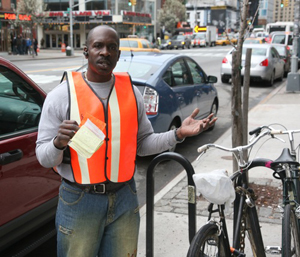
The officer then walked back to his vehicle, Seymour said, returning ten minutes later with the report in hand. But that wasn’t all. He’d also brought over two summonses. The first was for riding a bike without a bell, which Seymour admits he lacked. The second cited Seymour for riding without reflectors on the wheel. According to Seymour’s lawyer, the law only requires reflectors on new bikes for sale. Seymour noted that his bright orange reflective vest and reflective helmet should have made him perfectly visible—that and the fact that it was just before 10 a.m.
Continue reading “Cyclist Gets Doored … You want a report? I’ll give you a report!… Get a reflector on that bike, that vest does not cut it.”

BBC’s 26th ANNUAL INSTRUCTIONAL RIDE SERIES

The BALTIMORE BICYCLING CLUB’S popular Instructional Ride Series will begin with an orientation to be held on Sunday, May 2, 2010 at 10:30 a.m at the Ridgely Middle School in Baltimore County. Directions to the school are provided below.

This series is offered to anyone over 16 years of age interested in learning the basic skills of cycling, including doing minor road repairs and improving as a rider. We want to help people new to our sport find a comfortable riding level and develop so they can at least ride on the BBC casual rides by the end of the series and to permit experienced riders who are new to club riding to meet and to learn about group riding. The ride series will cover both road and recreational trail riding.

At the orientation, we will demonstrate cycling skills and techniques and discuss bicycles, equipment and clothing and answer any questions about the program. We will watch a short, informative video on cycling safety and bike handling. If you bring your bicycle to the orientation, we can check it out for you and show you how to do a pre-ride bike check. The indoor orientation will be held RAIN OR SHINE. Weather permitting, anyone who wants to do so can join us for a short ride following the orientation. You must have and wear a helmet in order to ride. Below is the full ride schedule.

DIRECTIONS — Ridgely Middle School is at the southeast corner of CHARMUTH and RIDGELY Roads. Take Exit 26 of the Baltimore Beltway (I-695) and go North on YORK Road for approximately one mile. Then make a Right on RIDGELY Road, go for one long block and make a Right on CHARMUTH Road. The school is on your left; enter the first driveway, park and walk to front of school.

THIS YEAR’S SCHEDULE —
ORIENTATION — Sunday, May 2, 2010 – Ridgely Middle School at 10:30 a.m.
Continue reading “BBC’s 26th ANNUAL INSTRUCTIONAL RIDE SERIES”

The American way of treating cyclists comes to Copenhagen

An American driving a rented car in Copenhagen hits a cyclists who had the right of way. "According to the Danish newspaper BT, the police have said that the American woman wasn’t used to watching for cyclists and, after the accident, couldn’t understand that it was her fault."
"American Express, through a collection agency, has been hassling Helle Kühl for $3106.41 – about 16,000 Danish kroner – for the damages to the car.
Helle Kühl said to BT newspaper: "This is completely insane. I’m an innocent victim and now they want me to pay 16,000 kroner because I got run over. This is an Americanization of the situation"."
Continue reading “The American way of treating cyclists comes to Copenhagen”

Best Guerrilla Activist Legba Carrefour

By —Andrew Beaujon
Last Sept. 10, Legba Carrefour left the house at 5 a.m. in a borrowed truck filled with 22 junk bikes he and friends had spray-painted white. He strewed them all over Dupont Circle, where 12 days earlier, a “ghost bike” memorial to Alice Swanson, a cyclist killed at 20th and R streets on July 8, 2008, had been removed by the city. By 11 a.m., 16 bikes remained; a week later there were two piles of tangled frames and forks that looked less like a memorial and more like a memento mori. Carrefour was nowhere to be found. “I was going to do more with them,” says Carrefour, “but the G-20 hit in Pittsburgh.” The self-described “D.C. native, cyclist, and anarchist” says he was busy with protests there when the ghost bikes turned into ghost rubbish, but he notes that his bike project “was not supposed to be permanent.…to a certain extent the idea was to have the city come down to rip them off.” Carrefour says his project was as much a public space protest (“I’m European by birth….Like, in Vienna [Austria] where I’m from, people vandalize 1,000-year-old statues on a regular basis”) as a memorial to Swanson, whom he never met. Carrefour says he plans more protests involving bicycles, though “the thing with the bikes,” he says, “depends on me getting a job.”
Continue reading “Best Guerrilla Activist Legba Carrefour”

The most injurious to happiness is commuting

by Jonah Lehrer

David Brooks, summarizing the current state of happiness research:

The daily activity most injurious to happiness is commuting. According to one study, being married produces a psychic gain equivalent to more than $100,000 a year.

In other words, the best way to make yourself happy is to have a short commute and get married. I’m afraid science can’t tell us very much about marriage so let’s talk about commuting. A few years ago, the Swiss economists Bruno Frey and Alois Stutzer announced the discovery of a new human foible, which they called “the commuters paradox”. They found that, when people are choosing where to live, they consistently underestimate the pain of a long commute. This leads people to mistakenly believe that the big house in the exurbs will make them happier, even though it might force them to drive an additional hour to work.

Of course, as Brooks notes, that time in traffic is torture, and the big house isn’t worth it. According to the calculations of Frey and Stutzer, a person with a one-hour commute has to earn 40 percent more money to be as satisfied with life as someone who walks to the office. Another study, led by Daniel Kahneman and the economist Alan Krueger, surveyed nine hundred working women in Texas and found that commuting was, by far, the least pleasurable part of their day.

Why is traffic so unpleasant? One reason is that it’s a painful ritual we never get used to – the flow of traffic is inherently unpredictable. As a result, we don’t habituate to the suffering of rush hour. (Ironically, if traffic was always bad, and not just usually bad, it would be easier to deal with. So the commutes that really kill us are those rare days when the highways are clear.) As the Harvard psychologist Daniel Gilbert notes, “Driving in traffic is a different kind of hell every day.”

But if commuting is so awful, then why are our commutes getting so much longer? (More than 3.5 million Americans spend more than three hours each day traveling to and from work.) In my book, I cite the speculative hypothesis of Ap Dijksterhuis, a psychologist at Radboud University in the Netherlands, who argues that long-distance commuters are victims of a “weighting mistake,” a classic decision-making error in which we lose sight of the important variables:

Consider two housing options: a three bedroom apartment that is located in the middle of a city, with a ten minute commute time, or a five bedroom McMansion on the urban outskirts, with a forty-five minute commute. “People will think about this trade-off for a long time,” Dijksterhuis says. “And most them will eventually choose the large house. After all, a third bathroom or extra bedroom is very important for when grandma and grandpa come over for Christmas, whereas driving two hours each day is really not that bad.” What’s interesting, Dijksterhuis says, is that the more time people spend deliberating, the more important that extra space becomes. They’ll imagine all sorts of scenarios (a big birthday party, Thanksgiving dinner, another child) that will turn the suburban house into an absolute necessity. The pain of a lengthy commute, meanwhile, will seem less and less significant, at least when compared to the allure of an extra bathroom. But, as Dijksterhuis points out, that reasoning process is exactly backwards: “The additional bathroom is a completely superfluous asset for at least 362 or 363 days each year, whereas a long commute does become a burden after a while.”

The same thing happens when we go car shopping. We tend to become fixated on quantifiable variables like horsepower (they’re so easy to compare), while discounting factors, such as the cost of maintenance or the comfort of the seats, that will play a much more significant role in our satisfaction with the car over time. I’m always surprised when people brag about variables like torque or the speed with which the car can rocket from 0-60 mph. Who cares? I’d much rather spend 30 minutes testing out the front seat.

Update: Matthew Yglesias argues that the misery of commuting should lead to congestion pricing. I agree.

Continue reading “The most injurious to happiness is commuting”